Comparative Performance of Plant Genome Editing Techniques: From Foundational Tools to Clinical-Grade Applications
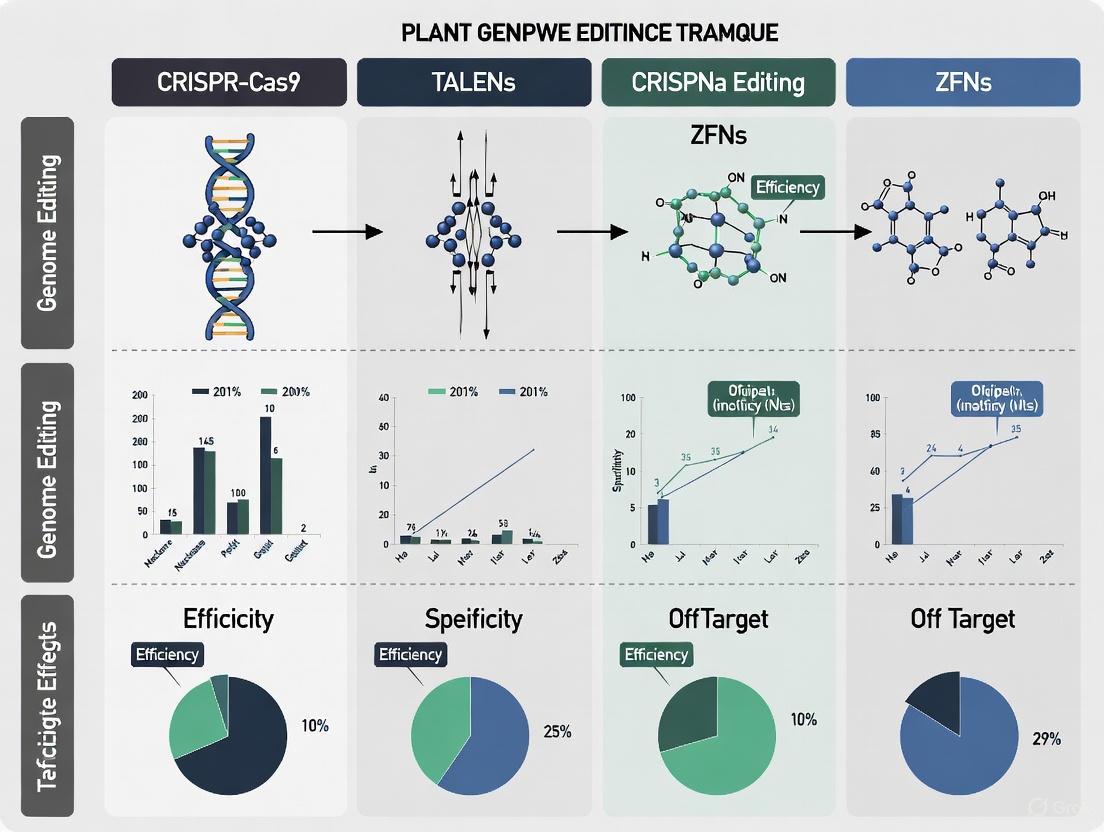
This article provides a comprehensive comparative analysis of the current landscape of plant genome editing techniques, including ZFNs, TALENs, and the CRISPR-Cas system.
Comparative Performance of Plant Genome Editing Techniques: From Foundational Tools to Clinical-Grade Applications
Abstract
This article provides a comprehensive comparative analysis of the current landscape of plant genome editing techniques, including ZFNs, TALENs, and the CRISPR-Cas system. Tailored for researchers, scientists, and biotechnology professionals, it explores the foundational mechanisms, diverse methodological applications in developing climate-resilient and nutritionally enhanced crops, critical troubleshooting for optimization, and advanced validation protocols. By synthesizing performance data on efficiency, specificity, scalability, and usability, this review serves as a strategic guide for selecting appropriate editing platforms and outlines future directions integrating AI and machine learning for precision plant breeding and biomanufacturing.
The Genome Editing Arsenal: Deconstructing Core Mechanisms from ZFNs to CRISPR-Cas
The field of genome editing has been revolutionized by the development of tools that enable precise modifications to DNA sequences. Among these, Zinc Finger Nucleases (ZFNs) represent the pioneering technology that demonstrated the feasibility of targeted genome engineering in eukaryotic cells [1]. As the first synthetic nucleases to allow researchers to induce double-strand breaks (DSBs) at predetermined genomic locations, ZFNs paved the way for subsequent technologies like TALENs and CRISPR-Cas9 [2]. These chimeric enzymes, created by fusing zinc finger DNA-binding domains with the FokI cleavage domain, opened new avenues for functional genomics research and molecular crop breeding by enabling targeted gene knockouts, insertions, and modifications previously challenging to achieve in plants [1]. This review examines the technical foundations of ZFNs, their comparative performance against later editing platforms, and their enduring impact on plant genome engineering despite the emergence of more recent technologies.
Molecular Architecture and Mechanism of ZFNs
The functional capability of ZFNs stems from their unique modular architecture, which combines sequence-specific recognition with targeted DNA cleavage. Understanding this structure is essential to appreciating both their pioneering role and their limitations within the genome editing toolkit.
Structural Components
ZFNs consist of two primary functional domains:
DNA-Binding Domain: This domain comprises a series of Cys2-His2 zinc finger repeats, each typically recognizing a 3-base pair DNA triplet [3] [2]. A standard ZFN array contains between 3-6 fingers, enabling recognition of a 9-18 base pair sequence [3] [2]. The specificity of this binding is determined by the amino acid sequence in the α-helix of each finger, particularly at positions -1, 2, 3, and 6 relative to the start of the helix [4].
DNA Cleavage Domain: The C-terminal of the ZFN is fused to the catalytic domain of the FokI restriction endonuclease, a nonspecific nuclease derived from Flavobacterium okeanokoites [2]. This domain requires dimerization to become active, which is a critical safety feature that reduces off-target activity [3].
Figure 1: Molecular architecture of a Zinc Finger Nuclease (ZFN) dimer. The DNA-binding domain consists of engineered zinc finger repeats, each recognizing a 3-bp sequence. The FokI cleavage domains must dimerize to create a double-strand break in the spacer region.
Mechanism of Action
The operational mechanism of ZFNs involves a coordinated process of recognition and cleavage:
Target Site Recognition: A pair of ZFN monomers is designed to bind opposite DNA strands at a predefined genomic site. The binding sites are typically spaced 5-7 base pairs apart, separated by a "spacer" region where cleavage will occur [5].
Dimerization and Cleavage: Upon binding of both ZFN monomers to their respective target sites, the FokI domains dimerize, forming a functional nuclease that creates a double-strand break (DSB) within the spacer region [3] [5].
DNA Repair and Editing Outcomes: The cellular repair machinery addresses the induced DSB through two primary pathways:
- Non-Homologous End Joining (NHEJ): An error-prone repair pathway that often results in small insertions or deletions (indels) at the break site, potentially leading to gene knockouts [3].
- Homology-Directed Repair (HDR): When a donor DNA template with homology arms is provided, this pathway can facilitate precise gene insertions or specific nucleotide changes [3] [1].
Comparative Analysis of Genome Editing Platforms
While ZFNs demonstrated the feasibility of targeted genome editing, the subsequent development of TALENs and CRISPR-Cas systems provided researchers with alternative tools featuring different operational characteristics. The table below presents a systematic comparison of these three major platforms across critical parameters relevant to plant genome engineering.
Table 1: Comparative analysis of major genome editing platforms
| Parameter | Zinc Finger Nucleases (ZFNs) | TALENs | CRISPR-Cas9 |
|---|---|---|---|
| DNA Recognition Mechanism | Protein-based (3 bp per zinc finger domain) [2] | Protein-based (1 bp per TALE repeat) [2] | RNA-based (sgRNA complementary base pairing) [6] |
| Nuclease Component | FokI (requires dimerization) [3] | FokI (requires dimerization) [3] | Cas9 (single nuclease acting as a monomer) [6] |
| Target Site Limitations | Limited to ~18 bp; requires G-rich sequences; target sites every 50-200 bp in random sequence [3] | Minimal constraints; can theoretically target any sequence [3] | Requires PAM sequence (NGG for SpCas9) adjacent to target [6] |
| Design and Assembly Complexity | High; context-dependent effects make reliable design challenging [3] [6] | Moderate; modular assembly but repetitive sequences complicate cloning [5] [6] | Low; only requires synthesis of a ~20 nt guide RNA sequence [6] |
| Development Timeline | Several months for design, optimization, and validation [3] [6] | Several days to weeks [3] | Several days [6] |
| Typical Editing Efficiency in Plants | Variable; can be high in optimized systems but often inconsistent [1] | Generally high and consistent [3] | High and consistently achieved across plant species [6] |
| Multiplexing Capacity | Low; difficult to express multiple ZFN pairs in the same cell [1] | Moderate; possible but challenging due to large size and repetitive nature [5] | High; multiple guide RNAs can be expressed simultaneously [7] |
| Off-Target Effects | Moderate to high; dependent on zinc finger specificity [3] | Generally low; high specificity of TALE DNA binding [3] | Variable; can be high but improved with high-fidelity variants [6] |
| Relative Cost | High (expensive design and assembly) [6] | Moderate (costly protein synthesis) [6] | Low (inexpensive guide RNA synthesis) [6] |
The comparative data reveal why CRISPR-Cas9 has become the predominant platform for new plant genome editing applications. The simplified design process, significantly lower cost, and superior multiplexing capability of CRISPR systems address several limitations inherent to both ZFNs and TALENs [6]. However, protein-based editors like ZFNs and TALENs can offer advantages in certain niche applications where RNA-guided systems may be less suitable, such as in environments with high nuclease activity that could degrade guide RNAs.
Experimental Applications and Workflows in Plants
The implementation of ZFN technology in plant systems follows well-established experimental protocols that have been optimized through various applications in crop improvement.
Key Research Reagent Solutions
Successful ZFN-mediated plant genome editing requires several critical reagents and components:
Table 2: Essential research reagents for ZFN-mediated plant genome editing
| Reagent/Solution | Function | Technical Considerations |
|---|---|---|
| ZFN Expression Construct | Expresses ZFN monomers in plant cells; typically uses strong constitutive promoters like CaMV 35S [4] | Vectors must be optimized for plant codon usage and may require specialized systems like CoDA or OPEN for zinc finger assembly [5] |
| Donor DNA Template | Provides repair template for HDR-mediated precise editing; contains desired modification flanked by homology arms [3] | Homology arms of 500-800 bp are typically used for plant systems; single-stranded oligonucleotides can be used for small changes [3] |
| Plant Transformation System | Delivers ZFN constructs into plant cells; Agrobacterium-mediated transformation or biolistics are common [4] | Transformation efficiency critically impacts editing outcomes; regeneration protocol must preserve edited genotypes [4] |
| Selection Markers | Enriches for successfully transformed cells; antibiotic or herbicide resistance genes [4] | Selection pressure must be optimized to avoid excessive cellular stress that could reduce regeneration efficiency [4] |
| Validation Primers | PCR amplification of target locus for sequence confirmation of edits [4] | Should flank target site by 200-500 bp; require validation in wild-type plants before use in edited lines [4] |
Representative Experimental Workflow
The standard protocol for ZFN-mediated gene editing in plants involves sequential steps from design to validation, as illustrated below:
Figure 2: Standard experimental workflow for ZFN-mediated plant genome editing, from target selection to validation of edited lines.
Case Study: ZFN-Mediated Herbicide Tolerance in Maize
A landmark application of ZFNs in crop improvement demonstrated the precise insertion of a herbicide-tolerance gene into the maize genome [1]. Researchers designed ZFNs to target the IPK1 gene locus, which is involved in inositol phosphate metabolism. A donor DNA construct containing the PAT herbicide-tolerance gene flanked by homology arms to IPK1 was co-delivered with the ZFN expression constructs into maize cells [1].
The experimental results confirmed:
- Precise targeted insertion of the PAT gene at the IPK1 locus
- Successful expression of herbicide tolerance in edited plants
- Altered inositol phosphate profiles in seeds of mutated plants, confirming gene functionality [1]
This study established ZFNs as a viable tool for precise trait stacking in a major crop, demonstrating their potential for agricultural biotechnology.
Current Status and Future Perspectives
While the genome editing landscape has shifted dramatically toward CRISPR-based systems, ZFNs maintain relevance in specific applications and retain historical significance as the technology that proved targeted genome editing was feasible in plants [8]. The primary applications of ZFNs in current plant research include:
- Specialized industrial applications where existing ZFN intellectual property provides freedom to operate
- Proof-of-concept studies in plant species where CRISPR systems have not yet been optimized
- Educational tools for demonstrating the evolution of genome editing technologies
The development of context-dependent assembly (CoDA) and oligomerized pool engineering (OPEN) platforms helped address some design challenges by providing pre-selected two-finger units and genetic selection methods for engineering zinc finger arrays [5]. However, these approaches still could not match the simplicity and scalability of CRISPR-based systems.
Recent advances in artificial intelligence and protein design suggest that computationally designed nucleases may represent the next evolutionary step in genome editing. In 2025, researchers demonstrated successful precision editing of the human genome with a programmable gene editor designed with artificial intelligence [9]. These AI-generated editors, while unrelated to ZFNs in structure, build upon the foundational concept established by ZFNs: that engineered biomolecules can be designed in silico to manipulate genetic information with precision.
ZFNs undeniably earned their place as the pioneering technology in the genome editing revolution. Their development provided the first compelling evidence that targeted genetic modifications in plants were not only possible but could be achieved with sufficient efficiency for practical application in crop improvement. While technical challenges in design complexity, targeting flexibility, and off-target effects ultimately limited their widespread adoption compared to later technologies, ZFNs demonstrated the fundamental principles that guided subsequent innovations in the field. Their legacy persists in the form of proven agricultural traits, established regulatory precedents, and the foundational knowledge that enabled the development of more advanced editing platforms. As the field progresses toward AI-designed editors and next-generation systems, the contributions of ZFNs remain embedded in the basic conceptual framework of programmable genome engineering.
Transcription Activator-Like Effector Nucleases (TALENs) represent a significant advancement in the field of targeted genome editing, offering researchers a powerful tool for precise genetic modifications. These engineered nucleases combine a customizable DNA-binding domain with a non-specific nuclease domain, creating molecular scissors that can be programmed to recognize and cleave specific DNA sequences [10]. The technology has rapidly evolved into a widely applicable platform for genome engineering in diverse organisms, including plants, animals, and human cells [10]. TALENs function as dimeric proteins, with each monomer comprising a TALE-derived DNA-binding domain fused to the FokI nuclease domain [11]. This architectural design leverages the natural mechanism of transcription activator-like effectors (TALEs) from Xanthomonas bacteria, which evolved to bind specific DNA sequences in host plant cells and modulate transcription [10].
The fundamental breakthrough that enabled TALEN engineering was the deciphering of the simple protein-DNA code that relates modular TALE repeat domains to individual DNA bases [10]. Each TALE repeat consists of 33-35 amino acids, with two hypervariable residues at positions 12 and 13 determining nucleotide specificity [11]. This modular recognition system allows researchers to assemble customized DNA-binding arrays capable of targeting virtually any genomic sequence of interest. The binding specificity is achieved through four primary repeat variable di-residue (RVD) combinations: NN for guanine (G), NI for adenine (A), HD for cytosine (C), and NG for thymine (T) [10]. The discovery of this programmable DNA recognition code, coupled with the efficient cleavage activity of the FokI nuclease, has positioned TALENs as a versatile technology for targeted genome manipulation across plant and animal systems.
Comparative Analysis: TALENs Versus Other Genome Editing Technologies
Mechanism and Design Comparisons
The landscape of genome editing technologies has evolved significantly, with TALENs, CRISPR/Cas systems, and zinc finger nucleases (ZFNs) representing the most prominent platforms. Each system employs distinct mechanisms for DNA recognition and cleavage, leading to important functional differences. TALENs utilize a protein-based recognition system where engineered TALE repeats individually recognize single base pairs through specific RVDs [11]. This modular protein-DNA interaction provides TALENs with considerable targeting flexibility and high specificity. In contrast, CRISPR/Cas systems rely on RNA-DNA interactions, where a short guide RNA (gRNA) directs the Cas nuclease to complementary DNA sequences [12]. The CRISPR system's dependence on RNA-DNA hybridization rather than protein-DNA interactions represents a fundamental mechanistic distinction that influences both practicality and specificity.
Zinc finger nucleases represent an earlier generation of engineered nucleases that utilize zinc finger proteins, each recognizing approximately three base pairs of DNA [10]. However, ZFN engineering faces challenges due to context-dependent effects between adjacent fingers, making reliable design more complex compared to the more modular TALEN architecture [10]. The table below summarizes the key structural and mechanistic differences between these three major genome editing platforms:
Table 1: Comparative Analysis of Major Genome Editing Technologies
| Feature | TALENs | CRISPR/Cas9 | ZFNs |
|---|---|---|---|
| DNA Recognition Mechanism | Protein-DNA (TALE repeats) | RNA-DNA (gRNA complementarity) | Protein-DNA (Zinc fingers) |
| Recognition Unit Size | Single base pair per repeat | ~20-nucleotide guide sequence | ~3 base pairs per zinc finger |
| Nuclease Component | FokI (requires dimerization) | Cas9 (single protein) | FokI (requires dimerization) |
| Targeting Constraints | 5' T required | PAM sequence (NGG for SpCas9) | Limited by zinc finger availability |
| Engineering Complexity | Moderate (modular assembly) | Simple (guide RNA design) | High (context-dependent effects) |
| Typical Mutation Profile | Indels at target site | Indels at target site | Indels at target site |
Specificity and Efficiency Profiles
Direct comparative studies of genome editing technologies in plant systems have yielded valuable insights into their relative specificities and efficiencies. A comprehensive genome-wide investigation in Physcomitrium patens compared the off-target effects of TALENs and CRISPR/Cas9, revealing that both systems showed minimal off-target activity when compared to control treatments [13]. The study found an average of 17.5 single nucleotide variants (SNVs) and 32 insertions/deletions (InDels) for TALEN-edited plants, compared to 8.25 SNVs and 19.5 InDels for CRISPR/Cas9-edited plants [13]. Importantly, the researchers noted that a comparable number of mutations could be detected in control plants treated only with polyethylene glycol (PEG), suggesting that the gene editing tools themselves did not significantly contribute to off-target effects beyond the background mutation rate [13].
The high specificity of TALENs stems from several architectural features. The requirement for FokI nuclease dimerization means that two independent TALEN monomers must correctly bind flanking DNA sequences in proper orientation and spacing to enable DNA cleavage [11]. This dual recognition system provides a built-in specificity check that reduces off-target effects. Additionally, the protein-DNA interaction mechanism of TALENs, with each repeat independently recognizing a single base pair, contributes to higher specificity compared to systems with overlapping recognition units [11]. Research has demonstrated that TALENs maintain high specificity across their entire target sequence, with particular stringency at the 5' end where the T nucleotide is recognized by the N-terminal domain [14].
Table 2: Experimental Specificity Assessment of TALENs vs. CRISPR/Cas9 in Plants
| Parameter | TALENs | CRISPR/Cas9 | Experimental Context |
|---|---|---|---|
| Average SNVs | 17.5 | 8.25 | Whole-genome sequencing in Physcomitrium patens [13] |
| Average InDels | 32 | 19.5 | Whole-genome sequencing in Physcomitrium patens [13] |
| Off-target Detection Rate | Low (not distinguishable from background) | Low (not distinguishable from background) | Whole-genome sequencing analysis [13] |
| Primary Specificity Determinant | FokI dimerization + protein-DNA recognition | gRNA seed region complementarity | Mechanism of target recognition [11] [12] |
| Mismatch Tolerance | Lower for longer TALEN arrays | Higher in PAM-distal region | In vitro specificity profiling [14] |
Experimental Assessment of TALEN Specificity
Methodologies for Specificity Profiling
Rigorous assessment of TALEN specificity requires specialized experimental approaches that comprehensively evaluate both on-target and off-target activities. High-throughput in vitro selection methods have been developed to profile TALEN specificity across large potential off-target sequence spaces. One such method involves incubating TALENs with highly diverse DNA libraries (>10^12 sequences) containing numerous off-target variants, followed by high-throughput sequencing to identify cleaved sequences [14]. This approach allows researchers to systematically evaluate TALEN activity against sequences with varying degrees of similarity to the intended target, providing a comprehensive specificity profile.
For plant research applications, whole-genome sequencing (WGS) represents the most unbiased method for detecting off-target mutations in edited plants [13]. This method involves sequencing the entire genomes of edited plant lines and comparing them to non-edited controls to identify any unexpected mutations that may have resulted from off-target nuclease activity. The experimental workflow typically involves: (1) designing TALEN pairs targeting specific genomic loci; (2) delivering TALEN constructs into plant cells via protoplast transfection or other transformation methods; (3) regenerating edited plants through tissue culture; (4) extracting genomic DNA from edited and control plants; and (5) conducting whole-genome sequencing and bioinformatic analysis to detect sequence variations [13]. This comprehensive approach provides a genome-wide view of editing specificity without prior assumptions about potential off-target sites.
Key Findings from Specificity Studies
Comprehensive specificity profiling of TALENs has revealed several important principles governing their off-target activity. Research examining 30 unique TALEN pairs with varying target sites, array lengths, and domain sequences demonstrated that TALENs generally exhibit high specificity, with cleaved sequences containing significantly fewer mutations than present in pre-selection libraries [14]. The 5' thymine recognized by the N-terminal domain was found to be highly specified, while the 3' end targeted by the C-terminal region generally tolerated more mutations [14]. This positional specificity gradient informs optimal TALEN design strategies to maximize targeting precision.
Studies in plant systems have yielded particularly encouraging results regarding TALEN specificity. A direct comparison of TALEN and CRISPR/Cas9 editing in Physcomitrium patens demonstrated that both systems showed minimal off-target effects that were indistinguishable from background mutation rates [13]. The research revealed that the polyethylene glycol (PEG) treatment used for protoplast transformation itself contributed more to observed mutations than the genome editing tools, highlighting the importance of proper experimental controls [13]. These findings suggest that when properly designed and delivered, TALENs can achieve highly specific genome editing in plants with minimal off-target effects.
Advanced TALEN Architectures and Engineering Innovations
Compact TALEN Designs
The relatively large size of standard TALEN constructs has prompted engineering efforts to develop more compact architectures while maintaining editing efficiency. One innovative approach involves creating single-chain TALENs that replace the FokI nuclease domain with the cleavage domain from the I-TevI homing endonuclease [15]. These compact TALENs (cTALENs) function as monomeric enzymes, significantly reducing the size of the editing machinery while retaining targeted cleavage activity. In vivo testing in yeast, plant, and mammalian cell assays demonstrated that cTALENs exhibit activity and specificity comparable to standard designer nucleases [15].
The cTALEN architecture leverages the natural tripartite structure of I-TevI, with its N-terminal catalytic domain fused to a minimal TALE DNA-binding scaffold [15]. This design preserves the natural N-to C-terminal layout of wild-type I-TevI while incorporating programmable DNA recognition through the TALE domain. Functional characterization revealed that TevI-based cTALENs show a defined spacer preference, with optimal activity at approximately 10 bp separation between the binding site and cleavage motif [15]. This compact architecture simplifies vectorization and reduces production costs while maintaining effective genome editing capability.
Specificity-Enhanced TALEN Variants
Engineering efforts have also focused on developing TALEN variants with enhanced specificity profiles. Based on the understanding that excess non-specific DNA-binding energy can contribute to off-target cleavage, researchers have engineered TALEN architectures with modified DNA-binding properties [14]. One such variant, called Q3, was designed to reduce non-specific DNA binding while maintaining on-target cleavage activity [14]. In cellular assays, the Q3 variant demonstrated equal on-target activity but showed a 10-fold reduction in average off-target activity compared to standard TALEN constructs [14].
The development of such specificity-enhanced variants involves identifying and mutating residues that contribute to non-specific DNA binding without compromising the engineered DNA recognition capability. This approach represents a significant advancement in TALEN technology, as it addresses one of the potential limitations of genome editing tools while maintaining their targeting flexibility and efficiency. For plant genome editing applications, these improved variants offer the potential for even greater precision in genetic modifications, reducing the likelihood of unintended changes that could complicate functional analysis or regulatory approval.
TALEN Applications in Plant Genome Engineering
Enhancing Secondary Metabolite Production
TALENs have demonstrated significant utility in modifying plant metabolic pathways, particularly for enhancing the production of valuable secondary metabolites. Research has focused on engineering biosynthetic pathways for compounds with pharmaceutical and industrial relevance, including alkaloids, flavonoids, terpenoids, and phenolic compounds [11]. These specialized metabolites play crucial roles in plant defense, growth regulation, and reproduction, while also possessing valuable pharmacological activities such as analgesic, anticancer, antioxidant, and anti-inflammatory properties [11].
The application of TALENs in medicinal plant research enables precise manipulation of key genes within complex biosynthetic pathways, potentially optimizing plant varieties for higher yields of bioactive compounds [11]. By targeting specific genes involved in the regulation or biosynthesis of secondary metabolites, researchers can overcome natural genetic limitations that restrict compound production. This approach represents a sustainable strategy for producing high-value plant metabolites with applications in pharmaceuticals, nutraceuticals, and other industries [11]. The high specificity of TALENs is particularly valuable in these applications, as it minimizes unintended disruptions to complex metabolic networks while enabling precise modifications to pathway components.
Expanding Genetic Diversity and Stress Tolerance
Beyond metabolic engineering, TALENs provide powerful capabilities for expanding genetic diversity and enhancing stress tolerance in plants. Unlike traditional breeding methods that rely on crossing genetically diverse parents and can be time-consuming, TALEN-mediated genome editing enables direct introduction of targeted modifications to create novel genetic variations [11]. This approach allows researchers to develop plant varieties with improved adaptation to changing environmental conditions, resistance to pests and diseases, and enhanced yield characteristics [11].
The capability to precisely modify specific genetic loci makes TALENs particularly valuable for introducing traits that involve multiple genetic factors or that are not readily available in natural germplasm collections. By generating targeted genetic variation at precise genomic locations, TALEN technology accelerates the development of improved plant varieties while maintaining the genetic integrity of elite backgrounds. This precision breeding approach complements traditional methods and provides researchers with expanded tools for addressing challenges in food security, climate adaptation, and sustainable agriculture.
Table 3: Essential Research Reagents for TALEN-Based Plant Genome Editing
| Reagent/Resource | Function | Application Notes |
|---|---|---|
| TALEN Assembly Kit | Modular construction of TALE repeat arrays | Commercial and academic kits available for golden gate assembly [10] |
| RVD Modules | Define nucleotide specificity (NN/G, NI/A, HD/C, NG/T) | NH and NK variants offer alternative G recognition [10] |
| FokI Nuclease Domain | DNA cleavage component | Obligate heterodimeric variants enhance specificity [14] |
| Plant Transformation Vectors | Delivery of TALEN constructs to plant cells | Binary vectors for Agrobacterium-mediated transformation [16] |
| Protoplast Isolation & Transfection Reagents | Direct delivery to plant cells | PEG-mediated transfection commonly used [13] |
| Developmental Regulators (BBM, WUS) | Enhance regeneration efficiency | Critical for overcoming genotype-dependent limitations [16] |
| Selection Markers | Identification of transformed tissue | Antibiotic/herbicide resistance or visual markers [16] |
| Genotyping Primers | Confirmation of edits | Flanking target site for PCR amplification and sequencing [17] |
| Whole Genome Sequencing Services | Off-target analysis | Comprehensive specificity assessment [13] |
TALEN technology represents a significant advancement in the field of programmable nucleases, offering a unique combination of targeting flexibility, high specificity, and proven efficacy across diverse plant species. The modular protein-DNA recognition mechanism of TALENs provides distinct advantages for applications requiring maximal specificity, while ongoing engineering efforts continue to address limitations related to construct size and delivery efficiency. When compared to CRISPR/Cas systems, TALENs demonstrate comparable on-target efficiency with minimal off-target effects, as evidenced by whole-genome sequencing studies in plant models [13].
The future development of TALEN technology will likely focus on further enhancing specificity through engineered DNA-binding domains, improving delivery methods to overcome size constraints, and expanding applications in complex genome modifications. Integration with emerging technologies such as nanomaterial-based delivery systems [16] and tissue culture-free transformation methods [16] may further broaden the utility of TALENs in plant species that have proven recalcitrant to genetic transformation. As the field of plant genome editing continues to evolve, TALENs remain a valuable platform for both basic research and applied biotechnology, particularly in applications where high specificity is paramount and where targeting requirements fall outside the constraints of CRISPR PAM sequences.
The advent of clustered regularly interspaced short palindromic repeats (CRISPR) and its CRISPR-associated (Cas) proteins has fundamentally transformed biological research and therapeutic development. Unlike previous genome editing technologies that required engineering complex DNA-binding proteins for each new target, the CRISPR-Cas9 system utilizes a programmable RNA guide to direct DNA cleavage, dramatically simplifying the process of achieving targeted genetic modifications [18] [12]. This revolutionary RNA-guided platform has established itself as a cornerstone technology in precision editing, enabling researchers to manipulate genes with unprecedented ease, efficiency, and specificity across diverse organisms, including plants, animals, and human cells [19] [20].
The CRISPR-Cas system originates from an adaptive immune mechanism in prokaryotes, which protects bacteria from invading viruses by storing fragments of viral DNA within their own genomes [12] [21]. When transcribed, these DNA fragments form CRISPR RNAs (crRNAs) that guide Cas nucleases to recognize and cleave complementary foreign DNA sequences, providing sequence-specific immunity [12]. This natural system was adapted for genome engineering by combining a single guide RNA (sgRNA), which fuses the crRNA with a trans-activating crRNA (tracrRNA), with the Cas9 nuclease to create a programmable molecular scissor [12] [19]. The development of CRISPR-Cas9 has effectively democratized genome editing, making sophisticated genetic manipulations accessible to laboratories worldwide and accelerating the pace of discovery in functional genomics, agricultural biotechnology, and therapeutic development [21] [22].
Evolution of Genome Editing Platforms
The journey to precision genome editing began with earlier technologies that demonstrated the feasibility of targeted genetic modifications but faced significant technical hurdles. Zinc-finger nucleases (ZFNs), the first generation of engineered nucleases, are composed of a DNA-binding domain comprised of cyteine2-histidine2 zinc-finger motifs fused to the FokI nuclease domain [18] [20]. Each zinc finger typically recognizes three base pairs, and multiple fingers are combined to achieve sequence specificity. A significant limitation of ZFNs is that the FokI cleavage domain must dimerize to become active, requiring the design and optimization of two different ZFN proteins that bind opposite strands of the target DNA with precise orientation and spacing [18] [20]. While ZFNs proved that targeted genome editing was possible, their development was time-consuming, expensive, and often yielded inconsistent results due to context-dependent effects between adjacent fingers [20].
The subsequent development of transcription activator-like effector nucleases (TALENs) represented a substantial advance in DNA recognition technology. TALENs are also fusions of a DNA-binding domain to the FokI nuclease, but their DNA-binding domain derives from transcription activator-like effectors (TALEs) produced by plant-pathogenic bacteria [18]. TALEs contain multiple repeats of 33-35 amino acids, with each repeat binding to a single base pair through two hypervariable amino acids known as repeat-variable diresidues (RVDs) [18]. The simple, modular code of TALENs (where specific RVDs correspond to specific nucleotides) made them easier to engineer than ZFNs for novel DNA targets. However, TALENs also require dimerization of the FokI nuclease and presented cloning challenges due to their highly repetitive sequences [18] [20].
The emergence of CRISPR-Cas9 technology addressed the primary limitations of both ZFNs and TALENs by decoupling the recognition and cleavage functions. The system's programmability resides in the guide RNA component, which can be easily designed to target virtually any genomic sequence by simply modifying its 20-nucleotide spacer region [12] [19]. This RNA-guided mechanism eliminated the need for protein engineering for each new target, significantly reducing the time, cost, and expertise required for effective genome editing [19]. The following table provides a comprehensive comparison of these three major nuclease platforms:
Table 1: Comparative Analysis of Major Genome Editing Platforms
| Feature | Zinc Finger Nucleases (ZFNs) | TALENs | CRISPR-Cas9 |
|---|---|---|---|
| DNA Recognition Mechanism | Protein-based (zinc finger domains) | Protein-based (TALE repeats) | RNA-based (guide RNA) |
| Recognition Code | Complex (1 finger ≈ 3 bp) | Modular (1 repeat = 1 bp) | Simple (RNA-DNA complementarity) |
| Nuclease Component | FokI (requires dimerization) | FokI (requires dimerization) | Cas9 (functions as monomer) |
| Target Design Complexity | High (context-dependent effects) | Moderate (repetitive sequence cloning) | Low (simple RNA design) |
| Development Time & Cost | High (months, expensive) | Moderate (weeks, costly) | Low (days, inexpensive) |
| Multiplexing Capability | Difficult | Difficult | Straightforward |
| Typical Editing Efficiency | Variable | Variable | High |
| Primary Constraint | Target site availability, context effects | Repetitive nature, cloning difficulty | PAM sequence requirement |
The following diagram illustrates the fundamental mechanistic differences between these three genome editing platforms:
Diagram 1: Mechanism comparison of ZFNs, TALENs, and CRISPR-Cas9
The Molecular Architecture of CRISPR-Cas9 Systems
Core Components and Mechanisms
The CRISPR-Cas9 system's functionality stems from the precise interaction between its two fundamental components: the Cas9 nuclease and the guide RNA (gRNA). The most widely used Cas9 protein from Streptococcus pyogenes (SpCas9) is a multi-domain enzyme comprising REC (recognition) and NUC (nuclease) lobes [12]. The REC lobe, consisting of REC1, REC2, and REC3 domains, is responsible for binding the gRNA and facilitating its hybridization with the target DNA. The NUC lobe contains the HNH and RuvC nuclease domains, which cleave the target and non-target DNA strands, respectively, along with the PAM-interacting (PI) domain that recognizes the protospacer adjacent motif [12].
The guide RNA is a chimeric molecule formed by fusing the CRISPR RNA (crRNA), which contains the 20-nucleotide sequence complementary to the target DNA, with the trans-activating crRNA (tracrRNA) that serves as a scaffold for Cas9 binding [12] [19]. This engineered single guide RNA (sgRNA) dramatically simplifies the system by reducing the number of components required for targeting. The targeting specificity of the CRISPR-Cas9 complex is determined by the complementarity between the spacer sequence in the gRNA and the target DNA, which must be adjacent to a protospacer adjacent motif (PAM) sequence (5'-NGG-3' for SpCas9) [12] [19]. The PAM sequence is a critical recognition element that distinguishes self from non-self DNA in bacterial immunity and is essential for initiating the Cas9 cleavage activity in genome editing applications.
The mechanism of CRISPR-Cas9 action involves a series of coordinated molecular events. First, the Cas9-gRNA complex scans DNA and binds to PAM sequences, initiating DNA unwinding. If the gRNA spacer sequence sufficiently matches the target DNA adjacent to the PAM, the complex becomes fully activated, positioning the HNH domain to cleave the target strand and the RuvC domain to cleave the non-target strand, resulting in a double-strand break (DSB) 3-4 nucleotides upstream of the PAM site [12]. This DSB then triggers the cell's innate DNA repair machinery, primarily through either the error-prone non-homologous end joining (NHEJ) pathway, which often results in small insertions or deletions (indels) that can disrupt gene function, or the homology-directed repair (HDR) pathway, which can introduce precise genetic modifications using a donor DNA template [18] [19].
Experimental Workflow for Plant Genome Editing
The application of CRISPR-Cas9 for plant genome editing follows a established pipeline that can be divided into distinct phases, from target selection to molecular analysis of edited plants. The following diagram outlines this comprehensive workflow:
Diagram 2: Plant CRISPR-Cas9 experimental workflow
A typical CRISPR-Cas9 experiment in plants begins with target selection and gRNA design. Researchers identify a 20-nucleotide target sequence adjacent to a PAM (5'-NGG-3') within the gene of interest. Bioinformatics tools like CRISPOR and CHOPCHOP are employed to design highly specific gRNAs with minimal off-target potential [21]. These tools evaluate gRNA efficiency scores, predict potential off-target sites across the genome, and assist in selecting optimal target regions. The specificity of the gRNA is paramount, as mismatches in the PAM-proximal "seed region" (nucleotides 10-20) can significantly reduce cleavage efficiency, while mismatches in the distal region may still permit cleavage, potentially leading to off-target effects [12] [21].
Once gRNAs are designed, the expression vector is constructed. A common approach involves cloning the Cas9 coding sequence under the control of the Cauliflower Mosaic Virus 35S (CaMV 35S) promoter, while the gRNA is typically expressed using RNA polymerase III-dependent promoters such as the U6 snRNA promoter [19]. These components are often assembled into a single binary vector for Agrobacterium-mediated transformation. The construct is then introduced into plant cells using established transformation methods, with Agrobacterium-mediated transformation being the most common for dicot plants like Arabidopsis, and biolistic or protoplast-based methods often used for monocots like rice [19].
Following transformation, regenerated plants are systematically screened for mutations. Initial screening often involves restriction fragment length polymorphism (RFLP) analysis if the target site includes a restriction enzyme recognition sequence, as Cas9-induced mutations frequently disrupt these sites [19]. This is followed by PCR amplification and Sanger sequencing of the target region. The sequencing chromatograms frequently show overlapping peaks downstream of the mutation site, indicating heterogeneous editing events. For more comprehensive analysis, amplicon deep sequencing provides a detailed profile of all mutation types and their frequencies. Successful editing is confirmed when sequencing reveals characteristic small insertions or deletions (indels) at the target site, typically 1-20 base pairs upstream of the PAM sequence [19].
Advanced CRISPR-Cas9 Derivatives: Base and Prime Editing
Base Editing Systems
While standard CRISPR-Cas9 creates double-strand breaks that primarily induce random mutations through NHEJ, base editing technologies enable precise, single-nucleotide changes without requiring DSBs or donor DNA templates [23]. Base editors are fusion proteins that combine a catalytically impaired Cas9 (nCas9) with a deaminase enzyme. The nCas9 retains the ability to bind DNA specified by the gRNA but only nicks one strand, while the deaminase performs chemical conversion of nucleotides [23].
There are two primary classes of base editors: Cytosine Base Editors (CBEs) convert cytosine to thymine (C•G to T•A), while Adenine Base Editors (ABEs) convert adenine to guanine (A•T to G•C) [23]. The first-generation CBE was developed by fusing rat cytidine deaminase (rAPOBEC1) to nCas9, but its efficiency was limited (0.8-7.7%). Subsequent versions incorporated uracil DNA glycosylase inhibitor (UGI) to prevent uracil excision repair (creating CBE2), used nCas9 instead of dCas9 (creating CBE3), and added a second UGI with optimized linkers (creating CBE4) [23]. The current state-of-the-art CBE4max incorporates nuclear localization signals and codon optimization, achieving editing efficiencies up to 89% across various cell types [23].
ABEs were developed through extensive engineering of the bacterial TadA tRNA deaminase to function on DNA. The latest ABE versions (ABE7.10, ABE8e) show remarkable efficiency, with ABE8e achieving editing rates of 50-80% across multiple genomic loci [23]. More recently, glycosylase base editors (GBEs) have expanded the editing scope by combining cytidine deaminases with uracil DNA glycosylase, enabling C-to-G transversions [23].
Prime Editing Systems
Prime editing represents a further advancement that expands the scope of precise genome editing beyond single-base substitutions. Prime editors can mediate all 12 possible base-to-base conversions, as well as small insertions and deletions, without requiring double-strand breaks or donor DNA templates [24]. The system consists of a prime editor protein—a fusion of nCas9 (H840A) with an engineered reverse transcriptase (RT)—and a specialized prime editing guide RNA (pegRNA) [24].
The pegRNA serves dual functions: it directs the prime editor to the target site and also contains a template for the reverse transcriptase to synthesize the desired edit. The editing process involves: (1) binding of the prime editor complex to the target DNA and nicking of the non-target strand; (2) hybridization of the 3' end of the nicked DNA to the primer binding site (PBS) region of the pegRNA; (3) reverse transcription using the reverse transcriptase template (RTT) containing the desired edit; (4) flap resolution that incorporates the edited strand into the genome [24].
The prime editing system has evolved through several generations with improving efficiency. PE1 was the initial proof-of-concept with modest efficiency (10-20% in HEK293T cells). PE2 incorporated an engineered reverse transcriptase with enhanced processivity, increasing efficiency to 20-40%. PE3 added a second nicking sgRNA to target the non-edited strand, further boosting efficiency to 30-50% [24]. More recent versions (PE4, PE5, PE6) include additional optimizations such as dominant-negative MLH1 to inhibit mismatch repair, engineered RT variants, and stabilized pegRNA designs, achieving efficiencies up to 90% in human cells [24].
Table 2: Comparison of CRISPR-Cas9 Editing Platforms
| Editing System | Key Components | Editing Outcomes | Efficiency Range | Advantages | Limitations |
|---|---|---|---|---|---|
| Standard CRISPR-Cas9 | Cas9 nuclease + gRNA | DSBs → indels (NHEJ) or precise edits (HDR) | 26-84% in plants [19] | Simple, effective gene knockout | DSB-associated risks, low HDR efficiency |
| Cytosine Base Editor (CBE) | nCas9 + cytidine deaminase + UGI | C•G to T•A conversions | Up to 89% (CBE4max) [23] | Precise base changes, no DSBs | Limited to specific transitions, bystander edits |
| Adenine Base Editor (ABE) | nCas9 + engineered TadA | A•T to G•C conversions | 50-80% (ABE8e) [23] | Precise A-to-G changes, minimal byproducts | Limited to A-to-G conversions |
| Prime Editor (PE) | nCas9-RT fusion + pegRNA | All 12 base conversions, small insertions/deletions | 30-90% (PE3-PE6) [24] | Versatile editing, no DSBs, broad applicability | Complex pegRNA design, variable efficiency |
Delivery Methods: Bridging the Laboratory-Application Gap
The effective delivery of CRISPR components into plant cells remains a critical challenge for implementing genome editing technologies. The most established method is Agrobacterium-mediated transformation, which utilizes the natural DNA transfer capability of Agrobacterium tumefaciens to deliver T-DNA containing Cas9 and gRNA expression cassettes into the plant genome [19]. This method has been successfully used in numerous crop species, including Arabidopsis, rice, tobacco, and tomato. While highly effective, it can result in random integration of the T-DNA into the plant genome, potentially disrupting native genes and requiring segregation in subsequent generations.
More recently, nanoparticle-based delivery has emerged as a promising alternative that avoids integration into the host genome. Nanoparticles, particularly lipid nanoparticles (LNPs), can encapsulate CRISPR components and facilitate their entry into plant cells through endocytosis [25]. This approach is particularly valuable for delivering preassembled Cas9-gRNA ribonucleoproteins (RNPs), which significantly reduce off-target effects due to the transient presence of editing components [25]. Nanoparticle-driven delivery has shown promise in overcoming the challenges of germline transformation, species independence, and HDR efficiency in plants [25].
The following diagram compares these delivery mechanisms and their pathways into plant cells:
Diagram 3: CRISPR delivery methods for plants
For rapid testing and applications where transgenic integration is undesirable, protoplast transfection offers a valuable approach. Plant protoplasts (cells without cell walls) can be transfected with CRISPR components using polyethylene glycol (PEG)-mediated transformation or electroporation [19]. While this method enables high-efficiency editing and transient expression, the regeneration of whole plants from protoplasts remains challenging for many crop species. Each delivery method offers distinct advantages and limitations, making them suitable for different applications from basic research to crop improvement programs.
The Scientist's Toolkit: Essential Research Reagents
Implementing CRISPR-Cas9 technology requires a collection of specialized reagents and tools. The following table outlines key solutions and their applications in plant genome editing research:
Table 3: Essential Research Reagents for Plant CRISPR-Cas9 Experiments
| Reagent Category | Specific Examples | Function & Application |
|---|---|---|
| Cas9 Variants | SpCas9, SaCas9, FnCas9, Cas12a | DNA cleavage; different variants offer varying PAM requirements and sizes [12] [21] |
| gRNA Design Tools | CRISPOR, CHOPCHOP, CRISPRdirect | Bioinformatics platforms for designing specific gRNAs with minimal off-target effects [21] |
| Expression Vectors | pRGEB vectors, pCAMBIA-Cas9 | Binary vectors for plant transformation containing Cas9 and gRNA expression cassettes [19] |
| Promoter Systems | CaMV 35S (constitutive), U6/U3 (Pol III) | Drive Cas9 (35S) and gRNA (U6) expression in plant cells [19] |
| Delivery Tools | Agrobacterium strains (GV3101, EHA105), Gold particles (biolistics) | Facilitate DNA transfer into plant cells [19] |
| Detection Reagents | Restriction enzymes for RFLP, PCR primers, Sanger sequencing | Validate editing efficiency and characterize mutations [19] |
| Plant Culture Media | Callus induction, regeneration media | Support plant tissue culture and regeneration of edited plants [19] |
CRISPR-Cas9 systems have unquestionably revolutionized genome editing by providing an unprecedented combination of precision, efficiency, and programmability. The technology's RNA-guided platform has democratized genetic engineering, enabling researchers across diverse fields to pursue questions and applications that were previously technically prohibitive or economically unfeasible. As the field continues to advance, the development of enhanced CRISPR systems with improved specificity, expanded targeting scope, and diverse functionalities promises to further accelerate both basic research and translational applications.
The recent emergence of prime editing with prolonged editing window (proPE) exemplifies the ongoing innovation in this field. This system uses a second non-cleaving sgRNA to target the reverse transcriptase template near the edit site, extending the editing window and enhancing efficiency where traditional prime editing is inefficient [26]. ProPE addresses several limitations of standard prime editing and broadens its applicability to modifications beyond the typical range, potentially encompassing a major portion of human pathogenic single nucleotide polymorphisms [26]. Such advancements, coupled with improvements in delivery methods like nanoparticle technologies, continue to push the boundaries of what's possible with precision genome editing.
As CRISPR technologies mature, their impact continues to expand across medicine, agriculture, and basic research. In the clinical realm, the first CRISPR-based medicine, Casgevy, has received approval for treating sickle cell disease and transfusion-dependent beta thalassemia, marking a historic milestone for the technology [22]. In agriculture, CRISPR systems are being deployed to develop crops with enhanced nutritional profiles, improved disease resistance, and greater climate resilience [25] [23]. The remarkable progress in this field suggests that we are only beginning to glimpse the full potential of RNA-guided precision editing, with future innovations likely to yield even more powerful tools for rewriting the code of life.
The advent of site-specific genome editing technologies has revolutionized plant biotechnology, enabling precise modifications for crop improvement. These technologies function by creating targeted double-strand breaks (DSBs) in the DNA, which are subsequently repaired by the cell's innate repair mechanisms [27] [6]. The repair pathways, primarily non-homologous end joining (NHEJ) or homology-directed repair (HDR), lead to desired genetic alterations such as gene knockouts, insertions, or substitutions [27] [28]. This guide provides a comparative analysis of three foundational genome editing platforms: Zinc Finger Nucleases (ZFNs), Transcription Activator-Like Effector Nucleases (TALENs), and the CRISPR-Cas9 system. The focus is on their core mechanisms—DNA recognition, cleavage, and Protospacer Adjacent Motif (PAM) requirements—within the context of plant genome editing, supported by experimental data and detailed methodologies.
Foundational Mechanisms of Genome Editing Tools
Zinc Finger Nucleases (ZFNs)
- DNA Recognition Mechanism: ZFNs utilize a protein-based recognition system. Each zinc finger domain (ZFD) recognizes and binds to a specific 3-base pair DNA triplet. Multiple ZFDs are assembled in tandem to target a longer, specific DNA sequence, typically 18-24 base pairs in length [6].
- Cleavage Mechanism: The DNA-binding domain is fused to the FokI endonuclease domain, which introduces a DSB. A critical feature is that the FokI domain must dimerize to become active. Consequently, two ZFN monomers are designed to bind opposite strands of the DNA target site in a tail-to-tail orientation, with their FokI domains dimerizing to create a DSB in the spacer region between the two binding sites [6] [28].
- PAM Requirements: ZFNs do not have a universal PAM requirement like CRISPR-Cas9. Instead, the target sequence specificity is determined entirely by the engineered zinc finger proteins. However, the need for the FokI nuclease to dimerize effectively constrains the architecture of the target site [6].
Transcription Activator-Like Effector Nucleases (TALENs)
- DNA Recognition Mechanism: Similar to ZFNs, TALENs employ a protein-based system using TAL effector (TALE) repeats. Each TALE repeat is modular and recognizes a single specific nucleotide. The sequence of these repeats is engineered to correspond one-to-one with the target DNA sequence, simplifying the design process compared to ZFNs [6].
- Cleavage Mechanism: TALENs also use the FokI endonuclease domain for cleavage. Like ZFNs, they function as pairs, with two TALEN monomers binding to opposite DNA strands and the FokI domains dimerizing to induce a DSB in the spacer region between the two binding sites [6] [28].
- PAM Requirements: TALENs themselves do not have a strict PAM. However, the TALEN architecture requires the target sequence to be preceded by a thymine (T) at the 5' end, which is a constraint imposed by the native TALE structure [6].
CRISPR-Cas9 System
- DNA Recognition Mechanism: The CRISPR-Cas9 system uses an RNA-guided mechanism for DNA recognition. A single guide RNA (sgRNA) is engineered with a ~20 nucleotide spacer sequence that is complementary to the target DNA site. The sgRNA directs the Cas9 nuclease to this specific locus through Watson-Crick base pairing [27] [6]. This mechanism is considered more straightforward and user-friendly than engineering proteins for each new target.
- Cleavage Mechanism: The Cas9 protein is a single endonuclease that introduces a DSB at the target site. It contains two distinct cleavage domains, HNH and RuvC, which cut the complementary and non-complementary DNA strands, respectively. This results in a blunt-ended or slightly staggered DSB a few base pairs upstream of the PAM site [27] [6].
- PAM Requirements: Cas9 requires a specific short nucleotide sequence, known as the Protospacer Adjacent Motif (PAM), to be located adjacent to the target site for successful recognition and cleavage. The PAM sequence is essential for the Cas9 protein to initiate DNA unwinding [27] [29]. For the most commonly used Streptococcus pyogenes Cas9 (SpCas9), the PAM sequence is 5'-NGG-3', where 'N' is any nucleotide [29] [6]. This requirement can limit the targeting scope of the standard Cas9.
The following diagram illustrates the fundamental differences in how these three technologies recognize their DNA target and initiate a double-strand break.
Quantitative Comparison of Performance Characteristics
The foundational mechanisms translate into distinct performance characteristics in practical applications. The table below summarizes a quantitative comparison of editing efficiency, specificity, and targeting range based on experimental data.
Table 1: Performance Comparison of Genome Editing Technologies
| Feature | ZFNs | TALENs | CRISPR-Cas9 |
|---|---|---|---|
| Target Sequence Size | 18-24 bp [6] | Customizable length, typically 30-40 bp [6] | 20 bp sgRNA + PAM [27] |
| Editing Efficiency (Indel Formation) | Demonstrated in complex genomes (e.g., hexaploid wheat) [6] | High efficiency and affinity (~96%) [6] | High efficiency across many plant species (e.g., maize, rice, wheat) [27] |
| Relative Off-Target Activity | Lower cell toxicity than ZFNs, but potential for off-target mutations exists [6] | Significantly fewer off-target mutations and lower cell toxicity than ZFNs [6] | Can have significant off-target activity; varies with specific Cas9 variant [29] [30] |
| Targeting Range / PAM Flexibility | No universal PAM, but target site is complex to design [6] | No strict PAM, but requires 5' Thymine [6] | Constrained by PAM (e.g., NGG for SpCas9). Newer variants (e.g., SpRY) offer NRN>NYN flexibility [29] [31] |
| Development Time & Cost | Complex design, months for development, high cost [6] | Easier design than ZFNs, days for assembly, high cost [6] | Simple sgRNA design, days for cloning, low cost [6] |
Experimental Protocols for Assessing Editing Efficiency and Specificity
To generate the comparative data presented in this guide, specific experimental protocols are employed. Below are detailed methodologies for key assays used to evaluate on-target editing efficiency and off-target activity.
T7 Endonuclease I (T7EI) Assay
The T7EI assay is a commonly used method to detect small insertions or deletions (indels) at the target site resulting from NHEJ repair [32].
- PCR Amplification: Genomic DNA is extracted from edited and control plant tissues. The target genomic region flanking the editing site is amplified by PCR using specific primers [32] [29].
- DNA Denaturation and Reannealing: The purified PCR products are denatured at 95°C and then slowly reannealed. This process allows the formation of heteroduplex DNA—where a wild-type DNA strand pairs with an indel-containing strand—resulting in a mismatch at the site of the mutation [32].
- T7EI Digestion: The reannealed DNA is treated with the T7 Endonuclease I enzyme, which recognizes and cleaves mismatched heteroduplex DNA.
- Gel Electrophoresis and Analysis: The digested products are separated by agarose gel electrophoresis. The gel is imaged, and the ratio of cleaved to uncleaved PCR products is analyzed using densitometric software (e.g., Image Lab) to estimate the editing efficiency. This method is considered semi-quantitative [32].
Primer-Extension-Mediated Sequencing (PEM-seq)
PEM-seq is a high-throughput sequencing method that provides a comprehensive, in-depth analysis of various editing outcomes, including indels, large deletions, and off-target translocations [29].
- Cell Transfection and Sorting: HEK293T cells are often used as a model system. Cells are co-transfected with plasmids expressing the Cas9 nuclease (or variant) and the sgRNA. After 72 hours, successfully transduced cells are sorted using Fluorescence-Activated Cell Sorting (FACS) if the plasmids contain fluorescent markers like mCherry and GFP [29].
- Genomic DNA Extraction and Primer Extension: Genomic DNA is extracted from the sorted cells. A biotinylated primer is designed close to the Cas9 target site (~150 bp) and used for primer extension.
- Library Preparation and Sequencing: The resulting DNA fragments are processed into a sequencing library using site-specific nested primers for amplification. All PEM-seq libraries are sequenced on platforms like Illumina HiSeq [29].
- Bioinformatic Analysis: Sequencing reads are analyzed using specialized pipelines to identify and quantify on-target editing efficiency, off-target sites (defined as sequences with less than eight mismatches to the on-target site), and other chromosomal rearrangements like translocations [29].
GUIDE-Seq
GUIDE-seq is a genome-wide, unbiased method for detecting off-target sites [31].
- Oligonucleotide Tag Integration: During the editing process, a double-stranded oligonucleotide tag is introduced into the cells along with the genome-editing components (e.g., Cas9 and sgRNA). This tag is preferentially integrated into DSB sites generated by the nuclease via the NHEJ pathway.
- Genomic DNA Extraction and Sequencing: Genomic DNA is harvested and sequenced. The integration sites of the oligonucleotide tag are mapped to the genome.
- Off-Target Site Identification: Genomic locations where the tag has integrated represent potential off-target cleavage sites. These sites are subsequently validated to confirm off-target activity.
Advanced Cas9 Engineering to Overcome PAM Limitations
The PAM requirement of wild-type SpCas9 (NGG) restricts the number of editable sites in a genome. To overcome this limitation, several engineered Cas9 variants with altered PAM specificities have been developed, significantly expanding the targeting scope [29] [31].
- SpCas9 Variants (xCas9, SpCas9-NG): These variants recognize NGN PAMs, effectively doubling the available target sites compared to the canonical NGG PAM [29].
- SpRY Cas9: Engineered to be a near-PAMless Cas9, SpRY can target a vast majority of NNN sequences, with a preference for NRN (R = A/G) over NYN (Y = C/T) PAMs. This dramatically increases the fraction of the genome that can be targeted [29] [31].
- SpRYc - A Chimeric Cas9: A recent innovation involves creating a chimeric enzyme, SpRYc, by combining the PAM-interacting domain (PID) of SpRY with the N-terminus of another Cas9 variant (Sc++). SpRYc leverages properties of both enzymes to edit diverse PAMs with high flexibility while demonstrating a lower off-target propensity than SpRY in human cells, as measured by GUIDE-Seq [31].
Table 2: Comparison of PAM Specificities and Off-Target Profiles of SpCas9 and Engineered Variants
| Cas9 Variant | PAM Specificity | Targeting Range | Relative Off-Target Activity | Key Characteristics |
|---|---|---|---|---|
| SpCas9 (Wild-type) | NGG [29] | Limited | Baseline (Can be significant) [29] | The original, widely used Cas9. |
| SpCas9-NG | NGN [29] | ~4x wider than NGG | Increased compared to wild-type [29] | Broadens targeting range but with a trade-off in specificity. |
| SpRY | NRN > NYN (near-PAMless) [29] [31] | Vast majority of NNN sites | Higher off-target activity than wild-type [29] | Maximum targeting flexibility, but requires careful off-target assessment. |
| SpRYc (Chimeric) | NNN (Highly flexible) [31] | Comparable to SpRY | Lower than SpRY [31] | Combines broad PAM flexibility with improved specificity. |
| eSpCas9(1.1), HypaCas9 | NGG | Limited | Lower than wild-type (High-fidelity) [29] | Engineered for enhanced specificity, reducing off-target effects. |
The following diagram summarizes the workflow for a comprehensive experiment designed to characterize a novel genome-editing tool, incorporating the protocols described above.
The Scientist's Toolkit: Essential Research Reagents
To conduct the experiments outlined in this guide, the following key reagents and resources are essential.
Table 3: Key Research Reagents and Resources for Genome Editing Analysis
| Reagent / Resource | Function and Application | Example Product / Source |
|---|---|---|
| Cas9 Expression Plasmid | Delivers the gene encoding the Cas9 nuclease (or variant) into the plant cells. | pX330 backbone (Addgene #42230) [29] |
| sgRNA Expression Vector | A plasmid for expressing the single guide RNA targeting the specific genomic locus of interest. | U6-promoter driven sgRNA cloning vector [29] |
| Q5 Hot Start High-Fidelity Master Mix | A high-fidelity PCR enzyme for accurate amplification of the target genomic locus from extracted DNA. | New England Biolabs (M0494) [32] |
| T7 Endonuclease I | The enzyme used in the T7EI assay to cleave heteroduplex DNA at mismatch sites, indicating indel mutations. | New England Biolabs (M0302) [32] [29] |
| Biotinylated Primers | Essential for targeted sequencing approaches like PEM-seq, enabling the capture and amplification of specific genomic regions. | Custom synthesized [29] |
| Fluorescence-Activated Cell Sorter (FACS) | Used to isolate successfully transfected cells when using fluorescent markers (e.g., GFP, mCherry) for downstream analysis. | e.g., MoFlo XDP (Beckman Coulter) [29] |
| Reference Genome Sequence | An indispensable bioinformatic resource for guide RNA design, analysis of sequencing data, and identification of variations. | Species-specific database (e.g., MaizeGDB, Rice Genome Annotation Project) [27] [33] |
Historical Trajectory and Technological Evolution in Plant Genome Editing
The field of plant genome editing has undergone a revolutionary transformation over the past two decades, fundamentally changing how scientists study and improve crops. This evolution began with protein-dependent engineered nucleases and progressed to the current RNA-guided systems that offer unprecedented precision and versatility. These technologies have emerged as powerful alternatives to traditional genetic modification, enabling the development of crops with enhanced resilience, nutritional quality, and yield without introducing foreign DNA [6]. As global population projections exceed 9 billion by 2050 and agricultural productivity growth lags behind demand, these precision breeding tools have become increasingly critical for ensuring future food security [6]. This review traces the historical trajectory of plant genome editing technologies, comparing their mechanistic foundations, experimental performance, and applications within plant bioengineering, with particular emphasis on their comparative efficiencies, specificities, and practical implementation in agricultural research.
The Evolution of Genome Editing Platforms
First-Generation Editors: Zinc Finger Nucleases (ZFNs)
Zinc Finger Nucleases represent the pioneering technology that demonstrated the feasibility of targeted genome engineering in plants. These chimeric enzymes combine a custom-designed Cys2-His2 zinc-finger DNA-binding domain with the cleavage domain of the FokI restriction endonuclease [18]. Each zinc finger domain recognizes approximately three base pairs, and multiple domains are assembled in tandem to achieve specificity for sequences typically ranging from 9 to 18 base pairs [18] [6]. The FokI domain functions as a dimer, necessitating the design of two ZFN monomers that bind opposite DNA strands with precise spacing and orientation to enable double-strand break formation [18].
ZFNs established the foundational principle that targeted DNA double-strand breaks could stimulate endogenous repair mechanisms—either error-prone non-homologous end joining (NHEJ) or homology-directed repair (HDR)—to achieve gene knockouts or precise modifications [18]. Their practical application was demonstrated in complex plant genomes, including hexaploid bread wheat, where they successfully created targeted mutations despite the challenges of polyploidy [6]. However, ZFN technology presented significant design challenges, as the assembly of functional zinc-finger arrays required sophisticated expertise, and the context-dependent specificity of adjacent fingers complicated predictable DNA recognition [18] [6]. The development of platforms like the Oligomerized Pool Engineering (OPEN) method and commercial services (e.g., CompoZr) helped mitigate these challenges but could not fully overcome the technical barriers to widespread adoption [18].
Second-Generation Editors: TALENs
Transcription Activator-Like Effector Nucleases (TALENs) emerged as a more programmable alternative to ZFNs, addressing many of the design limitations of their predecessors. Derived from natural transcription activator-like effector proteins in Xanthomonas bacteria, TALENs utilize a modular DNA-binding architecture where each repeat domain recognizes a single nucleotide [18] [6]. The specificity is determined by two hypervariable amino acids known as repeat-variable diresidues (RVDs), with common RVDs (NI, NG, HD, and NN) preferentially recognizing adenine, thymine, cytosine, and guanine/adenine, respectively [18]. This one-to-one correspondence between TALE repeats and nucleotides simplified the design process considerably compared to the context-dependent recognition of ZFNs.
Like ZFNs, TALENs employ the FokI nuclease domain that requires dimerization for activity, enhancing target specificity by necessitating two independent TALE arrays binding in proper orientation and spacing [34]. TALENs demonstrated high efficacy in plant systems, with one notable study engineering rice for resistance to bispyribac-sodium herbicide [6]. The primary technical challenge shifted from protein design to molecular assembly, which was addressed through developed methods such as "Golden Gate" cloning, high-throughput solid-phase assembly, and ligation-independent techniques [18]. Despite these advancements, the considerably larger size of TALE arrays (typically 2 kb larger than ZFN coding sequences) presented challenges for viral delivery and clinical applications [6].
Third-Generation Editor: CRISPR-Cas9
The advent of Clustered Regularly Interspaced Short Palindromic Repeats (CRISPR) and CRISPR-associated (Cas) proteins, particularly CRISPR-Cas9, marked a paradigm shift in genome editing technology. Derived from bacterial adaptive immune systems, CRISPR-Cas9 operates through an RNA-guided DNA recognition mechanism [6]. The system requires two key components: the Cas9 endonuclease and a single-guide RNA (sgRNA) that combines CRISPR RNA (crRNA) and trans-activating CRISPR RNA (tracrRNA) into a single molecule [6] [34]. The sgRNA directs Cas9 to specific genomic loci through complementary base pairing, while Cas9 cleavage requires the presence of a protospacer adjacent motif (PAM) adjacent to the target sequence—commonly 5'-NGG-3' for the commonly used Streptococcus pyogenes Cas9 (SpCas9) [6].
CRISPR-Cas9 significantly simplified the design process, as targeting new sequences requires only the synthesis of a ~20 nucleotide sgRNA rather than the engineering of complex protein domains [34]. This programmability enabled multiplexed editing where multiple genes could be targeted simultaneously by introducing several sgRNAs, a capability with profound implications for engineering complex polygenic traits in plants [35]. The technology demonstrated remarkable efficiency across diverse plant species, though concerns about off-target effects emerged due to potential tolerance of mismatches between the sgRNA and target DNA, particularly in the PAM-distal region [34]. Ongoing engineering efforts have focused on developing high-fidelity Cas9 variants, altering PAM specificities, and utilizing modified sgRNAs with enhanced stability and specificity to address these limitations.
Advanced CRISPR Systems: Base and Prime Editing
Recent innovations have expanded the CRISPR toolkit beyond nuclease-based approaches to include more precise editing modalities. Base editors utilize catalytically impaired Cas proteins (nickases or dead Cas9) fused to nucleotide deaminase enzymes that enable direct chemical conversion of one DNA base to another without generating double-strand breaks [24]. Cytosine base editors (CBEs) facilitate C•G to T•A conversions, while adenine base editors (ABEs) enable A•T to G•C changes [24]. These systems have proven valuable for installing precise point mutations in plants, though they are constrained by specific editing windows and potential bystander edits at adjacent nucleotides.
Prime editing represents a further advancement that overcome many limitations of previous technologies. This "search-and-replace" system employs a Cas9 nickase fused to a reverse transcriptase enzyme, programmed with a prime editing guide RNA (pegRNA) that both specifies the target site and encodes the desired edit [24]. The pegRNA directs the prime editor to the target locus where Cas9 nicks one DNA strand, and the reverse transcriptase uses the pegRNA's extended template to synthesize DNA containing the edit directly at the nicked site. Prime editing can theoretically accomplish all 12 possible base-to-base conversions, along with small insertions and deletions, without requiring double-strand breaks or donor DNA templates [24]. Successive generations of prime editors (PE1 through PE7) have demonstrated progressively improved efficiencies through protein engineering and optimized pegRNA designs, with PE6 and PE7 systems achieving editing rates of 70-95% in human cells [24]. While plant applications are still emerging, prime editing holds exceptional promise for precision plant breeding.
Figure 1: Evolution of genome editing technologies from early protein-based systems to advanced CRISPR platforms.
Comparative Performance Analysis
Efficiency and Specificity Benchmarking
Direct comparative studies provide valuable insights into the relative performances of different genome editing technologies. A comprehensive benchmarking study targeting human papillomavirus (HPV) genes employed GUIDE-seq methodology to systematically evaluate ZFNs, TALENs, and CRISPR-Cas9, revealing substantial differences in specificity profiles [36]. ZFNs exhibited the highest off-target activity, with one construct generating 287-1,856 off-target sites, while TALENs demonstrated intermediate specificity with 1-36 off-target loci depending on the target gene. Notably, SpCas9 showed superior performance with zero off-target events detected at two of the three target sites and only four off-targets at the third site [36]. The study also revealed design principles affecting specificity, including the correlation between ZFN off-target rates and the count of middle "G" nucleotides in zinc finger proteins, and the tradeoff between TALEN efficiency and specificity based on N-terminal domains and G-recognition modules [36].
Editing efficiencies also vary substantially between platforms. CRISPR-Cas9 generally achieves higher on-target modification rates than ZFNs and TALENs across diverse cell types and organisms [36] [34]. This efficiency advantage, combined with vastly simpler design requirements, has cemented CRISPR-Cas9 as the predominant technology for most plant genome editing applications. However, TALENs maintain utility for specific challenging targets, such as regions with high GC content or repetitive sequences where CRISPR-Cas9 may struggle [34]. Additionally, the smaller size of ZFNs compared to TALENs can be advantageous for viral delivery in therapeutic contexts, though this is less relevant for plant applications [6].
Table 1: Comparative analysis of major genome editing technologies
| Parameter | ZFNs | TALENs | CRISPR-Cas9 | Prime Editors |
|---|---|---|---|---|
| Recognition Mechanism | Protein-DNA (3 bp/finger) | Protein-DNA (1 bp/repeat) | RNA-DNA (20 nt guide) | RNA-DNA + pegRNA |
| Nuclease Component | FokI dimer | FokI dimer | Cas9 monomer | Cas9 nickase-reverse transcriptase |
| Target Length | 9-18 bp | 12-20 bp | 20 nt + PAM | 20 nt + PAM |
| Design Complexity | High (context-dependent) | Moderate (modular) | Low (base pairing) | Moderate (pegRNA design) |
| Development Time | Months [6] | Days [6] | Days | Days (after system establishment) |
| Multiplexing Capacity | Limited | Limited | High (multiple gRNAs) | Moderate (multiple pegRNAs) |
| Primary Applications | Gene knockout, transgene integration | Gene knockout, targeted mutation | Gene knockout, activation/repression, targeted insertion | Point mutations, small insertions/deletions |
| Key Limitations | Context-dependent specificity, complex design | Large size, repetitive sequences | PAM requirement, off-target effects | Efficiency, delivery complexity |
Applications in Plant Systems
Each editing platform has demonstrated unique strengths in plant biotechnology applications. ZFNs established foundational capabilities for targeted gene modification in crops, proving effective even in complex polyploid genomes like wheat [6]. TALENs advanced the field with applications including herbicide-resistant rice [6] and improved disease resistance traits. However, CRISPR-Cas9 has dramatically accelerated plant research through its unparalleled versatility and efficiency, enabling rapid development of crops with enhanced yield, nutritional quality, and environmental resilience [35] [37].
A critical frontier in plant genome editing is multiplex editing—simultaneously modifying multiple genetic loci. This approach is particularly valuable for engineering complex polygenic traits and stacking multiple beneficial characteristics [35]. However, emerging research indicates that highly multiplexed editing may induce unintended chromosomal rearrangements, large deletions, and alterations in epigenetic regulation [35]. Current investigations are establishing practical boundaries for multiplex editing, with preliminary evidence suggesting that simultaneous editing of approximately ten genes may be feasible with minimal unintended effects, while editing more than twenty loci significantly increases genomic instability risks [35]. These findings highlight the importance of comprehensive molecular characterization when implementing multiplex editing strategies in crop improvement programs.
Experimental Design and Validation Methods
Editing Workflow and Detection Techniques
Robust experimental design is essential for successful plant genome editing, regardless of the specific technology employed. A standardized workflow begins with target selection, considering factors such as genomic context, accessibility, and potential off-target sites [38]. Following editor design and construction, plant cells or tissues are transformed using appropriate methods (Agrobacterium-mediated, biolistics, or protoplast transformation). Regenerated plants are then screened for desired edits, and comprehensive molecular characterization confirms the specific modifications and excludes off-target events.
Multiple methods exist for detecting editing outcomes, each with distinct advantages and limitations. A comprehensive benchmarking study compared techniques including T7 endonuclease 1 (T7E1) assay, restriction fragment length polymorphism (RFLP) analysis, Sanger sequencing, droplet digital PCR (ddPCR), and targeted amplicon sequencing (AmpSeq) [38]. The study revealed that amplification-based sequencing (AmpSeq) provides the highest sensitivity and accuracy, particularly for detecting low-frequency editing events in heterogeneous plant populations [38]. PCR-capillary electrophoresis/InDel detection by amplicon analysis (PCR-CE/IDAA) and ddPCR also demonstrated strong performance when benchmarked against AmpSeq, while enzyme-based methods (T7E1 and RFLP) showed lower sensitivity but offer cost-effective initial screening options [38]. Selection of appropriate detection methods should consider the specific application, required sensitivity, and available resources.
Figure 2: Standardized workflow for plant genome editing experiments from design to validation.
Essential Research Reagents and Solutions
Successful implementation of plant genome editing requires specialized reagents and tools. The following table summarizes key solutions commonly used in the field.
Table 2: Essential research reagents and solutions for plant genome editing
| Reagent Category | Specific Examples | Function and Application |
|---|---|---|
| Editor Plasmids | CRISPR-Cas9 vectors (pRGEB, pHEE), TALEN kits, ZFN constructs | Delivery of editing machinery to plant cells; plant-specific vectors include codon-optimized Cas9, plant promoters, and selection markers |
| Transformation Reagents | Agrobacterium strains (GV3101, EHA105), biolistic particles, PEG solutions (for protoplasts) | Introduction of editing components into plant cells; selection depends on plant species and transformation efficiency |
| Guide RNA Design Tools | CRISPR-P, CHOPCHOP, E-CRISP, TALE-NT | Computational design of targeting components; predicts efficiency and identifies potential off-target sites |
| Detection Kits | T7 Endonuclease I, Surveyor Mutation Detection kits, restriction enzymes | Initial screening for editing events; detects heteroduplex formation at target sites |
| Sequencing Reagents | Illumina amplicon sequencing kits, Sanger sequencing primers, barcoded adapters | Comprehensive characterization of editing outcomes and off-target analysis |
| Plant Culture Media | Callus induction media, regeneration media, selection media (antibiotics/herbicides) | Plant tissue culture and regeneration of edited plants; species-specific formulations required |
Current Challenges and Future Perspectives
Despite remarkable progress, plant genome editing still faces several technical and regulatory challenges. Delivery efficiency remains a significant bottleneck, particularly for difficult-to-transform crops and for advanced editors like prime editing systems that require larger genetic payloads [37] [24]. The development of nanoparticle-based delivery systems and DNA-free editing approaches using ribonucleoprotein (RNP) complexes offers promising alternatives to overcome transformation limitations [37]. For multiplex editing, understanding the threshold at which unintended chromosomal effects occur is critical; ongoing research aims to establish safety boundaries for simultaneous edits [35].
The regulatory landscape for gene-edited plants continues to evolve worldwide, with significant variations between countries [37]. Clear, science-based regulatory frameworks are essential to realize the potential of these technologies in global agriculture. Additionally, public acceptance and ethical considerations must be addressed through transparent communication and responsible innovation practices.
Future directions in plant genome editing will likely focus on enhancing precision and expanding capabilities through engineered editors with improved specificity, altered PAM requirements, and reduced off-target effects [37] [24]. The integration of artificial intelligence and machine learning approaches will accelerate editor design and outcome prediction. Furthermore, combining genome editing with other emerging technologies like synthetic biology and speed breeding will create powerful platforms for rapid crop improvement [37]. As these tools continue to evolve, they hold immense promise for developing sustainable agricultural systems capable of meeting the challenges of climate change and global food security.
From Lab to Field: Methodological Applications in Crop Enhancement and Trait Development
Climate change poses a significant threat to global food security, with increasing temperatures, water scarcity, and soil salinization causing substantial yield losses in major crops. Developing climate-resilient crops has therefore become an urgent priority for agricultural research. Among the various technological approaches, genome editing has emerged as a transformative tool for precisely engineering crop traits to enhance tolerance to abiotic stresses. Unlike conventional genetic modification, modern genome editing techniques, particularly CRISPR/Cas systems, enable targeted, specific changes to plant DNA without introducing foreign genes, potentially leading to more rapid regulatory approval and public acceptance [35] [39].
This guide provides a comparative analysis of genome editing techniques applied to develop crops with enhanced resilience to three critical abiotic stresses: drought, heat, and salinity. We focus on the experimental performance of different CRISPR-based systems—including standard CRISPR/Cas9, base editing, prime editing, and CRISPR activation (CRISPRa)—across various crop species, supported by quantitative data and detailed methodologies. The objective is to inform researchers, scientists, and product development professionals about the current state and future prospects of these powerful technologies.
Comparative Analysis of Genome Editing Platforms
The evolution of genome editing has progressed from early nucleases to increasingly precise and sophisticated systems. Zinc-finger nucleases (ZFNs) and Transcription Activator-Like Effector Nucleases (TALENs) represented the first generation of programmable nucleases but were limited by their complexity, cost, and lower efficiency [40] [41]. The discovery of the CRISPR/Cas9 system marked a turning point, offering unprecedented simplicity, efficiency, and versatility [12]. CRISPR/Cas9 functions by creating double-strand breaks (DSBs) in DNA at user-specified locations, guided by a short RNA sequence. The cell's repair of these breaks, primarily through error-prone non-homologous end joining (NHEJ), often results in gene knockouts [42] [41].
More recent advancements have focused on improving precision and expanding functionality. Base editing allows for the direct, irreversible conversion of one DNA base into another without requiring a DSB, while prime editing offers even greater precision for targeted insertions, deletions, and all possible base-to-base conversions [12]. For gain-of-function applications, CRISPR activation (CRISPRa) uses a deactivated Cas9 (dCas9) fused to transcriptional activators to upregulate endogenous gene expression without altering the DNA sequence itself [43]. The chronological development of these key tools is outlined in the diagram below.
Table 1: Core Genome Editing Platforms and Their Key Characteristics
| Editing Platform | Core Mechanism | Primary Editing Outcome | Key Advantage | Main Limitation |
|---|---|---|---|---|
| CRISPR/Cas9 | DSB creation, repaired by NHEJ/HDR | Gene knockouts, large deletions | High efficiency for gene disruption; well-established protocols | Prone to off-target effects; limited precision for small edits [41] |
| Base Editing | Chemical conversion of bases without DSB | Point mutations (C>T, A>G) | High precision for single-base changes; no DSB required | Restricted to specific base changes; requires a PAM site nearby [12] |
| Prime Editing | Reverse transcription of edited template from pegRNA | Targeted insertions, deletions, all base-to-base conversions | Unprecedented precision and versatility; no DSB required | Lower efficiency compared to Cas9 knockouts; complex pegRNA design [12] |
| CRISPR Activation (CRISPRa) | dCas9 fused to transcriptional activators | Upregulation of endogenous gene expression | Reversible, gain-of-function modulation; no DNA sequence change | Efficacy depends on endogenous gene's potential [43] |
Editing for Drought Tolerance: A Focus on Water-Use Efficiency
Drought stress severely limits agricultural productivity by disrupting plant water relations and photosynthesis. Genome editing has been successfully deployed to enhance drought tolerance by targeting genes involved in stress signaling, stomatal regulation, and osmotic balance.
A landmark study in potato (Solanum tuberosum) demonstrates the efficacy of CRISPR/Cas9 for imparting drought resilience. Researchers targeted the StCBP80 gene, a component of the abscisic acid (ABA) signaling pathway, in the commercial cultivar 'Spunta' [42].
Experimental Protocol for Drought Tolerance in Potato
- Target Gene:
StCBP80(Nuclear cap-binding protein subunit 1) - Editing Tool: CRISPR/Cas9 system delivered via Agrobacterium tumefaciens-mediated transformation.
- Guide RNA Design: Two sgRNAs (sgRNAG9 and sgRNAG104) were designed using the Cas-Designer Tool, targeting exonic regions of StCBP80 with high specificity and no allelic variation.
- Plant Material: Tetraploid potato cultivar Spunta. Eight independent partially edited lines (with two or three of the four alleles edited) were generated and two were selected for detailed analysis.
- Phenotypic Screening: Edited and non-edited control plants were subjected to restricted water conditions. Parameters measured included transpiration rate, leaf area index, biomass, and tuber yield.
- Molecular Analysis: Gene expression analysis via qRT-PCR for drought-responsive genes (
P5CS,PDH,MYB33); Sanger sequencing to confirm edits [42].
Performance Data of CRISPR-Edited Drought-Tolerant Potato
Table 2: Quantitative Phenotypic Data of StCBP80-Edited Potato under Drought Stress [42]
| Plant Line | Transpiration Rate | Leaf Area Index | Tuber Yield Biomass | Expression of P5CS |
|---|---|---|---|---|
| Non-Edited Control | Baseline (High) | Baseline (Low) | Significant yield penalty | Baseline |
| StCBP80 Edited Line | Reduced | Improved | Lower yield penalty | Upregulated |
The data shows that knocking out StCBP80 led to reduced transpiration and improved water retention, thereby reducing the yield penalty under drought conditions. This was mechanistically linked to increased ABA sensitivity, promoting stomatal closure [42]. The relationship between the genetic edit and the observed drought-tolerant phenotype is summarized in the pathway below.
Enhancing Salinity Tolerance: Regulating Ion Homeostasis
Soil salinity induces ionic toxicity, osmotic stress, and oxidative damage in plants. CRISPR editing strategies for salinity tolerance often focus on reinforcing the SOS (Salt Overlay Sensitive) pathway and genes responsible for ion transport and compartmentalization [44].
The core salinity tolerance pathway involves sensing excess sodium (Na+) ions in the cytosol, which triggers a calcium signal. This signal activates the SOS pathway, culminating in the expulsion of Na+ from the cell via the Na+/H+ antiporter, SOS1 [44]. Editing key components of this pathway or upstream regulators can enhance a plant's ability to maintain ion homeostasis. Beyond the core pathway, other targets include genes governing root architecture and reactive oxygen species (ROS) scavenging.
Table 3: Target Genes for Salinity Tolerance via Genome Editing
| Target Gene | Gene Function | Editing Strategy | Expected Phenotype |
|---|---|---|---|
| SOS1 / CBL4 | Encodes a Na+/H+ antiporter for ion export [44] | Knockout or precise editing to enhance activity | Improved Na+ exclusion, reduced ion toxicity |
| HKT1 | Controls Na+ uptake and transport [44] | Knockout to reduce shoot Na+ accumulation | Improved K+/Na+ ratio, maintained photosynthesis |
| ARF (Auxin Response Factor) | Regulates root system architecture [44] | Knockout to promote longer lateral roots | Enhanced root surface area for water/nutrient uptake |
Developing Heat Resilience: A Challenge for Cereal Crops
Heat stress, particularly during flowering and grain filling, can be devastating for cereal crops. Tolerance involves a complex network of physiological and molecular responses, making it a challenging trait to engineer. Key targets for editing include heat shock factors (HSFs) and heat shock proteins (HSPs), which are master regulators of the thermotolerance response [45].
For instance, the heat shock factor ZmHsf05 from maize, when overexpressed, improved thermotolerance in Arabidopsis [45]. While overexpression via transgenics has shown promise, CRISPRa presents a novel, non-transgenic strategy to achieve similar outcomes by upregulating these endogenous master regulators. Other promising targets include genes involved in thermomorphogenesis (e.g., leading to accelerated flowering to escape peak heat) and antioxidant production to mitigate heat-induced oxidative damage [45].
Advanced Techniques: Multiplexing and CRISPRa for Complex Traits
Climate resilience is often a polygenic trait, controlled by multiple genes. Multiplex genome editing—the simultaneous editing of several genomic sites—is a powerful strategy for this purpose. However, a key concern is the potential for unintended chromosomal rearrangements when introducing multiple double-strand breaks [35]. Ongoing research, such as a USDA-funded project in tomatoes, aims to determine the threshold at which these unintended effects are triggered, investigating the consequences of editing 10-20 genes simultaneously [35].
For traits where gene upregulation is desirable, CRISPR activation (CRISPRa) offers a precise tool. It employs a deactivated Cas9 (dCas9) fused to transcriptional activators like VP64 to upregulate target genes in their native genomic context [43]. This system has been successfully used to enhance disease resistance by upregulating pathogen-related genes in tomatoes and antimicrobial peptide genes in Phaseolus vulgaris (common bean) [43]. This same approach is highly applicable to abiotic stress tolerance, for instance, by upregulating key transcription factors like HSFs or OsMYB55, which has been shown to enhance heat and drought tolerance when expressed in maize [45] [43].
The Scientist's Toolkit: Essential Reagents and Solutions
Table 4: Key Research Reagent Solutions for Plant Genome Editing Experiments
| Reagent / Solution | Critical Function | Example Use-Case |
|---|---|---|
| CRISPR/Cas9 Vector System | Delivers the genetic blueprint for the editing machinery (e.g., pTRANS_100d) [42]. | Stable integration of Cas9 and sgRNA(s) into the plant genome via Agrobacterium. |
| Ribonucleoprotein (RNP) Complexes | Pre-assembled Cas9 protein and sgRNA; allows for DNA-free editing [39]. | Transfection into raspberry protoplasts to create edits without foreign DNA integration. |
| Protoplast Isolation System | Enzymatic digestion of plant cell walls to release single cells (protoplasts) [39]. | Essential for RNP transfection and rapid screening of editing efficiency in a cell culture. |
| sgRNA Synthesis Kit | For in vitro transcription or synthesis of high-purity guide RNAs. | Required for RNP assembly and for testing sgRNA efficiency prior to plant transformation. |
| Plant Tissue Culture Media | Supports the growth and regeneration of whole plants from single edited cells. | Critical step for recovering non-chimeric, edited plants after transformation or transfection. |
| dCas9-Activator Fusion Vector | Specialized vector for CRISPRa, combining dCas9 with transcriptional activator domains [43]. | Targeted upregulation of endogenous stress-responsive genes (e.g., SlPR-1 in tomato). |
The comparative analysis presented in this guide demonstrates that genome editing technologies have moved beyond proof-of-concept to become powerful tools for developing climate-resilient crops. While CRISPR/Cas9-mediated knockout remains the most established and efficient method for validating gene function and generating loss-of-function traits, newer platforms are expanding the horizons of crop improvement.
Base editing and prime editing offer pathways to precise, predictable allele replacement, which is crucial for fine-tuning traits without completely disrupting gene function. Meanwhile, CRISPRa provides a versatile tool for gain-of-function studies and trait enhancement by upregulating beneficial genes. The future of climate-resilient crop development lies in the intelligent application of this entire toolkit, often in a multiplexed fashion, to engineer complex, polygenic traits.
Key challenges remain, including optimizing delivery systems, improving editing efficiency in polyploid crops, and navigating global regulatory frameworks. However, the rapid pace of innovation, exemplified by DNA-free editing techniques and more precise editors, promises to overcome these hurdles. As these technologies mature and are integrated with traditional breeding, they hold the undeniable potential to create a new generation of crops capable of withstanding the challenges of a changing climate.
Nutritional biofortification represents a strategic approach to ameliorating micronutrient deficiencies by enhancing the nutritional value of staple food crops. This guide objectively compares two prominent case studies in plant biofortification: the development of high-GABA tomatoes via CRISPR-Cas9 genome editing and the metabolic engineering of tomatoes for elevated vitamin D precursors. Both approaches utilize advanced genome editing technologies but target distinct metabolic pathways and address different global nutritional deficiencies. Gamma-aminobutyric acid (GABA) is a non-protein amino acid with documented benefits in reducing blood pressure and alleviating stress, while vitamin D insufficiency affects approximately one billion people worldwide and is linked to increased risk of chronic diseases and neurocognitive decline [46] [47]. This analysis provides a comparative examination of the methodological frameworks, experimental outcomes, and practical applications of these biofortification strategies, contextualized within the broader scope of plant genome editing techniques.
Comparative Analysis of Biofortification Strategies
Table 1: Fundamental Characteristics of GABA and Vitamin D Biofortification
| Characteristic | High-GABA Tomato | Vitamin D-Enhanced Tomato |
|---|---|---|
| Target compound | γ-Aminobutyric acid (GABA) | Provitamin D3 (7-dehydrocholesterol, 7-DHC) |
| Primary nutritional benefit | Anti-hypertensive, stress reduction | Bone health, immune function, chronic disease prevention |
| Global health context | Addresses lifestyle-related conditions | Targets ~1 billion people with vitamin D insufficiency |
| Engineering approach | Constitutive activation of biosynthetic enzyme | Blockage of metabolic pathway to accumulate precursor |
| Key genetic target | SlGAD2 & SlGAD3 (glutamate decarboxylases) | Sl7-DR2 (7-dehydrocholesterol reductase) |
| Commercial status | Marketed in Japan (Sanatech Seed) | Research and development phase |
Table 2: Experimental Outcomes and Efficacy Data
| Performance metric | High-GABA Tomato | Vitamin D-Enhanced Tomato |
|---|---|---|
| Fold-increase in target compound | 3.5-fold in leaves, 3.2-fold in fruits [46] | Substantial accumulation from undetectable levels [47] |
| Absolute levels achieved | Quantified via amino acid analyzer [46] | One tomato ≈ two medium eggs or 28g tuna after UVB conversion [47] |
| Impact on plant morphology | No adverse effects on development or fruit quality [46] | No effect on growth, development, or yield [47] |
| Secondary metabolic effects | Upregulation of GAD, GABA-T, SSADH; Downregulation of stress-responsive TFs [46] | Reduced α-tomatine and esculeoside A; Increased cholesterol [47] |
| Stability of biofortified compound | Maintained in fruit at BR+10 stage [46] | Convertible to vitamin D3 via UVB exposure [47] |
Detailed Experimental Protocols
High-GABA Tomato Development
The development of high-GABA tomatoes employed CRISPR-Cas9-mediated genome editing to enhance the activity of glutamate decarboxylase (GAD) enzymes, which catalyze the conversion of glutamate to GABA. The experimental workflow encompassed several critical phases:
Target Identification and gRNA Design: Researchers selected SlGAD2 (Solyc11g011920) and SlGAD3 (Solyc01g005000) as targets due to their high expression in fruit tissues [46]. Guide RNAs (gRNAs) were designed to target the calmodulin-binding domain (CaMBD) in the C-terminal region of these genes using CRISPR RGEN Tools Cas-Designer [46].
Vector Construction and Plant Transformation: The designed sgRNAs were synthesized and cloned into the pKAtC binary vector using AarI restriction sites [46]. The constructs were introduced into Agrobacterium tumefaciens strain EHA105 and transformed into cotyledon explants of the tomato cultivar 'K19' [46]. Transgenic shoots were selected on MS medium containing 100 mg/L kanamycin.
Molecular Characterization: Successful editing was confirmed by PCR genotyping, and homozygous T1 lines were obtained through self-pollination [46]. The specific edits generated truncated GAD enzymes lacking the auto-inhibitory CaMBD, resulting in constitutively active enzymes.
Metabolite Analysis: GABA quantification was performed using an amino acid analyzer with ninhydrin-based post-column derivatization [46]. Lyophilized tomato powder (250 mg) was extracted with 70% ethanol, centrifuged, and filtered prior to analysis.
The transcriptomic analysis of edited lines revealed 1383 differentially expressed genes (DEGs) in gad2 lines and 808 DEGs in gad3 lines, with 434 DEGs shared between both lines [46]. These changes indicated upregulation of GABA shunt enzymes and downregulation of stress-responsive transcription factors.
Vitamin D-Enhanced Tomato Development
The vitamin D biofortification strategy targeted the sterol biosynthesis pathway in tomato to accumulate 7-dehydrocholesterol (7-DHC), the precursor to vitamin D3:
Target Identification and gRNA Design: Researchers identified Sl7-DR2, which encodes a 7-dehydrocholesterol reductase that converts 7-DHC to cholesterol in the steroidal glycoalkaloid (SGA) biosynthesis pathway [47]. Two sgRNAs were designed to target the second exon of Sl7-DR2 with minimal homology to Sl7-DR1, the other sterol Δ7 reductase gene in tomato.
Plant Transformation and Selection: Five independent knockout alleles of Sl7-DR2 were generated in the T1 generation using CRISPR-Cas9 [47]. Homozygous knockout lines lacking the T-DNA carrying the Cas9 and sgRNA sequences were recovered in the T2 generation through segregation.
Metabolite Profiling: Sterol analysis was conducted using liquid chromatography-mass spectrometry (LC-MS) [47]. Matrix-assisted laser desorption/ionization (MALDI) imaging was employed to visualize the spatial distribution of 7-DHC and related sterols in fruit tissues.
UVB Conversion Protocol: To convert accumulated 7-DHC to vitamin D3, leaves and sliced fruit of mutant lines were irradiated with UVB light for 1 hour [47]. The resulting vitamin D3 levels were quantified to assess the efficacy of the approach.
This strategy leveraged the duplicate pathway for cholesterol/SGA biosynthesis in Solanaceous plants, which provides metabolic flexibility that minimized pleiotropic effects on phytosterol and brassinosteroid biosynthesis [47].
Pathway Engineering and Molecular Mechanisms
Figure 1: GABA Biosynthesis Pathway and Regulation in Tomato. The diagram illustrates the conversion of glutamate to GABA by glutamate decarboxylase (GAD) and the regulatory role of the calmodulin-binding domain (CaMBD). CRISPR editing of CaMBD results in constitutively active GAD enzymes, enhancing GABA accumulation [46].
Figure 2: Vitamin D3 Biosynthesis Pathway Engineering in Tomato. The diagram shows the metabolic engineering strategy where knockout of Sl7-DR2 blocks the conversion of 7-dehydrocholesterol (7-DHC) to cholesterol, leading to 7-DHC accumulation. Subsequent UVB exposure converts 7-DHC to vitamin D3 [47].
Research Reagent Solutions Toolkit
Table 3: Essential Research Reagents and Materials for Nutritional Biofortification Studies
| Reagent/Material | Specific Application | Function/Purpose |
|---|---|---|
| CRISPR-Cas9 system | Targeted gene editing | Introduction of precise genetic modifications in SlGAD and Sl7-DR2 genes [46] [47] |
| Amino acid analyzer | GABA quantification | Precise measurement of GABA levels in plant tissues using ninhydrin-based detection [46] |
| LC-MS (Liquid Chromatography-Mass Spectrometry) | Sterol profiling | Quantification of 7-DHC, cholesterol, and related sterols in plant tissues [47] |
| MALDI imaging | Spatial metabolite distribution | Visualization of 7-DHC distribution in tomato flesh and peel [47] |
| UVB light source | Vitamin D3 conversion | Photoconversion of accumulated 7-DHC to vitamin D3 in plant tissues [47] |
| Agrobacterium tumefaciens EHA105 | Plant transformation | Delivery of CRISPR constructs into tomato explants [46] |
| RNA-seq technology | Transcriptomic analysis | Identification of differentially expressed genes in edited lines [46] |
Discussion and Comparative Performance
The comparative analysis of these two biofortification strategies reveals distinct advantages and technical considerations. The high-GABA tomato approach demonstrates the potential for enhancing compounds through constitutive enzyme activation, while the vitamin D strategy illustrates the effective blockage of a metabolic pathway to accumulate valuable precursors.
The high-GABA tomato achieved significant increases in GABA content (3.2-3.5 fold) without compromising plant development or fruit quality, indicating the precision of targeting the regulatory domain of GAD enzymes [46]. The commercial deployment of this product in Japan underscores its practical viability and consumer acceptance in certain markets [48]. The transcriptomic analysis provided comprehensive data on systemic effects, revealing both expected upregulation of GABA shunt enzymes and unexpected downregulation of stress-responsive transcription factors [46].
The vitamin D biofortification approach effectively capitalized on the duplicate sterol biosynthesis pathway in Solanaceous plants, accumulating 7-DHC in tissues where it is normally undetectable while minimizing pleiotropic effects on plant growth and development [47]. This strategy offers the unique advantage of post-harvest enhancement through UVB exposure, potentially allowing customization of vitamin D3 levels based on consumer needs. The reduction in SGAs such as α-tomatine might be considered beneficial due to their reported antinutritional activity, though this requires further investigation [47].
Both approaches exemplify the power of CRISPR-Cas9 genome editing in crop biofortification, offering sustainable solutions to address global nutritional challenges without the extensive breeding timelines associated with conventional approaches. Their performance in field conditions and long-term stability will be critical determinants of their broader adoption and impact on public health.
Application of Base Editing and Prime Editing for Precise Single-Nucleotide Changes
The advent of precision genome editing has revolutionized molecular biology, providing researchers with unparalleled tools to make specific, targeted changes to the genome. Among these technologies, base editing and prime editing have emerged as leading platforms for introducing precise single-nucleotide changes without relying on double-strand breaks (DSBs) or donor DNA templates [49]. These technologies address significant limitations of earlier CRISPR-Cas9 systems, which often produce unpredictable insertions and deletions (indels) and require the co-delivery of repair templates for precise edits [24] [50].
The fundamental distinction between these platforms lies in their mechanisms: base editors utilize deaminase enzymes to directly convert one base to another, while prime editors employ a reverse transcriptase to "write" new genetic information directly into the target site [23] [49]. This comparative analysis examines the architectural principles, editing capabilities, and practical applications of both systems, providing researchers with a framework for selecting the appropriate technology for specific experimental or therapeutic goals in plant genomics and beyond.
Base Editing Architecture and Mechanism
Base editing represents a significant advancement beyond conventional CRISPR-Cas9 systems by enabling direct chemical conversion of one DNA base to another without creating DSBs. The core base editing system consists of three key components: a catalytically impaired Cas protein (typically a nickase version known as nCas9), a nucleotide deaminase enzyme, and a single guide RNA (sgRNA) [23] [49].
Two primary classes of base editors have been developed: Cytosine Base Editors (CBEs) mediate the conversion of cytosine to thymine (C•G to T•A), while Adenine Base Editors (ABEs) catalyze the conversion of adenine to guanine (A•T to G•C) [23]. The editing process begins when the sgRNA directs the base editor to the target DNA sequence. The Cas protein then partially unwinds the DNA, creating an R-loop structure that exposes a single-stranded DNA region. The deaminase enzyme acts on this exposed single-stranded DNA, directly converting cytosine to uracil (in CBEs) or adenine to inosine (in ABEs). Cellular DNA repair machinery subsequently processes these intermediates, ultimately resulting in permanent base substitutions during subsequent rounds of DNA replication [23] [49].
A critical consideration for base editors is the editing window, typically spanning positions 4-8 within the protospacer adjacent motif (PAM)-distal region of the target site [24]. This restricted activity window can limit targeting flexibility and sometimes leads to bystander editing, where non-target bases within the window are unintentionally modified [24] [50]. To address this limitation, engineered deaminases with narrowed activity windows have been developed, along with systems incorporating additional motifs such as uracil DNA glycosylase inhibitor (UGI) in CBEs to prevent unwanted base excision repair [23].
Prime Editing Architecture and Mechanism
Prime editing represents a more versatile "search-and-replace" genome editing technology that overcomes several limitations of base editing. The prime editing system consists of two fundamental components: (1) a prime editor protein, which is a fusion of a Cas9 nickase (H840A) and an engineered reverse transcriptase (RT), and (2) a specialized prime editing guide RNA (pegRNA) [24] [50].
The pegRNA serves dual functions: it contains a spacer sequence that specifies the target genomic locus and an extension that includes a primer binding site (PBS) and a reverse transcriptase template (RTT) encoding the desired edit [24]. The editing mechanism occurs through a multi-step process: first, the nCas9 domain nicks the target DNA strand, exposing a 3' hydroxyl group that serves as a primer for reverse transcription. The RT then uses the RTT portion of the pegRNA as a template to synthesize a DNA flap containing the desired edit. Cellular repair mechanisms subsequently resolve this intermediate structure, incorporating the edited strand into the genome [24] [50].
This sophisticated mechanism enables prime editors to mediate all 12 possible base-to-base conversions, in addition to targeted insertions and deletions, without creating DSBs [24] [50]. Since prime editing does not rely on deaminase enzymes, it avoids the issue of bystander editing that plagues base editing systems. However, this increased versatility comes with practical challenges, including generally lower editing efficiencies compared to optimized base editors and the requirement for more complex pegRNA design [51].
Figure 1: Comparative Mechanisms of Base Editing and Prime Editing. Base editors use deaminase enzymes for direct base conversion, while prime editors employ a reverse transcriptase to write new genetic information based on an RNA template.
Comparative Performance Analysis
Editing Capabilities and Limitations
The functional capabilities of base editing and prime editing platforms differ significantly in their scope and precision. Base editors offer high efficiency for specific transition mutations (C•G to T•A and A•T to G•C) but cannot achieve transversion mutations (e.g., C•G to G•C) or other base substitutions [23] [49]. This limitation stems from the fundamental chemistry of deaminase enzymes, which are naturally evolved to perform specific base conversions. Additionally, base editors are generally unsuitable for introducing targeted insertions or deletions beyond single-nucleotide changes [24].
In contrast, prime editing provides a substantially broader editing scope, capable of achieving all 12 possible base substitutions, as well as targeted insertions (typically up to dozens of base pairs) and deletions [24] [50]. This versatility makes prime editing particularly valuable for modeling genetic disorders that involve multiple mutation types or for therapeutic applications requiring diverse genetic corrections. However, this expanded capability comes with trade-offs in complexity, as pegRNA design requires careful optimization of both the primer binding site and reverse transcription template sequences [51].
Table 1: Core Capabilities of Base Editing and Prime Editing Systems
| Editing Feature | Base Editing | Prime Editing |
|---|---|---|
| C•G to T•A | Yes (High efficiency) | Yes |
| A•T to G•C | Yes (High efficiency) | Yes |
| Other base substitutions | No | Yes (All 12 possible) |
| Small insertions | No | Yes (Typically < 50 bp) |
| Small deletions | Limited | Yes (Typically < 50 bp) |
| DSB formation | No | No |
| Donor DNA required | No | No |
| Bystander editing | Yes (Limitation) | No |
| PAM constraints | Yes (SpCas9: NGG) | Yes (SpCas9: NGG) |
Efficiency and Specificity Benchmarks
Editing efficiency varies substantially between these platforms and is influenced by numerous factors including cell type, delivery method, target sequence, and specific editor architecture. Base editors typically demonstrate higher editing efficiencies, ranging from 20% to over 90% in optimal conditions, particularly for CBE and ABE systems that have undergone multiple optimization cycles [23]. For example, the optimized CBE4max system has demonstrated editing efficiencies up to 89% in mammalian cells [23].
Prime editing systems generally show more variable and often lower efficiencies, typically ranging from 1% to 50% depending on the specific application and cell type [24] [51]. However, continuous optimization of prime editor components has yielded substantial improvements. The evolution from PE1 to PE7 systems has progressively increased editing efficiency through RT optimization, Cas9 engineering, and pegRNA stabilization [24] [50]. For instance, PE7 systems have achieved editing efficiencies of 80-95% in HEK293T cells through fusion with La protein to enhance complex stability [24].
Table 2: Efficiency Comparison of Prime Editor Generations in HEK293T Cells
| Editor Version | Key Improvements | Typical Editing Efficiency | Applications |
|---|---|---|---|
| PE1 | Foundational system | ~10-20% | Proof-of-concept |
| PE2 | Optimized RT | ~20-40% | Basic applications |
| PE3 | Additional sgRNA for nicking non-edited strand | ~30-50% | Enhanced efficiency |
| PE6 | Compact RT variants, stabilized pegRNAs | ~70-90% | Therapeutic development |
| PE7 | La protein fusion for complex stability | ~80-95% | Challenging cell types |
Specificity represents another critical differentiator between these technologies. Base editors are susceptible to off-target editing through two primary mechanisms: Cas9-dependent off-target effects (binding at incorrect genomic sites) and deaminase-dependent off-target effects (promiscuous deamination activity) [24] [23]. Additionally, the bystander effect - where non-target bases within the editing window are modified - represents a significant challenge for base editing applications requiring single-base precision [24] [50].
Prime editing generally demonstrates higher editing precision with minimal indel formation and reduced off-target effects, as the requirement for three independent hybridization events (spacer binding, PBS hybridization, and RTT complementarity) enhances specificity [24] [49]. Engineered PE systems incorporating additional mutations in nCas9 (e.g., N863A) have further reduced unwanted DSB formation and subsequent indel generation [50].
Experimental Applications and Protocols
Plant Genome Editing Applications
The application of base editing and prime editing in plants has demonstrated significant potential for crop improvement, though with varying success across species and target genes. Base editing has been successfully implemented in major crops including rice, wheat, maize, and potato, primarily for introducing agronomically valuable point mutations associated with herbicide resistance, disease resistance, and improved grain quality [23]. For example, base editors have been used to develop herbicide-resistant rice through precise modification of the acetolactate synthase (ALS) gene and to enhance grain quality traits through editing of starch biosynthesis genes [23].
Prime editing applications in plants have rapidly expanded since the technology's first demonstration in rice and wheat [51]. However, editing efficiency in plants has proven highly variable, ranging from undetectable to 29.17% at different target loci [51]. This variability is influenced by multiple factors including plant species, target gene, edit type, and pegRNA design. Rice has generally shown higher prime editing efficiency compared to other crops like tomato and legumes [51]. Systematic optimization efforts have identified four key strategies to enhance plant prime editing efficiency: (1) engineering core components (Cas9, RT, editor architecture), (2) optimizing expression and delivery systems, (3) modulating DNA repair pathways, and (4) implementing selection systems to enrich edited events [51].
Table 3: Plant Prime Editing Efficiency Across Different Species and Targets
| Plant Species | Target Gene | Edit Type | Efficiency Range | Reference |
|---|---|---|---|---|
| Rice | OsCDC48 | Point mutation | Up to 29.17% | [51] |
| Rice | OsACC1 | Point mutation | 0.0% | [51] |
| Wheat | Multiple | Point mutations | 1.0-6.3% | [51] |
| Maize | ALS | Herbicide resistance | 1-10% | [51] |
| Tomato | PDS | Gene knockout | Variable (0-2%) | [51] |
Essential Experimental Protocols
Base Editing Workflow
A standard base editing experiment involves the following key steps:
Target Selection: Identify target sequence with the desired base change within the editing window (typically positions 4-8 of the protospacer). Consider potential bystander edits and select targets where these would not cause undesirable effects [23].
Editor Selection: Choose appropriate base editor (CBE for C•G to T•A conversions; ABE for A•T to G•C conversions). Consider optimized versions such as BE4max for CBEs or ABE8e for ABEs for enhanced efficiency [23].
sgRNA Design: Design sgRNA with spacer sequence complementary to target site followed by appropriate PAM (NGG for SpCas9). Verify specificity using computational tools to minimize off-target effects [23].
Delivery System: Deliver base editing components to target cells. Common approaches include:
- Plasmid DNA: Co-deliver editor and sgRNA expression cassettes
- RNP Complexes: Deliver preassembled ribonucleoproteins for reduced off-target effects
- Viral Vectors: Use AAV or lentiviral systems for challenging cell types [23]
Analysis: Assess editing efficiency using sequencing-based methods (amplicon sequencing) and evaluate potential off-target effects through whole-genome sequencing or targeted analysis of predicted off-target sites [17].
Prime Editing Workflow
A comprehensive prime editing protocol includes these critical steps:
pegRNA Design: Design pegRNA with the following components:
PE System Selection: Choose appropriate prime editor version based on application. PE2 is suitable for basic editing, while PE3 and later versions offer higher efficiency through additional strand nicking [24].
Delivery Optimization: Co-deliver PE protein and pegRNA using optimized expression systems. For plant applications, consider:
- Promoter Selection: Use strong, species-appropriate promoters (e.g., Ubiquitin for monocots, 35S for dicots)
- Vector Systems: Implement dual-vector systems for large PE constructs
- Stabilized pegRNAs: Employ engineered pegRNAs (epegRNAs) with 3' RNA motifs to reduce degradation [51]
Efficiency Enhancement: Implement strategies to boost editing efficiency:
- Dual pegRNA Strategy: Use two pegRNAs targeting opposite strands
- MMR Suppression: Co-express dominant-negative MLH1 to inhibit mismatch repair
- Temperature Optimization: Adjust incubation temperatures for improved editing in plants [51]
Analysis and Validation: Use targeted amplicon sequencing (AmpSeq) for accurate quantification of editing efficiency and byproduct formation. For plant applications, include analysis of multiple independent transformation events to account for variability [17] [51].
Figure 2: Experimental Workflows for Base Editing and Prime Editing. Both technologies follow similar overall processes but differ significantly in their molecular components and optimization strategies.
Research Reagent Solutions
Successful implementation of base editing and prime editing technologies requires access to specialized reagents and tools. The following table summarizes essential research reagents for establishing these genome editing platforms:
Table 4: Essential Research Reagents for Base Editing and Prime Editing
| Reagent Category | Specific Examples | Function | Considerations |
|---|---|---|---|
| Editor Plasmids | BE4max (CBE), ABE8e (ABE), PE2, PE5, PE7 | Encode editor proteins with optimized nuclear localization | Select based on efficiency requirements and size constraints |
| Guide RNA Systems | U6-sgRNA vectors, pegRNA expression constructs | Direct editors to target genomic loci | pegRNA vectors require PBS and RTT cloning |
| Delivery Tools | AAV vectors, lipid nanoparticles, electroporation systems | Introduce editing components into target cells | Consider size limitations (∼4.7 kb for AAV) |
| Efficiency Enhancers | epegRNA scaffolds, MMR inhibitors (MLH1dn), La fusion proteins | Improve editing efficiency and reduce degradation | Particularly important for challenging targets |
| Analysis Tools | Targeted amplicon sequencing, T7E1 assay, ICE analysis | Quantify editing efficiency and specificity | Amplicon sequencing provides highest accuracy |
| Plant-Specific Reagents | Geminiviral replicon systems, species-appropriate promoters | Enhance expression in plant systems | Replicon systems increase copy number |
Base editing and prime editing represent complementary technologies in the precision genome editing toolkit, each with distinct advantages and limitations. Base editing offers higher efficiency for specific transition mutations and has proven particularly valuable for applications requiring C•G to T•A or A•T to G•C conversions, such as introducing agronomically important point mutations in crops [23]. However, its susceptibility to bystander editing and limited scope represent significant constraints for many applications.
Prime editing provides substantially greater versatility, enabling all possible base substitutions as well as small insertions and deletions, with higher precision and reduced off-target effects [24] [50]. While generally less efficient than base editors, ongoing optimization of PE systems through protein engineering, pegRNA stabilization, and cellular pathway modulation continues to narrow this efficiency gap [51].
The future development of both technologies will likely focus on expanding targeting scope through PAM relaxation, enhancing efficiency in challenging cell types (including plants with low transformation efficiency), and improving specificity through novel editor architectures [51] [12]. Additionally, the integration of machine learning approaches for optimized guide RNA design and outcome prediction represents a promising direction for both platforms [49].
For researchers selecting between these technologies, the decision should be guided by the specific experimental requirements: base editing is preferable for high-efficiency introduction of specific transition mutations where bystander effects are manageable, while prime editing is the superior choice for applications requiring diverse edit types, complex mutations, or maximal precision without bystander edits [24] [23] [49]. As both platforms continue to evolve, they will undoubtedly expand the frontiers of precise genome manipulation in both basic research and applied biotechnology.
Genome editing technologies have transitioned from research tools to powerful drivers of innovation in the agricultural biotechnology sector. This review examines the commercial successes of three industry leaders—Bayer, Pairwise, and Sanatech Seed—in bringing genome-edited crops to market. Framed within a broader thesis on the comparative performance of plant genome editing techniques, this analysis provides a critical assessment of the applied methodologies, their efficiency, and the tangible products developed. For researchers and drug development professionals, understanding these real-world applications provides crucial insights into the scalability, regulatory challenges, and commercial viability of different editing platforms. The progression from foundational technologies like CRISPR-Cas9 to more advanced applications demonstrates a rapidly evolving landscape with significant implications for future therapeutic and agricultural development [52] [12].
Commercial Landscape and Product Portfolio
The agribusiness sector has witnessed strategic partnerships and collaborations that accelerate the commercialization of genome-edited crops. Established companies and startups are leveraging distinct technological strengths to address diverse market needs, from improved nutritional content to enhanced consumer traits.
Table 1: Commercial Product Portfolio of Key Industry Players
| Company | Commercial Products/Initiatives | Key Traits | Editing Technology | Market Status |
|---|---|---|---|---|
| Bayer | Vitamin D-enhanced tomatoes | Addresses vitamin D deficiency | CRISPR-based [52] | Development phase (with G+FLAS) [52] |
| Bayer (with Pairwise) | Mustard greens | Reduced bitterness, higher nutrients | CRISPR (multiple edits) [52] [53] | Available in select US markets [52] [53] |
| Sanatech Seed | Sicilian Rouge High GABA tomato | Elevated GABA content for stress reduction | CRISPR/Cas9 [52] [12] | First in Japanese market (2021) [52] |
| Pairwise | Seedless blackberries, Pitless cherries (with Sun World) | Enhanced convenience traits | Fulcrum Platform (SHARC enzyme) [54] | Development phase [54] |
| KWS Group | Sugar beets, sunflower, corn, cereals | Resistance to pests, viruses, fungi | Gene editing technology [52] | In development [52] |
| Calyxt | High oleic acid soybean (Calyno) | Improved oil quality | TALEN [52] | Commercialized [52] |
Bayer's strategy exemplifies an "open innovation approach," combining internal research with external collaborations. Their partnership with Pairwise, which began with licensing edited mustard greens, has expanded into a multi-million dollar, five-year collaboration focused on developing short-stature corn [52] [54]. Similarly, Bayer's collaboration with South Korea's G+FLAS aims to develop tomatoes biofortified with vitamin D3, addressing a global health concern affecting an estimated billion people worldwide [52]. These partnerships highlight how established agribusiness giants are leveraging startup innovation to accelerate product development.
Sanatech Seed represents a successful venture model, commercializing research originating from the University of Tsukuba. Their "Sicilian Rouge High GABA" tomato was developed by modifying the SlGAD3 gene to disrupt its autoinhibitory domain, resulting in significantly elevated GABA levels in the fruit [52]. This product holds the distinction of being the first unprocessed genome-edited crop introduced to the market, paving the way for global regulatory developments and consumer acceptance of gene-edited foods [52].
Pairwise has established itself as a technology platform company, leveraging its Fulcrum Platform across multiple crops and through partnerships with global organizations. Beyond its commercial products, Pairwise has licensed its technology to the International Rice Research Institute (IRRI) and the International Maize and Wheat Improvement Center (CIMMYT) to develop climate-resilient, nutritious staple crops, demonstrating the technology's potential to address food security challenges [54].
Technical Comparison of Editing Methodologies
The commercial successes reviewed herein rely on distinct genome editing technologies, each with specific mechanisms, advantages, and limitations. Understanding these technical differences is crucial for evaluating their comparative performance in agricultural applications.
Technology Platforms and Mechanisms
CRISPR-Cas9 Systems: The most widely used platform employs the Cas9 endonuclease from Streptococcus pyogenes (SpCas9) complexed with a single guide RNA (sgRNA) to create double-strand breaks (DSBs) at specific genomic locations [12]. The system requires a protospacer adjacent motif (PAM) sequence (NGG for SpCas9) adjacent to the target site. The SpCas9 protein contains two catalytic domains: HNH, which cleaves the DNA strand complementary to the sgRNA, and RuvC, which cleaves the non-target strand [12]. Cellular repair of these breaks through non-homologous end joining (NHEJ) or homology-directed repair (HDR) enables gene knock-outs or precise edits, respectively [55].
TALEN Technology: Transcription Activator-Like Effector Nucleases (TALENs) utilize engineered DNA-binding domains derived from Xanthomonas plant pathogens fused to FokI nuclease domains. Each TALEN repeat recognizes a single base pair through repeat variable diresidues (RVDs), providing high specificity [6] [55]. Unlike CRISPR, TALENs do not require PAM sequences, offering greater targeting flexibility but with more complex protein engineering requirements [6].
Advanced Editing Systems: Beyond standard CRISPR-Cas9, newer platforms are gaining traction:
- Base Editing: Utilizes catalytically impaired Cas proteins fused to deaminase enzymes for direct chemical conversion of one DNA base to another (C→T or A→G) without creating DSBs [55] [12].
- Prime Editing: Employs Cas9 nickase fused to reverse transcriptase, programmed with a prime editing guide RNA (pegRNA) to directly write new genetic information into target sites, enabling all 12 possible base-to-base conversions plus small insertions and deletions without DSBs [56] [12].
- CRISPR-Associated Transposase (CAST) Systems: Combine CRISPR targeting with transposase-mediated DNA insertion, enabling precise integration of large DNA fragments (up to 30 kb) without DSBs, though applications in plant systems remain limited [56].
Comparative Performance Metrics
Table 2: Performance Comparison of Genome Editing Technologies in Plant Applications
| Editing Technology | Editing Efficiency Range | Targeting Limitations | Multiplexing Capacity | Key Applications in Crops |
|---|---|---|---|---|
| CRISPR-Cas9 | High (varies by construct and delivery) | Requires PAM sequence (NGG for SpCas9) [12] | High (multiple gRNAs) [54] | Gene knock-outs, large deletions, trait introduction [52] |
| TALEN | Moderate to High [6] | No PAM requirement; complex protein design [6] | Low (complex assembly) [6] | Specific point mutations, gene knock-outs [52] |
| Base Editing | Moderate [55] | Restricted editing window near PAM [55] | Moderate | Precise nucleotide substitutions [55] |
| Prime Editing | Low to Moderate in plants [12] | Limited by pegRNA design and efficiency [12] | Low | All 12 base-to-base changes, small insertions/deletions [12] |
| CAST Systems | Low in eukaryotic systems (~1-3%) [56] | Large cargo capacity but low efficiency [56] | Low | Large DNA fragment insertion [56] |
The CRISPR-Cas9 system's dominance in commercial applications stems from its superior ease of design, high efficiency, and multiplexing capabilities. Pairwise's Fulcrum Platform demonstrates this advantage, enabling "17 precise edits in a single plant" in their mustard greens to reduce bitterness while retaining nutritional value [53]. In contrast, TALEN technology, while effective for specific applications like Calyxt's high oleic acid soybean, presents greater challenges in design and implementation, limiting its widespread adoption for complex traits [52] [6].
Experimental Protocols and Workflows
Representative Experimental Workflow for Crop Genome Editing
The development of commercial genome-edited crops follows a standardized workflow, from target identification to regulatory approval. The following diagram illustrates this process, with variations depending on the specific technology platform:
Diagram Title: Crop Genome Editing Workflow
Detailed Methodologies for Key Commercial Products
Sanatech Seed's High-GABA Tomato Protocol:
- Target Identification: Researchers identified the SlGAD3 gene as critical for GABA accumulation in tomato fruits, specifically targeting its autoinhibitory domain (AID) [52].
- gRNA Design: CRISPR guide RNAs were designed to introduce a stop codon preceding the nucleotide sequence encoding the AID of the endogenous SlGAD3 gene [52].
- Vector Construction: The CRISPR/Cas9 system was assembled with the specific gRNA expression cassette.
- Plant Transformation: Tomato explants were transformed using Agrobacterium-mediated transformation.
- Selection and Regeneration: Positive transformations were selected and regenerated into whole plants.
- Molecular Validation: Edited lines were sequenced to confirm precise editing at the SlGAD3 locus.
- Metabolite Analysis: GABA levels in fruits were quantified using HPLC or LC-MS, showing significant accumulation compared to wild-type tomatoes [52].
- Field Trials: Selected lines underwent multi-generation field trials to evaluate trait stability and agronomic performance.
Pairwise Mustard Greens Protocol:
- Trait Discovery: Identified genes responsible for pungency in mustard greens, targeting multiple copies of these genes [52] [53].
- Multiplex gRNA Design: Designed multiple gRNAs to target several copies of the target gene simultaneously.
- Fulcrum Platform Implementation: Utilized Pairwise's proprietary SHARC enzyme system for precise editing [54].
- Protoplast Transformation: Implemented high-throughput screening in protoplast systems before stable plant transformation.
- Plant Regeneration: Regenerated edited plants from single cells.
- Phenotypic Screening: Selected lines with reduced bitterness while maintaining antioxidant content, fiber, and other nutrients [52].
- Taste Validation: Conducted organoleptic testing to validate improved flavor profiles.
Research Reagent Solutions Toolkit
Table 3: Essential Research Reagents for Plant Genome Editing
| Reagent Category | Specific Examples | Function | Commercial Applications |
|---|---|---|---|
| Editing Enzymes | SpCas9, Cas12a, SHARC enzymes [54] | Target DNA cleavage | Pairwise's Fulcrum Platform [54] |
| Guide RNA Systems | sgRNA, crRNA:tracrRNA, pegRNA [12] | Target recognition and editing specification | Sanatech's tomato gRNA for SlGAD3 [52] |
| Delivery Vectors | Agrobacterium Ti plasmids, viral vectors | Introducing editing components into plant cells | Standard plant transformation protocols |
| Selection Markers | Antibiotic resistance, fluorescent proteins | Identifying successfully transformed cells | Selection of edited events |
| Quantification Assays | AmpSeq, RFLP, T7E1, ddPCR [57] | Measuring editing efficiency and specificity | Quality control in commercial development |
| Plant Culture Media | MS media, callus induction media | Supporting plant cell growth and regeneration | Tissue culture steps in editing workflow |
Quantitative Analysis and Performance Data
Editing Efficiency and Product Performance
The commercial success of genome-edited crops depends on both the efficiency of the editing process and the performance of the resulting products. Quantitative data from commercial applications demonstrates the real-world effectiveness of these technologies.
Table 4: Quantitative Performance Data of Commercial Genome-Edited Crops
| Product | Editing Efficiency | Key Performance Metrics | Regulatory Status | Development Timeline |
|---|---|---|---|---|
| Sanatech GABA Tomato | High (precise editing confirmed) [52] | Significant GABA accumulation (functional health effects) [52] | Approved in Japan [52] | Commercialized in 2021 [52] |
| Pairwise Mustard Greens | High (multiple gene copies targeted) [53] | Reduced bitterness, maintained nutrition [52] [53] | USDA approval (2020) [53] | Market launch 2023-2024 [52] [53] |
| Calyxt High Oleic Soybean | High (TALEN-mediated) [52] | Improved oil composition (high oleic acid) [52] | Commercialized [52] | First product using TALENs [52] |
| Bayer/Pairwise Corn | Not specified | 10% yield increase reported in development [52] | In development | 2 years development [52] |
Methodologies for Editing Quantification
Accurate measurement of editing efficiency is crucial for commercial development. A 2025 benchmarking study compared various quantification methods for plant genome editing applications [57]:
- Targeted Amplicon Sequencing (AmpSeq): Considered the gold standard for accuracy and sensitivity, enabling detection of low-frequency edits [57].
- PCR-Restriction Fragment Length Polymorphism (RFLP): Medium efficiency, cost-effective for high-throughput screening but limited by restriction site availability [57].
- T7 Endonuclease 1 (T7E1) Assay: Low to medium efficiency, simple implementation but less sensitive than sequencing methods [57].
- Droplet Digital PCR (ddPCR): High sensitivity and accuracy for detecting specific edits, but limited to known targets [57].
- PCR-Capillary Electrophoresis/IDAA: Medium efficiency, good for quantifying indel patterns [57].
The study recommended AmpSeq as the benchmark method for commercial applications requiring high accuracy, with ddPCR suitable for specific known edits in quality control processes [57].
The commercial successes of Bayer, Pairwise, and Sanatech Seed demonstrate the transformative potential of genome editing technologies in agriculture. CRISPR-Cas9 has emerged as the dominant platform due to its targeting flexibility, efficiency, and relative simplicity compared to earlier technologies like TALENs and ZFNs. Each company has leveraged distinct technical strengths—Bayer through strategic partnerships, Pairwise via its proprietary Fulcrum Platform enabling complex multiplex editing, and Sanatech Seed through focused modification of nutritional traits. The experimental protocols and quantification methodologies refined through these commercial applications provide valuable frameworks for researchers developing new edited crops. As the regulatory landscape continues to evolve and editing technologies advance with systems like base editing and prime editing, the agricultural biotechnology sector is poised for accelerated innovation addressing challenges from food security to climate resilience.
De Novo Domestication and Development of Novel Crops for Sustainable Agriculture
De novo domestication represents a revolutionary breeding strategy that utilizes advanced genome editing tools to rapidly domesticate wild plant species into novel crops over a significantly condensed timeframe [58]. This approach stands in stark contrast to traditional domestication, which occurred over millennia through gradual artificial selection of desirable traits, resulting in a significant loss of genetic diversity [59]. With the global population projected to reach 10-12 billion by the end of this century, agricultural productivity must increase by approximately 50% to meet ensuing food demands [58] [60]. This challenge is further compounded by climate change and the reduction of arable land, necessitating the development of climate-resilient crops [59].
The theoretical foundation of de novo domestication leverages the vast genetic resources found in crop wild relatives (CWRs), which often possess valuable traits for stress resistance that were lost during the initial domestication bottlenecks [59] [60]. Modern genomics, including next-generation sequencing and pan-genome analyses, has enabled researchers to identify key domestication genes and precisely manipulate them in wild species using genome editing platforms [59]. This process typically involves four key steps: (1) selecting appropriate wild starting material with desirable resilience traits, (2) establishing efficient transformation systems and annotated reference genomes, (3) editing domestication-related genes, and (4) conducting agronomic evaluation of the edited lines [58] [59]. Successful demonstrations of this strategy have been reported in species including wild tomato (Solanum pimpinellifolium), groundcherry (Physalis pruinosa), and allotetraploid rice (O. alta), validating de novo domestication as a viable pathway for developing new crops that retain the stress tolerance of their wild progenitors while acquiring domesticated traits suited for agriculture [58].
Comparative Analysis of Genome Editing Platforms for De Novo Domestication
The success of de novo domestication strategies hinges on the selection of appropriate genome editing technologies. The primary tools facilitating precise genetic modifications include Zinc Finger Nucleases (ZFNs), Transcription Activator-Like Effector Nucleases (TALENs), and the CRISPR-Cas system. Each platform operates by creating double-strand breaks (DSBs) at specified genomic locations, which are subsequently repaired by the cell's endogenous DNA repair mechanisms—either non-homologous end joining (NHEJ) or homology-directed repair (HDR)—to achieve the desired genetic alteration [6]. A comparative analysis of their operational parameters, supported by experimental data, is essential for informed tool selection.
Table 1: Comparative Analysis of Major Genome Editing Platforms for De Novo Domestication Applications
| Feature | Zinc Finger Nucleases (ZFNs) | TALENs | CRISPR-Cas9 |
|---|---|---|---|
| Target Recognition | Protein-DNA (DNA triplet) [6] | Protein-DNA (single nucleotide) [6] | RNA-DNA (sgRNA) [6] |
| Nuclease Domain | FokI [6] | FokI [6] | Cas9 [6] |
| Design Complexity | High (complex design of ZF domains) [6] | Moderate (modular TALE repeats) [6] | Low (simple sgRNA design) [6] |
| Development Timeline | Several months [6] | Several days [6] | Very short [6] |
| Typical Target Length | ~18 bp [6] | Customizable length [6] | 20 bp + PAM [6] |
| Efficiency in Plants | Demonstrated in complex genomes (e.g., hexaploid wheat) [6] | High efficiency and specificity (e.g., rice) [6] | High efficiency with variability across targets [6] [17] |
| Off-Target Effects | Moderate (observed in stem cell studies) [6] | Low (demonstrated fewer off-targets vs. ZFNs) [6] | Variable; dependent on gRNA specificity and Cas9 variant [6] |
| Advantages | Foundational role; high precision in optimal conditions [6] | High binding affinity; low cell toxicity [6] | High versatility, scalability, and user-friendliness [6] |
| Limitations | Limited target range; costly and time-consuming design [6] | Large size challenges delivery; complex design [6] | PAM sequence dependency; potential for off-target effects [6] |
| Ideal Use Case in De Novo Domestication | Projects requiring high precision where older platforms are already optimized | Editing complex target sites where high specificity is critical | Large-scale, high-throughput multiplexed editing of domestication genes [6] |
Zinc Finger Nucleases (ZFNs)
As one of the earliest precise genome editing technologies, ZFNs demonstrated the feasibility of using engineered nucleases to induce targeted DSBs in complex plant genomes [6]. Their mechanism involves multiple zinc finger domains, each recognizing a specific DNA triplet, fused to a FokI nuclease domain [6]. A key study demonstrated ZFN efficacy in hexaploid bread wheat, where intentional double-strand breaks were successfully introduced, showcasing the tool's ability to navigate polyploid genomes [6]. However, ZFNs present significant limitations for widespread application in de novo domestication, primarily due to their complexity in design, as each zinc finger domain must be meticulously engineered to recognize a specific DNA triplet [6]. Furthermore, the development, synthesis, and validation of effective ZFNs can extend over several months, and their target range is generally restricted to sequences of approximately 18 base pairs [6]. Studies have also reported detectable off-target mutations and reduced accessibility for researchers lacking specialized expertise in ZFN design [6].
Transcription Activator-Like Effector Nucleases (TALENs)
TALENs improved upon ZFN technology by utilizing TAL effectors (TALEs) from plant pathogens as DNA-binding domains [6]. A significant advantage of TALENs is their modular structure, where each domain recognizes a single nucleotide, simplifying the design process through a one-to-one correspondence with the target sequence [6]. This design flexibility allows TALENs to be customized and extended to various lengths, and they can be created within days rather than the months required for ZFNs [6]. TALENs demonstrate high efficiency in binding target DNA sequences, with affinity rates reaching 96%, and exhibit fewer off-target mutations and reduced cell toxicity compared to ZFNs [6]. Their application in agriculture has been successfully demonstrated in rice, where TALEN-edited lines exhibited strong resistance to the herbicide bispyribac-sodium (BS) [6]. A primary limitation of TALENs is their significantly larger size compared to ZFNs, which complicates delivery into plant cells [6]. Although the design is less complex than ZFNs, it remains costly and challenging, potentially hindering commercial and agricultural scalability [6].
CRISPR-Cas9 System
The CRISPR-Cas9 system, derived from bacterial immune systems, has emerged as the most transformative genome editing tool for de novo domestication applications [6]. Its operation relies on a single guide RNA (sgRNA) that directs the Cas9 endonuclease to a specific DNA sequence, inducing a double-strand break adjacent to a Protospacer Adjacent Motif (PAM) [6]. The primary advantage of CRISPR-Cas9 lies in its simplicity and versatility; targeting different genomic sites requires only the redesign of the sgRNA, a relatively straightforward process compared to the protein engineering needed for ZFNs and TALENs [6]. This user-friendliness, combined with high efficiency and the capacity for multiplexed editing (simultaneously targeting multiple genes), makes CRISPR-Cas9 particularly suitable for de novo domestication, which often requires modifying several domestication genes concurrently [58]. While PAM sequence requirements and potential off-target effects present challenges, continued development of novel Cas variants with altered PAM specificities and enhanced fidelity is mitigating these limitations [6]. The scalability and efficiency of CRISPR-Cas9 position it as the leading platform for rapidly creating novel crops from wild species to enhance food security [6].
Experimental Workflows and Efficiency Assessment in Plant Genome Editing
The reliable quantification of genome editing efficiency is paramount for developing and optimizing editing tools and strategies in de novo domestication projects. The evaluation process typically begins with transient expression assays in plant protoplasts or specific tissues to test sgRNA efficiency before undertaking stable transformation, a lengthy and laborious process [17]. However, protoplast-based assays face limitations, including complex isolation procedures, low protoplast viability, and suboptimal transfection efficiency [61].
Hairy Root Transformation System
As an alternative, a simple and efficient system based on hairy root transformation has been developed for evaluating somatic genome editing efficiency in plants [61]. This method, mediated by Agrobacterium rhizogenes, enables visual identification of transgenic hairy roots within two weeks without requiring sterile conditions [61]. The experimental protocol involves:
- Germinating seeds (e.g., soybean) for 5-7 days [61].
- Making a slant cut on the hypocotyl and infecting it with A. rhizogenes (e.g., strain K599) harboring a genome editing vector with a visual reporter like the Ruby gene [61].
- Cultivating the infected plants in moist vermiculite for two weeks [61].
- Visually selecting transgenic hairy roots (red when using Ruby) and extracting genomic DNA for analysis [61].
This system has been validated across multiple legume species, including soybean, peanut, adzuki bean, and mung bean, with transformation efficiencies ranging from 17.7% to 43.3% [61]. When applied to evaluate CRISPR/Cas9 targeting endogenous genes in soybean, this method revealed significant variation in editing efficiency (0% to 45.1%) even between homologous genes with identical target sequences, underscoring the importance of pre-screening editing sites [61].
Methods for Quantifying Editing Efficiency
Following the generation of edited plant material, several molecular techniques are employed to detect and quantify editing outcomes. A comprehensive benchmarking study compared eight different methods using transient CRISPR expression in Nicotiana benthamiana across 20 sgRNA targets [17].
Table 2: Comparison of Methods for Quantifying Genome Editing Efficiency
| Method | Principle | Key Advantages | Key Limitations | Reported Accuracy/Sensitivity |
|---|---|---|---|---|
| T7 Endonuclease I (T7E1) | Cleaves heteroduplex DNA formed by wild-type and indel-containing strands [32]. | Rapid results; low cost; no need for specialized equipment beyond PCR and gel electrophoresis [17] [32]. | Semi-quantitative; low sensitivity (>5% indel frequency typically required); cannot identify specific edit sequences [17] [32]. | Lower accuracy, especially for low-frequency edits [17]. |
| TIDE & ICE | Decomposes Sanger sequencing chromatograms from edited populations to infer indel frequencies and types [17] [32]. | More quantitative than T7E1; provides information on indel spectra; uses standard Sanger sequencing [17] [32]. | Accuracy depends on sequencing quality; sensitivity can be affected by base-calling software [17]. | Variable; ICE performed better than TIDE in benchmarking [17]. |
| Droplet Digital PCR (ddPCR) | Uses fluorescent probes to distinguish between wild-type and edited alleles within thousands of individual droplets [17] [32]. | Highly precise and quantitative; excellent for discriminating specific edit types (e.g., NHEJ vs. HDR) [17] [32]. | Requires specific probe design and specialized, costly equipment [17]. | High accuracy when benchmarked against AmpSeq [17]. |
| PCR-CE/IDAA | Uses fluorescent primers and capillary electrophoresis to size PCR amplicons and detect indels [17]. | Accurate; provides a fingerprint of the editing profile; high throughput [17]. | Requires capillary electrophoresis equipment [17]. | High accuracy when benchmarked against AmpSeq [17]. |
| Targeted Amplicon Sequencing (AmpSeq) | High-throughput sequencing of PCR amplicons spanning the target site, enabling detailed sequence-level analysis of editing outcomes [17]. | Considered the "gold standard"; highly sensitive and accurate; provides comprehensive profiling of all mutation types and frequencies [17] [62]. | Relatively high cost; longer turnaround time; requires specialized bioinformatics analysis [17]. | Highest sensitivity and accuracy; can detect edits at frequencies as low as 0.1% [17] [62]. |
The benchmarking study concluded that AmpSeq is the most sensitive and accurate method, establishing it as the gold standard [17]. For applications where AmpSeq is not feasible, ddPCR and PCR-CE/IDAA were identified as accurate alternatives [17]. The performance of Sanger sequencing-based methods (TIDE/ICE) can be satisfactory but is more variable and influenced by technical factors [17]. The T7E1 assay, while useful for initial rapid checks, lacks the sensitivity and quantitative accuracy of the other methods, particularly for detecting low-frequency editing events [17] [32].
Advanced computational tools like CRISPECTOR have been developed to enhance the analysis of AmpSeq data, particularly for experiments with low editing rates or for detecting adverse structural variations like translocations [62]. CRISPECTOR employs a statistical model comparison approach to distinguish true editing signals from background noise more effectively than simple subtraction methods, providing statistical confidence intervals for its estimates [62].
Diagram 1: Integrated workflow for de novo domestication of wild plants, featuring a central pipeline for creating novel crops and a dedicated module for assessing genome editing efficiency using various molecular methods.
The Scientist's Toolkit: Essential Research Reagents and Solutions
The successful implementation of de novo domestication relies on a suite of specialized reagents and tools. The following table details key components essential for researchers embarking on genome editing projects in wild plant species.
Table 3: Essential Research Reagents and Solutions for Plant Genome Editing and De Novo Domestication
| Tool/Reagent | Function/Description | Application in De Novo Domestication |
|---|---|---|
| CRISPR-Cas9 System | A ribonucleoprotein complex consisting of the Cas9 nuclease guided by a single-guide RNA (sgRNA) to induce targeted DNA double-strand breaks [6]. | The primary genome editing tool for introducing precise mutations into key domestication genes of wild plants [58] [59]. |
| TnpB Nucleases | A recently identified, compact nuclease (e.g., ISAam1) considered a progenitor of CRISPR-Cas12 systems, showing promise for plant genome editing [61]. | An emerging alternative to Cas9; engineered variants like ISAam1(N3Y) show enhanced editing efficiency in plants [61]. |
| Agrobacterium Strains | Soil-borne bacteria used as vectors to deliver genome editing components into plant cells. Common strains include A. tumefaciens for stable transformation and A. rhizogenes (e.g., K599) for hairy root transformation [61]. | Essential for plant transformation. A. rhizogenes is particularly valuable for rapid, transient evaluation of editing efficiency in roots of various species [61]. |
| Visual Reporter Genes (e.g., Ruby) | A synthetic reporter gene system that produces a visible red pigment (betalain) in transformed plant tissues without specialized equipment [61]. | Enables rapid, visual screening of successfully transformed tissues, such as hairy roots, significantly streamlining the initial identification of edited plant material [61]. |
| Domestication Gene Databases | Curated collections of key genes known to control domestication syndrome traits (e.g., seed shattering, plant architecture, flowering time) across various plant species [58] [59]. | Guides the selection of target genes for editing in wild species, based on knowledge from model crops like rice and tomato [58] [59]. |
| Editing Efficiency Analysis Software (e.g., ICE, TIDE, CRISPECTOR) | Bioinformatics tools that analyze sequencing data (Sanger or NGS) to deconvolute complex indel patterns and quantify genome editing efficiency [17] [32] [62]. | Critical for accurately measuring the success of editing experiments, especially in the heterogeneous cell populations often encountered in initial transformations [17] [62]. |
Diagram 2: Functional relationships between key laboratory reagents and their primary applications in a de novo domestication pipeline, showing how each tool contributes to the overall workflow.
The comparative analysis presented in this guide unequivocally positions CRISPR-Cas9 as the most scalable and user-friendly genome editing platform for de novo domestication projects, primarily due to its simpler design and capacity for multiplexing [6]. However, the successful application of any editing tool hinges on robust evaluation methods. The empirical data from benchmarking studies clearly establishes Targeted Amplicon Sequencing (AmpSeq) as the gold standard for quantifying editing outcomes, with ddPCR and PCR-CE/IDAA serving as viable, accurate alternatives for specific applications [17].
The integrated workflow combining hairy root transformation for rapid testing with high-resolution molecular quantification provides a powerful, efficient pipeline for accelerating de novo domestication [61]. As the field progresses, overcoming challenges related to transformation efficiency in diverse wild species, understanding potential epistatic and pleiotropic effects of edited genes, and navigating regulatory landscapes will be critical [58] [63]. By leveraging the synergistic potential of advanced genome editing tools, precise efficiency assessment methods, and the rich genetic diversity of crop wild relatives, de novo domestication stands to revolutionize crop breeding, enabling the development of resilient, high-yielding novel crops essential for sustainable agriculture and global food security.
Navigating Technical Challenges: Optimization Strategies for Enhanced Editing Efficiency
The advent of clustered regularly interspaced short palindromic repeats (CRISPR) technology has revolutionized biological research by enabling precise genome editing in a relatively straightforward manner with high efficiency [17]. However, a significant concern in the applications of the CRISPR/Cas9 system is its off-target effects, which refer to unintended, unwanted, or even adverse alterations to the genome at sites other than the intended target [64]. These effects occur when the Cas9 nuclease acts on untargeted genomic sites and creates cleavages that may lead to adverse outcomes, primarily due to the system's tolerance for mismatches between the guide RNA (gRNA) and genomic DNA [64].
Off-target effects pose substantial challenges across research and therapeutic applications. In functional genomics, they can confound experimental results and decrease repeatability, making it difficult to determine if observed phenotypes result from the intended edit or off-target activity [65]. More critically, in therapeutic development, off-target effects present significant safety risks to patients. If an off-target edit causes a mutation in an oncogene or tumor suppressor gene, it could have life-threatening consequences [65]. The recent approval of Casgevy, the first CRISPR-based medicine, has further intensified scrutiny of off-target effects throughout the clinical development pipeline [65].
Comparative Analysis of Genome Editing Technologies
Editing Specificity Across Platforms
Different genome editing platforms exhibit distinct off-target profiles and specificity challenges. Understanding these differences is crucial for selecting the appropriate technology for specific applications.
Table 1: Comparison of Genome Editing Technologies and Their Off-Target Profiles
| Editing Technology | Mechanism of Action | Primary Off-Target Concerns | Notable Advantages | Key Limitations |
|---|---|---|---|---|
| CRISPR-Cas9 | Double-strand breaks via RNA-guided Cas9 nuclease | High mismatch tolerance (3-5 bp), sgRNA-dependent off-targets [64] [65] | Easy programmability, high efficiency [64] | Significant off-target activity with wild-type SpCas9 [65] |
| TALENs | Double-strand breaks via engineered DNA-binding domains | Fewer off-targets due to longer recognition sequence [13] | High binding specificity, lower off-target rates [13] | Difficult and expensive protein engineering [64] |
| Base Editors | Chemical conversion of bases without double-strand breaks | Bystander editing within activity window, RNA off-targets [24] | No double-strand breaks, higher product purity [24] | Restricted to specific base transitions, bystander edits [24] |
| Prime Editors | "Search-and-replace" editing via reverse transcription | Reduced off-targets compared to Cas9, but pegRNA-dependent errors [66] [24] | Versatile editing without double-strand breaks [24] | Complex delivery, potential for prime editing errors [66] |
Quantitative Comparison of Editing Specificity
Recent studies have provided quantitative data on the specificity of different editing systems, enabling evidence-based selection of editing technologies.
Table 2: Experimental Data on Editing Specificity Across Platforms
| Editing System | On-Target Efficiency | Off-Target Rate | Experimental Model | Key Findings |
|---|---|---|---|---|
| CRISPR-Cas9 [13] | 2.41-3.39% mutation rate | Not significantly different from negative controls | Physcomitrium patens | Average of 8.25 SNVs and 19.5 InDels in edited plants |
| TALENs [13] | 0.08% mutation rate | Comparable to CRISPR-Cas9 and control treatments | Physcomitrium patens | Average of 17.5 SNVs and 32 InDels in edited plants |
| Prime Editing (vPE) [66] | High efficiency | 1 in 101 to 1 in 543 edits (dramatically improved from 1 in 7 to 1 in 121) | Mouse and human cells | Significantly reduced error rates through engineered Cas9 variants |
| PEG-treated Control [13] | N/A | Baseline mutation rate | Physcomitrium patens | Average of 22.5 SNVs and 35.5 InDels, highlighting transformation impact |
The data reveal several critical insights. First, both CRISPR-Cas9 and TALENs can achieve targeted mutagenesis with off-target mutation rates comparable to negative controls in plant systems [13]. Interestingly, the transformation method itself (PEG treatment) contributed significantly to the observed mutations, emphasizing the importance of proper controls in genome editing experiments [13]. For prime editing, recent engineering efforts have dramatically improved specificity, reducing error rates from approximately one error in seven edits to one in 101 for the most-used editing mode [66].
Detection and Analysis of Off-Target Effects
Methodologies for Off-Target Assessment
Accurately detecting and quantifying off-target effects is crucial for developing safe genome editing applications. Multiple experimental methods have been developed, each with distinct advantages and limitations.
Table 3: Methods for Detecting and Analyzing CRISPR Off-Target Effects
| Method Category | Specific Techniques | Key Principles | Sensitivity | Advantages | Disadvantages |
|---|---|---|---|---|---|
| In silico Prediction | CasOT, Cas-OFFinder, FlashFry [64] | Computational prediction of off-target sites based on sequence similarity | Variable | Convenient, accessible, guides experimental design [64] | Biased toward sgRNA-dependent effects, may miss true off-targets [64] |
| Cell-Free Methods | Digenome-seq, CIRCLE-seq, SITE-seq [64] [13] | In vitro digestion of purified DNA or chromatin with Cas9 RNP followed by sequencing | High (Digenome-seq, CIRCLE-seq) | Highly sensitive, controlled conditions [64] | May not reflect cellular context, chromatin environment [13] |
| Cell-Based Methods | GUIDE-seq, DISCOVER-seq, BLISS [64] [13] | Capturing DNA breaks or repair events in living cells | Moderate to High | Reflects cellular context, chromatin accessibility [13] | Limited by transfection efficiency, complex implementation [64] |
| Comprehensive Analysis | Whole Genome Sequencing (WGS) [13] [65] | Sequencing entire genome before and after editing | Ultimate comprehensiveness | Unbiased, detects all mutation types including structural variations [65] | Expensive, requires high sequencing depth [65] |
Experimental Workflow for Off-Target Assessment
The following diagram illustrates a comprehensive workflow for assessing off-target effects in genome editing experiments, integrating computational prediction with experimental validation:
Comprehensive Off-Target Assessment Workflow
This integrated approach begins with computational prediction to identify potential off-target sites, followed by experimental validation using either targeted methods for cost-effective screening or comprehensive whole-genome sequencing for ultimate thoroughness [64] [65]. The final analysis phase utilizes specialized tools like ICE (Inference of CRISPR Edits), TIDE (Tracking of Indels by DEcomposition), or DECODR (Deconvolution of Complex DNA Repair) to characterize the off-target profile [17] [65].
Strategies to Minimize Off-Target Effects
Technical Approaches to Enhance Specificity
Multiple strategies have been developed to minimize off-target effects in CRISPR-based genome editing, addressing different aspects of the editing system from nuclease selection to delivery optimization.
Strategies for Improving Editing Specificity
Advanced Editing Systems with Enhanced Specificity
Recent advances in genome editing technology have yielded systems with fundamentally improved specificity profiles:
Prime Editing Systems represent a significant advancement in editing precision. These systems use a catalytically impaired Cas9 nickase (nCas9) fused to a reverse transcriptase, programmed with a prime editing guide RNA (pegRNA) that specifies the target site and encodes the desired edit [24]. This architecture avoids double-strand breaks, significantly reducing off-target effects compared to conventional CRISPR-Cas9 systems [24]. The evolution of prime editors from PE1 to PE7 has progressively enhanced their efficiency and specificity through various optimizations, including improved reverse transcriptase variants and engineered pegRNA designs [24].
Recent work has further improved prime editing specificity. MIT researchers developed modified versions of prime editing proteins that dramatically lowered the error rate from about one error in seven edits to one in 101 for the most-used editing mode, and from one error in 122 edits to one in 543 for a high-precision mode [66]. This enhancement was achieved by engineering Cas9 mutations that make the original DNA strands less stable after cutting, allowing the new edited strands to be incorporated more reliably [66].
Base Editing systems offer another alternative with improved specificity characteristics. These systems utilize catalytically impaired Cas9 variants fused to deaminase enzymes that directly convert one base to another without creating double-strand breaks [24]. While base editors can achieve precise nucleotide conversions, they are limited to specific transition mutations (C-to-T or A-to-G) and can cause unwanted bystander edits within their activity window [24].
Experimental Protocols for Specificity Assessment
Comprehensive Workflow for Plant Genome Editing Assessment
For plant genome editing applications, a systematic approach to assessing editing specificity is essential. Based on benchmarking studies, the following protocol provides a robust framework for evaluating both on-target efficiency and off-target effects:
Target Selection and gRNA Design: Utilize web-based tools like CRISPOR to select targets with a range of predicted efficiency scores, aiming to obtain diverse frequencies of genome editing [17]. Carefully evaluate potential off-target sites using in silico prediction tools.
Transient Expression System: Implement transient expression in plant leaves (e.g., Nicotiana benthamiana) using modified dual geminiviral replicon systems based on viruses like Bean yellow dwarf virus for rapid co-expression of Cas9 and sgRNAs [17]. Extract genomic DNA from infiltrated tissue 7 days after agroinfiltration.
Editing Efficiency Quantification: Analyze editing efficiency using multiple complementary techniques:
- Targeted Amplicon Sequencing (AmpSeq): Employ as the benchmark method due to its sensitivity, accuracy, and reliability [17]
- PCR-restriction fragment length polymorphism (RFLP) assays: Use for rapid assessment of editing efficiency [17]
- T7 Endonuclease 1 (T7E1) assays: Deploy as additional validation method [17]
- Droplet Digital PCR (ddPCR): Utilize for absolute quantification of editing events [17]
Off-Target Analysis: Implement a tiered approach:
- Sequence all predicted off-target sites identified during gRNA design
- For comprehensive assessment, employ whole-genome sequencing of edited and control plants
- Include proper controls (non-transfected plants, transformation-treated controls) to account for background mutations [13]
Data Analysis: Use specialized tools like ICE (Inference of CRISPR Edits), TIDE (Tracking of Indels by DEcomposition), or DECODR (Deconvolution of Complex DNA Repair) for detailed characterization of editing outcomes [17].
Essential Research Reagents and Tools
Table 4: Research Reagent Solutions for Genome Editing Specificity Analysis
| Reagent/Tool Category | Specific Examples | Key Function | Application Notes |
|---|---|---|---|
| In silico Design Tools | CRISPOR, Cas-OFFinder, FlashFry [64] [65] | gRNA design and off-target prediction | Critical for selecting gRNAs with high on-target and low off-target activity [65] |
| Editing Enzymes | High-fidelity Cas9 variants, Cas12a, Prime Editors [65] [24] | Core editing function | Choice of nuclease significantly impacts specificity profiles [65] |
| Detection Reagents | T7E1 assay kits, RFLP enzymes, sequencing libraries [17] | Detection and quantification of edits | Multiplexed approaches provide validation through orthogonal methods [17] |
| Analysis Software | ICE, TIDE, DECODR [17] [65] | Data analysis and interpretation | Enable characterization of editing efficiency and specificity from sequencing data [17] |
| Delivery Systems | Geminiviral replicons, RNPs, transient expression systems [17] [65] | Delivery of editing components | Transient expression reduces off-target risk by limiting editing window [65] |
The comprehensive comparison of genome editing technologies reveals a complex landscape where specificity considerations must be balanced against editing efficiency, versatility, and practical implementation constraints. While conventional CRISPR-Cas9 systems offer high efficiency and ease of use, they present significant off-target concerns that must be carefully managed through gRNA design, nuclease selection, and delivery optimization [65]. Emerging technologies like base editing and prime editing provide fundamentally improved specificity profiles by avoiding double-strand breaks, but come with their own limitations in targeting scope and implementation complexity [66] [24].
Future directions in enhancing editing specificity will likely involve continued protein engineering of novel Cas nucleases with improved fidelity, development of more sophisticated computational prediction algorithms incorporating epigenetic and structural considerations, and optimization of delivery systems that provide transient, controlled expression of editing components [67] [66]. The integration of artificial intelligence and machine learning approaches holds particular promise for advancing the field by accelerating the optimization of gene editors, guiding engineering of existing tools, and supporting the discovery of novel genome-editing enzymes [67].
For researchers planning genome editing experiments, particularly in plant systems, the evidence supports a rigorous, multi-faceted approach to specificity assessment that combines computational prediction with experimental validation using appropriate controls and orthogonal detection methods [17] [13]. As the field continues to evolve, maintaining this comprehensive perspective on editing specificity will be essential for realizing the full potential of genome editing across research and therapeutic applications.
The efficacy of plant genome editing is fundamentally constrained by the ability to deliver editing reagents into plant cells. The ideal delivery system would be highly efficient, species-agnostic, and avoid the integration of foreign DNA to streamline regulatory approval. Current methodologies are broadly divided into biological and physical approaches, each with distinct advantages and limitations. Agrobacterium-mediated transformation is a well-established biological method, while viral vectors represent a potent tool for transient delivery. Biolistic and nanoparticle-mediated delivery are key physical methods capable of transferring a wider range of cargo types, including RNA and proteins. This guide provides a comparative analysis of these dominant delivery systems, focusing on recent technological breakthroughs, quantitative performance data, and detailed experimental protocols to inform their application in plant biotechnology and drug development research.
Performance Comparison of Delivery Systems
The table below summarizes the key performance metrics, optimal use cases, and limitations of the major plant gene delivery systems based on current research.
Table 1: Comparative Performance of Plant Gene Delivery Systems
| Delivery System | Key Recent Innovation | Reported Efficiency Gain | Optimal Cargo | Primary Applications | Major Limitations |
|---|---|---|---|---|---|
| Agrobacterium-mediated | Ternary Vector Systems [68] | 1.5 to 21.5-fold increase in stable transformation [68] | DNA (T-DNA) | Stable transformation of recalcitrant crops; genome editing with CRISPR/Cas [69] [68] | Host range limitations; can trigger plant defense responses [69] |
| Viral Vectors | TRV-delivered TnpB editor [70] | Germline editing achieved in Arabidopsis; minimal editor enables packaging [70] | RNA, compact nucleases (e.g., TnpB) | Transgene-free germline editing; rapid transient expression [71] [72] [70] | Limited cargo capacity; inconsistent germline transmission; biosafety concerns [73] [71] |
| Biolistic / Nanoparticle | Flow Guiding Barrel (FGB) [74] | 22-fold increase in transient transfection; 4.5-fold increase in RNP editing [74] | DNA, mRNA, RNP, proteins | DNA-free editing; organelle transformation; species-independent delivery [75] [74] [76] | Tissue damage; complex multiple transgene insertions [75] [74] |
| Advanced mRNA Delivery | Optimized 5'UTR & protamine coating [76] | 4.7-fold increase in knock-out efficiency vs. plasmid DNA [76] | IVT mRNA | Transgene-free base editing and knock-out [76] | RNA instability; requires optimization of UTRs and delivery [76] |
Agrobacterium-Mediated Transformation: Protocols and Engineering
Experimental Workflow and Key Reagents
Agrobacterium-mediated transformation (AMT) utilizes the natural ability of Agrobacterium tumefaciens to transfer DNA into plant genomes. The core of this system is the Ti (tumor-inducing) plasmid, which has been genetically "disarmed" by removing the oncogenes and repurposed to deliver genes of interest within the T-DNA region [69]. The following diagram outlines a generalized workflow for stable plant transformation using this method.
Table 2: Key Research Reagents for Agrobacterium-Mediated Transformation
| Reagent / Solution | Function | Example & Notes |
|---|---|---|
| Binary Vector | Carries gene of interest within T-DNA borders | Standard vectors like pCAMBIA series; contains plant selection marker. |
| Agrobacterium Strain | Mediates T-DNA transfer into plant cell | Common lab strains: LBA4404, EHA105, AGL-1 [69]. Strain choice affects efficiency. |
| Virulence Gene Inducers | Activates vir gene expression for T-DNA transfer | Acetosyringone; typically used at 100-200 μM during co-cultivation [69] [61]. |
| Plant Explant | Target tissue for transformation | Immature embryos, leaf discs, hypocotyls. Species- and genotype-dependent. |
| Selection Agent | Selects for transformed plant cells | Antibiotics (e.g., kanamycin, hygromycin) or herbicides. |
Advancements in Agrobacterium Engineering
Recent research focuses on overcoming the host-range limitations and low efficiency in recalcitrant species. Key advancements include:
- Ternary Vector Systems: These systems supplement the standard binary vector with an additional "helper" plasmid carrying key virulence (vir) genes or plant immune suppressors. This strategy has provided dramatic, 1.5 to 21.5-fold increases in stable transformation efficiency in crops like maize, sorghum, and soybean [68].
- Mining Natural Strain Diversity: Most laboratory strains are derived from a very narrow genetic pool. Screening of wild Agrobacterium strains from public collections has identified novel variants with improved T-DNA delivery and reduced elicitation of plant defense responses in specific hosts, such as citrus [69].
- Strain Engineering with Modern Tools: CRISPR-based genome editing and recombineering are now being applied to "engineer the engineer," allowing for precise domestication of wild strains and the creation of auxotrophic mutants for improved biosafety [69] [68].
Viral Vector Delivery: Protocols and Applications
Experimental Workflow for Transient Expression
Viral vectors are engineered to carry genes of interest, leveraging the virus's ability to systemically infect plants and achieve high-level, transient expression without genomic integration. The following workflow is commonly used for rapid protein expression and, more recently, for genome editing.
Table 3: Key Research Reagents for Viral Vector Systems
| Reagent / Solution | Function | Example & Notes |
|---|---|---|
| Viral Vector | Replicon for high-level cargo expression | Tobacco Rattle Virus (TRV), Bean Yellow Dwarf Virus (BeYDV). Chosen for cargo capacity and host range [72] [70]. |
| Agrobacterium Strain | Delivery vehicle for viral vector DNA | Strains like GV3101. Cultures are prepared in infiltration medium [72]. |
| Infiltration Buffer | Medium for agro-infiltration | Typically based on Murashige and Skoog (MS) salts, often with acetosyringone [72]. |
| Model Plant | High-susceptibility host for infection | Nicotiana benthamiana is widely used due to its susceptibility and rapid growth [72]. |
Breakthrough in Heritable Genome Editing
A landmark advancement in viral delivery is the use of ultra-compact genome editors to overcome the stringent cargo size limitations of viral vectors. Researchers recently engineered the Tobacco Rattle Virus (TRV) to carry the ISYmu1 TnpB nuclease, a compact RNA-guided editor (~400 amino acids), along with its guide RNA [70]. This single transcript system was successfully delivered into Arabidopsis thaliana via agrofection, leading to somatic editing and, crucially, heritable mutations in the subsequent generation without any transgenic DNA integration [70]. This represents a significant step toward simplified, transgene-free plant breeding.
Biolistic and Nanoparticle-Based Delivery: Protocols and Innovations
Experimental Workflow for Biolistic Transformation
Biolistic delivery, or particle bombardment, physically shoots microprojectiles coated with genetic cargo into plant cells. It is the primary method for delivering non-DNA cargo like RNA and ribonucleoproteins (RNPs). A major recent innovation is the Flow Guiding Barrel (FGB), which addresses fundamental inefficiencies in the gene gun apparatus [74].
Table 4: Key Research Reagents for Biolistic and Nanoparticle Delivery
| Reagent / Solution | Function | Example & Notes |
|---|---|---|
| Microcarriers | Microparticles that carry the cargo | Gold or tungsten particles (0.6-1.0 μm diameter) are most common [74]. |
| Cargo | Genetic material for delivery | Plasmid DNA, IVT mRNA, or pre-assembled CRISPR RNP complexes [74] [76]. |
| Coating Agent | Binds cargo to microcarriers | Calcium chloride and spermidine are used in a standard precipitation protocol [74]. |
| Optimized mRNA Construct | Enhances stability and translation | Features a Dengue virus-derived 5'UTR (DEN2) and a 120-nt poly(A) tail [76]. |
| Protamine | Cationic peptide for mRNA protection | Coating mRNA with protamine before bombardment significantly improves editing efficiency [76]. |
Advancements in Biolistic Hardware and Cargo Formulation
- Flow Guiding Barrel (FGB): Computational fluid dynamics revealed that conventional gene guns produce turbulent, diffusive gas flow, leading to massive particle loss and inconsistent delivery. The 3D-printed FGB creates a uniform laminar flow, directing nearly 100% of the loaded microprojectiles to the target tissue with higher velocity and over a 4-fold larger area. This translates to a 22-fold boost in transient GFP expression and a 10-fold increase in stable transformation frequency in maize embryos [74].
- Optimized mRNA Delivery: For DNA-free editing, delivering in vitro-transcribed (IVT) mRNA is more flexible than purifying proteins. Researchers have developed a highly efficient mRNA system by optimizing the 5' untranslated region (UTR), extending the poly(A) tail to 120 nucleotides, and coating the mRNA with protamine to protect it during bombardment. This v2_TMV/DEN2 system achieved up to a 4.7-fold increase in knockout efficiency and a 3.4-fold increase in base editing compared to plasmid DNA delivery in rice and wheat [76].
The choice of a delivery system for plant genome editing is a critical determinant of success. Agrobacterium-mediated transformation, enhanced by ternary vectors, remains the workhorse for high-efficiency stable transformation in an expanding range of crops. Viral vector systems, particularly with the advent of compact editors like TnpB, offer an unparalleled path to transgene-free, heritable editing, though their cargo capacity and biosafety require further attention. Biolistic and nanoparticle-based methods provide the ultimate flexibility in cargo type (DNA, RNA, RNP) and host species, with recent engineering breakthroughs like the FGB and optimized mRNA formulations dramatically elevating their efficiency and reliability. The ongoing innovation across all these platforms is steadily dismantling the barriers to plant genetic engineering, paving the way for more precise and rapid crop improvement.
The field of plant genome editing has been revolutionized by the advent of clustered regularly interspaced short palindromic repeats (CRISPR) systems, which have provided researchers with unprecedented tools for precise genetic modifications. However, the development and optimization of novel editing systems specifically for plant applications have lagged behind progress in mammalian systems, despite the critical importance of crop improvement for global food security. Many editing systems that demonstrate high efficiency in mammalian cells either fail to work or exhibit significantly reduced editing efficiency when applied to plants due to fundamental biological differences [61] [77]. This technological gap has highlighted the urgent need for efficient evaluation systems that can rapidly assess genome editing efficiency in plant contexts, accelerating the development of optimized nucleases for agricultural biotechnology.
Within this landscape, the recent exploration of transposon-encoded nucleases, particularly TnpB proteins, represents a promising frontier. These compact RNA-guided DNA nucleases are considered evolutionary ancestors of Cas12 nucleases and offer potential advantages for plant genome editing applications due to their small size and distinct mechanistic properties [77] [78]. The ISAam1 TnpB nuclease has emerged as a particularly promising candidate, though its editing efficiency in plants has remained relatively low with significant variation across different target sites [61]. This case study examines how protein engineering approaches have successfully enhanced the performance of ISAam1 TnpB, positioning this novel nuclease as a valuable addition to the plant genome editing toolkit.
Comparative Analysis of Genome Editing Technologies
Before delving into the specific case of ISAam1 TnpB, it is essential to understand the broader context of genome editing technologies and their relative strengths and limitations. The current genome editing landscape is dominated by several platform technologies, each with distinct characteristics that make them suitable for different applications.
Table 1: Comparative Analysis of Major Genome Editing Platforms
| Technology | Mechanism of Action | Target Size | Design Complexity | Editing Efficiency | Primary Applications |
|---|---|---|---|---|---|
| ZFNs | Zinc finger domains recognize DNA triplets + FokI nuclease creates DSBs | ~18 bp | High (requires expert design) | Moderate to high | Foundational technology; proven in polyploid plants |
| TALENs | TALE repeats recognize single nucleotides + FokI nuclease creates DSBs | Customizable length | Moderate (modular assembly) | High (96% affinity) | Precision editing with minimal off-target effects |
| CRISPR-Cas9 | sgRNA guides Cas9 to target sequence adjacent to PAM site | 20 bp + NGG PAM | Low (simple sgRNA design) | High | Versatile applications; most widely used system |
| TnpB Systems | RNA-guided nuclease derived from IS200/IS605 transposons | Varies by specific system | Moderate (guide RNA design) | Variable (improved with engineering) | Emerging platform with compact size advantages |
The CRISPR-Cas9 system has become the predominant genome editing tool due to its relatively simple design and high efficiency. The system comprises two key components: the Cas9 endonuclease and a single-guide RNA (sgRNA) that directs Cas9 to a specific DNA sequence adjacent to a protospacer adjacent motif (PAM) sequence [6] [12]. For the commonly used Streptococcus pyogenes Cas9 (SpCas9), the PAM requirement is "NGG" (where "N" is any nucleotide), which restricts targetable sites in plant genomes [12]. The Cas9 protein contains multiple structural domains, including REC1, REC2, REC3, BH, Pi, HNH, and RuvC domains, with the HNH and RuvC domains responsible for DNA strand cleavage [12]. While CRISPR-Cas9 offers unprecedented versatility, the search for smaller, more specific, and more efficient nucleases continues, driving interest in alternatives such as TnpB systems.
Case Study: Engineering Enhanced ISAam1 TnpB Nucleases
ISAam1 TnpB Background and Initial Challenges
The ISAam1 TnpB nuclease represents an emerging genome editing platform derived from IS200/IS605 transposons. These transposon-encoded nucleases are considered evolutionary precursors to Cas12 nucleases and have been engineered to function as RNA-guided DNA endonucleases in various systems, including bacteria, human cells, and more recently, plants [61] [77] [78]. The initial application of ISAam1 TnpB in plants, including Arabidopsis, rice, and medicinal plants, revealed a common challenge: the nuclease exhibited relatively low editing efficiency with substantial variation across different genomic targets [77]. This limitation restricted its practical utility for plant genome editing applications and prompted research efforts to enhance its performance through protein engineering.
The compact size of TnpB nucleases relative to standard Cas9 proteins offers potential advantages for delivery into plant cells, particularly using viral vectors with limited cargo capacity. However, without improved editing efficiency, these size advantages remained largely theoretical. Researchers therefore sought to identify specific amino acid substitutions that could enhance the nuclease activity of ISAam1 TnpB without compromising its specificity or stability [61].
Protein Engineering Approach and Experimental Methodology
The protein engineering strategy employed to enhance ISAam1 TnpB performance combined structure-guided mutagenesis with high-throughput screening in plant systems. Researchers developed a simple and efficient evaluation system based on hairy root transformation to rapidly assess somatic genome editing efficiency in plants [61] [77] [78]. This innovative approach enabled quick iteration and testing of multiple TnpB variants, dramatically accelerating the engineering process.
Table 2: Key Experimental Methods for Evaluating ISAam1 TnpB Variants
| Method Component | Specific Implementation | Purpose/Function |
|---|---|---|
| Plant Material | Soybean (Glycine max), Black soybean, Peanut, Adzuki bean, Mung bean | Model systems for evaluating editing efficiency across species |
| Transformation System | Agrobacterium rhizogenes-mediated hairy root transformation (strain K599) | Rapid generation of transgenic roots without sterile conditions |
| Visual Reporter | 35S:Ruby vector expressing Ruby gene | Visual identification of transgenic hairy roots (red coloration) |
| Infection Method | Slant-cut hypocotyl scraped on LB medium with Agrobacterium | High-efficiency transformation (80% success rate) |
| Editing Assessment | Next-generation sequencing (NGS) of target loci | Quantitative measurement of editing efficiency |
| Control System | CRISPR/Cas9 targeting GmWRKY28, GmCHR6, GmPDS1, GmPDS2, GmSCL1 | Benchmarking against established editing system |
The experimental workflow involved creating specific amino acid substitutions in the ISAam1 TnpB protein based on structural predictions and evolutionary analysis. The mutant variants were then cloned into vectors containing the Ruby visual marker gene and introduced into soybean plants using Agrobacterium rhizogenes strain K599 [61] [77]. This approach enabled visual identification of transgenic hairy roots within two weeks, followed by molecular analysis of editing efficiency at target genomic loci. The use of a non-sterile transformation system significantly reduced the time and labor requirements compared to traditional plant transformation methods, facilitating rapid screening of multiple protein variants [61].
Performance Results of Engineered TnpB Variants
Through systematic protein engineering, researchers identified two key ISAam1 TnpB variants with substantially improved genome editing activity: ISAam1(N3Y) and ISAam1(T296R). These single-amino-acid substitutions resulted in remarkable enhancements in somatic editing efficiency compared to the wild-type ISAam1 TnpB nuclease [61] [78].
Table 3: Quantitative Performance Enhancement of Engineered ISAam1 TnpB Variants
| Nuclease Variant | Amino Acid Substitution | Editing Efficiency Enhancement | Key Characteristics |
|---|---|---|---|
| Wild-type ISAam1 TnpB | None (reference) | Baseline | Low editing efficiency with significant target-to-target variation |
| ISAam1(N3Y) | Asparagine to Tyrosine at position 3 | 5.1-fold improvement over wild-type | Substantially enhanced catalytic activity; maintained specificity |
| ISAam1(T296R) | Threonine to Arginine at position 296 | 4.4-fold improvement over wild-type | Improved DNA binding or cleavage efficiency |
| CRISPR/Cas9 (Reference) | N/A | Variable (13.1%-45.1% at efficient targets) | Benchmark established editing technology |
The dramatic improvement in editing efficiency observed with these engineered variants demonstrates the power of targeted protein engineering to overcome limitations of natural nucleases. The fact that single-amino-acid substitutions could yield 4.4 to 5.1-fold enhancements suggests that these positions play critical roles in the nuclease's catalytic activity or DNA binding capability [61] [78]. The enhanced variants significantly narrow the performance gap with established CRISPR-Cas9 systems while potentially offering the advantages of a smaller, distinct nuclease platform.
Advanced Methodologies for Editing Assessment and Protein Engineering
Quantitative Assessment of Genome Editing Efficiency
Accurately quantifying genome editing efficiency presents significant technical challenges, particularly when evaluating novel engineered nucleases. Different assessment methods vary in their sensitivity, accuracy, and suitability for detecting editing events across a range of efficiencies. Recent benchmarking studies have systematically compared experimental techniques for quantifying plant genome editing outcomes, providing guidelines for method selection based on specific research needs [57] [38].
The most comprehensive assessment approach employs targeted amplicon sequencing (AmpSeq) using next-generation sequencing platforms, which provides quantitative data on editing frequencies with high sensitivity and accuracy [57]. This method was utilized in the evaluation of the ISAam1 TnpB variants, enabling precise measurement of the enhancements achieved through protein engineering [61]. Alternative methods include PCR-restriction fragment length polymorphism (RFLP) assays, T7 endonuclease 1 (T7E1) mismatch cleavage assays, PCR-capillary electrophoresis/InDel detection by amplicon analysis (PCR-CE/IDAA), and droplet digital PCR (ddPCR) [57] [38]. Each method offers different tradeoffs between sensitivity, cost, and technical requirements, with AmpSeq generally providing the most reliable data for rigorous comparison of editing efficiencies across different nuclease platforms and variants.
Machine Learning Approaches in Protein Engineering
The protein engineering strategy that yielded the enhanced ISAam1 TnpB variants exemplifies traditional structure-guided approaches. However, the field is rapidly evolving to incorporate machine learning methods that can dramatically accelerate the design of improved protein variants. Recent advances in computational protein engineering include frameworks like TeleProt and Seq2Fitness, which blend evolutionary data with experimental measurements to design diverse protein libraries with enhanced properties [79] [80].
These machine learning approaches leverage protein language models trained on evolutionary sequences to predict fitness landscapes, enabling in silico screening of thousands of potential variants before experimental testing [80]. Methods such as BADASS (biphasic annealing for diverse and adaptive sequence sampling) efficiently explore these fitness landscapes by dynamically adjusting parameters to discover high-fitness proteins while maintaining sequence diversity [80]. Such computational approaches have demonstrated superior performance compared to traditional directed evolution, achieving higher hit rates and identifying novel enzymes with dramatically improved specific activity – in some cases up to 11-fold enhancement [79]. These methodologies represent the next frontier in nuclease engineering and could be applied to further optimize TnpB systems and other emerging genome editing platforms.
The Scientist's Toolkit: Essential Research Reagents and Materials
Successful implementation of nuclease engineering and evaluation workflows requires specific research reagents and experimental materials. The following table details key components used in the featured ISAam1 TnpB engineering study and their critical functions in the research process.
Table 4: Essential Research Reagents and Materials for Nuclease Engineering Studies
| Reagent/Material | Specifications | Research Function |
|---|---|---|
| Agrobacterium rhizogenes | Strain K599 (most efficient for soybean) | Delivery of editing constructs into plant cells |
| Ruby Reporter Vector | 35S promoter-driven Ruby gene expression | Visual selection of transformed tissues (red pigmentation) |
| Plant Growth Media | Vermiculite substrate with 1/4 MS liquid medium | Plant growth and maintenance during transformation |
| Selection Antibiotics | Species-specific for bacterial and plant selection | Maintenance of plasmid integrity and selection of transformed tissues |
| PCR Reagents | High-fidelity polymerases and target-specific primers | Amplification of target loci for editing efficiency analysis |
| Sequencing Platform | Next-generation sequencing (Illumina) | High-throughput quantification of editing events |
| Bioinformatics Tools | Editing variant calling algorithms | Analysis and interpretation of sequencing data |
The successful enhancement of ISAam1 TnpB nuclease through protein engineering represents a significant advancement in the plant genome editing toolkit. The development of variants with 4.4 to 5.1-fold improvements in editing efficiency addresses the primary limitation of this compact nuclease system, potentially enabling new applications in crop improvement and plant functional genomics. The parallel development of rapid evaluation systems based on hairy root transformation provides an efficient pathway for future optimization of additional nuclease platforms.
These engineered TnpB variants offer plant researchers an alternative to CRISPR-Cas systems with potentially distinct targeting specificities and functional characteristics. As the field moves toward increasingly sophisticated editing approaches – including base editing, prime editing, and gene targeting – the availability of multiple, highly efficient nuclease platforms will be essential for overcoming limitations associated with any single system. The integration of machine learning approaches with high-throughput experimental screening, as demonstrated in recent protein engineering studies, promises to further accelerate the development of next-generation editing tools specifically optimized for plant applications.
Nuclease Engineering and Evaluation Workflow: This diagram illustrates the integrated process of protein engineering and plant evaluation that led to the development of enhanced ISAam1 TnpB variants. The workflow begins with computational design, proceeds through experimental transformation and selection, and culminates in the identification of high-performance variants, with data feedback enabling iterative improvement.
Genome editing in plants presents unique challenges not typically encountered in animal systems, including complex polyploid genomes, high heterozygosity, and recalcitrant regeneration systems. This guide objectively compares the performance of current genome editing techniques—specifically CRISPR-Cas9, TALENs, and ZFNs—in overcoming these plant-specific hurdles, supported by experimental data on their efficiency, specificity, and applicability.
The editing of plant genomes requires navigating complexities such as polyploidy, where species possess multiple sets of chromosomes, and the challenges of efficient regeneration from edited cells. Site-specific nucleases (SSNs), including Zinc Finger Nucleases (ZFNs), Transcription Activator-Like Effector Nucleases (TALENs), and the CRISPR-Cas system, have revolutionized this field by enabling targeted double-strand breaks (DSBs) in DNA. These breaks are repaired primarily via non-homologous end joining (NHEJ), often resulting in insertion-deletion mutations (indels), or via homology-directed repair (HDR) for more precise edits [81] [6]. The ability to target multiple gene copies or alleles simultaneously is particularly critical for polyploid species, where functional knockouts may require mutations in all homologous or homeologous copies [81] [82].
Quantitative Comparison of Editing Techniques
The following tables synthesize experimental data on the performance, key characteristics, and relative advantages of the primary genome editing tools as applied to plant systems.
Table 1: Performance Comparison of Genome Editing Tools in Plants
| Editing Tool | Reported Editing Efficiency in Polyploid Crops | Multiplexing Capacity (Simultaneous Targets) | Typical Target Length | Relative Development Time | Key Limitations |
|---|---|---|---|---|---|
| CRISPR-Cas9 | Up to 100% in triploid banana PDS gene [81] | High (Limited mainly by delivery system) [82] [6] | ~20-22 bp + PAM [6] | Days to weeks [6] | PAM sequence requirement; potential for off-target effects [6] |
| TALENs | High efficacy demonstrated in rice [6] | Low to Moderate [6] | Customizable (e.g., 30-40 bp) [6] | Days [6] | Large size complicates delivery; complex protein design [6] |
| ZFNs | Effective in hexaploid wheat [6] | Low [6] | Limited (~18 bp) [6] | Months [6] | High complexity in design; lower accessibility [6] |
Table 2: Suitability of Techniques for Plant-Specific Challenges
| Plant-Specific Hurdle | CRISPR-Cas9 | TALENs | ZFNs |
|---|---|---|---|
| Polyploid Genome Editing | Excellent. High efficiency in mutating multiple homoeologs simultaneously [81] [82]. | Good. Can be designed for multiple alleles but delivery is challenging [6]. | Moderate. Demonstrated in polyploids but design is complex [6]. |
| Navigating High Heterozygosity | Excellent. gRNAs can be designed to target variable sequences [82]. | Good. TALE repeats can be tailored to heterozygous loci [6]. | Moderate. Zinc finger domains are harder to design for diverse sequences [6]. |
| Transformation & Regeneration | Good to Excellent. Benefits from advanced delivery methods (e.g., viral vectors, morphogenic genes) [82]. | Challenging. Large TALEN sequences are difficult to deliver via viral vectors [6]. | Challenging. Similar delivery limitations as TALENs [6]. |
| Achieving Homozygous/Null Mutations | Excellent. High frequency of biallelic/ multiallelic mutations in primary transformants [81]. | Moderate. Less efficient at generating multiallelic mutations simultaneously [6]. | Moderate. Less efficient at generating multiallelic mutations simultaneously [6]. |
Experimental Protocols and Methodologies
Benchmarking CRISPR Edit Quantification Methods
Accurately quantifying editing efficiency is crucial for technology development. A 2025 benchmarking study systematically evaluated techniques for detecting CRISPR edits in Nicotiana benthamiana [17].
- Experimental Workflow: The researchers designed 20 guide RNAs targeting six endogenous genes. They employed a dual geminiviral replicon (GVR) system for transient co-expression of SpCas9 and sgRNAs in leaves via agroinfiltration. Genomic DNA was extracted seven days post-infiltration [17].
- Quantification Methods Tested: Targeted amplicon sequencing (AmpSeq), PCR-restriction fragment length polymorphism (RFLP), T7 endonuclease I (T7E1) assay, Sanger sequencing (analyzed with ICE, TIDE, DECODR algorithms), PCR-capillary electrophoresis/IDAA, and droplet digital PCR (ddPCR) were compared [17].
- Key Findings: When benchmarked against AmpSeq (the "gold standard"), PCR-CE/IDAA and ddPCR were identified as the most accurate alternative methods. The study also highlighted that the base-calling algorithm for Sanger sequencing can significantly impact the sensitivity for detecting low-frequency edits [17].
Editing a Polyploid Crop: Triploid Banana
A protocol for editing the triploid banana cultivar 'Cavendish' demonstrates the application of CRISPR-Cas9 in a complex, vegetatively propagated polyploid [81].
- Transformation: Somatic embryos were transformed via Agrobacterium tumefaciens carrying a CRISPR/Cas9 construct targeting the phytoene desaturase (PDS) gene [81].
- Selection and Regeneration: Transformed tissue was selected on antibiotic media and regenerated into whole plants. The albino phenotype resulting from PDS knockout was used as a visual marker of successful editing [81].
- Efficiency Assessment: Editing efficiency was calculated as the percentage of regenerated plants showing the albino phenotype. The study reported efficiencies of up to 100%, indicating successful knockout of all three PDS alleles in many regenerants [81].
Advanced Delivery Methods to Overcome Regeneration Barriers
A significant hurdle in plant genome editing is the reliance on inefficient tissue culture and regeneration. Research is focused on delivery methods that bypass these bottlenecks [82].
- Morphogenic Gene Assistance: The CRISPR-Combo system co-expresses Cas9 for editing with genes that promote plant regeneration, such as WUSCHEL (WUS2) and BABY BOOM (BBM), to improve transformation efficiency [82].
- Viral Vector Delivery: Engineered viruses, such as the Sonchus yellow net rhabdovirus (SYNV), can deliver the entire CRISPR-Cas9 cassette. This approach has achieved high-frequency mutagenesis in somatic cells of allotetraploid tobacco without stable transformation [82].
- Enhancing Meristematic Editing: Fusing guide RNA (gRNA) to the mobile Flowering Locus T (FT) RNA sequence has been shown to enhance the efficiency of mutation induction in meristematic cells, promoting the generation of heritable mutations [82].
The Scientist's Toolkit: Essential Reagents and Solutions
Table 3: Key Research Reagent Solutions for Plant Genome Editing
| Reagent / Material | Function in the Workflow | Specific Examples & Notes |
|---|---|---|
| CRISPR-Cas9 System | Induces targeted double-strand breaks. | SpCas9 requires NGG PAM [6]. Multiplexed gRNA cassettes are crucial for polyploids [82]. |
| TALEN Plasmids | Alternative nuclease for targeted DSBs. | Modular DNA-binding domains; larger size complicates delivery [6]. |
| Delivery Vector System | Delivers editing reagents into plant cells. | Agrobacterium T-DNA (most common) [82], Geminiviral Replicons (GVR) [17], or Virus-Based Vectors (e.g., SYNV) [82]. |
| Morphogenic Regulators | Enhances regeneration of transformed cells. | WUS2, BBM, or WOX11 genes can be co-delivered to boost shoot formation [82]. |
| Quantification Assays | Measures genome editing efficiency. | AmpSeq (gold standard), PCR-CE/IDAA, and ddPCR are highly accurate methods [17]. |
| Selective Agents | Selects for successfully transformed tissue. | Antibiotics (e.g., kanamycin) or herbicides, depending on the selectable marker gene used. |
The comparative data clearly establishes CRISPR-Cas9 as the most scalable and user-friendly tool for addressing plant-specific genome editing challenges, particularly for polyploid crops. Its superior multiplexing capacity and high efficiency in generating multiallelic knockouts are unmatched by older technologies like TALENs and ZFNs [6]. Future research will focus on refining delivery systems to bypass tissue culture entirely, improving the efficiency of base and prime editors in polyploid species, and developing novel reagents to manipulate gene regulation and complex traits [82]. As the toolbox expands and overcomes existing bottlenecks, genome editing is poised to revolutionize the breeding of increasingly resilient and productive crop varieties.
The development and application of novel genome editing tools in plants face a significant bottleneck: the lengthy and inefficient process of stable plant transformation. Traditional stable transformation methods, which rely on Agrobacterium tumefaciens or particle bombardment followed by tissue culture and plant regeneration, are often time-consuming, labor-intensive, and genotype-dependent, taking months to complete [83]. This poses a major challenge for the initial screening and optimization of editing systems, such as testing the efficiency of different guide RNAs (gRNAs) or novel CRISPR-Cas nucleases.
To overcome this bottleneck, researchers have developed rapid transient assay systems that allow for the quick assessment of editing efficiency without the need for stable plant regeneration. Two primary methods have emerged as front-runners: hairy root transformation and protoplast assays. This guide provides a objective, data-driven comparison of these two systems, enabling researchers to select the most appropriate platform for their specific genome editing validation needs.
Hairy Root Transformation
Hairy root transformation utilizes the natural pathogen Agrobacterium rhizogenes, which infects wounded plant tissues and transfers root-inducing (Ri) plasmid DNA into the plant genome. This process triggers the development of genetically transformed "hairy roots" from the infection site within 2-4 weeks [77] [61] [84]. These roots can be used as composite plants—with transgenic roots and wild-type shoots—for rapid in planta assessment of editing efficiency.
Protoplast Assays
Protoplast assays are based on the isolation of plant cells whose cell walls have been enzymatically removed, resulting in naked protoplasts. These protoplasts can then be transfected with genome editing constructs (e.g., via polyethylene glycol (PEG)-mediated transformation) to enable transient expression of the editing machinery [77] [17]. Editing outcomes are typically assessed within days of transfection.
Head-to-Head Technology Comparison
The table below summarizes the core characteristics, advantages, and limitations of these two rapid evaluation systems.
Table 1: Comparative Analysis of Hairy Root Transformation and Protoplast Assays
| Feature | Hairy Root Transformation | Protoplast Assays |
|---|---|---|
| Core Principle | A. rhizogenes-mediated gene transfer to produce transgenic roots | Transient transfection of wall-less plant cells |
| Duration | ~2-4 weeks to obtain editable tissue [77] [85] | A few days from isolation to analysis [77] |
| Key Advantage | In planta context; suitable for root biology studies | Very fast; high-throughput screening potential |
| Primary Limitation | Primarily applicable to root tissue | Lacks tissue and developmental context |
| Editing Context | Somatic editing in a multicellular, organized root tissue [77] | Editing in individual, undifferentiated cells |
| Representation of Stable Editing | More predictive of editing in stable transformants [77] | May not accurately reflect efficiency in stable lines [77] |
| Technical Complexity | Moderate; requires plant cultivation and infection | High; requires delicate protoplast isolation and transfection |
| Cell Viability/Health | Robust, growing root systems | Low viability and suboptimal transfection efficiency are common [77] |
| Sterile Conditions | Not required for some simplified protocols [77] [61] | Absolutely required |
| Throughput | Medium | Potentially high |
Performance Data and Experimental Evidence
Quantifying Genome Editing Efficiency
A critical aspect of both systems is the accurate quantification of editing efficiency. A 2025 benchmarking study systematically compared methods for detecting CRISPR edits, highlighting that the choice of quantification technique significantly impacts the reported efficiency values [17]. The study identified targeted amplicon sequencing (AmpSeq) as the "gold standard" due to its high sensitivity and accuracy, but also found that PCR-capillary electrophoresis (PCR-CE/IDAA) and droplet digital PCR (ddPCR) were highly accurate when benchmarked against AmpSeq [17]. Methods like the T7 endonuclease 1 (T7E1) assay tend to underestimate editing frequencies.
Documented Performance in Editing Assessment
Both systems have been successfully validated for assessing the efficiency of CRISPR/Cas systems and other nucleases.
Hairy Root Transformation Performance:
- In soybean, a hairy root system using a Ruby visual reporter achieved a high transformation success rate, with about 80% of infected plants producing transgenic roots [77] [61].
- When used to evaluate CRISPR/Cas9 editing, 5 out of 7 target sites showed successful somatic editing, with efficiencies for one target (GmWRKY28-T2) reaching up to 45.1% [61].
- The system proved effective for optimizing new editors, enabling the identification of ISAam1 TnpB nuclease variants with a 5.1-fold enhancement in editing efficiency [77] [61].
Protoplast Assay Performance:
- Protoplasts remain a common tool for rapid gRNA validation. One study in Nicotiana benthamiana used transient expression in leaves to assess 20 sgRNA targets, which exhibited a wide range of editing efficiencies from less than 0.1% to over 30%, demonstrating the utility of transient assays for gRNA screening [17].
Table 2: Documented Editing Efficiencies in Rapid Evaluation Systems
| System | Plant Species | Editing Tool | Reported Efficiency | Citation |
|---|---|---|---|---|
| Hairy Root | Soybean | CRISPR/Cas9 | Up to 45.1% at a specific target | [61] |
| Hairy Root | Soybean | ISAam1 TnpB (wild-type) | Detectable activity, quantifiable | [77] |
| Hairy Root | Soybean | ISAam1 TnpB (N3Y variant) | 5.1-fold increase over wild-type | [77] |
| Protoplast/Transient | N. benthamiana | CRISPR/SpCas9 | Variable, from <0.1% to >30% across targets | [17] |
Detailed Experimental Protocols
Simplified Hairy Root Transformation Protocol
The following workflow and protocol are adapted from a 2025 study describing a simple, non-sterile hairy root system in soybean [77] [61].
Diagram Title: Hairy Root Transformation Workflow
Key Steps:
- Plant Material: Germinate soybean seeds for 5-7 days [77] [61].
- Infection: Make a slant cut on the hypocotyl of the seedling. Inoculate the wound by scraping it onto solid LB medium containing A. rhizogenes strain K599 (carrying the genome editing construct and a visual marker like the Ruby gene) [77] [61].
- Cultivation: Plant the infected seedlings directly into moist vermiculite and cultivate for approximately two weeks. No sterile conditions are required [77].
- Identification: Visually identify successfully transformed hairy roots based on the red color produced by the Ruby reporter [77] [61].
- Analysis: Harvest the transgenic roots and extract genomic DNA for molecular analysis of editing efficiency, typically using next-generation sequencing (NGS) of PCR amplicons [77] [61].
Protoplast Isolation and Transfection Protocol
The following outlines a standard workflow for protoplast-based editing assays.
Diagram Title: Protoplast Isolation and Transfection Workflow
Key Steps:
- Tissue Preparation: Harvest and thinly slice young leaves from sterile plants [77]. 2.. Digestion: Incubate the tissue in an enzyme solution (e.g., containing cellulase and macerozyme) for several hours to digest the cell walls [77].
- Isolation: Filter the mixture through a mesh to remove debris and collect the protoplasts by centrifugation through a sucrose or mannitol gradient [77].
- Transfection: Re-suspend the protoplasts in a mannitol solution and transfert with the genome editing DNA (or ribonucleoproteins, RNPs) using a PEG-mediated transformation protocol [17].
- Incubation: Incubate the transfected protoplasts for 24-72 hours to allow for expression of the editing machinery and target cleavage.
- Analysis: Extract genomic DNA and analyze editing efficiency at the target locus. Due to the mixed cell population, sensitive methods like ampseq or T7E1 are required [17].
The Scientist's Toolkit: Essential Research Reagents
The table below lists key reagents and materials required for establishing hairy root transformation and protoplast assay systems.
Table 3: Essential Research Reagent Solutions for Rapid Editing Evaluation
| Reagent / Material | Function / Purpose | Example Specifications / Notes |
|---|---|---|
| Agrobacterium rhizogenes | Bacterial vector for delivering T-DNA into plant genome to induce hairy roots. | Strain K599 is highly effective in legumes like soybean; ATCC 15834 and A4 are also widely used [77] [84] [86]. |
| Visual Reporter Vector | Allows visual identification of transformed tissues without antibiotics. | Vectors expressing the Ruby gene (produces betalain red pigment) are highly effective [77] [85] [61]. |
| Plant Growth Medium | Supports germination and growth of plant material. | Murashige and Skoog (MS) basal salts, with or without vitamins, are standard [77] [86]. |
| Cell Wall Digesting Enzymes | Degrade cellulose and pectin to release protoplasts from plant tissue. | Mixtures of cellulase and macerozyme are commonly used; concentration and incubation time must be optimized per species [77]. |
| PEG Solution | Facilitates the uptake of DNA into protoplasts by inducing membrane fusion. | PEG 4000 or PEG 6000 solutions are typical components of transfection protocols. |
| DNA Extraction Kit | Isolate high-quality genomic DNA from roots or protoplasts for molecular analysis. | Kits suitable for plant tissues, providing DNA free of polysaccharide and phenolic compounds. |
| Editing Quantification Reagents | Detect and quantify induced mutations at the target locus. | AmpSeq is the gold standard; T7E1 or RFLP reagents offer lower-cost alternatives [17]. |
Hairy root transformation and protoplast assays are both powerful, yet fundamentally different, tools for the rapid evaluation of plant genome editing efficiency. The choice between them depends heavily on the research question's specific requirements.
- For a rapid, high-throughput initial screen of gRNA activity in a simplified cellular system, protoplast assays are advantageous.
- For evaluating editing tools in the context of an organized, multicellular plant tissue—particularly for studying root biology or for a more reliable prediction of performance in stable lines—the hairy root system is superior.
Future developments will continue to enhance these systems. The engineering of novel, compact nucleases like TnpB for easier delivery [77] [87], the use of developmental regulators to overcome genotype-dependent regeneration [83], and the creation of more robust visual markers [85] are all active areas of research that will further solidify the role of these rapid evaluation systems as indispensable tools in the plant genome editing pipeline.
Benchmarking and Validation: Quantitative Assessment of Editing Outcomes and Efficacy
Targeted amplicon sequencing (TAS) has emerged as a gold-standard validation technique in plant genome editing, offering a unique combination of precision, sensitivity, and cost-effectiveness. This comparison guide objectively evaluates TAS performance against alternative genotyping methods including RT-ddPCR, hybridization capture, and whole-genome sequencing. Supported by experimental data from recent plant studies, we demonstrate that TAS achieves approximately 80% genotyping success rates with capabilities for detecting low-frequency mutations down to 0.1% variant allele frequency in optimized systems. The comprehensive analysis presented herein establishes that TAS provides the optimal balance of accuracy, throughput, and practical implementation for routine validation in plant genome editing pipelines, while more specialized alternatives serve complementary roles for specific application scenarios.
The rapid advancement of plant genome editing technologies has created an urgent need for reliable, scalable validation techniques. As researchers develop increasingly sophisticated editing approaches including base editors, prime editors, and novel nuclease systems like TnpB, the demand for validation methods that can accurately characterize editing outcomes has intensified [57] [61]. In this landscape, targeted amplicon sequencing has emerged as a gold-standard technique, particularly for applications requiring precise quantification of editing efficiencies and detection of heterogeneous editing outcomes within complex samples.
Targeted amplicon sequencing operates through a streamlined workflow designed to amplify specific genomic regions of interest using polymerase chain reaction (PCR), followed by high-throughput sequencing and specialized bioinformatic analysis [88]. This method enables researchers to obtain deep coverage of targeted loci, typically generating thousands to millions of reads per amplicon, which provides the statistical power to detect even low-frequency editing events [89]. The technique's flexibility has made it indispensable for validating CRISPR editing efficiency, screening transformants, and identifying off-target effects in diverse plant systems from model organisms to agriculturally important crops [61] [90].
The positioning of TAS as a gold-standard technique reflects its optimal balance of technical performance and practical implementation requirements. While methods like whole-genome sequencing provide comprehensive coverage and hybridization capture enables larger target regions, TAS offers superior cost-effectiveness for focused studies and simpler data interpretation through direct targeting of edited loci [91] [88]. This guide provides a comprehensive comparison of TAS against alternative validation methodologies, supported by experimental data and implementation protocols from current plant genome editing research.
Technical Comparison of Validation Methodologies
Performance Benchmarking Across Techniques
Table 1: Comparative performance of genome editing validation techniques
| Technique | Variant Detection Sensitivity | Multiplexing Capacity | Hands-on Time | Cost per Sample | Best Application Context |
|---|---|---|---|---|---|
| Targeted Amplicon Sequencing | 0.1%-1% VAF [89] | High (100-1000s targets) [90] | Moderate (1-2 days) [88] | $$$$ | High-throughput screening of known targets |
| RT-ddPCR | 0.01%-0.1% VAF [92] | Low (1-5 targets) | Low (<1 day) | $$ | Absolute quantification of specific mutations |
| Hybridization Capture | 1%-5% VAF [91] | Very High (entire exomes) | High (3-5 days) | $$$$$ | Large genomic regions (>50 genes) |
| Whole Genome Sequencing | 1%-5% VAF [93] | Comprehensive | High (3-7 days) | $$$$$$ | Discovery of off-target effects |
| T7 Endonuclease 1 Assay | 5%-10% VAF [57] | Very Low | Low (<1 day) | $ | Rapid efficiency assessment |
Table 2: Experimental data from plant genome editing validation studies
| Study | Technique | Application | Editing Efficiency Detected | Key Findings |
|---|---|---|---|---|
| Zhu et al., 2025 [61] | TAS | Evaluation of ISAam1 TnpB variants | 13.1%-45.1% across targets | Identified protein variants with 4.4-5.1× enhanced efficiency |
| iScience, 2025 [57] | Multiplex TAS | Screening of 20 Cas9 targets | Benchmark for accuracy | Established TAS as reference standard for plant editing quantification |
| Frontiers, 2025 [61] | TAS vs. Rhizogenes | Somatic editing detection | Predominantly chimeric editing | Validated efficient screening prior to stable transformation |
| BMC, 2025 [90] | TAS with MKDESIGNER | Rice genotyping | ~80% success rate | Enabled high-throughput marker analysis with even genome coverage |
Critical Performance Differentiators
The comparative data reveal several key differentiators among validation techniques. Targeted amplicon sequencing demonstrates particular strength in multiplexing capacity, enabling simultaneous assessment of hundreds to thousands of targets in a single reaction [90]. This capability is crucial for comprehensive editing efficiency studies where multiple target sites require evaluation. Additionally, TAS provides the optimal balance between sensitivity and throughput, detecting variant allele frequencies (VAF) as low as 0.1% while maintaining cost-effectiveness for medium-scale studies [89].
For applications requiring the absolute quantification of specific mutations, particularly in complex environmental samples, RT-ddPCR offers superior sensitivity with VAF detection down to 0.01% [92]. However, this comes at the cost of limited multiplexing capacity, typically restricting analysis to 1-5 targets per reaction. The comprehensive nature of whole-genome sequencing provides unbiased discovery of off-target effects but with substantially higher costs and computational requirements [93].
Recent plant studies have demonstrated TAS success rates of approximately 80% for genotyping applications, establishing it as a robust and reliable validation methodology [90]. The technique has proven particularly valuable for detecting chimeric editing events in somatic tissues, which is essential for early-stage screening of editing efficiency before committing to lengthy stable transformation processes [61].
Experimental Applications in Plant Genome Editing
TAS Implementation for Novel Nuclease Evaluation
Recent research demonstrates the critical role of targeted amplicon sequencing in evaluating novel genome editing systems in plants. A 2025 study established a simple, rapid hairy root transformation system for assessing the somatic editing efficiency of the ISAam1 TnpB nuclease in soybean [61]. The experimental protocol involved:
- Plant Material Preparation: Soybean seeds germinated for 5-7 days until hypocotyls reached appropriate size for transformation.
- Agrobacterium rhizogenes Infection: Hypocotyls received slant cuts and were infected with A. rhizogenes K599 strain carrying CRISPR editing constructs.
- Transgenic Root Selection: Ruby reporter gene expression enabled visual identification of successfully transformed roots within two weeks post-infection.
- Editing Efficiency Quantification: Genomic DNA extraction from hairy roots followed by TAS of target loci including GmWRKY28, GmCHR6, GmPDS1, GmPDS2 and GmSCL1 genes.
This TAS-based approach revealed significant variation in editing efficiency between homologous genes, with GmWRKY28-T2 showing 45.1% efficiency while GmWRKY28-T1 demonstrated no detectable activity [61]. The study further employed TAS to identify protein engineering variants (ISAam1(N3Y) and ISAam1(T296R)) with 4.4-5.1-fold enhanced editing efficiency, showcasing the method's sensitivity for quantifying incremental improvements in editing systems.
Large-Scale Genotyping Applications
Targeted amplicon sequencing enables high-throughput genotyping for quantitative trait loci (QTL) analysis and marker-assisted breeding in crops. A 2025 development of MKDESIGNER and TASEQ tools addressed previous bioinformatic barriers to TAS implementation in plants [90]. The experimental workflow encompasses:
Table 3: Research Reagent Solutions for Plant TAS Implementation
| Reagent/Tool | Function | Implementation Example |
|---|---|---|
| MKDESIGNER | Genome-wide primer design | Designs evenly distributed markers; reduces centromere density |
| TASEQ | Post-sequencing analysis | Processes FASTQ to analysis-ready genotype files |
| PurePlex HC | Library preparation | Streamlines workflow; 5-hour processing for 96 samples |
| Agrobacterium rhizogenes K599 | Hairy root transformation | Enables rapid somatic editing assessment without sterile conditions |
| Ruby Reporter | Visual selection | Identifies transgenic roots without specialized equipment |
The MKDESIGNER algorithm employs a three-step process: (1) "mkvcf" creates variant calls from parental NGS data, (2) "mkprimer" designs polymorphism-flanking primers using Primer3 with BLAST specificity verification, and (3) "mkselect" thins markers to specified numbers at equal genomic intervals [90]. This approach achieved 80% genotyping success in rice, demonstrating robust performance for crop breeding applications.
The complementary TASEQ pipeline processes FASTQ files through four commands: "taseqhapcall" extracts target polymorphisms using mapping and variant calling, "taseqgenotype" determines homozygous/heterozygous states, and additional commands enable haplotyping and result integration [90]. This streamlined bioinformatic process has significantly increased TAS accessibility for plant researchers without extensive computational expertise.
Technical Protocols and Implementation Guidelines
Optimized TAS Wet-Lab Protocol
Based on recent plant genomics studies, the following protocol ensures high-quality targeted amplicon sequencing results:
Step 1: DNA Extraction and Quality Control
- Input Requirement: 10-100ng high-quality genomic DNA
- Quality Metrics: A260/A280 ratio of 1.8-2.0, A260/A230 ratio >2.0
- Extraction Methods: CTAB-based protocols recommended for plant tissues with high polysaccharide/polyphenol content
Step 2: Multiplex PCR Amplification
- Primer Design: Employ MKDESIGNER or similar tools for genome-specific primers
- Reaction Conditions: Optimize annealing temperature through gradient PCR
- Cycle Number: Limit to minimum necessary (typically 25-35 cycles) to reduce amplification bias
- Validation: Verify amplicon size and specificity through agarose gel electrophoresis
Step 3: Library Preparation and Normalization
- Library Prep Kits: Implement streamlined systems such as purePlex (seqWell) for efficient processing
- Pooling Strategy: Employ early sample pooling to reduce hands-on time
- Normalization: Use bead-based cleanups for fragment size selection and purification
Step 4: Sequencing and Data Analysis
- Sequencing Depth: Target ≥1000x coverage for confident variant calling
- Platform Selection: Illumina platforms most common for short-read applications
- Bioinformatics: Implement TASEQ pipeline for genotype calling with minimum 10x depth threshold per marker
Sensitivity Optimization Strategies
Maximizing detection sensitivity for low-frequency mutations requires specific experimental considerations:
PCR Enzyme Selection: Utilize high-fidelity polymerases with error rates <5×10^-7 errors/bp to reduce artifactual mutations during amplification [89].
Duplicate Removal: Implement bioinformatic tools to collapse PCR duplicates, distinguishing true low-frequency variants from amplification artifacts.
Controls Implementation: Include negative controls (unmodified samples) to establish background error rates and positive controls (samples with known mutations) to verify detection sensitivity.
Coverage Requirements: For detecting variants at 0.1% frequency, minimum coverage of 10,000x is recommended to ensure statistical confidence in variant calling [89].
Targeted amplicon sequencing represents the gold-standard validation technique for plant genome editing applications requiring balanced throughput, sensitivity, and cost-effectiveness. The experimental data and implementation protocols presented demonstrate TAS capabilities for detecting editing efficiencies across a wide dynamic range (0.1%-100% VAF) with genotyping success rates approaching 80% in optimized systems [90] [89].
For comprehensive validation pipelines, TAS serves as the cornerstone technique complemented by specialized methods for specific applications: RT-ddPCR for absolute quantification of key mutations, hybridization capture for large target regions (>50 genes), and whole-genome sequencing for unbiased off-target discovery [92] [91] [93]. The ongoing development of streamlined bioinformatic tools like MKDESIGNER and TASEQ continues to enhance TAS accessibility, further solidifying its position as the preferred validation methodology for plant genome editing research [90].
As plant genome editing advances toward more sophisticated applications including multiplex editing and gene stacking, targeted amplicon sequencing will continue to evolve through integration with long-read technologies, AI-enhanced bioinformatics, and multi-omics approaches. These innovations will further expand TAS capabilities while maintaining its fundamental advantages as a precise, reproducible, and practically implementable validation technique for the plant research community.
Accurately quantifying the efficiency of genome editing is a critical step in developing robust CRISPR-based applications in plant research and drug development. This guide provides a comparative performance analysis of four common quantification techniques—PCR-Restriction Fragment Length Polymorphism (RFLP), T7 Endonuclease I (T7E1), Droplet Digital PCR (ddPCR), and Indel Detection by Amplicon Analysis (IDAA)—based on recent experimental benchmarking studies. The evaluation focuses on their sensitivity, accuracy, cost, and practicality, providing a framework for researchers to select the most appropriate method for their specific application within plant genome editing.
The advancement of CRISPR-Cas9 technology has revolutionized plant genomics, enabling precise genome modifications. However, the outcomes of these edits are highly variable, necessitating reliable methods to detect and quantify editing efficiencies [17]. Techniques for quantifying edits vary significantly in their principle, sensitivity, and required resources. While some methods offer rapid, cost-effective screening, others provide high-resolution, quantitative data essential for characterizing heterogeneous plant populations or low-frequency editing events [17] [94]. This guide objectively compares RFLP, T7E1, ddPCR, and IDAA (also referred to as PCR-Capillary Electrophoresis, PCR-CE) to standardize data output and inform method selection for plant genome editing techniques [17].
Performance Comparison of Quantification Methods
A comprehensive benchmarking study against targeted amplicon sequencing (AmpSeq), the established gold standard, revealed significant differences in the performance of common quantification methods [17]. The following table summarizes the key comparative metrics for RFLP, T7E1, ddPCR, and IDAA.
Table 1: Performance Benchmarking of Genome Editing Quantification Methods
| Method | Principle | Reported Sensitivity (vs. AmpSeq) | Accuracy & Quantitative Nature | Throughput & Cost | Key Advantages | Key Limitations |
|---|---|---|---|---|---|---|
| PCR-RFLP [17] | Enzyme-based restriction site disruption | Lower sensitivity | Semi-quantitative | Low cost, medium throughput | Simple, uses basic lab equipment | Requires introduced/disrupted restriction site; semi-quantitative |
| T7E1 Assay [17] [95] [96] | Mismatch cleavage of heteroduplex DNA | Lower sensitivity; better for deletions than point mutations [96] | Semi-quantitative [95] [32] | Low cost, medium throughput | Rapid, no specialized equipment needed | Semi-quantitative; sensitivity varies with mismatch type [96] |
| ddPCR [17] [94] [32] | Endpoint partitioning and fluorescent probe-based quantification | High sensitivity; LOD as low as 0.001%-0.01% [94] [97] | Highly accurate and quantitative [17] [32] | High cost, medium throughput | Absolute quantification without standard curve; high precision; excels in complex genomes [94] | Requires specialized droplet system and probes |
| IDAA (PCR-CE) [17] | Fluorescent primer PCR and capillary electrophoresis | High sensitivity | Accurate and quantitative [17] | Medium cost, high throughput | High-throughput; provides indel spectrum | Requires capillary electrophoresis instrument |
Experimental Protocols for Key Methods
To ensure reproducibility, this section details the core experimental workflows for each method as described in the cited literature.
T7 Endonuclease I (T7E1) Assay
The T7E1 protocol is adapted from a 2025 comparative analysis [32].
- PCR Amplification: Amplify the target genomic region from extracted DNA using high-fidelity PCR primers that flank the CRISPR-Cas9 cut site.
- DNA Denaturation and Annealing: Purify the PCR product. To form heteroduplexes, denature the DNA by heating (95°C for 5-10 minutes) and then slowly reanneal by ramping the temperature down to 25°C (e.g., -0.1°C per second).
- T7E1 Digestion: Prepare a reaction mix containing 8 μL of the purified, heteroduplexed PCR product, 1 μL of the appropriate reaction buffer (e.g., NEBuffer 2), and 1 μL of T7 Endonuclease I enzyme (M0302, New England Biolabs). Incubate at 37°C for 30-60 minutes.
- Analysis: Separate the digestion products by agarose gel electrophoresis (e.g., 1-2% gel). Visualize the DNA bands with an imaging system. The editing efficiency can be estimated semi-quantitatively by comparing the band intensities of the cleaved products to the uncleaved parent band using densitometric software [32].
Droplet Digital PCR (ddPCR)
The ddPCR protocol is based on plant genome editing applications [94].
- Assay Design: Design two primer and probe sets. The first set targets the mutation site, with the probe spanning the expected edit region (e.g., the PAM site) and labeled with FAM. The second set targets an endogenous reference gene for normalization, labeled with HEX or VIC.
- Reaction Setup: Prepare a 20 μL reaction mixture containing 10 μL of ddPCR SuperMix for Probes (no dUTP), 450 nM of each primer, 250 nM of each probe, and 1 μL of template genomic DNA.
- Droplet Generation: Load the reaction mixture into a droplet generator (e.g., Bio-Rad QX200) to create ~20,000 nanodroplets.
- PCR Amplification: Perform PCR on the droplet emulsion using standard cycling conditions (e.g., 95°C for 10 min, 40 cycles of 94°C for 30 s and a designated annealing/extension temperature for 60 s, 98°C for 10 min).
- Droplet Reading and Analysis: Read the droplets in a droplet reader (e.g., Bio-Rad QX200). Use the instrument's software (e.g., QuantaSoft) to count the FAM-positive (mutant), HEX/VIC-positive (reference), and double-positive (wild-type) droplets. The mutation frequency is quantified by the ratio of mutant to wild-type droplets [94].
Indel Detection by Amplicon Analysis (IDAA)
The IDAA protocol is summarized from a plant genomics benchmarking study [17].
- Fluorescent PCR: Amplify the target locus from genomic DNA using a fluorescently labeled (e.g., 6-FAM) forward primer and a standard reverse primer.
- Capillary Electrophoresis: Dilute the PCR products and run them on a high-resolution capillary electrophoresis instrument (e.g., an automated DNA sequencer).
- Data Analysis: The instrument's software separates DNA fragments by size with single-base-pair resolution. The resulting electrophoretogram displays a series of peaks, each representing a different insertion or deletion (indel) product. The editing efficiency and the spectrum of specific indels are determined by analyzing the height and area of these peaks relative to the wild-type peak [17].
Workflow Visualization
The following diagram illustrates the core procedural steps and logical relationships for the three primary quantitative methods discussed in this guide.
Figure 1: Experimental workflows for ddPCR, IDAA, and T7E1 quantification methods.
Essential Research Reagent Solutions
The following table lists key reagents and kits required to implement the discussed genome editing quantification protocols.
Table 2: Key Research Reagents for Genome Editing Quantification
| Reagent / Kit | Function / Application | Example Product / Source |
|---|---|---|
| High-Fidelity PCR Master Mix | Accurate amplification of the target locus for all methods. | Q5 Hot Start High-Fidelity Master Mix (New England Biolabs) [32] |
| T7 Endonuclease I | Enzyme for mismatch cleavage in the T7E1 assay. | T7 Endonuclease I (M0302, New England Biolabs) [32] |
| ddPCR SuperMix for Probes | Reaction mix optimized for droplet digital PCR. | ddPCR SuperMix for Probes (no dUTP) (Bio-Rad) [94] |
| Fluorescent Dyes & Probes | Labeling for ddPCR probes and IDAA primers. | FAM- and HEX-labeled TaqMan probes; 6-FAM-labeled primers [17] [94] |
| Droplet Generator & Reader | Instrumentation for generating and reading droplets in ddPCR. | QX200 Droplet Digital PCR System (Bio-Rad) [94] [97] |
| Capillary Electrophoresis System | Instrumentation for fragment analysis in the IDAA method. | Automated DNA sequencers for capillary electrophoresis [17] |
| Gel & PCR Clean-Up Kit | Purification of PCR products prior to steps like T7E1 digestion. | Gel and PCR Clean-Up Kit (Macherey-Nagel) [32] |
This comparative guide demonstrates that the choice of a genome editing quantification method involves a clear trade-off between simplicity and quantitative rigor. For rapid, low-cost screening where absolute precision is not critical, T7E1 or RFLP offer viable pathways. However, for applications requiring high sensitivity and accurate quantification—such as characterizing low-frequency edits in complex plant genomes, validating guide RNA efficiency, or meeting stringent regulatory requirements for drug development—ddPCR and IDAA are the superior choices, with their performance closely matching the gold standard of amplicon sequencing [17] [94]. The decision matrix ultimately depends on the specific experimental goals, available resources, and the required level of analytical precision within the broader context of plant genome editing research.
Evaluating Editing Efficiency Across Plant Species and Tissue Types
The comparative performance of plant genome editing techniques is a cornerstone of modern plant biotechnology, directly influencing the success of functional genomics research and crop improvement programs. Editing efficiency varies significantly across different plant species, tissue types, and experimental platforms, creating a complex landscape for researchers to navigate [61] [98]. This variability stems from numerous biological and technical factors, including transformation methods, CRISPR component delivery systems, cellular environments, and species-specific physiological characteristics. The development of robust evaluation systems has become critically important for assessing genome editing efficiency in diverse plant contexts, particularly as novel editing tools like TnpB nucleases, CasΦ, and various base editors continue to emerge [61] [99]. This guide provides a comprehensive comparison of current platforms and methodologies for evaluating editing efficiency across major crop species and tissue types, offering researchers objective performance data and standardized protocols to inform their experimental designs.
Major Platforms for Editing Efficiency Evaluation
Researchers currently employ several principal platforms to assess genome editing efficiency in plants, each with distinct advantages, limitations, and optimal applications. The selection of an appropriate evaluation platform depends on multiple factors, including target species, desired throughput, regulatory considerations, and available laboratory resources.
Table 1: Comparison of Major Platforms for Evaluating Plant Genome Editing Efficiency
| Evaluation Platform | Key Features | Target Species | Time Required | Editing Efficiency Range | Key Advantages |
|---|---|---|---|---|---|
| Hairy Root Transformation [61] | Visual selection with Ruby reporter; non-sterile conditions | Soybean, peanut, adzuki bean, mung bean, black soybean | 2 weeks | 13.1%-45.1% (somatic editing) | Rapid; no sterile conditions required; visual screening |
| Protoplast Transfection (ITER) [100] | 96-well arrayed transfections; high-content imaging | Wheat, maize | 3 weeks (design to results) | 0.2%-57.3% (CBE); 1.6%-22.7% (ABE) | High-throughput; quantitative; multiple species compatibility |
| Stable Plant Transformation [101] [99] | Regeneration of whole edited plants; heritability assessment | Rice, tomato, Arabidopsis, poplar | 3-6 months | 1.8%-25.9% (A-to-T in rice); Up to 55% (wheat LbCas12a-ABE) | Assesses germline transmission; generates transgene-free progeny |
| Virus-Induced Genome Editing [102] | BSMV vector; tissue culture-free | Wheat | 1-2 generations | Not specified | Bypasses tissue culture; multiplex editing capability |
| Biolistic Delivery (with FGB) [74] | Flow guiding barrel technology; RNP delivery | Onion, maize, wheat, soybean | Varies by application | 4.5-fold increase in RNP editing | DNA-free editing; species-independent; reduced off-target effects |
Hairy Root Transformation Systems
The hairy root transformation system mediated by Agrobacterium rhizogenes represents a simple, rapid, and efficient approach for evaluating somatic genome editing efficiency in plants. This system is particularly valuable for dicot species and enables visual identification of transgenic hairy roots within two weeks using the Ruby reporter gene, which produces a visible red coloration without requiring specialized equipment [61]. The methodology involves making slant cuts in the hypocotyl of 5-7 day old germinated plants, infecting with A. rhizogenes harboring editing constructs, and cultivating in moist vermiculite without sterile conditions.
Transformation efficiency varies across species, with reported rates of 43.3% in black soybean, 28.3% in mung bean, 17.7% in adzuki bean, and 43.3% in peanut [61]. Different infection methods, including direct scraping on bacterial solid medium or watering with liquid bacterial cultures, yield approximately 80% successful transformation in infected plants, with 10% of roots successfully transformed per plant [61]. The system has been successfully validated for assessing CRISPR/Cas9 efficiency and optimizing novel editors like the ISAam1 TnpB nuclease, where protein engineering identified variants with 4.4 to 5.1-fold enhanced somatic editing efficiency [61].
High-Throughput Protoplast Platforms (ITER)
The ITER (Iterative Testing of Editing Reagents) platform represents a significant advancement in high-throughput editing efficiency assessment, utilizing 96-well arrayed protoplast transfections combined with high-content imaging to rapidly test CRISPR components [100]. This system enables complete optimization cycles—from design to results—within approximately three weeks, dramatically accelerating the development of novel editing tools.
The platform employs fluorescent reporters to quantify base editing efficiency, with editing rates ranging from 0.2% to 57.3% for cytosine base editors (CBEs) and 1.6% to 22.7% for adenine base editors (ABEs) in wheat protoplasts [100]. Maize protoplasts typically show higher editing efficiencies with similar trends, demonstrating species-specific variations. The ITER platform's sensitivity allows detection of subtle differences between editor architectures, enabling researchers to systematically optimize nuclear localization signals, crRNA designs, nuclease variants, deaminases, and linkers through iterative design-build-test-learn cycles [100].
Stable Plant Transformation
Stable plant transformation remains the gold standard for assessing heritable genome editing and generating transgene-free edited plants. This approach provides comprehensive data on editing efficiency across generations, including transmission patterns and potential chimerism in primary transformants.
In rice, AKBE base editors have demonstrated A-to-T editing efficiencies up to 25.9% and A-to-C editing at 1.8% on average, with most edits being heritable to subsequent generations [101]. Optimization of editing components significantly impacts efficiency, as evidenced by LbCas12a-ABE development in wheat, where sequential improvement of five components increased editing rates from nearly undetectable to 40% on an extrachromosomal GFP reporter, with stable transformation efficiency reaching 55% in some events [100]. Similar optimization of CasΦ variants in Arabidopsis resulted in substantially higher editing efficiency and more offspring plants with inherited edits compared to the wild-type editor [99].
Figure 1: Experimental Workflow for Evaluating Plant Genome Editing Efficiency
Editing Efficiency Across Plant Species
Substantial variation in editing efficiency occurs across plant species due to differences in physiological characteristics, transformation compatibility, and cellular environments. Understanding these species-specific patterns is crucial for selecting appropriate evaluation platforms and setting realistic efficiency expectations.
Table 2: Editing Efficiency Across Major Crop Species and Tissue Types
| Plant Species | Tissue/Platform | Editing System | Efficiency Range | Key Findings |
|---|---|---|---|---|
| Rice [101] [103] | Protoplasts; Stable transformation | AKBE; CGBE; Cas9 | A-to-T: Up to 25.9%; A-to-C: ~1.8%; C-to-G: Up to 38% | Efficient A-to-Y base editing; C-to-G editing preference for non-GC sites |
| Tomato [101] [103] | Protoplasts; Stable transformation | AKBE; CGBE | A-to-T: Up to 10.5%; C-to-G editing confirmed | Successful base editing in dicot species; lower efficiency than rice |
| Wheat [100] [102] | Protoplasts; Stable transformation; Viral vector | LbCas12a-ABE; Cas9; BSMV | Up to 55% stable transformation; Tissue culture-free editing demonstrated | Polyploid editing achievable; optimized LbCas12a-ABE highly effective |
| Maize [100] [74] | Protoplasts; Biolistic delivery | Cas9-CBE; Cas9-ABE; RNP | Higher than wheat in protoplasts; 10-fold stable transformation improvement with FGB | Species-dependent efficiency patterns; biolistic enhancement significant |
| Arabidopsis [99] | Stable transformation | CasΦ variants | vCasΦ/nCasΦ much higher than WT CasΦ | Chromatin environment affects efficiency; DNA methylation reduces editing |
| Legumes [61] | Hairy root system | CRISPR/Cas9; TnpB | 13.1%-45.1% (somatic) | High variation between homologous genes; chimeric editing common |
Cereal Crop Editing Efficiency
Cereal crops display distinct editing efficiency patterns influenced by both biological factors and delivery systems. In rice, extensive base editing research has demonstrated the feasibility of transversion base changes beyond standard transition mutations. AKBE systems achieve efficient A-to-T conversion with efficiencies up to 25.9% in addition to A-to-G substitutions averaging 41.0% [101]. C-to-G base editing in rice using CGBE systems shows a preference for editing at the C6 position in the target sequence, with monoallelic editing efficiencies up to 38% in T0 lines when using rXRCC1-based editors [103].
Comparative studies in wheat, barley, and rice reveal that guide RNA delivery systems significantly impact editing outcomes across cereal species. While both tRNA and ribozyme systems perform well in rice, the tRNA system achieves higher editing rates in wheat and barley, particularly for multiplex editing in polyploid species [98]. This highlights the importance of optimizing expression systems for specific crops rather than assuming universal performance across plant families.
Dicot Species Editing Efficiency
Dicot species exhibit their own efficiency patterns, with generally high editing rates in model systems like Arabidopsis but substantial variation in crop species. In tomato, AKBE systems achieve A-to-T conversion efficiencies up to 10.5%, approximately 2.5-fold lower than in rice, highlighting species-dependent performance of the same editing tools [101]. Similarly, C-to-G base editing efficiency in tomato protoplasts is confirmed but at reduced rates compared to rice [103].
Legume species including soybean, peanut, adzuki bean, and mung bean show successful editing through hairy root transformation systems, with significant variation in transformation efficiency between species (17.7% to 43.3%) [61]. Interestingly, substantial efficiency differences occur even between homologous genes in the same species, as demonstrated by GmWRKY28 editing where identical target sequences showed 0% versus 45.1% editing efficiency between homologs [61].
Methodologies for Assessing Editing Efficiency
Quantitative Detection Methods
Accurately detecting and quantifying CRISPR edits with high sensitivity is crucial for evaluating editing efficiency, particularly when analyzing heterogeneous cell populations from transient expression assays. Multiple detection methods offer different advantages in sensitivity, throughput, and cost.
- Amplicon Sequencing (AmpSeq): Considered the gold standard for sensitivity and accuracy, enabling precise quantification of editing frequencies and identification of specific edit types [38].
- PCR-CE/IDAA and ddPCR: Demonstrate high accuracy when benchmarked against AmpSeq, providing reliable quantitative data with simpler workflows [38].
- Sanger Sequencing: Affected by base caller algorithms with variable sensitivity for low-frequency edits; less reliable for quantitative comparisons [38].
- T7 Endonuclease 1 (T7E1) and RFLP Assays: Semi-quantitative methods with lower sensitivity compared to sequencing-based approaches [38].
- TIP Sequencing: A rapid, cost-effective long-read sequencing approach for digital quantification of RNA editing events, costing approximately $5 per replicate per gene with <24 hour turnaround [104].
Experimental Protocols
- Plant Material: Germinate soybean seeds for 5-7 days
- Agrobacterium Preparation: Transform A. rhizogenes K599 with 35S:Ruby vector containing editing constructs
- Infection: Make slant cuts on hypocotyl and inoculate with bacterial culture
- Cultivation: Plant infected seedlings in moist vermiculite and grow for 2 weeks
- Screening: Visually identify transgenic roots by Ruby-induced red coloration
- Efficiency Assessment: Harvest root tissue for DNA extraction and sequencing analysis
- Protoplast Isolation: Isolate protoplasts from etiolated wheat or maize seedlings
- Arrayed Transfections: Transfer 1×10^5 cells in 100μl to 96-well plates
- Plasmid Delivery: Co-transfect BE vectors, gRNA, and fluorescent reporters
- Incubation: Culture protoplasts for 48-72 hours
- High-Content Imaging: Analyze using OPERA High-Content Screening System
- Quantification: Determine editing efficiency as ratio of edited to transfected cells based on fluorescent reporter conversion
- Device Setup: Install 3D-printed Flow Guiding Barrel in Bio-Rad PDS-1000/He system
- Particle Preparation: Coat 600nm gold particles with DNA, RNA, or RNP constructs
- Target Preparation: Position samples at optimized distance (longer than conventional protocol)
- Bombardment: Apply reduced pressure (650-1100psi) compared to conventional system
- Analysis: Assess transient expression or stable integration based on experimental goals
The Scientist's Toolkit: Essential Research Reagents
Table 3: Key Research Reagent Solutions for Plant Genome Editing Efficiency Analysis
| Reagent/Component | Function | Examples/Specifications | Application Notes |
|---|---|---|---|
| Ruby Reporter [61] | Visual marker for transformation | Synthetic betalain pigment genes | Enables visual screening without specialized equipment; stable expression |
| Fluorescent Reporters [100] | Quantitative efficiency assessment | BFP-to-GFP; GFP(stop)-to-GFP | Compatible with high-content imaging; quantitative efficiency measurement |
| Base Editor Systems [101] [100] | Precision genome editing | AKBE; CGBE; LbCas12a-ABE; CasΦ variants | Species-dependent performance; require optimization for each application |
| Guide RNA Systems [98] | Target sequence recognition | tRNA-based; ribozyme-based; Pol II/III promoters | tRNA system superior in wheat/barley; both work well in rice |
| Protospacer Adjacent Motif (PAM) Variants [99] [103] | Expanded targeting range | SpRY (PAM-less); CasΦ (T-rich PAM); Cas12a (TTTV PAM) | Increase targetable sites; species-specific preference |
| Transformation Vectors [61] [100] | Delivery of editing components | 35S:Ruby; pCX series; Gateway-compatible vectors | Species-specific promoter optimization critical for efficiency |
| Quantification Tools [38] [104] | Editing efficiency measurement | AmpSeq; TIP sequencing; PCR-CE/IDAA; ddPCR | Sensitivity and cost trade-offs; method selection depends on application |
The evaluation of editing efficiency across plant species and tissue types reveals a complex interplay of biological factors and technical parameters that collectively determine experimental success. Hairy root transformation provides rapid assessment for dicot species, protoplast platforms enable high-throughput optimization, stable transformation assesses heritability, and advanced biolistic delivery expands species accessibility. The performance of editing systems varies significantly across species, with cereal crops generally showing higher efficiency than many dicots, and substantial variation occurring even between closely related species or homologous genes within the same species. The continued development of novel evaluation platforms like ITER and technological improvements such as the Flow Guiding Barrel for biolistic delivery promise to further enhance our ability to precisely quantify and optimize genome editing across the plant kingdom. As the field advances, standardized assessment methodologies and comprehensive cross-species comparisons will be essential for meaningful evaluation of new editing technologies and their application in crop improvement programs.
The advent of programmable nucleases has revolutionized plant molecular biology and crop breeding. Selecting the appropriate genome-editing technology is paramount to the success of a research program, a decision guided by a clear understanding of key performance metrics. This guide provides an objective comparison of three foundational technologies—Zinc Finger Nucleases (ZFNs), Transcription Activator-Like Effector Nucleases (TALENs), and the CRISPR-Cas9 system—focusing on their efficiency, specificity, multiplexing capacity, and usability in plant systems. By synthesizing quantitative data and experimental methodologies, this article serves as a strategic resource for researchers and scientists in the field of plant genome editing.
The core function of ZFNs, TALENs, and CRISPR-Cas9 is to induce a double-strand break (DSB) in DNA at a predefined site. These breaks are then repaired by the cell's endogenous repair pathways, namely Non-Homologous End Joining (NHEJ) or Homology-Directed Repair (HDR), leading to targeted mutations [6]. Despite this shared principle, their underlying mechanisms and performance characteristics differ significantly.
Zinc Finger Nucleases (ZFNs) were one of the first programmable nucleases developed. They use a combination of zinc finger domains, each recognizing a specific DNA triplet, fused to a FokI nuclease domain. A significant limitation is that the target sequence size is typically restricted to about 18 base pairs, and the design is complex, as each domain must be engineered to recognize a nucleotide triplet [6].
Transcription Activator-Like Effector Nucleases (TALENs) improved upon the design simplicity of ZFNs. They utilize TAL effector repeats, which follow a simple one-to-one correspondence with the target DNA sequence (each repeat recognizes a single nucleotide). This modularity makes them easier to design and assemble than ZFNs, and they can be extended to target longer sequences. However, the large size of the TALEN cDNA (typically 2 kb larger than ZFNs) can pose challenges for delivery [6].
The CRISPR-Cas9 system, derived from a bacterial adaptive immune system, uses a guide RNA (gRNA) molecule to direct the Cas9 nuclease to a specific DNA sequence via Watson-Crick base pairing. This RNA-guided mechanism makes it the most user-friendly system, as targeting a new site requires only the design of a new short RNA sequence, bypassing the need for complex protein engineering [105] [6].
Table 1: Comparative Analysis of Major Genome Editing Technologies
| Performance Metric | ZFNs | TALENs | CRISPR-Cas9 |
|---|---|---|---|
| Efficiency | Moderate to High (demonstrated in polyploid wheat) [6] | High (e.g., 96% affinity rate in some studies) [6] | High, but can be variable; enhanced by multiplexing [106] |
| Specificity & Off-Target Effects | Lower specificity; potential for off-target effects and cell toxicity [6] | High specificity; demonstrated lower off-target effects and cell toxicity than ZFNs [6] | High on-target efficiency; off-target risk is a consideration, but can be mitigated with advanced tools [105] [107] |
| Multiplexing Capacity | Low; complex and costly to target multiple sites [6] | Low; challenging due to large size and repetitive nature [6] | Very High; systems can target >40 loci simultaneously [106] [108] |
| Usability & Design | Complex design requiring protein engineering expertise; process can take months [6] | Modular but complex design; assembly can be done in days [6] | Simple and rapid; design involves simple gRNA subcloning [6] |
| Target Range | Limited by 18-bp target size and G-rich sequence preference [6] | Broad; limited only by the need for a TALE-compatible 5' T nucleotide [6] | Broad; requires an adjacent PAM sequence (e.g., NGG for SpCas9) [6] |
| Delivery Challenge | Moderate | High due to large cDNA size [6] | Low to Moderate (varies with Cas/gRNA format) |
Table 2: Quantitative Performance Data from Key Studies
| Technology | Experimental System | Key Quantitative Outcome | Reference |
|---|---|---|---|
| TALENs | Human CCR5 gene editing | Showed significantly fewer off-target mutations and less cell toxicity compared to ZFNs targeting the same site. [6] | |
| TALENs | Rice | Successfully created rice with strong resistance to bispyribac-sodium (BS). [6] | |
| CRISPR-Cas9 | Rice (Ultra-multiplex system) | A single vector with 49 sgRNA cassettes was assembled, resulting in high co-editing efficiency. [108] | |
| ZFNs | Hexaploid bread wheat | Operated with high efficiency and efficacy, successfully navigating the complex polyploid genome. [6] |
The following diagram illustrates the fundamental mechanisms of action for ZFNs, TALENs, and CRISPR-Cas9, highlighting their structural differences and the process of inducing a double-strand break.
Detailed Experimental Protocols and Methodologies
To ensure the reproducibility of genome editing experiments, it is critical to understand the standard protocols for designing editing constructs, delivering them into plant cells, and regenerating whole edited plants.
Protocol 1: Designing and Assembling a Multiplex CRISPR-Cas9 Construct
The ability to target multiple genomic loci simultaneously is a key advantage of the CRISPR-Cas9 system. The following protocol, inspired by systems capable of targeting over 40 loci, outlines the steps for assembling a highly multiplexed editing vector [108].
- gRNA Design and Selection: Identify the target genomic sequences adjacent to a Protospacer Adjacent Motif (PAM), typically "NGG" for the commonly used Streptococcus pyogenes Cas9 (SpCas9). Use computational tools (e.g., CHOPCHOP, CRISPR-P) to select gRNA sequences with high predicted on-target efficiency and minimal off-target potential [109].
- Oligonucleotide Synthesis: Synthesize oligonucleotide pairs encoding the target-specific 20-nucleotide sequence for each gRNA, with appropriate 4-bp overhangs for downstream cloning.
- Golden Gate Assembly: To overcome the challenge of assembling highly repetitive gRNA sequences, employ Golden Gate assembly. This method uses a type IIS restriction enzyme (e.g., BsaI) which cuts outside its recognition site, allowing for the precise, scarless assembly of multiple gRNA expression units into an intermediate donor vector [108].
- Gateway Recombination: The final step involves using Gateway LR recombination to transfer the entire assembled array of gRNA expression cassettes from the donor vector into a binary destination vector that also contains the Cas9 nuclease expression cassette. This creates a single, multifunctional binary vector ready for plant transformation [108].
Protocol 2: Plant Transformation and Regeneration of Edited Lines
After constructing the editing vector, the next critical phase is its delivery into plant cells and the regeneration of whole, fertile plants. This process, while improved, remains a bottleneck, especially for genotype-dependent species [83].
- DNA Delivery: The preferred method for many plant species is Agrobacterium-mediated transformation. The binary vector harboring the Cas9 and gRNA(s) is introduced into an Agrobacterium tumefaciens strain, which is then co-cultivated with plant explants (e.g., immature embryos, leaf discs). The Agrobacterium naturally transfers the T-DNA region of the binary vector into the plant cell's genome [83].
- Tissue Culture and Selection: The explants are transferred to a series of sterile media under controlled conditions.
- Callus Induction: A medium with specific auxin-to-cytokinin ratios promotes the formation of an undifferentiated cell mass (callus) from the transformed cells.
- Selection: The medium contains antibiotics to eliminate non-transformed Agrobacterium and selective agents (e.g., herbicides or antibiotics) to inhibit the growth of non-transformed plant cells, allowing only transgenic cells to proliferate.
- Regeneration: The selected calli are moved to a regeneration medium with a different hormonal balance to induce the formation of shoots and roots. The efficiency of this stage can be significantly enhanced by overexpressing developmental regulators (DRs) like BBM (Baby Boom) or WUS (Wuschel), which promote embryogenesis and shoot meristem formation, respectively [83].
- Molecular Confirmation: Regenerated plantlets (T0 generation) are genetically analyzed to confirm the presence of the intended edits. This typically involves:
- PCR Amplification: of the targeted genomic region(s).
- Sequencing Analysis: Sanger or Next-Generation Sequencing (NGS) of the PCR amplicons is used to detect insertion/deletion (indel) mutations or other sequence modifications resulting from NHEJ or HDR repair.
The following workflow summarizes the key steps in creating a genome-edited plant, from design to validation.
The Scientist's Toolkit: Essential Research Reagents
Successful plant genome editing relies on a suite of key reagents and computational tools. The table below details essential components for planning and executing editing experiments.
Table 3: Essential Research Reagents and Tools for Plant Genome Editing
| Category | Item/Software | Critical Function |
|---|---|---|
| Nuclease Systems | Cas9 (SpCas9), Cas12a (Cpf1), Base Editors | Engineered enzymes that perform the core editing function (cutting, base conversion). Selection depends on desired edit type (knockout, base substitution). [110] [83] |
| Delivery Vectors | Binary Vectors (for Agrobacterium), Golden Gate MoClo Kits | Plasmid systems for harboring and delivering expression cassettes for nucleases and gRNAs into plant cells. [83] [108] |
| Computational Tools | gRNA Design Software (e.g., CHOPCHOP, CRISPR-P) | Algorithms for selecting gRNA sequences with high on-target efficiency and low off-target effects. [107] [109] |
| Developmental Regulators (DRs) | BBM, WUS2, GRF-GIF fusions | Transcription factors used to enhance regeneration efficiency, particularly in hard-to-transform crops, by promoting cell proliferation and organogenesis. [83] |
| Transformation Reagents | Agrobacterium Strains (e.g., LBA4404, EHA105), Plant Tissue Culture Media | Biological and chemical reagents essential for the delivery of genetic material and the subsequent in vitro growth and regeneration of plant tissues. [83] |
The comparative analysis of ZFNs, TALENs, and CRISPR-Cas9 reveals a clear evolutionary trajectory in genome editing technology. While ZFNs and TALENs demonstrated the feasibility of precise genome engineering, the CRISPR-Cas9 system has emerged as the dominant platform due to its superior usability, unparalleled multiplexing capacity, and high efficiency. For plant researchers, the choice of tool is increasingly guided by project-specific needs: CRISPR-Cas9 is typically the default for most applications, especially those requiring multiple knockouts or high-throughput screening. TALENs may still be considered for applications requiring extreme specificity in niches where CRISPR's PAM requirement is prohibitive. As the field advances, the integration of these tools with AI for gRNA design and outcome prediction [107], alongside continued improvements in delivery and regeneration using developmental regulators [83], will further empower scientists to precisely engineer crops for improved yield, resilience, and sustainability.
Regulatory Considerations and Detection of Edit Types for Product Development
The development of products using plant genome editing technologies requires a dual focus: robust molecular techniques to accurately characterize the edits and a clear understanding of the evolving regulatory landscape that governs their commercialization. For researchers and product developers, the choice of genome editing tool and the corresponding detection method is not merely a technical decision; it is a strategic one that directly influences the regulatory pathway and global market potential. The comparative performance of editing techniques—particularly in terms of efficiency, specificity, and the types of edits they introduce—is therefore a critical area of research. This guide provides a comparative analysis of major genome editing technologies and their associated detection methods, framed within the context of product development and the essential regulatory considerations for bringing edited plant products to market.
Comparison of Major Genome Editing Technologies
Genome editing has been revolutionized by the development of programmable nucleases. Zinc-Finger Nucleases (ZFNs) and Transcription Activator-Like Effector Nucleases (TALENs) represent the first generations of these tools, both functioning as chimeric proteins composed of a customizable DNA-binding domain fused to a non-specific DNA cleavage module [18]. The more recent CRISPR/Cas systems, particularly those using Cas9, are RNA-guided endonucleases that have gained widespread adoption due to their simplicity and versatility [111].
A direct comparison of these technologies, especially for clinical and product development purposes, must evaluate both their on-target efficiency and off-target activity. A 2021 study utilizing GUIDE-seq for unbiased off-target detection provides critical comparative data when targeting the human papillomavirus (HPV) genome [112]. The findings demonstrated that SpCas9 was not only more efficient but also more specific than the ZFNs and TALENs tested. Specifically, in the HPV URR gene, SpCas9 had zero detected off-target events, compared to 1 for TALENs and 287 for ZFNs. Similarly, in the E6 gene, SpCas9 had zero off-targets, while TALENs had 7 [112]. This high specificity is a significant advantage for product development.
Table 1: Comparative Analysis of Genome Editing Technologies
| Feature | ZFNs | TALENs | CRISPR/Cas9 |
|---|---|---|---|
| DNA-Binding Mechanism | Protein-based (Zinc-finger domains) [18] | Protein-based (TALE repeats) [18] | RNA-guided (crRNA & tracrRNA) [111] |
| Target Recognition | 3 base pairs per zinc-finger domain [18] | 1 base pair per TALE repeat [18] | ~20-nucleotide guide RNA sequence [111] |
| Molecular Engineering | Complex, with context-dependent effects [18] | Simplified by a modular code, but repetitive sequences make cloning challenging [18] | Simplified; requires only guide RNA design [111] |
| Cleavage Pattern | Dimer-dependent; creates overhangs [112] | Dimer-dependent; creates overhangs [112] | Single protein; creates blunt ends [111] |
| Reported Off-Target Count (HPV URR gene) | 287 [112] | 1 [112] | 0 [112] |
| Key Advantage | Long history of use; commercial availability [18] | High design flexibility and specificity [18] | High efficiency, specificity, and ease of design [112] [111] |
The field continues to advance with the integration of artificial intelligence. A 2025 study used large language models trained on over a million CRISPR operons to generate novel, highly functional gene editors, such as OpenCRISPR-1, which exhibit comparable or improved activity and specificity relative to SpCas9 while being highly divergent in sequence [9]. This AI-driven expansion of the CRISPR toolbox holds great promise for developing next-generation editing tools with optimized properties.
Detection and Quantification of Genome Edits
Accurately detecting and quantifying editing outcomes is essential for assessing the performance of editing tools and characterizing final products. A 2025 systematic benchmarking study in plants evaluated eight different techniques across 20 target sites, providing a robust framework for method selection [17].
Targeted Amplicon Sequencing (AmpSeq) is widely considered the "gold standard" due to its high sensitivity, accuracy, and ability to provide comprehensive profiling of all mutation types at a sequence level. However, its use can be limited by cost and the need for specialized facilities [17]. Other common methods include fragment analysis techniques like PCR-restriction fragment length polymorphism (RFLP) and T7 endonuclease 1 (T7E1) assay, which detect edits based on altered fragment sizes after cleavage, and Sanger sequencing analyzed with decomposition algorithms (ICE, TIDE, DECODR) [17]. The study found that PCR-capillary electrophoresis/InDel detection by amplicon analysis (PCR-CE/IDAA) and droplet digital PCR (ddPCR) were highly accurate when benchmarked against AmpSeq [17].
Table 2: Methods for Detecting and Quantifying Genome Edits
| Method | Principle | Key Advantages | Key Limitations | Suitability for Product Development |
|---|---|---|---|---|
| Targeted Amplicon Sequencing (AmpSeq) [17] | High-throughput sequencing of PCR amplicons | High sensitivity & accuracy; comprehensive sequence data | Higher cost; specialized equipment & analysis | Gold standard for definitive characterization |
| PCR-CE/IDAA [17] | Capillary electrophoresis to size-fragment amplicons | Accurate; quantitative; high throughput | Limited to detecting size variations (InDels) | Excellent for high-throughput screening of InDels |
| Droplet Digital PCR (ddPCR) [17] | Absolute quantification via nucleic acid partitioning | Highly sensitive and precise; absolute quantification | Requires specific probe/assay design | Ideal for validating specific, known edit types |
| T7E1 & RFLP Assays [17] | Cleavage of heteroduplex DNA by enzymes | Low cost; technically simple; no specialized equipment | Low sensitivity; semi-quantitative; indirect detection | Useful for initial, low-cost screening |
| Sanger Sequencing + Algorithms (ICE, TIDE) [17] | Deconvolution of complex sequencing chromatograms | Low cost; provides sequence information | Lower sensitivity for rare edits (<5%); software-dependent | Good for early-stage research and efficiency checks |
Experimental Protocol for Edit Quantification
The following workflow, based on the plant benchmarking study, outlines a standard protocol for quantifying genome editing efficiency [17]:
- sgRNA Design and Delivery: Select target sites using a design tool (e.g., CRISPOR). For transient assays in plants, co-infiltrate Nicotiana benthamiana leaves with Agrobacterium strains containing binary vectors for expressing SpCas9 and the specific sgRNA.
- Genomic DNA (gDNA) Extraction: Harvest infiltrated leaf tissue after seven days. Extract high-quality gDNA using a standard CTAB or commercial kit protocol.
- Target Amplification: Design primers flanking the target site. Amplify the region of interest from the extracted gDNA using a high-fidelity PCR enzyme.
- Quantification Analysis:
- For AmpSeq, purify the PCR amplicons and prepare a sequencing library using a platform-specific kit (e.g., Illumina). Sequence on an appropriate high-throughput platform. Process the raw data through a bioinformatics pipeline (alignment to a reference sequence, followed by variant calling to identify and quantify insertions, deletions, and substitutions).
- For PCR-CE/IDAA, purify the PCR amplicons and run them on a capillary electrophoresis instrument (e.g., an ABI sequencer). The resulting electrophoretograms are analyzed with specialized software to detect and quantify fragments of different sizes, corresponding to edited and wild-type alleles.
- For ddPCR, design a fluorescent probe assay (e.g., FAM-labeled) that specifically binds the edited sequence and a second probe (e.g., HEX-labeled) for a reference sequence. Partition the PCR reaction into thousands of droplets. After endpoint PCR, count the positive droplets for each fluorophore to absolutely quantify the edited allele frequency.
The Scientist's Toolkit: Key Research Reagent Solutions
Successful genome editing experiments require a suite of reliable reagents and tools. The following table details essential materials and their functions based on the methodologies cited in this guide.
Table 3: Essential Reagents for Genome Editing Research
| Reagent / Tool | Function in Research | Example Use-Case |
|---|---|---|
| Programmable Nuclease (e.g., SpCas9, TALEN, ZFN) [18] [111] | Creates a targeted double-strand break (DSB) in the genome, initiating the DNA repair process that leads to editing. | SpCas9 expressed from a plasmid vector is used to generate knock-out mutations in a plant protoplast. |
| Guide RNA (gRNA) Expression Construct [17] | For CRISPR systems, this RNA molecule directs the Cas nuclease to the specific target DNA sequence. | A sgRNA under the control of the Arabidopsis U6-26 promoter is cloned and transiently expressed. |
| High-Fidelity PCR Enzyme [17] | Amplifies the target genomic locus with minimal error, which is critical for subsequent sequencing and analysis. | Used to generate clean amplicons from extracted plant gDNA for AmpSeq or T7E1 analysis. |
| Next-Generation Sequencing Platform (e.g., Illumina) [17] | Enables high-sensitivity, high-throughput sequencing of amplicons to comprehensively identify and quantify all edit types (AmpSeq). | Used to definitively characterize the spectrum of mutations in a regenerated plant population. |
| Capillary Electrophoresis System [17] | Separates DNA fragments by size, allowing for the quantification of insertion/deletion mutations (PCR-CE/IDAA). | Provides a high-throughput, quantitative method to screen hundreds of plant samples for editing efficiency. |
| Droplet Digital PCR System [17] | Provides absolute quantification of a specific nucleic acid sequence without the need for a standard curve, offering high precision. | Used to validate the homozygous status of a specific edit in a line destined for regulatory submission. |
Regulatory Considerations for Product Development
The global regulatory landscape for genome-edited plants is complex and fragmented, posing a significant challenge for product development and international trade. Regulations are broadly divided into two approaches: process-based, which triggers oversight based on the use of recombinant DNA technology, and product-based, which assesses the novelty and risk of the final plant trait, regardless of the technique used [113].
- The European Union: Historically employs a strict process-based approach, regulating genome-edited organisms as GMOs. However, a pivotal agreement was reached in the European Council in March 2025 to move forward with a new regulation for plants derived from New Genomic Techniques (NGTs). The proposal categorizes NGT plants into two groups: Category 1 NGT plants (those equivalent to conventional plants) would be exempt from GMO regulations, while Category 2 NGT plants would remain under the existing GMO framework [114].
- The Americas and Asia: Many countries, including Argentina, Brazil, the United States, Canada, China, and India, have adopted more flexible, product-based or case-by-case approaches [113]. Canada's "Plants with Novel Traits" framework is a classic example of product-based regulation [113]. India excludes products without foreign DNA (SDN1/SDN2) from GMO classification, and China has streamlined approval for certain edited products [113].
- Africa: An emerging trend sees countries like Kenya, Nigeria, and Malawi developing adaptive guidelines that use a case-by-case review and risk-proportionality for genome-edited products [113].
These divergent regulations create barriers to global trade. Products easily commercialized in one region may face stringent requirements or outright bans in another, affecting research and development decisions [113]. Developers must engage in early consultation with relevant national authorities to determine the regulatory status of their product, a process offered by several Latin American countries and others [113].
Conclusion
The comparative analysis unequivocally establishes the CRISPR-Cas system as the most versatile, scalable, and user-friendly platform for plant genome editing, though ZFNs and TALENs retain value for specific high-precision applications. Future directions point toward the integration of advanced editing tools like base and prime editors with emerging technologies such as artificial intelligence and machine learning for predictive gRNA design and trait discovery. The successful commercialization of edited crops, from high-GABA tomatoes to vitamin-enriched greens, demonstrates the tangible transition from research to real-world impact. For clinical and biomedical research, these plant-based systems offer valuable models for tool development and highlight the critical importance of robust validation protocols. The continued optimization of delivery methods, reduction of off-target effects, and evolution of regulatory frameworks will ultimately dictate the pace at which these transformative technologies address global challenges in food security and sustainable agriculture.
References
- 1. Applications and Major Achievements of Genome Editing ... [https://www.frontiersin.org/journals/plant-science/articles/10.3389/fpls.2021.688980/full]
- 2. A Revolution toward Gene-Editing Technology and Its ... [https://www.mdpi.com/1422-0067/21/16/5665]
- 3. Expanding the genetic editing tool kit: ZFNs, TALENs, and ... [https://pmc.ncbi.nlm.nih.gov/articles/PMC4191047/]
- 4. Genome editing in plant cells by zinc finger nucleases [https://www.sciencedirect.com/science/article/abs/pii/S1360138510000579]
- 5. Progress in gene editing tools, implications and success in ... [https://pmc.ncbi.nlm.nih.gov/articles/PMC10744593/]
- 6. A Comparative Review of Genetic Modification Tools for ... [https://nhsjs.com/2025/a-comparative-review-of-genetic-modification-tools-for-crop-improvement-efficiency-scalability-and-usability/]
- 7. CARBON Newsletter (28 January 2025) - Your Latest ... [https://crisprmedicinenews.com/news/carbon-newsletter-28-january-2025-your-latest-news-about-crispr-in-agrobio/]
- 8. A decade of genome editing comparative review of zfn ... [https://www.ijisrt.com/a-decade-of-genome-editing-comparative-review-of-zfn-talen-and-crisprcas9]
- 9. Design of highly functional genome editors by modelling ... [https://www.nature.com/articles/s41586-025-09298-z]
- 10. TALENs: a widely applicable technology for targeted ... [https://pmc.ncbi.nlm.nih.gov/articles/PMC3547402/]
- 11. TALEN-Interceded Genome Editing in Plants [https://www.mdpi.com/2223-7747/14/19/3024]
- 12. A long journey towards genome editing technologies in ... [https://www.frontiersin.org/journals/genome-editing/articles/10.3389/fgeed.2025.1663352/full]
- 13. Genome-wide specificity of plant genome editing by both ... [https://www.nature.com/articles/s41598-022-13034-2]
- 14. Broad Specificity Profiling of TALENs Results in ... [https://pmc.ncbi.nlm.nih.gov/articles/PMC4010127/]
- 15. Compact designer TALENs for efficient genome engineering [https://www.nature.com/articles/ncomms2782]
- 16. Current Advancement and Future Prospects in Simplified ... [https://pmc.ncbi.nlm.nih.gov/articles/PMC11944944/]
- 17. Comprehensive benchmarking of genome editing ... [https://pmc.ncbi.nlm.nih.gov/articles/PMC12144422/]
- 18. ZFN, TALEN and CRISPR/Cas-based methods for genome ... [https://pmc.ncbi.nlm.nih.gov/articles/PMC3694601/]
- 19. Efficient genome editing in plants using a CRISPR/Cas ... [https://www.nature.com/articles/cr2013114]
- 20. Progress in gene editing tools, implications and success ... [https://www.frontiersin.org/journals/genome-editing/articles/10.3389/fgeed.2023.1272678/full]
- 21. Unlocking the potential of CRISPR tools and databases for ... [https://www.frontiersin.org/journals/plant-science/articles/10.3389/fpls.2025.1563711/full]
- 22. CRISPR Clinical Trials: A 2025 Update [https://innovativegenomics.org/news/crispr-clinical-trials-2025/]
- 23. Advances and Applications of Plant Base Editing Technologies [https://pmc.ncbi.nlm.nih.gov/articles/PMC12524351/]
- 24. Emerging trends in prime editing for precision genome ... [https://pmc.ncbi.nlm.nih.gov/articles/PMC12322275/]
- 25. Nanoparticle-driven CRISPR-Cas9 genome editing [https://pubmed.ncbi.nlm.nih.gov/41074985/]
- 26. ProPE expands the prime editing window and enhances ... [https://www.nature.com/articles/s41929-025-01406-6]
- 27. Applying gene editing to tailor precise genetic ... [https://pmc.ncbi.nlm.nih.gov/articles/PMC7504920/]
- 28. Precise genome-editing in human diseases [https://www.nature.com/articles/s41392-024-01750-2]
- 29. In-depth assessment of the PAM compatibility and editing ... [https://pmc.ncbi.nlm.nih.gov/articles/PMC8421146/]
- 30. Genome Editing in Plants: Mechanism, Advantages, ... [https://www.cd-genomics.com/resource-genome-editing-plants-mechanism-advantages-applications-case-study.html]
- 31. PAM-flexible genome editing with an engineered chimeric ... [https://www.nature.com/articles/s41467-023-41829-y]
- 32. Comparative Analysis of Methods for Assessing On-Target ... [https://pmc.ncbi.nlm.nih.gov/articles/PMC11932317/]
- 33. Detection and Identification of Genome Editing in Plants [https://www.frontiersin.org/journals/plant-science/articles/10.3389/fpls.2019.00236/full]
- 34. CRISPR-Cas9 vs TALEN vs ZFN: Precision Gene Editing ... [https://synapse.patsnap.com/article/crispr-cas9-vs-talen-vs-zfn-precision-gene-editing-compared]
- 35. USDA Grant Funds Study of Multiplex Genome Editing in ... [https://today.uconn.edu/2025/11/usda-grant-funds-study-of-multiplex-genome-editing-in-tomatoes/]
- 36. The comparison of ZFNs, TALENs, and SpCas9 by GUIDE- ... [https://www.sciencedirect.com/science/article/pii/S216225312100202X]
- 37. Special Issue: Latest Research on Plant Genomics and ... [https://pmc.ncbi.nlm.nih.gov/articles/PMC12562773/]
- 38. Comprehensive benchmarking of genome editing ... [http://www.sciencedirect.com/science/article/pii/S258900422500611X]
- 39. In search of the perfect raspberry: Pioneering genome ... [https://www.cranfield.ac.uk/press/news-2025/in-search-of-the-perfect-raspberry]
- 40. CRISPR/Cas9 opens new horizon of crop improvement ... [https://www.sciencedirect.com/science/article/abs/pii/S0304416524001284]
- 41. An insight into the journey of CRISPR-CAS9 and its ... [https://link.springer.com/article/10.1007/s44372-025-00343-9]
- 42. CRISPR/Cas9 editing of CBP80 enhances drought ... [https://pmc.ncbi.nlm.nih.gov/articles/PMC12287025/]
- 43. CRISPR activation: identifying and using novel genes for ... [https://pmc.ncbi.nlm.nih.gov/articles/PMC12450905/]
- 44. Technological advancements in the CRISPR toolbox for ... [https://link.springer.com/article/10.1007/s44279-024-00105-3]
- 45. Genome editing prospects for heat stress tolerance in ... [https://www.sciencedirect.com/science/article/abs/pii/S0981942824006570]
- 46. Transcriptomic Insights into GABA Accumulation in Tomato via ... [https://pmc.ncbi.nlm.nih.gov/articles/PMC12294585/]
- 47. Biofortified tomatoes provide a new route to vitamin D ... [https://www.nature.com/articles/s41477-022-01154-6]
- 48. Consumer choices regarding genome-edited food crops [https://www.frontiersin.org/journals/genome-editing/articles/10.3389/fgeed.2025.1672358/full]
- 49. cutting-edge applications of base editing and prime editing in ... [https://translational-medicine.biomedcentral.com/articles/10.1186/s12967-024-05957-3]
- 50. Emerging trends in prime editing for precision genome ... [https://www.nature.com/articles/s12276-025-01463-8]
- 51. Prime Editing for Crop Improvement: A Systematic Review ... [https://pmc.ncbi.nlm.nih.gov/articles/PMC12385346/]
- 52. Recent developments, challenges and opportunities in ... [https://pmc.ncbi.nlm.nih.gov/articles/PMC12170646/]
- 53. Another GMO 'Vanity Product:' Bayer to Sell Gene-Edited ... [https://kleanindustries.com/insights/market-analysis-reports/another-gmo-vanity-product-bayer-to-sell-gene-edited-salad-greens-in-u.s-stores/]
- 54. Pairwise, Bayer Build On Successful Gene Editing ... [https://www.pairwise.com/insights/pairwise-bayer-build-on-successful-gene-editing-partnership-with-new-five-year-multi-million-dollar-collaboration-to-further-advance-short-stature-corn]
- 55. Advancing CRISPR genome editing into gene therapy clinical ... [https://pmc.ncbi.nlm.nih.gov/articles/PMC12094669/]
- 56. Advances in large-scale DNA engineering with the ... [https://www.nature.com/articles/s12276-025-01530-0]
- 57. Comprehensive benchmarking of genome editing ... [https://pubmed.ncbi.nlm.nih.gov/40487430/]
- 58. Breeding future crops to feed the world through de novo ... [https://pmc.ncbi.nlm.nih.gov/articles/PMC8897434/]
- 59. Future-Proofing Agriculture: De Novo Domestication for ... [https://pmc.ncbi.nlm.nih.gov/articles/PMC10888583/]
- 60. De-novo Domestication for Improving Salt Tolerance in Crops [https://www.frontiersin.org/journals/plant-science/articles/10.3389/fpls.2021.681367/full]
- 61. A simple and efficient system for evaluating plant genome ... [https://www.frontiersin.org/journals/plant-science/articles/10.3389/fpls.2025.1620874/full]
- 62. CRISPECTOR provides accurate estimation of genome ... [https://www.nature.com/articles/s41467-021-22417-4]
- 63. De novo domestication in the Solanaceae: advances and ... [https://pubmed.ncbi.nlm.nih.gov/39106791/]
- 64. Off-target effects in CRISPR/Cas9 gene editing - PMC [https://pmc.ncbi.nlm.nih.gov/articles/PMC10034092/]
- 65. CRISPR Off-Target Editing: Prediction, Analysis, and More [https://www.synthego.com/blog/crispr-off-target-editing/]
- 66. A more precise way to edit the genome [https://news.mit.edu/2025/more-precise-way-edit-genome-0917]
- 67. Harnessing artificial intelligence to advance CRISPR- ... [https://www.nature.com/articles/s41576-025-00907-1]
- 68. Empowering Agrobacterium: Ternary vector systems as a ... [https://www.sciencedirect.com/science/article/pii/S073497502500117X]
- 69. Engineering Agrobacterium for improved plant transformation [https://pmc.ncbi.nlm.nih.gov/articles/PMC11885899/]
- 70. Viral delivery of an RNA-guided genome editor for ... [https://www.nature.com/articles/s41477-025-01989-9]
- 71. Plant genome editing goes viral [https://www.sciencedirect.com/science/article/abs/pii/S0167779925001714]
- 72. Viral vector-based transient expression systems for plant ... [https://www.frontiersin.org/journals/education/articles/10.3389/feduc.2025.1598673/full]
- 73. Plant genome editing goes viral: balancing innovation and ... [https://pubmed.ncbi.nlm.nih.gov/41205588/]
- 74. Enhancing biolistic plant transformation and genome ... [https://www.nature.com/articles/s41467-025-60761-x]
- 75. Nanoparticle-mediated gene delivery techniques in plant ... [https://www.frontiersin.org/journals/nanotechnology/articles/10.3389/fnano.2025.1516180/full]
- 76. An efficient mRNA delivery system for genome editing in ... [https://pmc.ncbi.nlm.nih.gov/articles/PMC11933840/]
- 77. A simple and efficient system for evaluating plant genome ... [https://pmc.ncbi.nlm.nih.gov/articles/PMC12433972/]
- 78. A simple and efficient system for evaluating plant genome ... [https://pubmed.ncbi.nlm.nih.gov/40959542/]
- 79. Engineering highly active nuclease enzymes with machine ... [https://www.sciencedirect.com/science/article/pii/S2405471225000699]
- 80. Designing diverse and high-performance proteins with a ... [https://pmc.ncbi.nlm.nih.gov/articles/PMC12169546/]
- 81. Genome editing of polyploid crops [https://pmc.ncbi.nlm.nih.gov/articles/PMC8316217/]
- 82. Editorial: Genome editing technology in polyploid crops [https://www.frontiersin.org/journals/plant-science/articles/10.3389/fpls.2023.1340455/full]
- 83. Current Advancement and Future Prospects in Simplified ... [https://www.mdpi.com/2223-7747/14/6/889]
- 84. Hairy CRISPR: Genome Editing in Plants Using Hairy Root ... [https://www.mdpi.com/2223-7747/11/1/51]
- 85. An efficient hairy root transformation system for protein ... [https://www.sciencedirect.com/science/article/pii/S2468014125001669]
- 86. An Efficient Hairy Root System for Validation of Plant ... [https://www.frontiersin.org/journals/plant-science/articles/10.3389/fpls.2021.770062/full]
- 87. Editorial: Engineering future crops through genome editing [https://www.frontiersin.org/journals/plant-science/articles/10.3389/fpls.2025.1720325/full]
- 88. Amplicon Sequencing vs. Other NGS Techniques [https://www.paragongenomics.com/amplicon-sequencing-vs-other-ngs-techniques-choosing-the-right-approach-for-your-research/]
- 89. GENOMICON-Seq enables realistic simulation of amplicon ... [https://www.nature.com/articles/s41598-025-05267-8]
- 90. a set of tools for plant genotyping by targeted amplicon ... [https://pmc.ncbi.nlm.nih.gov/articles/PMC12247248/]
- 91. Method Matters: Comparing Common Targeted NGS ... [https://seqwell.com/method-matters-comparing-common-targeted-ngs-techniques/]
- 92. Direct comparison of RT-ddPCR and targeted amplicon ... [https://pmc.ncbi.nlm.nih.gov/articles/PMC8983075/]
- 93. DNA Sequencing Technologies, How They Differ, and Why ... [https://www.fjc.gov/content/361255/dna-sequencing-technologies-how-they-differ-and-why-it-matters]
- 94. Accurate Detection and Evaluation of the Gene-Editing ... [https://www.frontiersin.org/journals/plant-science/articles/10.3389/fpls.2020.610790/full]
- 95. Comparative Analysis of Methods for Assessing On-Target ... [https://www.mdpi.com/2409-9279/8/2/23]
- 96. Comparison of T7E1 and Surveyor Mismatch Cleavage ... [https://pmc.ncbi.nlm.nih.gov/articles/PMC4349094/]
- 97. digital pcr ddpcr [https://www.science.gov/topicpages/d/digital+pcr+ddpcr]
- 98. Differential editing efficiencies in cereal crops [https://pmc.ncbi.nlm.nih.gov/articles/PMC11657133/]
- 99. Genome editing in plants using the compact editor CasΦ - PMC [https://pmc.ncbi.nlm.nih.gov/articles/PMC9942878/]
- 100. Systematic optimization of Cas12a base editors in wheat and ... [https://genomebiology.biomedcentral.com/articles/10.1186/s13059-022-02836-2]
- 101. Efficient and heritable A-to-K base editing in rice and tomato [https://pmc.ncbi.nlm.nih.gov/articles/PMC10807703/]
- 102. Highly efficient heritable genome editing in wheat using an ... [https://www.sciencedirect.com/science/article/pii/S1674205221002768]
- 103. Exploring C-To-G Base Editing in Rice, Tomato, and Poplar [https://www.frontiersin.org/journals/genome-editing/articles/10.3389/fgeed.2021.756766/full]
- 104. Rapid and Cost‐Effective Digital Quantification of RNA Editing ... [https://pmc.ncbi.nlm.nih.gov/articles/PMC12537063/]
- 105. CRISPR/Cas System and Factors Affecting Its Precision ... [https://pmc.ncbi.nlm.nih.gov/articles/PMC8652214/]
- 106. Multiplexed CRISPR technologies for gene editing and ... [https://www.nature.com/articles/s41467-020-15053-x]
- 107. Integration of Artificial Intelligence with Genome Editing [https://www.sciencedirect.com/science/article/abs/pii/S0885576525003911]
- 108. A simple and efficient CRISPR/Cas9 system permits ultra ... [https://www.sciencedirect.com/science/article/pii/S2214514124000230]
- 109. Critical considerations and computational tools in plant ... [https://www.sciencedirect.com/science/article/pii/S2405844024171666]
- 110. Emerging tools in plant genome editing [https://www.frontiersin.org/journals/genome-editing/articles/10.3389/fgeed.2025.1588089/full]
- 111. Review ZFN, TALEN, and CRISPR/Cas-based methods for ... [https://www.sciencedirect.com/science/article/abs/pii/S0167779913000875]
- 112. The comparison of ZFNs, TALENs, and SpCas9 by GUIDE ... [https://pmc.ncbi.nlm.nih.gov/articles/PMC8655392/]
- 113. Regulatory challenges and global trade implications of ... [https://pmc.ncbi.nlm.nih.gov/articles/PMC12222225/]
- 114. April 2025 Update on Regulation of New Genomic ... [https://www.mofo.com/resources/insights/250425-april-2025-update-on-regulation]