Duplicating Defense: How Whole-Genome and Tandem Duplications Expand the NBS Gene Family in Plant Immunity
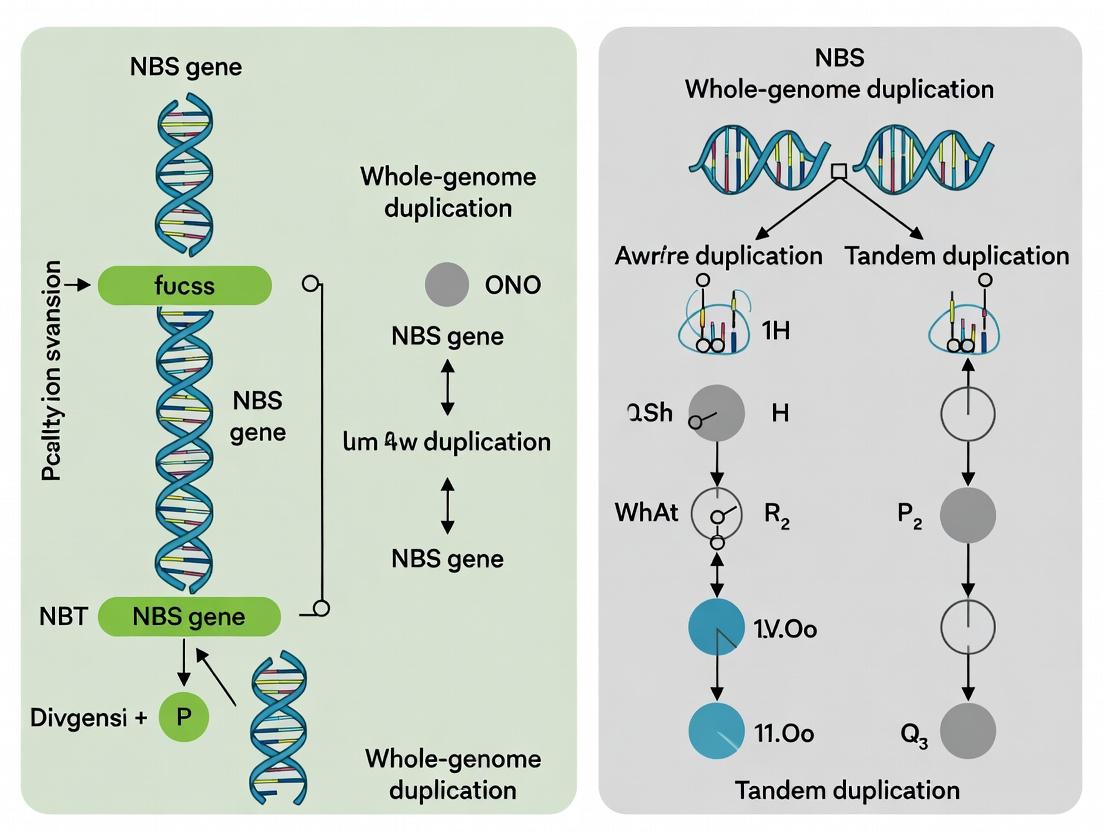
This article provides a comprehensive analysis of NBS (Nucleotide-Binding Site) gene expansion mechanisms, focusing on whole-genome duplication (WGD) and tandem duplication.
Duplicating Defense: How Whole-Genome and Tandem Duplications Expand the NBS Gene Family in Plant Immunity
Abstract
This article provides a comprehensive analysis of NBS (Nucleotide-Binding Site) gene expansion mechanisms, focusing on whole-genome duplication (WGD) and tandem duplication. Targeting researchers, scientists, and drug development professionals, we first explore the foundational role of NBS genes in plant innate immunity and pathogen recognition. We then detail methodologies for identifying and characterizing duplication events, including comparative genomics and bioinformatic pipelines. The article addresses common challenges in data analysis, such as distinguishing between duplication types and annotating complex loci, offering optimization strategies. Finally, we validate findings through cross-species comparisons and discuss the implications of NBS expansion for disease resistance breeding and the development of novel plant protection strategies. This synthesis connects evolutionary genomics with practical applications in agricultural biotechnology.
The NBS Gene Arsenal: Evolutionary Origins and Functional Significance in Plant Immunity
Nucleotide-Binding Site Leucine-Rich Repeat (NBS-LRR) genes constitute the largest and most critical family of plant disease resistance (R) genes. They encode intracellular immune receptors that directly or indirectly perceive pathogen effector proteins, triggering a robust defense response often culminating in the hypersensitive response (HR). The evolution and diversification of this gene family are primarily driven by two mechanisms: whole-genome duplication (WGD) and tandem duplication. WGD events provide raw genetic material, while subsequent tandem duplications and diversifying selection lead to the rapid expansion and functional specialization of NBS-LRR clusters, enabling plants to keep pace with evolving pathogen populations.
Classification, Structure, and Activation Mechanisms
NBS-LRR proteins are classified based on their N-terminal domains:
- TNLs: With a Toll/Interleukin-1 Receptor (TIR) domain. Common in dicots.
- CNLs: With a Coiled-Coil (CC) domain. Found in both monocots and dicots.
- RNLs: A subfamily of CNLs (CC(_{R})-NBS-LRR) that function as helper proteins in signaling.
Core Domain Structure:
- Variable N-terminal Domain (TIR or CC): Involved in signaling initiation.
- Nucleotide-Binding Site (NBS or NB-ARC): Binds ATP/ADP; acts as a molecular switch for activation.
- Leucine-Rich Repeat (LRR): Primary site for effector recognition and autoinhibition.
Activation Models:
- Direct Recognition: Effector binds directly to the LRR domain.
- Indirect Recognition (Guard/Decoy): Effector targets a host protein (the guardee/decoy), and the NBS-LRR monitors this host protein's integrity.
Upon effector perception, a conformational change from ADP-bound (inactive) to ATP-bound (active) state occurs, leading to oligomerization and formation of a resistosome. The TNL resistosome acts as an NADase, while the CNL resistosome forms a calcium-permeable channel.
Quantitative Analysis of NBS-LRR Expansion
Table 1: NBS-LRR Gene Counts and Expansion Mechanisms in Selected Plant Genomes
| Plant Species | Approx. NBS-LRR Count | Predominant Type | Key Genomic Organization | Implicated Major Expansion Mechanism | Reference (Example) |
|---|---|---|---|---|---|
| Arabidopsis thaliana | ~150 | TNL | Dispersed clusters | Tandem Duplication | (Meyers et al., 2003) |
| Oryza sativa (Rice) | ~500 | CNL | Large clusters | Tandem Duplication & Segmental Duplication | (Zhou et al., 2004) |
| Glycine max (Soybean) | ~300-500 | TNL & CNL | Large clusters on multiple chromosomes | Whole-Genome Duplication (Polyploidy) | (Kang et al., 2012) |
| Solanum tuberosum (Potato) | ~400 | CNL | Dense clusters | Rapid Tandem Duplication | (Jupe et al., 2012) |
| Zea mays (Maize) | ~150 | CNL | Small clusters | Tandem Duplication | (Xiao et al., 2007) |
Key Experimental Protocols in NBS-LRR Research
Genome-Wide Identification and Phylogenetic Analysis
Purpose: To catalog and classify NBS-LRR genes, infer evolutionary relationships, and identify expansion patterns. Protocol:
- Sequence Retrieval: Download the proteome/genome of the target species from Phytozome or NCBI.
- HMMER Search: Use hidden Markov model (HMM) profiles (e.g., PF00931 for NBS, PF00560 for TIR, PF13855 for LRR) with
hmmsearch(e-value cutoff: 1e-5) to identify candidate genes. - Domain Validation: Confirm domain architecture using tools like NCBI CD-Search or InterProScan.
- Phylogenetic Tree Construction: Align protein sequences (e.g., NBS domain) using MAFFT or Clustal Omega. Build a maximum-likelihood tree with IQ-TREE or MEGA, using bootstrap analysis (1000 replicates).
- Genomic Location Mapping: Map gene loci to chromosomes using GFF3 annotation files. Identify clusters (genes within 200 kb with no more than 8 non-NBS-LRR genes intervening).
- Synteny & Duplication Analysis: Use MCScanX to analyze collinear blocks and classify genes as tandem, segmental (WGD), or dispersed duplicates.
Functional Validation via Transient Agrobacterium Assays
Purpose: To test specific NBS-LRR/effector pairs for cell death induction. Protocol:
- Cloning: Clone the candidate NBS-LRR gene and the putative cognate effector gene into binary vectors (e.g., pEAQ-HT for expression, with appropriate tags).
- Transformation: Transform constructs into Agrobacterium tumefaciens strain GV3101.
- Infiltration: Grow cultures to OD600=0.5-0.8, resuspend in infiltration buffer (10 mM MES, 10 mM MgCl2, 150 µM acetosyringone). Co-infiltrate NBS-LRR and effector strains (1:1 ratio) into leaves of Nicotiana benthamiana.
- Phenotyping: Monitor infiltrated patches for HR cell death over 2-5 days. Quantify using ion leakage assays or trypan blue staining.
Resistosome Biochemistry (e.g., TNL NADase Activity)
Purpose: To characterize the enzymatic activity of activated NBS-LRR complexes. Protocol:
- Protein Purification: Express and purify recombinant TNL protein (e.g., Arabidopsis RPP1) from insect cells or N. benthamiana.
- In Vitro Activation: Incubate purified TNL with its cognate effector protein (e.g., ATR1) and NAD+ co-factor in reaction buffer.
- Activity Assay: Monitor consumption of NAD+ and production of ADP-ribose (ADPR) or cyclic ADPR (cADPR) using thin-layer chromatography (TLC) or HPLC-MS.
- Complex Analysis: Use size-exclusion chromatography coupled with multi-angle light scattering (SEC-MALS) to determine the oligomeric state of the activated resistosome.
Diagrams
Title: NBS-LRR Effector Recognition Pathways
Title: NBS-LRR Resistosome Activation Workflow
The Scientist's Toolkit: Key Research Reagent Solutions
Table 2: Essential Reagents and Resources for NBS-LRR Research
| Reagent / Resource | Primary Function / Application | Example / Specification |
|---|---|---|
| HMMER Software Suite | Bioinformatics tool for identifying NBS, TIR, LRR domains in protein sequences using profile hidden Markov models. | hmmsearch with PFAM profiles (PF00931, PF00560, PF13855). |
| Binary Vectors (e.g., pEAQ-HT) | High-throughput, high-yield transient expression in plants via Agrobacterium infiltration. | Gateway-compatible, C-terminal tags (HA, GFP, RFP). |
| Agrobacterium tumefaciens GV3101 | Standard disarmed strain for transient transformation of Nicotiana benthamiana. | Contains pMP90 (pTiC58) helper plasmid; Rifamycin resistant. |
| Nicotiana benthamiana | Model plant for transient assays (e.g., co-expression, subcellular localization, protein purification). | Susceptible to Agrobacterium; lacks major NBS-LRRs interfering with assays. |
| NAD+ / cADPR / ADPR Standards | Substrates and analytical standards for measuring TNL resistosome enzymatic activity. | HPLC- or MS-grade for quantifying nucleotide hydrolysis products. |
| Anti-Tag Antibodies (HA, FLAG, GFP) | Immunodetection (Western blot, co-IP) and localization of recombinant NBS-LRR proteins. | High-affinity monoclonal antibodies conjugated to HRP for detection. |
| Trypan Blue Stain | Visualizes dead plant cells to confirm hypersensitive response (HR) phenotype. | 0.4% solution in lactophenol; stains compromised cell membranes. |
| SEC-MALS Columns (e.g., Superose 6) | Size-exclusion chromatography for determining the oligomeric state and molecular weight of protein complexes (e.g., resistosomes). | Coupled with multi-angle light scattering (MALS) detector. |
This overview details the primary molecular mechanisms driving gene family expansion, with a specific focus on nucleotide-binding site-leucine-rich repeat (NBS-LRR) genes, a critical class of plant disease resistance genes. The expansion of these gene families is a cornerstone of adaptive evolution and is central to ongoing research in plant-pathogen co-evolution and potential agricultural and pharmaceutical applications.
Core Duplication Mechanisms
Gene duplication is the primary source of new genetic material. The main mechanisms are:
A. Whole-Genome Duplication (WGD/Polyploidy) An event where an organism's entire genome is duplicated, resulting in polyploidy. This provides massive raw genetic material, with most duplicates eventually being lost (fractionation), but some are retained, often undergoing subfunctionalization or neofunctionalization. WGD events are prevalent in plant lineages and are strongly correlated with bursts of NBS-LRR gene expansion.
B. Tandem Duplication The duplication of a DNA segment containing one or more genes in a head-to-tail or head-to-head fashion, typically via unequal crossing over or replication slippage. This mechanism creates arrays of closely related paralogs and is a major driver for rapid, local expansion of gene families like NBS-LRRs, allowing for high sequence diversity and adaptation to specific pathogens.
C. Retrotransposition (Retroduplication) An mRNA is reverse-transcribed and integrated back into the genome, creating a processed pseudogene or, rarely, a functional retrogene. These copies are intron-less and lack native regulatory sequences. While less common for large, complex genes like NBS-LRRs, it contributes to dispersal across the genome.
D. Segmental Duplication Duplication of large chromosomal blocks (1-200 kb), often through non-allelic homologous recombination (NAHR). It occupies an intermediate scale between WGD and tandem duplication and can copy multiple linked genes simultaneously.
E. Transposon-Mediated Duplication DNA transposons can capture and mobilize gene fragments or entire genes, leading to their dispersal to new genomic locations.
Table 1: Comparative Analysis of Key Duplication Mechanisms
| Mechanism | Typical Scale | Primary Molecular Process | Key Features for NBS-LRR Genes | Fate of Duplicates |
|---|---|---|---|---|
| Whole-Genome Duplication | Entire Genome | Non-disjunction, polyspermy | Provides substrate for large-scale expansion; duplicates are dispersed genome-wide. | High fractionation rate; retained copies may sub-/neo-functionalize. |
| Tandem Duplication | 1 - 200 kbp | Unequal crossing over, replication slippage | Primary driver of rapid, local cluster formation; enables "birth-and-death" evolution. | High turnover; frequent homologous recombination. |
| Segmental Duplication | 10 kbp - 5 Mbp | Non-allelic homologous recombination (NAHR) | Can duplicate small NBS-LRR clusters; creates copy number variation. | Can be stable or undergo further rearrangement. |
| Retrotransposition | Single Gene (processed) | Reverse transcription & integration | Rare for full-length NBS-LRR due to size/complexity; may create non-functional copies. | Often degenerates into pseudogenes; rare neofunctionalization. |
Experimental Methodologies for Studying Duplication Events
Protocol 1: Identifying Tandem Duplication Clusters
- Objective: To identify and characterize tandem arrays of NBS-LRR genes within a genome assembly.
- Steps:
- Sequence Retrieval: Extract all predicted NBS-LRR protein sequences from the genome annotation using conserved Pfam domains (NB-ARC: PF00931; LRR: PF00560, PF07723, PF07725, PF12799, PF13306, PF13516).
- All-vs-All BLASTP: Perform a BLASTP search of all sequences against each other with an E-value cutoff of 1e-10.
- Synteny and Physical Mapping: Map the genomic coordinates of all genes. Define a tandem cluster as ≥2 NBS-LRR genes of the same phylogenetic clade located within 200 kb, with no more than one non-NBS gene interrupting the array.
- Phylogenetic Analysis: Construct a neighbor-joining or maximum-likelihood tree of the proteins within a cluster to infer recent duplication events.
Protocol 2: Detecting Ancient Whole-Genome Duplications
- Objective: To infer historical WGD events using synonymous substitution rate (Ks) analysis.
- Steps:
- Paralog Pair Identification: Identify intra-genomic paralog pairs from a whole-proteome all-vs-all BLAST, filtered for alignment coverage >70%.
- Ks Calculation: Align coding sequences (CDS) of each pair using PRANK or MAFFT. Calculate the number of synonymous substitutions per synonymous site (Ks) using the CodeML program in PAML or KaKs_Calculator, applying the Yang-Nielsen model.
- Ks Distribution Plotting: Create a histogram of Ks values for all paralog pairs.
- Peak Identification: Significant peaks in the Ks distribution indicate periods of mass duplication. A large peak at low Ks (~0.1-0.3) suggests a recent WGD, while a peak at higher Ks suggests an older event.
Protocol 3: Analyzing Gene Conversion in Tandem Arrays
- Objective: To detect gene conversion events that homogenize sequences in NBS-LRR clusters.
- Steps:
- Multiple Sequence Alignment: Generate a high-quality nucleotide alignment of a tandem cluster using MUSCLE or CLUSTALW.
- Sliding Window Analysis: Use software like GENECONV or RDP5 to scan aligned sequences for regions of exceptionally high similarity relative to flanking regions.
- Statistical Testing: Calculate pairwise mismatch distributions and perform statistical tests (e.g., Sawyer's test) to identify significantly conserved tracts indicative of gene conversion.
- Phylogenetic Incongruence: Construct phylogenetic trees for the converted region versus flanking regions; topological discordance supports a conversion event.
Diagram 1: Gene Duplication Detection Workflow
Diagram 2: NBS-LRR Expansion via Tandem & WGD
The Scientist's Toolkit: Research Reagent Solutions
| Item/Reagent | Function/Application in Duplication Research |
|---|---|
| High-Quality Genome Assembly (PacBio HiFi, Oxford Nanopore, Hi-C) | Provides the contiguous chromosomal-scale reference essential for accurately mapping gene order, identifying tandem arrays, and distinguishing true duplications from assembly artifacts. |
| Pfam HMM Profiles (NB-ARC: PF00931, LRR profiles) | Curated hidden Markov models used for sensitive, domain-based identification of NBS-LRR family members across diverse genomes. |
| BLAST+ Suite & DIAMOND | For fast all-vs-all sequence similarity searches to identify paralogs within a genome (BLASTP) or across species. DIAMOND enables ultra-fast searches of large datasets. |
| BioPython/BioPerl Toolkits | Programming libraries for automating genomic coordinate manipulation, sequence extraction, parsing BLAST results, and building analysis pipelines. |
| PAML (CodeML) / KaKs_Calculator | Software packages for calculating synonymous (Ks) and non-synonymous (Ka) substitution rates, crucial for dating duplication events and inferring selection pressure. |
| MUSCLE/MAFFT/PRANK | Multiple sequence alignment software. PRANK is preferred for phylogenetic analysis as it models insertion/deletion events more accurately. |
| Gene Conversion Detection Software (GENECONV, RDP5) | Specialized programs for statistically identifying gene conversion events within aligned sequences of paralogs. |
| Phylogenetic Software (IQ-TREE, RAxML, MEGA) | For constructing gene trees to infer orthology/paralogy relationships and visualize the evolutionary history of duplicated genes. |
| Syntery Visualization Tools (JCVI, SynVisio) | For graphically comparing genomic regions across species or paralogous regions within a genome to identify WGD-derived syntenic blocks and rearrangements. |
Quantitative Insights into NBS-LRR Expansion
Table 3: Exemplary Data from Plant NBS-LRR Gene Family Studies
| Plant Species | Estimated Total NBS-LRR Genes | % in Tandem Clusters | Major Expansion Driver(s) | Key Reference Insights |
|---|---|---|---|---|
| Arabidopsis thaliana | ~200 | ~70% | Tandem Duplication | Model for "birth-and-death" evolution; clusters show high sequence diversity and frequent rearrangements. |
| Oryza sativa (Rice) | ~500 | >75% | Tandem Duplication & WGD | Significant expansion linked to tandem events post-ancient WGD; clusters are often lineage-specific. |
| Glycine max (Soybean) | ~500-700 | ~60% | Whole-Genome Duplication (Palaeopolyploidy) | Two ancient WGD events provided substrate; many retained NBS-LRRs reside in syntenic blocks. |
| Solanum lycopersicum (Tomato) | ~350 | ~85% | Tandem Duplication | Extremely high clustering rate; rapid turnover in clusters linked to pathogen pressure. |
| Zea mays (Maize) | ~150-200 | ~50% | Segmental & Tandem | Lower count attributed to a high fractionation rate post-WGD, but remaining genes are often in clusters. |
Whole-genome duplication (WGD), or polyploidy, is a pivotal evolutionary force that generates massive genetic redundancy. Within the specific thesis context of NBS (Nucleotide-Binding Site) gene expansion, WGD serves as a primary macro-evolutionary mechanism, complementing tandem duplication. NBS genes, key components of plant disease resistance (R) genes, often form large, diverse families. Studying their expansion through WGD provides insights into the birth-and-death evolution of multigene families, offering a framework for understanding genomic innovation and the reservoir of genetic material for novel trait development, including drug targets.
Mechanisms and Evolutionary Consequences of WGD
WGD results in an organism possessing multiple complete sets of chromosomes. This event provides raw material for evolution through:
- Genetic Redundancy: Immediate duplication of all genes buffers against deleterious mutations.
- Neofunctionalization: One copy retains the original function while the other acquires a new one.
- Subfunctionalization: The original functions are partitioned between the two copies.
- Gene Loss (Fractionation): Non-random loss of duplicated genes, often creating a dominant subgenome.
For NBS-encoding genes, WGD events (e.g., in Brassica, Glycine) have created large, duplicated blocks harboring paralogous NBS genes, which subsequently undergo divergent selective pressures compared to tandemly duplicated clusters.
Quantitative Data on WGD and NBS Gene Dynamics
Table 1: Impact of Documented WGD Events on NBS Gene Repertoire in Selected Plant Species
| Species | Common Name | WGD Event (Mya) | Approx. Total NBS Genes Post-WGD | % of NBS Genes in WGD-derived Blocks | Key Reference (Example) |
|---|---|---|---|---|---|
| Glycine max | Soybean | ~13 (Legume WGD) | >500 | ~60% | Schmutz et al., 2010 |
| Brassica napus | Rapeseed | ~0.015 (Allopolyploidy) | ~450 | ~70% | Chalhoub et al., 2014 |
| Arabidopsis thaliana | Thale cress | α, β, γ events | ~200 | ~35% (post-fractionation) | Mondragón-Palomino et al., 2009 |
| Oryza sativa | Rice | τ event | ~500 | ~50% | Goff et al., 2002 |
Table 2: Comparative Features of NBS Gene Expansion via WGD vs. Tandem Duplication
| Feature | WGD-driven Expansion | Tandem Duplication-driven Expansion |
|---|---|---|
| Genomic Scale | Whole genome / Large segments | Localized, single locus |
| Gene Context | Duplicates entire gene neighborhoods (synteny) | Isolated gene clusters |
| Initial Functional Fate | Redundancy, complete copy | Potential for immediate unequal crossing over |
| Evolutionary Rate | Often slower, higher retention initially | Faster, birth-and-death dynamics pronounced |
| Impact on NBS Diversity | Provides raw material for long-term divergence | Rapid generation of sequence variants |
Experimental Protocols for Investigating WGD-Derived NBS Genes
Protocol 1: Identifying WGD-Derived NBS Genes via Synteny Analysis
- Data Acquisition: Obtain genome assembly and annotation files (GFF3/GTF) for the target and a related non-WGD outgroup species.
- NBS Gene Identification: Use HMMER (with NB-ARC domain PF00931) or RGAugury pipeline to identify all NBS-encoding genes.
- Whole-Genome Syntery Detection: Use MCScanX (python version: jcvi) with all protein sequences. Run
python -m jcvi.graphics.syntenywith appropriate parameters to identify collinear blocks. - Paralog Classification: Within collinear blocks, extract gene pairs. Classify NBS genes located within systemic blocks as WGD-derived paralogs (ohnologs).
- Dating Duplication: Calculate Ks (synonymous substitution rate) for each systemic NBS pair using PAML (yn00) or KaKs_Calculator. Plot Ks distribution to associate peaks with known WGD events.
Protocol 2: Functional Divergence Analysis of WGD-Duplicated NBS Genes
- Sequence Alignment: Perform multiple sequence alignment of ohnolog pairs/clusters using MAFFT or Clustal Omega.
- Selection Pressure Test: For each ohnolog pair, calculate non-synonymous (Ka) and synonymous (Ks) rates. Perform a branch-site likelihood ratio test (in PAML) to detect signatures of positive selection.
- Expression Profiling: Analyze RNA-seq data (from databases like SRA) for tissue-specific and pathogen-induced expression of NBS ohnologs using a pipeline (HISAT2, StringTie, Ballgown). Test for expression divergence (subfunctionalization).
- VIGS-based Functional Screening: Use Virus-Induced Gene Silencing (VIGS) constructs targeting each ohnolog individually and in combination in a model plant (e.g., N. benthamiana). Challenge with relevant pathogens and quantify susceptibility phenotypes to assess functional redundancy/divergence.
Visualizations: Pathways and Workflows
Diagram 1: WGD-Derived NBS Gene Analysis Workflow (92 chars)
Diagram 2: NBS Gene Expansion via WGD and Tandem Duplication (99 chars)
The Scientist's Toolkit: Research Reagent Solutions
Table 3: Essential Reagents & Tools for WGD/NBS Gene Research
| Item/Category | Function & Application in WGD/NBS Research | Example Product/Resource |
|---|---|---|
| HMMER Suite | Profile HMM-based search for identifying NBS-encoding genes (NB-ARC domain PF00931) in genomic/proteomic data. | http://hmmer.org/ |
| MCScanX / JCVI | Tool for genome-wide synteny and collinearity analysis to detect WGD-derived systemic blocks. | https://github.com/tanghaibao/jcvi |
| PAML (CodeML) | Phylogenetic Analysis by Maximum Likelihood; used for calculating Ka/Ks ratios and testing selection pressure on ohnologs. | http://abacus.gene.ucl.ac.uk/software/paml.html |
| TRV-based VIGS Vectors | Virus-Induced Gene Silencing vectors (e.g., pTRV1/pTRV2) for functional validation of duplicated NBS genes in plants. | pTRV1/pTRV2 (Arabidopsis Resource Center) |
| Phusion HF DNA Polymerase | High-fidelity PCR enzyme for cloning NBS gene fragments (full-length or for VIGS construct creation). | Thermo Scientific #F530 |
| RNA-seq Library Prep Kits | For generating expression profiles of NBS ohnologs under control and treated conditions. | Illumina TruSeq Stranded mRNA |
| SynTReys Database | A curated public database of phylogenies of genes derived from WGDs across eukaryotes, useful for comparative studies. | https://synthreysdb.genouest.org/ |
The expansion of Nucleotide-Binding Site Leucine-Rich Repeat (NBS-LRR) genes is a cornerstone of plant immune system evolution. This whitepaper situates tandem duplication (TD) within the broader genomic mechanisms driving this expansion. While whole-genome duplication (WGD) provides raw genetic material and broad-scale redundancy, tandem duplication acts as a rapid, adaptive engine for local amplification of specific disease resistance (R) loci. This targeted amplification enables the generation of diverse allelic series and novel resistance specificities, allowing populations to keep pace with evolving pathogens. The synergy between WGD's macro-evolutionary framework and TD's micro-evolutionary agility is critical for understanding the dynamic architecture of plant immunity.
Mechanisms and Comparative Genomics of Duplication
Molecular Mechanisms of Tandem Duplication
Tandem duplications arise from mechanisms that generate adjacent, head-to-tail repeats of genomic segments. Key processes include:
- Replication-Based Mechanisms: Fork stalling and template switching (FoSTeS) or microhomology-mediated break-induced replication (MMBIR) can cause localized re-replication of DNA segments.
- Non-Allelic Homologous Recombination (NAHR): Unequal crossing-over between misaligned repetitive sequences (e.g., transposable elements) on sister chromatids or homologous chromosomes.
- DNA Repair Errors: Incorrect repair of double-strand breaks via non-homologous end joining (NHEJ) can fuse duplicated segments.
These mechanisms contrast with WGD, which results from errors in meiosis or mitosis (e.g., polyploidization), duplicating the entire genome.
Quantitative Comparison: WGD vs. Tandem Duplication in R-Gene Evolution
The table below summarizes the distinct and complementary roles of these two duplication modes.
Table 1: Comparative Impact of Whole-Genome and Tandem Duplication on R-Gene Evolution
| Feature | Whole-Genome Duplication (WGD) | Tandem Duplication (TD) |
|---|---|---|
| Genomic Scale | Entire genome | Localized (1-10s of genes) |
| Evolutionary Rate | Episodic, rare events | Continuous, frequent events |
| Primary Driver | Macrosynthesis, speciation | Rapid adaptation, diversifying selection |
| Impact on R-Genes | Creates large, redundant paralogous blocks; provides substrate for neofunctionalization. | Creates tightly linked gene clusters; enables rapid generation of novel specificities via sequence divergence. |
| Typical Fate of Copies | Fractionation and gene loss; some retained for sub/neofunctionalization. | Retained under positive selection; high sequence turnover within clusters. |
| Key Evidence | Syntenic blocks across species, karyotype analysis. | Dense, phylogenetically related gene arrays with sequence heterogeneity. |
Experimental Analysis of Tandemly Duplicated R-Loci
Protocol: Identification and Characterization of Tandem Clusters
Objective: To identify, annotate, and analyze tandemly duplicated NBS-LRR genes from a plant genome assembly.
Materials & Workflow:
- Genomic Data: High-quality, chromosome-level genome assembly and annotation file (GFF3/GTF).
- NBS-LRR Domain Identification: Use HMMER (with PFAM models PF00931, PF00560, PF07723, PF12799, PF13306) or RGAugury pipeline to scan the proteome.
- Tandem Cluster Definition: Use MCScanX or custom scripts to identify genes of the same family (NBS-LRR) located within a defined genomic window (e.g., ≤ 10 intervening genes).
- Sequence Alignment & Phylogeny: Generate multiple sequence alignments (Clustal Omega, MAFFT) and construct neighbor-joining or maximum-likelihood trees (MEGA, IQ-TREE) to infer duplication history.
- Selection Pressure Analysis: Calculate non-synonymous to synonymous substitution rates (dN/dS, ω) using PAML's codeml (site/branch-site models) to test for positive selection.
- Expression Analysis: Map RNA-seq reads (Hisat2, STAR) to the genome and quantify expression (StringTie, featureCounts) across clusters.
Title: Workflow for Tandem R-Gene Cluster Analysis
Protocol: Functional Validation Using CRISPR-Cas9
Objective: To validate the functional redundancy or specificity of genes within a tandemly duplicated R-gene cluster.
Materials & Workflow:
- sgRNA Design: Design 2-3 sgRNAs targeting conserved exonic regions shared across the tandem cluster. Use tools like CHOPCHOP.
- Vector Construction: Clone sgRNAs into a plant CRISPR-Cas9 binary vector (e.g., pHEE401E for Arabidopsis).
- Plant Transformation: Transform the construct into the target plant via Agrobacterium-mediated transformation.
- Genotype Screening: Use PCR and sequencing across the target locus to identify deletion/editing events. Long-read sequencing (PacBio, Nanopore) is ideal for resolving complex haplotypes.
- Phenotype Assay: Inoculate edited T1/T2 plants with cognate avirulent pathogens and quantify disease symptoms (lesion size, pathogen biomass via qPCR).
- Transcript Analysis: Perform RT-qPCR on flanking genes in the cluster to check for compensatory regulation.
The Scientist's Toolkit: Research Reagent Solutions
Table 2: Essential Reagents for Tandem Duplication Research in R-Genes
| Reagent / Material | Function in Research | Example / Specification |
|---|---|---|
| High-Molecular-Weight DNA Kit | Extraction of ultra-pure DNA for long-read sequencing to resolve repetitive cluster regions. | PacBio SMRTbell Prep Kit, Nanobind CBB Big DNA Kit. |
| Long-Read Sequencing Platform | Generate reads spanning entire tandem arrays for accurate assembly and haplotyping. | PacBio Revio, Oxford Nanopore PromethION. |
| NBS-LRR Specific HMM Profiles | Hidden Markov Models for sensitive in silico identification of resistance gene candidates. | PFAM PF00931 (NB-ARC), PF12799 (TIR), PF13306 (LRR). |
| Plant CRISPR-Cas9 Vector | For multiplexed knockout of redundant tandem genes to test function. | pHEE401E (Polycistronic tRNA-gRNA), pRGEB32 (Golden Gate). |
| Pathogen Isolates | Avirulent and virulent strains for phenotyping edited plant lines. | Defined by specific Avr genes matching the targeted R-genes. |
| dN/dS Analysis Software | Statistical detection of positive selection acting on duplicated paralogs. | PAML (codeml), HyPhy (FUBAR, MEME). |
| Synteny Visualization Tool | Comparative genomics to distinguish TD from WGD-derived paralogs. | JCVI (McScan), SynVisio, Circos. |
Signaling Pathways in Tandem-Duplicated NBS-LRR Networks
Tandemly duplicated NBS-LRRs often exhibit functional specialization within immune signaling networks.
Title: Immune Signaling in a Tandem R-Gene Cluster
Data Synthesis: Case Studies in Key Crops
Recent studies highlight the prevalence and adaptive significance of tandemly amplified R-loci.
Table 3: Documented Tandem Duplications of R-Genes in Major Crops
| Crop Species | R-Gene Locus / Family | Estimated Copy Number (Tandem) | Pathogen Target | Key Evidence | Reference (Year) |
|---|---|---|---|---|---|
| Rice (Oryza sativa) | Pi2/9 locus (NBS-LRR) | 7-19 copies per haplotype | Magnaporthe oryzae (Blight) | Haplotype-specific copy number variation correlates with resistance. | Deng et al. (2017) |
| Soybean (Glycine max) | Rpp locus (TIR-NBS-LRR) | 5-15 copies clustered | Phakopsora pachyrhizi (Rust) | Rapid evolution of new specificities via TD and recombination. | Chagné et al. (2023) |
| Wheat (Triticum aestivum) | Pm2 locus (CC-NBS-LRR) | 3-8 paralogous copies | Blumeria graminis (Powdery Mildew) | Complex array of functional and pseudogenized copies. | Sánchez-Martín et al. (2021) |
| Maize (Zea mays) | Rxo1 locus (NBS-LRR) | ~6 tandem copies | Burkholderia andropogonis | Recent, lineage-specific expansions. | Zhao et al. (2022) |
Tandem duplication is a fundamental and agile genetic mechanism for the rapid expansion and diversification of disease resistance loci. Its role, complementary to WGD, provides a powerful model for understanding how plants adapt to pathogen pressure at the molecular level. Future research leveraging pan-genomics, long-read sequencing, and genome editing will further elucidate the rules governing the birth, evolution, and functional coordination of genes within these dynamic clusters. For drug development professionals, understanding these natural amplification mechanisms can inform strategies for engineering durable, broad-spectrum resistance in crops and potentially inspire analogous approaches in managing genetic disease in other systems.
Within the broader thesis on nucleotide-binding site (NBS) gene expansion through whole-genome and tandem duplication, this analysis provides a comparative framework across major plant lineages. NBS-encoding genes form the largest class of plant disease resistance (R) genes, and their expansion patterns are critical for understanding plant-pathogen co-evolution and for informing synthetic biology approaches in crop protection.
Quantitative Expansion Patterns Across Lineages
Recent comparative genomic analyses (2023-2024) quantify NBS-LRR (NLR) repertoires, revealing lineage-specific expansion mechanisms.
Table 1: NBS-LRR Gene Counts and Expansion Patterns in Representative Plant Genomes
| Lineage / Species | Total NLR Genes | Tandem Duplication Clusters | % Genes in Tandem | Predominant NBS Type (TNL/CNL) | Notable Whole-Genome Duplication (WGD) Event Contributing to Expansion |
|---|---|---|---|---|---|
| Eudicots | |||||
| Arabidopsis thaliana | ~165 | 22 | ~55% | CNL | At-α, At-β |
| Glycine max (Soybean) | ~755 | 112 | ~70% | CNL | Recent WGD (~13 Mya) |
| Monocots | |||||
| Oryza sativa (Rice) | ~500 | 89 | ~65% | CNL (TNL absent) | None recent |
| Zea mays (Maize) | ~195 | 45 | ~75% | CNL | Ancient WGD |
| Basal Angiosperms | |||||
| Amborella trichopoda | ~125 | 15 | ~40% | Balanced TNL/CNL | None |
| Gymnosperms | |||||
| Picea abies (Spruce) | ~450 | 30 | ~25% | TNL-dominated | None (Expansion via dispersed duplications) |
Table 2: Key Genomic Features Correlated with NBS Expansion
| Feature | Correlation with NLR Expansion | Method of Analysis | Representative Reference (2024) |
|---|---|---|---|
| Tandem Repeat Density | Strong Positive (r=0.87) | Linear Regression on 50 plant genomes | Li et al., 2024 |
| Recent WGD History | Moderate Positive | Phylogenetic Reconciliation | Wang & Xu, 2023 |
| Genome Size | Weak Positive (r=0.45) | Pearson Correlation | Singh et al., 2023 |
| Transposable Element Proximity | Strong Positive | Hi-C & NLR Locality Analysis | Castro et al., 2024 |
Core Experimental Protocols for NBS Expansion Analysis
Protocol 1: Genome-Wide Identification and Classification of NLR Genes
Principle: Use integrated HMM profiles and sequence motifs to identify NBS domains, then classify into TNL (TIR-NBS-LRR) or CNL (CC-NBS-LRR). Steps:
- Data Retrieval: Download proteome and genome assembly (FASTA, GFF3) from Phytozome/NCBI.
- Domain Scanning: Scan proteome using
hmmsearch(HMMER v3.3) against Pfam profiles: NB-ARC (PF00931), TIR (PF01582), RPW8/CC (PF05659), LRR (PF00560, PF07723, PF07725). E-value threshold < 1e-5. - Gene Classification: Classify genes as:
- TNL: Possess TIR and NB-ARC.
- CNL: Possess RPW8/CC or coiled-coil prediction (via ncoils) and NB-ARC.
- RNL/helper: RPW8-NB-ARC-LRR (often required for TNL signaling).
- N-only: NB-ARC only.
- Validation: Manually check gene models using transcriptomic support (RNA-seq BAM files) in a genome browser (e.g., IGV).
Protocol 2: Determining Duplication Mechanisms (Tandem vs. WGD)
Principle: Use synteny analysis and local genomic clustering to assign expansion mechanisms. Steps:
- Tandem Duplication Identification: Define a tandem cluster as ≥2 NLR genes within a 200-kb genomic window with no intervening non-NLR gene.
- Whole-Genome Duplication Analysis:
- Perform all-vs-all whole-genome alignment using MCScanX.
- Identify syntenic blocks using default parameters.
- Map NLR genes onto syntenic blocks. Genes located in corresponding positions of duplicated blocks are considered WGD-derived.
- Dating Duplications: Calculate Ks (synonymous substitution rate) for paralog pairs within tandem clusters and syntenic blocks using
KaKs_Calculator. Compare Ks distributions to known WGD event peaks.
Protocol 3: Evolutionary Dynamics Analysis (Positive Selection)
Principle: Detect sites under positive selection in NBS domains, indicative of arms-race co-evolution. Steps:
- Alignment & Phylogeny: Generate multiple sequence alignments (MAFFT) of NBS domains from a defined cluster. Construct a maximum-likelihood tree (IQ-TREE).
- Selection Tests: Use the CodeML module in PAML to compare site-specific models:
- Null model (M7): β-distribution for ω (dN/dS) between 0 and 1.
- Alternative model (M8): allows for ω > 1.
- Statistical Significance: Apply likelihood ratio test (LRT). Sites with posterior probability >0.95 under M8 are considered under positive selection. Visualize sites on a protein structure model if available.
Visualizations
Title: NLR Identification and Expansion Analysis Workflow
Title: Core NLR-Mediated Immune Signaling Pathway
The Scientist's Toolkit: Key Research Reagent Solutions
Table 3: Essential Reagents and Resources for NBS Expansion Research
| Item/Category | Function/Description | Example Product/Resource |
|---|---|---|
| Curated HMM Profiles | Hidden Markov Models for sensitive domain detection of NB-ARC, TIR, LRR, etc. | Pfam database; NLR-Annotator pre-built profiles. |
| Plant Genome Databases | Source of high-quality, annotated genome assemblies and proteomes. | Phytozome v13, Ensembl Plants, NCBI Genome. |
| Synteny Analysis Toolkit | Identifies genomic blocks derived from WGD or segmental duplication. | JCVI (MCScanX), SynMap (CoGe platform). |
| Positive Selection Analysis Software | Calculates dN/dS ratios to identify residues under diversifying selection. | PAML CodeML, HyPhy. |
| NLR Sequence Classification Pipeline | Automated annotation and classification of NLR genes from genomes. | NLR-Parser, NLR-Annotator, DRAGO2. |
| Coiled-Coil Prediction Tool | Distinguishes CNL proteins from TNLs based on N-terminal structure. | ncoils, DeepCoil. |
| Comparative Genomics Platform | Web-based platform for multi-species genome comparison and visualization. | CoGe, PLAZA. |
| Plant Transformation Kit (for Validation) | For functional validation of NLR expansion candidates via transgenic complementation. | Agrobacterium GV3101, Golden Gate cloning kits for plant R genes. |
Mapping the Expansion: Techniques for Identifying and Analyzing NBS Duplication Events
Bioinformatics Pipelines for Genome-Wide NBS Gene Identification (HMMER, RGAugury)
This technical guide details integrated bioinformatics pipelines for the genome-wide identification of Nucleotide-Binding Site (NBS) genes, a major class of plant disease resistance (R) genes. Framed within a thesis investigating NBS gene expansion via whole-genome and tandem duplication events, the protocols provide a robust framework for researchers and drug development professionals to catalog and characterize these critical genetic elements. The integration of HMMER-based homology searches with the RGAugury automated prediction suite offers a comprehensive, reproducible approach for mining increasingly complex plant genomes.
NBS-LRR genes constitute one of the largest and most dynamic gene families in plant genomes. Their expansion, primarily driven by whole-genome duplication (WGD) and tandem duplication, is a cornerstone of plant adaptive evolution, providing a reservoir for novel disease resistance specificities. Systematic identification of these genes across entire genomes is the critical first step for studying their evolutionary history, functional diversification, and potential application in breeding and drug discovery (e.g., elicitor-based therapeutics).
Core Computational Pipeline Architecture
The standard pipeline involves two complementary, sequential phases: 1) Primary identification using curated hidden Markov models (HMMs), and 2) Functional annotation and classification using an integrated tool like RGAugury.
Phase 1: HMMER-Based Identification
This phase uses the HMMER software suite to scan the proteome for domains characteristic of NBS genes.
Experimental Protocol:
- Data Acquisition: Obtain the complete proteome file (FASTA format) of the target organism from repositories like Phytozome, NCBI, or EnsemblPlants.
- HMM Profile Selection: Download the latest curated HMM profiles for NBS domains. Key profiles include:
NB-ARC(PF00931) from Pfam.TIR(PF01582) for TIR-NBS-LRR (TNL) genes.CC(Coiled-coil) profiles (e.g., PF13855) for CC-NBS-LRR (CNL) genes.
- HMMER Scan Execution:
- Result Parsing: Extract sequences with significant hits (E-value < 1e-5 is commonly used). Use custom scripts or bioinformatics toolkits (Biopython) to merge results and remove redundant hits from the same gene model.
Phase 2: RGAugury for Classification and Prediction
RGAugury is a machine learning-based pipeline that classifies R genes and predicts their integrated domains.
Experimental Protocol:
- Input Preparation: Compile the candidate protein sequences from Phase 1 into a single FASTA file.
- Pipeline Execution:
- Output Analysis: RGAugury generates multiple output files, including:
*.TMCC.candidate.list: CNL genes.*.TMTIR.candidate.list: TNL genes.*.NBS.candidate.list: NBS genes lacking typical N-terminal domains.*.RLP.list&*.RLK.list: Receptor-like proteins/kinases.
Data Integration for Duplication Analysis
Identifying the mode of gene expansion requires integrating identification results with genomic location data.
Experimental Protocol for Tandem Duplication Detection:
- Extract Genomic Coordinates: From the genome annotation file (GFF3/GTF), obtain the chromosome, start, and end positions for all identified NBS genes.
- Define Tandem Duplicates: Apply standard criteria: genes of the same subtype (e.g., CNL) located within a defined genomic distance (typically ≤ 10 intervening genes and/or ≤ 100 kb) on the same chromosome.
- Identify WGD-Derived Duplicates: Use synteny analysis tools (e.g., MCScanX) to identify systemic blocks within the genome. NBS gene pairs located in systemic blocks are putative WGD-derived duplicates.
Visualized Workflows and Pathways
Diagram 1: NBS Gene Identification Pipeline
Diagram 2: NBS-LRR Gene Structure & Signaling
Key Research Reagent Solutions
| Reagent / Resource | Function in NBS Gene Research | Typical Source / Example |
|---|---|---|
| Curated HMM Profiles (NB-ARC, TIR, CC) | Core mathematical models for identifying conserved protein domains in primary sequence data. | Pfam database, TAIR published model sets. |
| Reference Proteome (FASTA) | The complete set of predicted protein sequences for the organism under study; the search space for HMMER. | Phytozome, NCBI RefSeq, EnsemblPlants. |
| Genome Annotation (GFF3/GTF) | File containing genomic coordinates and structure of genes; essential for mapping gene location and duplication analysis. | Same as reference proteome sources. |
| RGAugury Software Package | Integrated pipeline for automated classification of R genes and prediction of additional domains. | GitHub repository (RGAugury). |
| MCScanX Software | Tool for genome collinearity (synteny) analysis; critical for identifying whole-genome duplication events. | Academic distribution (e.g., from GitHub). |
| Biopython / Custom Perl Scripts | For parsing intermediate file formats (HMMER tblout, RGAugury lists), filtering results, and integrating data streams. | Public repositories (Biopython) or custom code. |
Table 1: Typical NBS Gene Family Size in Model Plant Genomes
| Plant Species | Estimated Total NBS Genes | CNL Subtype | TNL Subtype | Reference (Example) |
|---|---|---|---|---|
| Arabidopsis thaliana | ~150 | ~55 | ~95 | Meyers et al., 2003 |
| Oryza sativa (Rice) | ~500 | ~450 | ~1 | Zhou et al., 2004 |
| Zea mays (Maize) | ~120 | ~100 | ~7 | Xiao et al., 2004 |
| Glycine max (Soybean) | ~500+ | ~300 | ~200 | Kang et al., 2012 |
Table 2: Common HMMER Parameters for NBS Identification
| Parameter | Value | Purpose / Rationale |
|---|---|---|
| E-value cutoff (domain) | 1e-5 to 1e-10 | Balances sensitivity and specificity for distant homologs. |
| Sequence E-value | 0.01 | Filters overall sequence significance. |
| Bit Score | Profile-specific | More stable than E-value; consult model for thresholds. |
| CPU cores | 4-16 | Speeds up genome-scale searches through parallelization. |
The combined HMMER and RGAugury pipeline provides a standardized, high-throughput method for cataloging NBS genes, forming the essential data foundation for subsequent evolutionary analysis. By precisely identifying gene family members and categorizing them into subtypes, researchers can effectively investigate patterns of expansion through tandem and whole-genome duplication. This systematic approach is indispensable for linking genomic architecture to the evolution of plant immune capacity, with downstream implications for understanding plant-pathogen co-evolution and developing durable resistance strategies in agriculture and beyond.
Nucleotide-binding site-leucine-rich repeat (NBS-LRR) genes constitute a primary plant disease resistance (R) gene family. Their expansion in plant genomes is primarily driven by two evolutionary mechanisms: Whole-Genome Duplication (WGD) and Tandem Duplication (TD). Distinguishing between these origins is critical for understanding plant-pathogen co-evolution and for leveraging R-genes in crop improvement. This technical guide outlines integrated methodologies for differentiating WGD-derived from tandem-duplicated NBS genes, framed within the context of elucidating the evolutionary dynamics of NBS gene family expansion.
Core Concepts and Definitions
- NBS-LRR Genes: A major class of intracellular immune receptors in plants, characterized by a conserved nucleotide-binding site (NBS) and a leucine-rich repeat (LRR) domain.
- Whole-Genome Duplication (WGD): A polyploidization event that duplicates the entire genome, generating multiple syntenic blocks (ohnologs) across the genome.
- Tandem Duplication (TD): The sequential duplication of a DNA segment in close proximity on the same chromosome, leading to gene clusters.
Synteny Analysis for Identifying WGD-Derived Genes
Synteny analysis identifies conserved gene order across genomic regions, providing the primary evidence for WGD events.
Experimental Protocol: Synteny Network Construction
- Data Acquisition: Download genomic data (GFF3/GTF annotation files and nucleotide/protein FASTA files) for the target species and a closely related outgroup from Ensembl Plants or Phytozome.
- Homolog Identification: Perform an all-vs-all protein sequence alignment using BLASTP (E-value < 1e-10). Use MCScanX (
python -m jcvi.compara.catalog ortholog) to identify homologous gene pairs. - Synteny Block Detection: Run MCScanX with default parameters to identify collinear blocks (minimum of 5 gene pairs per block).
- Visualization: Generate synteny diagrams using the
JCVIgraphics library orCircosto visualize collinear blocks harboring NBS genes.
Data Interpretation
- WGD Signature: NBS gene pairs located in the middle of large, well-conserved collinear blocks spanning multiple chromosomes.
- TD Signature: Multiple NBS genes clustered within a single locus, with no collinearity to other genomic regions beyond the cluster itself.
Table 1: Key Characteristics of WGD vs. Tandem-Duplicated NBS Genes
| Feature | WGD-Derived NBS Genes | Tandem-Duplicated NBS Genes |
|---|---|---|
| Genomic Distribution | Dispersed across syntenic blocks on different chromosomes/segments | Clustered in arrays on a single chromosome |
| Syntenic Partner | Have clear ohnologs in corresponding syntenic blocks | Lack syntenic partners; only intra-cluster similarity |
| Sequence Divergence | Moderate to high, reflecting ancient duplication | Low to moderate, often reflecting recent expansion |
| Promoter Regions | Often divergent | Highly conserved, may share regulatory elements |
| Ka/Ks Ratio | Typically indicates purifying selection (Ka/Ks < 1) | May show signs of positive selection (Ka/Ks ≥ 1) in some cases |
Phylogenetic Analysis for Validating Evolutionary History
Phylogenetics provides independent validation and resolves evolutionary relationships within complex gene families.
Experimental Protocol: Phylogenetic Tree Construction
- Sequence Retrieval: Extract NBS domain sequences (Pfam: PF00931) from all candidate genes using HMMER (
hmmsearch). - Multiple Sequence Alignment: Align sequences using MAFFT or MUSCLE with default parameters. Trim poorly aligned regions with Gblocks or TrimAl.
- Model Selection: Use ModelFinder (in IQ-TREE) or jModelTest to determine the best-fit substitution model (e.g., JTT+G+I).
- Tree Inference: Construct a maximum-likelihood tree using IQ-TREE (
iqtree -s alignment.fa -m MFP -bb 1000 -alrt 1000) with 1000 ultrafast bootstrap replicates. - Reconciliation: Map gene locations (chromosome, cluster ID) onto the tree tips using iTOL to visualize phylogenetic patterns against genomic organization.
Data Interpretation
- WGD Signature: Pairs or groups of genes from different syntenic blocks form well-supported clades (orthologs/ohnologs) in the phylogeny.
- TD Signature: Genes from the same physical cluster form species-specific monophyletic clades (paralogs), indicating recent, lineage-specific expansion.
Table 2: Expected Phylogenetic Patterns for Different Duplication Types
| Analysis Type | Signal for WGD | Signal for Tandem Duplication |
|---|---|---|
| Gene Tree Topology | Mixed clades containing genes from different syntenic blocks | Distinct, well-supported clades containing genes from the same genomic cluster |
| Reconciliation with Synteny | Tree topology is concordant with synteny map | Tree topology shows recent radiations independent of synteny |
| Divergence Time Estimation | Duplication nodes correspond to known WGD events in the lineage | Duplication nodes are recent and sporadic across the tree |
Integrated Workflow for Differentiation
A conclusive diagnosis requires integrating synteny and phylogenetic evidence.
Integrated Analysis Workflow
The Scientist's Toolkit: Research Reagent Solutions
Table 3: Essential Materials and Tools for Analysis
| Item | Function/Description |
|---|---|
| High-Quality Genome Assembly (Chromosome-level) | Essential for accurate gene annotation, synteny detection, and distinguishing tandem arrays from dispersed genes. |
| Comparative Genomes (Multiple related species) | Required for constructing syntenic networks and inferring ancestral vs. lineage-specific duplications. |
| NBS Domain HMM Profile (Pfam PF00931) | Used to reliably identify and extract the conserved NBS domain from genomic sequences for phylogenetic analysis. |
| MCScanX / JCVI Suite | Standard software for detecting synteny and collinearity blocks from pairwise genome comparisons. |
| IQ-TREE / RAxML | Maximum-likelihood phylogenetic inference software robust for large gene families, supporting model selection and branch tests. |
| iTOL / ggtree | Tools for visualizing and annotating phylogenetic trees with metadata (e.g., genomic location, duplication type). |
Case Study & Data Presentation
Analysis of the Arabidopsis thaliana genome reveals both patterns.
Table 4: Example Classification from A. thaliana NBS Genes
| Gene Identifier (AGI) | Chromosome Location | Syntenic Block | Phylogenetic Clade | Inferred Origin | Supporting Evidence |
|---|---|---|---|---|---|
| AT1G10920 | Chr1 | Alpha WGD Block | Clade II (with Chr3 genes) | WGD (α event) | Collinear with AT3G14470; forms an ohnolog pair. |
| AT4G16890 | Chr4 | Beta WGD Block | Clade V (with Chr2 genes) | WGD (β event) | Collinear with AT2G14080; deep phylogenetic node. |
| AT4G27190 | Chr4 (Cluster 1) | None (isolated cluster) | Clade VII-A (all from Chr4 C1) | Tandem Duplication | 3 genes within 50kb; monophyletic cluster. |
| AT5G17880 | Chr5 (Cluster 2) | None (isolated cluster) | Clade IX-B (all from Chr5 C2) | Tandem Duplication | 5 genes within 100kb; recent divergence. |
Implications for Research and Drug Development
Understanding the origin of NBS genes informs strategies for durable resistance. WGD-derived genes, often involved in broad-spectrum recognition, are candidates for interspecific transfer. Tandemly duplicated genes, evolving rapidly under pathogen pressure, are targets for studying functional diversification and allele mining within species. This evolutionary framework aids in prioritizing R-genes for biotechnology and breeding programs aimed at sustainable crop protection.
This whitepaper serves as a technical guide to the analysis of tandemly arrayed genes (TAGs), framed within the broader thesis research investigating the expansion of Nucleotide-Binding Site Leucine-Rich Repeat (NBS-LRR) gene families. NBS genes, critical for plant disease resistance, undergo frequent expansion through both whole-genome duplication (WGD) and, more dynamically, through tandem duplication. This analysis is pivotal for understanding the birth-and-death evolution of multi-gene families, where tandem arrays generate raw genetic material for functional diversification and adaptive evolution.
Genomic Clustering of Tandem Arrays
Tandem arrays are defined as multiple genes of the same family located on the same chromosome within a defined physical distance, typically with no intervening non-homologous genes.
Identification and Annotation Workflow
Experimental Protocol: In Silico Identification of Tandem Arrays
- Data Acquisition: Obtain a high-quality, chromosome-level genome assembly (e.g., from NCBI Assembly, Ensembl Plants).
- Gene Family Definition: Compile protein sequences of known NBS-LRR genes (e.g., from Pfam domains PF00931, PF07723, PF12799, PF13306). Use these as queries for a genome-wide BLASTP or HMMER (hmmsearch) search against the target proteome (E-value threshold ≤ 1e-5).
- Genomic Coordinate Mapping: Extract chromosomal locations (scaffold/chromosome, start, end, strand) for all significant hits from the genome annotation GFF3 file.
- Tandem Cluster Definition: Apply clustering criteria:
- Genes must belong to the same homologous family (BLAST mutual best hit or HMM profile match).
- A maximum of 10 intervening non-homologous genes is allowed between two homologous genes.
- A maximum physical distance of 200 kilobases (kb) between two adjacent homologous genes is permitted.
- Cluster Validation: Visually inspect candidate clusters using genome browsers (e.g., IGV, JBrowse) to confirm synteny and annotation quality.
Quantitative Analysis of Clustering
Table 1: Example Metrics of NBS-LRR Tandem Arrays in Model Plant Genomes
| Genome (Species) | Total NBS-LRR Genes | Genes in Tandem Arrays (%) | Number of Tandem Arrays | Avg. Genes per Array | Largest Array (Gene Count) | Primary Chromosomal Location(s) |
|---|---|---|---|---|---|---|
| Arabidopsis thaliana (Col-0) | ~200 | ~35% | ~15 | 4.7 | 14 | Chr 1, Chr 5 |
| Oryza sativa (Japonica) | ~500 | ~65% | ~45 | 7.2 | 27 | Chr 11, Chr 12 |
| Zea mays (B73) | ~150 | ~50% | ~20 | 3.8 | 9 | Chr 2, Chr 10 |
Data synthesized from recent genome re-annotations (2022-2024). Percentages are approximate and vary with annotation methods.
Title: Workflow for In Silico Tandem Array Identification
Sequence Divergence Analysis
Sequence divergence within tandem arrays is a key driver of functional innovation. Analysis focuses on synonymous (dS) and non-synonymous (dN) substitution rates.
Protocol for Calculating Divergence Metrics
Experimental Protocol: Pairwise dN/dS Calculation within Arrays
- Sequence Alignment: For each tandem array, perform multiple sequence alignment (MSA) of coding sequences (CDS) using MAFFT or MUSCLE. Align at the amino acid level and back-translate to nucleotides using PAL2NAL for codon alignment.
- Phylogenetic Reconstruction: Build a neighbor-joining or maximum-likelihood tree from the MSA (e.g., using IQ-TREE) to understand pairwise relationships.
- Substitution Rate Calculation: Calculate pairwise dN (non-synonymous substitutions per non-synonymous site) and dS (synonymous substitutions per synonymous site) using the CodeML program in the PAML package or the
seqinrR package with the Nei-Gojobori method. - Statistical Analysis: Calculate the dN/dS (ω) ratio for each gene pair. ω < 1 indicates purifying selection; ω ≈ 1 indicates neutral evolution; ω > 1 suggests positive/diversifying selection.
Data on Selection Pressures
Table 2: Typical dN/dS (ω) Distribution in NBS-LRR Tandem Arrays
| Comparison Type | Average dS | Average dN | Average ω (dN/dS) | Implied Evolutionary Pressure |
|---|---|---|---|---|
| Recent Tandem Pairs (Array members < 2 MYA*) | < 0.05 | < 0.01 | ~0.15 - 0.30 | Strong Purifying Selection |
| Ancient Tandem Pairs (Array members > 5 MYA*) | 0.5 - 1.2 | 0.1 - 0.3 | ~0.2 - 0.5 | Purifying to Relaxed Selection |
| Orthologous Pairs (Between species) | 0.3 - 0.8 | 0.05 - 0.15 | ~0.15 - 0.25 | Strong Purifying Selection |
| Specific LRR Domain Residues | N/A | N/A | > 1.0 (detected in hotspots) | Positive/Diversifying Selection |
MYA: Million Years Ago. LRR = Leucine-Rich Repeat domain involved in pathogen recognition.
Title: Pipeline for Sequence Divergence & Selection Analysis
Expression Dynamics
Expression heterogeneity within tandem arrays reflects subfunctionalization or neofunctionalization.
Protocol for Multi-Condition Expression Profiling
Experimental Protocol: RNA-seq Analysis of Tandem Gene Expression
- Sample Preparation: Collect plant tissue under multiple conditions: pathogen infection (e.g., Pseudomonas syringae), mock treatment, and developmental stages. Perform triplicate biological replicates.
- Library & Sequencing: Isolate total RNA, prepare stranded mRNA-seq libraries, and sequence on an Illumina platform (≥ 20 million 150bp paired-end reads per sample).
- Bioinformatic Processing:
- Alignment: Map reads to the reference genome using HISAT2 or STAR with strict parameters.
- Quantification: Use featureCounts (from Subread package) to assign reads to individual genes in the tandem array, using the annotated GTF file. Crucially, enable the
--fracOverlapoption to handle multi-mapping reads common in tandem arrays. - Differential Expression: Analyze count matrices in R using DESeq2. Compare infection vs. mock for each gene. Significance threshold: Adjusted p-value (FDR) < 0.05 and |log2FoldChange| > 1.
- Validation: Perform qRT-PCR on 3-5 array members using gene-specific primers designed in unique non-homologous regions (e.g., 5'/3' UTRs).
Expression Data
Table 3: Hypothetical Expression Patterns in a 5-Gene NBS-LRR Tandem Array
| Gene Locus | Basal Expression (TPM*) | Log2 Fold Change (Pathogen/Mock) | Adj. p-value | Inferred Role |
|---|---|---|---|---|
| Gene_1 | 15.2 | +4.8 | 1.2e-6 | Responsive Effector |
| Gene_2 | 8.7 | +0.5 | 0.43 | Constitutive, Neutral |
| Gene_3 | 2.1 | -3.2 | 5.0e-4 | Repressed / Regulated |
| Gene_4 | 0.5 | +1.1 | 0.07 | Lowly Expressed |
| Gene_5 | 22.5 | +0.2 | 0.61 | High Constitutive |
TPM: Transcripts Per Million. Data illustrates common heterogeneity.
Title: Workflow for Expression Dynamics in Tandem Arrays
The Scientist's Toolkit: Research Reagent Solutions
Table 4: Essential Materials for Tandem Array Research
| Item / Reagent | Function / Application | Example Product / Source |
|---|---|---|
| High-Fidelity DNA Polymerase (e.g., Q5, Phusion) | Amplification of specific, highly homologous tandem genes for cloning or sequencing with minimal errors. | NEB Q5 High-Fidelity DNA Polymerase |
| Gene-Specific Primer Design Service | Critical for distinguishing individual array members via qRT-PCR or sequencing; targets unique UTRs or low-homology segments. | IDT Custom DNA Oligos |
| Stranded mRNA-seq Library Prep Kit | Preserves strand information, crucial for accurately quantifying overlapping or antisense transcripts in dense arrays. | Illumina Stranded mRNA Prep |
| HMMER Software Suite | Profile hidden Markov model searches for sensitive identification of all NBS-LRR family members in a genome. | http://hmmer.org/ |
| PAML (Phylogenetic Analysis by Maximum Likelihood) | Statistical package for calculating codon substitution rates (dN/dS) to infer selection pressures. | http://abacus.gene.ucl.ac.uk/software/paml.html |
| DESeq2 R/Bioconductor Package | Statistical analysis of differential gene expression from RNA-seq count data, robust to low counts. | https://bioconductor.org/packages/DESeq2 |
| Plant Pathogen Strains | For eliciting expression responses from disease-resistant NBS-LRR genes (e.g., Pseudomonas syringae pv. tomato DC3000). | ATCC, lab stocks |
| Gel Extraction & DNA Clean-up Kit | Purification of PCR products for cloning or sequencing, essential when working with multi-gene families. | Qiagen QIAquick Kit |
| Genome Browser (e.g., IGV, JBrowse) | Visualization tool for inspecting gene models, synteny, and read coverage across tandem arrays. | Integrative Genomics Viewer (IGV) |
| Codon Alignment Software (PAL2NAL) | Creates accurate codon-based nucleotide alignments from protein MSAs, required for dN/dS calculation. | http://www.bork.embl.de/pal2nal/ |
Within the broader study of NBS (Nucleotide-Binding Site) gene family expansion via whole-genome duplication (WGD) and tandem duplication, accurately dating these events is fundamental. This whitepaper provides an in-depth technical guide to the core methodologies of molecular clock calibration and synonymous substitution rate (Ks) analysis for dating duplication events. We detail protocols, data interpretation frameworks, and practical tools for researchers investigating genome evolution and its implications for drug discovery in plant resistance genes.
The expansion of the NBS-LRR gene family, central to plant innate immunity, is primarily driven by tandem and whole-genome duplications. Placing these duplication events on a temporal scale is critical for understanding co-evolution with pathogens and identifying conserved, functionally important clades for potential drug targeting. Molecular clock approaches, particularly the analysis of the rate of synonymous substitutions (Ks), serve as the primary tool for estimating the timing of these genomic events.
Theoretical Foundations
The Molecular Clock Hypothesis
The neutral theory posits that synonymous substitutions accumulate at a roughly constant rate over time, acting as a "molecular clock." For dating duplications, the clock is applied to paralogous gene pairs formed during a duplication event.
Ks: The Synonymous Substitution Rate
Ks represents the number of synonymous substitutions per synonymous site. Following a gene duplication event, synonymous mutations accumulate independently in the two paralogs. The Ks value between the paralogs is thus proportional to the time since their divergence from the common ancestral sequence.
Key Calculation: The relationship is simplified as: T = Ks / 2r, where T is time since duplication, Ks is the synonymous substitution rate, and r is the assumed constant rate of synonymous substitutions per site per year.
Core Methodological Pipeline
Experimental & Computational Workflow
The standard pipeline for Ks-based dating involves sequence identification, alignment, evolutionary model selection, and Ks calculation.
Detailed Protocols
Protocol 1: Identification of Paralogous Pairs from NBS Gene Families
- Gene Family Identification: Use HMMER (with Pfam models: NB-ARC, PF00931) to scan the target genome for all NBS-containing genes.
- Classification: Classify genes into TNL (TIR-NBS-LRR) and CNL (CC-NBS-LRR) subfamilies based on domain architecture.
- Synteny Analysis (for WGD): Use MCScanX or JCVI to identify systemic blocks within the genome. Paralogous pairs located in systemic blocks are candidates for WGD.
- Tandem Array Identification: Cluster genes separated by ≤10 intervening genes on the same chromosome as candidate tandem duplicates.
Protocol 2: Calculation of Ks Values
- Sequence Alignment: Align coding sequences (CDS) of each paralogous pair using PRANK or MACSE, which account for frameshifts.
- Model Selection & Calculation: Use the Codeml program in the PAML package or KaKsCalculator 3.0.
- For PAML: Prepare a control file (
*.ctl) specifying aligned sequences, a tree file defining the pair, and the model (runmode = -2 for pairwise, CodonFreq = 2). Executecodeml. - For KaKsCalculator: Run with the model averaging method (MA) recommended for accuracy:
KaKs_Calculator -i input.aln -o result.out -m MA.
- For PAML: Prepare a control file (
- Output Parsing: Extract the
dS(Ks) value for each pair. Filter pairs with Ks > 5 (saturation) or Ka/Ks (ω) > 1 (potential positive selection).
Protocol 3: Calibrating the Molecular Clock
- Rate Estimation from Known Events:
- Identify a well-dated WGD event (e.g., the γ event in eudicots ~120-160 MYA).
- Calculate the median Ks value for systemic paralogs attributed to this event (Ks_γ).
- Compute the synonymous substitution rate: r = Ksγ / (2 * Tγ). (e.g., if Ksγ = 1.0 and Tγ = 140 MY, r ≈ 3.57E-09 subs/site/year).
- Dating Unknown Events: For a peak of Ks values (Ksunknown) from a duplication event of interest, calculate: Tunknown = Ks_unknown / (2 * r).
Data Interpretation & Critical Analysis
Ks Distribution Tables
Ks peaks are interpreted as bursts of duplication activity. The following table summarizes hypothetical data from an analysis of a plant genome (e.g., Glycine max).
Table 1: Interpreted Duplication Events from Ks Peaks in a Hypothetical NBS Gene Analysis
| Ks Peak Median | Inferred Event Type | Putative Genomic Cause | Calibrated Age (MYA)* | Associated NBS Clade Enrichment |
|---|---|---|---|---|
| 0.05 - 0.15 | Recent Tandem Dups | Species-specific adaptation | 2 - 7 | TNL subgroup VII |
| 0.45 - 0.55 | Recent WGD | Lineage-specific tetraploidy | 20 - 25 | CNL subgroup I |
| 1.8 - 2.1 | Ancient WGD | Core eudicot γ hexaploidy | 100 - 120 | Ancestral TNL/CNL |
| > 2.5 | Ancient Segmental | Paleopolyploidy / Saturation | > 140 | Highly divergent genes |
*Assuming a calibration rate r = 3.5E-09.
Table 2: Common Artifacts and Solutions in Ks Analysis
| Artifact | Cause | Effect on Ks | Solution |
|---|---|---|---|
| Saturation | Multiple hits at same site, Ks > ~2-3 | Underestimation of true divergence | Use correction models (e.g., MYN), focus on Ks < 2. |
| Positive Selection | Ka/Ks (ω) > 1 for some sites | Ks may be unreliable for dating | Filter pairs with overall ω > 0.5. |
| Alignment Error | Frameshifts, non-homologous sequence | Spurious high Ks/Ka | Use codon-aware aligners (MACSE). |
| Rate Variation | Different rates among lineages | Mis-dating if single rate used | Use relaxed clock models (e.g., in BEAST). |
Advanced Considerations: Relaxed Clocks and Fossil Calibration
For deeper divergence times, Bayesian relaxed clock models implemented in software like BEAST2 allow rates to vary across branches. These models can incorporate fossil evidence or known geological events as calibration points to produce posterior distributions of divergence times, providing confidence intervals for duplication dates.
The Scientist's Toolkit: Research Reagent Solutions
Table 3: Essential Tools for Ks Analysis and Molecular Dating
| Item / Reagent | Function / Purpose | Example / Note |
|---|---|---|
| HMMER Suite | Identifies NBS domains in genomic sequences using profile hidden Markov models. | Pfam models NB-ARC (PF00931), TIR (PF01582), LRR (PF00560, PF07723, etc.). |
| Bioconductor (R) | Biostrings, GenomicRanges, rtracklayer for genomic data manipulation and parsing. |
Essential for custom filtering, Ks distribution plotting, and peak detection. |
| PAML (Codemi) | Gold-standard package for estimating synonymous (Ks) and non-synonymous (Ka) substitution rates. | Requires aligned CDS and a phylogenetic tree. Configure codeml.ctl carefully. |
| KaKs_Calculator 3.0 | User-friendly alternative with multiple models for Ka/Ks calculation. | The Model Averaging (MA) method is robust for divergent sequences. |
| BEAST2 Package | Bayesian evolutionary analysis for relaxed molecular clock dating. | Use with SA (Sequence Analyzer) and TreeAnnotator for final dated trees. |
| Calibration Rate (r) | The critical constant to convert Ks to time. Must be sourced from published, lineage-specific studies. | E.g., For Brassicaceae: ~1.5e-8; For Poaceae: ~6.5e-9. Context is critical. |
| MCScanX / JCVI | Identifies systemic genomic blocks, distinguishing WGD-derived from tandem paralogs. | Key for classifying the mode of duplication before dating. |
Molecular clock approaches, centered on Ks analysis, provide a powerful quantitative framework for dating the duplication events that drive NBS gene family expansion. Rigorous application of the protocols and critical interpretation of data outlined in this guide allow researchers to construct a temporal map of genome evolution. This timeline is indispensable for correlating duplication bursts with historical geological or climatic events and for pinpointing evolutionarily stable, functionally essential NBS genes that represent prime candidates for guiding the development of novel plant immunity modulators and agricultural therapeutics.
This whitepaper details methodologies for connecting gene duplication events to observable phenotypes, specifically within the broader thesis of Nucleotide-Binding Site-Leucine-Rich Repeat (NBS-LRR) gene expansion. The expansion of NBS-LRR genes, a primary class of RGAs, is a driving force in the evolution of plant immunity. This expansion occurs primarily through two mechanisms: whole-genome duplication (WGD/polyploidy) and tandem duplication. The central challenge is to move from cataloging these duplication events to understanding their functional consequences. This guide integrates Genome-Wide Association Studies (GWAS) with targeted RGA association studies to establish causal links between structural variation from duplication and phenotypic traits, such as disease resistance.
Core Methodologies and Experimental Protocols
Identification and Categorization of RGAs from Genome Sequences
Protocol:
- Sequence Retrieval: Obtain the whole-genome sequence of the target organism and related species for comparative analysis.
- Hidden Markov Model (HMM) Search: Use HMM profiles for conserved NBS (NB-ARC), LRR, TIR, and CC domains (e.g., from Pfam: PF00931, PF12799, PF01582, PF00560) to scan the proteome with tools like
hmmsearch(HMMER3). - Sequence Alignment & Phylogenetics: Perform multiple sequence alignment (e.g., MAFFT) of identified RGA proteins. Construct a phylogenetic tree (e.g., using IQ-TREE) to classify RGAs into families (TNL, CNL, RNL, etc.).
- Duplicate Gene Classification: Analyze genomic coordinates to identify duplication events.
- Tandem Duplicates: Genes from the same phylogenetic clade located within 100 kb of each other, separated by ≤1 non-RGA gene.
- WGD/Segmental Duplicates: Identify syntenic blocks between genomes or within a genome using MCScanX. Paralogous pairs within syntenic blocks are classified as WGD-derived.
- Singleton/Other: RGAs not falling into the above categories.
Key Research Reagent Solutions:
| Item | Function |
|---|---|
| HMMER3 Suite | Software for searching sequence databases for homologs using profile hidden Markov models. Essential for initial RGA discovery. |
| Pfam Database | Repository of protein family HMM profiles. Provides the critical seed profiles for NBS, LRR, and other RGA domains. |
| MCScanX | Toolkit for synteny and collinearity analysis. Crucial for distinguishing WGD-derived duplicates from tandem duplicates. |
| IQ-TREE / MrBayes | Software for maximum likelihood or Bayesian inference phylogenetics. Used for robust phylogenetic classification of RGA sequences. |
Phenotyping for Resistance Traits
Protocol:
- Plant Materials: Use a diverse population (e.g., a genome-wide association panel of 200-500 inbred lines or accessions).
- Pathogen Inoculation: Apply a standardized inoculum of the target pathogen (e.g., fungal spore suspension, bacterial culture) via spray, injection, or dip method.
- Disease Assessment: Score disease symptoms at multiple time points post-inoculation. Common quantitative metrics include:
- Lesion size (mm)
- Disease severity index (0-5 or 0-9 scale)
- Percentage of leaf area affected (using digital image analysis like ImageJ)
- Pathogen biomass quantification (qPCR of pathogen DNA).
Genome-Wide Association Study (GWAS) for Duplication Events
Protocol:
- Variant Calling from Duplication Data: Generate presence/absence variation (PAV) or copy number variation (CNV) matrices for RGA clusters.
- For each tandem array or WGD-derived paralogous region, define it as a "locus."
- Genotype each accession as
0(absent/low copy),1(intermediate), or2(high copy/multiple copies) based on read depth (from whole-genome resequencing data) or de novo assembly.
- GWAS Execution: Use a mixed linear model (MLM) to account for population structure (Q) and kinship (K). Tools: GAPIT, GEMMA, or TASSEL.
- Model: Phenotype = µ + Q + K + Duplication_Marker + ε
- Significance Threshold: Apply a strict Bonferroni correction based on the number of RGA duplication loci tested.
- Validation: Significant associations should be validated in a separate biparental population (e.g., F2, RILs) or via transgenic complementation/knockout.
Table 1: Example GWAS Results Linking RGA Tandem Array CNV to Downy Mildew Resistance
| RGA Locus (Chromosome) | Duplication Type | P-value | Effect Size (β) | Phenotypic Variance Explained (R²) |
|---|---|---|---|---|
| Cluster_5.2 (Chr05) | Tandem Array (CNV) | 2.1 x 10⁻¹² | -1.8 (reduced severity) | 14.2% |
| NLR_12.1 (Chr12) | Singleton PAV | 6.7 x 10⁻⁸ | 1.2 (increased severity) | 5.1% |
| WGDPairA (Chr03/11) | WGD-Derived (PAV) | 3.4 x 10⁻⁵ | -0.9 | 3.8% |
Targeted RGA Allele Sequencing & Haplotype-Based Association
Protocol:
- Target Enrichment: Design biotinylated RNA baits (e.g., Twist Bioscience, Agilent SureSelect) spanning conserved and variable regions of candidate RGA families identified in GWAS.
- Sequencing & Assembly: Perform high-coverage targeted sequencing (≥100x). Assemble reads per accession using a de novo or reference-guided approach (SPAdes, BWA-GATK).
- Haplotype Network Analysis: Identify all unique protein-coding alleles. Construct a haplotype network (e.g., using PopART) to visualize relationships.
- Association Mapping: Test the correlation between specific RGA alleles/haplotypes and the resistance phenotype using Fisher's exact test or logistic regression.
Table 2: Key Experimental Protocols Summary
| Experiment | Primary Input | Key Tools/Methods | Primary Output |
|---|---|---|---|
| RGA Identification | Genome Assembly | HMMER, MCScanX, Phylogenetics | Catalog of RGAs classified by type & duplication mode |
| Phenotyping | Plant Population, Pathogen | Inoculation, Digital Scoring | Quantitative resistance data (e.g., DSI, lesion size) |
| GWAS for CNV/PAV | RGA CNV Matrix, Phenotype | GAPIT/GEMMA (MLM) | Significant associations between RGA copy number and trait |
| Targeted RGA Seq | Genomic DNA | Bait Capture, Hi-Plex Sequencing, Haplotype Analysis | Functional alleles correlated with resistance/susceptibility |
Visualizing the Integrated Workflow and Logical Relationships
Diagram 1: Linking Duplication to Phenotype Workflow (83 chars)
Diagram 2: RGA Copy Number Enhances Recognition (78 chars)
Resolving Complexity: Best Practices for Overcoming Challenges in NBS Gene Analysis
Understanding the expansion of Nucleotide-Binding Site-Leucine-Rich Repeat (NBS-LRR) genes is central to elucidating plant-pathogen co-evolution. A core thesis posits that NBS gene families undergo rapid, adaptive evolution primarily driven by whole-genome duplication (WGD) and tandem duplication events. However, accurate testing of this hypothesis is critically dependent on precise gene annotation. This guide addresses two pervasive technical pitfalls—fragmented gene models and misannotation of pseudogenes—that systematically distort copy-number estimates, phylogenetic analyses, and functional characterization, thereby undermining research on duplication-driven expansion.
Core Pitfalls: Technical Definitions and Impacts
Fragmented Gene Models
Definition: A single, complete NBS-LRR gene is incorrectly annotated as two or more separate gene loci due to sequencing gaps, assembly errors, or algorithmic limitations in gene prediction. Impact on Research: Artificially inflates gene counts, leading to overestimation of tandem duplication events and misinterpretation of evolutionary dynamics.
Pseudogene Misidentification
Definition: Non-functional, degraded NBS-LRR sequences (pseudogenes) are annotated as functional genes, or vice-versa. Pseudogenes often arise from frameshifts, premature stop codons, or deletions in conserved domains following duplication. Impact on Research: Overestimation of functional repertoire, confounding genotype-phenotype association studies, and skewing selection pressure (Ka/Ks) analyses.
Table 1: Quantitative Impact of Annotation Errors on NBS Gene Family Analysis
| Metric | Correct Annotation | With 20% Fragmentation | With 15% Pseudogene Inclusion | Primary Research Consequence |
|---|---|---|---|---|
| Apparent Gene Count | 100 | 120 (+20%) | 100 | False-positive expansion signals |
| Functional Gene Estimate | 85 | 102 | 115 (+17.6%) | Misguided functional studies |
| Tandem Duplication Clusters | 12 | 18 (+50%) | 12 | Overestimation of tandem events |
| Average Ka/Ks Ratio | 1.2 (positive selection) | 1.15 | 0.95 (purifying selection) | Misinterpretation of evolutionary forces |
Experimental Protocols for Validation and Correction
Protocol: Resolving Gene Fragmentation
Objective: To reconstruct complete NBS-LRR gene models from fragmented annotations. Methodology:
- Extract Sequences: Obtain genomic sequences and GFF3 annotations for candidate fragmented genes and flanking regions (± 20 kb).
- Manual Curation via Alignments:
- Perform protein BLAST (BLASTP) against a curated database of reference NBS-LRR proteins (e.g., from Arabidopsis, rice).
- Align candidate gene fragments and the intergenic genomic region to the best-hit reference using a spliced alignment tool like
GeneWiseorSPALN2. - Inspect for the presence of split NBS (NB-ARC) and LRR domains across fragments and the unannotated region.
- Evidence Integration:
- Map full-length RNA-Seq reads or Iso-Seq transcripts to the region using
minimap2to validate exon junctions. - Check for the presence of a continuous open reading frame (ORF) spanning the fragments.
- Map full-length RNA-Seq reads or Iso-Seq transcripts to the region using
- Model Correction: Manually merge fragmented annotations in the GFF3 file, defining new exons/introns based on alignment and transcript evidence.
Protocol: Pseudogene Identification
Objective: To distinguish functional NBS-LRR genes from non-functional pseudogenes. Methodology:
- Sequence Extraction: Compile all annotated NBS-LRR nucleotide and protein sequences.
- ORF and Domain Integrity Check:
- Use
getorf(EMBOSS) to identify the longest ORF. Genes where the longest ORF is <80% of the annotated length are strong pseudogene candidates. - Run
hmmscan(HMMER3) against the Pfam database. Authentic genes must contain core NB-ARC domain (PF00931). Missing or severely truncated domains indicate pseudogenes.
- Use
- Mutation Detection:
- Align protein sequences to a multiple sequence alignment of canonical NBS-LRRs.
- Scan for disruptive mutations: premature stop codons (*), frameshifts (indels not multiples of 3), and critical substitutions in conserved motifs (e.g., kinase-2, RNBS-D).
- Transcriptional Evidence: Analyze RNA-Seq data. Truncated or absent expression supports pseudogene status, but some may be transcribed; hence this is supportive, not definitive, evidence.
- Classification: Classify sequences as: Functional, Expressed Pseudogene, or Non-expressed Pseudogene.
Diagram: Workflow for NBS-LRR Gene Annotation Validation
The Scientist's Toolkit: Research Reagent Solutions
Table 2: Essential Resources for Accurate NBS Gene Annotation
| Item / Resource | Category | Function & Application |
|---|---|---|
| Pfam NB-ARC HMM (PF00931) | Bioinformatics Database | Hidden Markov Model profile for definitive identification of the NBS domain via HMMER search. |
| Plant rlsgenes Database | Curated Dataset | Reference set of validated disease resistance genes for comparative analysis and domain verification. |
| Full-length Transcriptome Data (Iso-Seq) | Experimental Data | Provides direct evidence of splice variants and full-length transcripts to correct gene models and identify expressed pseudogenes. |
| GeneWise / SPALN2 | Bioinformatics Tool | Performs spliced protein-to-genome alignment, critical for reconstructing genes from fragmented sequences or divergent homologs. |
| HMMER3 Suite (hmmscan) | Bioinformatics Software | Scans protein sequences against Pfam HMMs to assess domain architecture and integrity. |
| Diamond / BLAST+ | Bioinformatics Software | For rapid homology searches against custom or public NR databases to identify conserved NBS-LRR features. |
| Custom Python/R Scripts | Bioinformatics Pipeline | For automating batch analyses of ORF length, motif presence, and mutation screening across large gene families. |
Pathway: Impact of Errors on Evolutionary Analysis
Annotation errors directly distort key analyses in duplication-driven expansion research. The following diagram illustrates the logical cascade of consequences.
Diagram: Impact of Annotation Errors on Duplication Research
Robust annotation is the non-negotiable foundation for studying NBS gene expansion. Researchers must move beyond automated annotation pipelines. A hybrid approach integrating ab initio prediction, homology-based alignment, transcriptomic evidence, and meticulous manual curation focused on domain integrity is essential. Validating gene models and filtering pseudogenes prior to phylogenetic, selection, or copy-number variation analysis is critical for generating reliable data to test evolutionary theses on WGD and tandem duplication.
Optimizing Parameters for HMM Searches and Domain Architecture Prediction
Thesis Context: This guide is situated within a comprehensive thesis investigating the expansion of Nucleotide-Binding Site (NBS) encoding genes in plants, driven by whole-genome and tandem duplication events. Accurate identification and annotation of these genes and their domain architectures are foundational to understanding their evolutionary dynamics and functional diversification.
Hidden Markov Models (HMMs) are probabilistic models crucial for identifying distant homologs of protein domains, such as the NB-ARC domain central to NBS-type resistance genes. Optimization of HMM search parameters is essential to balance sensitivity (finding all true NBS domains) and specificity (avoiding false positives) in large, complex plant genomes.
Key Parameters for HMMER3 Searches and Optimization Guidelines
HMMER3 is the standard suite for profile HMM searches. The following table summarizes core parameters and recommended optimization strategies for NBS domain discovery.
Table 1: Key HMMER3 hmmsearch Parameters and Optimization for NBS Domains
| Parameter | Default Value | Recommended Range for NBS Genes | Function & Optimization Rationale |
|---|---|---|---|
-E / --domE |
10.0 | 0.01 - 0.1 | Sequence E-value threshold. Stricter values (0.01-0.05) reduce false positives in duplication-rich genomes. |
-T / --domT |
None | 25 - 35 | Sequence bit-score threshold. More stable than E-value across diverse genomes. Use curated NBS seed alignment to calibrate. |
--incE / --incdomE |
0.01 | 0.1 - 1.0 | Inclusive E-value threshold for per-target reporting. Loosening can help capture diverged domains from recent duplications. |
--cut_ga / --cut_nc / --cut_tc |
None | Use --cut_ga |
Use curated gathering (GA) thresholds from Pfam/CDD models. Strongly recommended for standardized domain prediction. |
--fraction |
1.0 | 0.5 - 0.7 | Fraction of best-scoring domain hits to report per sequence. Lower values reduce redundant hits from tandem arrays. |
--noali |
Off | On | Suppress alignment output. Significantly reduces result file size for large proteome scans. |
Domain Architecture Prediction and Post-Processing
Identifying the full domain architecture (e.g., TIR-NB-ARC-LRR, CC-NB-ARC-LRR) is key to NBS gene classification.
Experimental Protocol 1: Comprehensive Domain Architecture Pipeline
- Input Preparation: Gather proteome FASTA file for target genome.
- Primary HMM Scan: Run
hmmsearchagainst a combined library of relevant domain HMMs (e.g., Pfam: TIR, NB-ARC, LRR_1, RPW8, Coiled-Coil). Use gathering thresholds (--cut_ga). - Result Parsing: Parse the
domtbloutfile to extract hits above thresholds. - Architecture Reconstruction: For each protein, order domains by their alignment positions (hmmfrom/hmmto). Merge overlapping hits from similar domains.
- Filtering & Classification: Filter proteins containing the canonical NB-ARC domain. Classify based on N-terminal domain (TIR, CC, or other) and C-terminal LRR presence.
Table 2: Essential Domains for NBS-LRR Protein Classification
| Domain Name (Pfam ID) | Typical Role in NBS-LRR Proteins | Expected Position |
|---|---|---|
| TIR (PF01582) | Signaling initiation | N-terminal |
| NB-ARC (PF00931) | Nucleotide-binding, molecular switch | Central |
| LRR_1 (PF00560) | Protein-protein interaction, ligand perception | C-terminal |
| RPW8 (PF05659) | N-terminal domain in specific NLR classes | N-terminal |
| Coiled-Coil (No Pfam) | Oligomerization (often predicted by tools like DeepCoil) | N-terminal |
Diagram 1: NBS Gene Identification & Architecture Workflow
The Scientist's Toolkit: Research Reagent Solutions
Table 3: Essential Toolkit for HMM-Based NBS Gene Research
| Item | Function & Application | Example/Note |
|---|---|---|
| HMMER3 Suite | Core software for building HMMs and scanning sequences. | Essential for hmmbuild, hmmsearch, hmmscan. |
| Pfam/InterPro Database | Source of curated, high-quality protein domain HMMs. | Use NB-ARC (PF00931), TIR (PF01582) models. |
| CDD (Conserved Domain Database) | NCBI's collection of domain models for annotation. | Alternative source for NB-ARC-related models. |
| Biopython/R/BioPerl | Scripting toolkits for parsing HMMER outputs and automating pipelines. | Critical for custom post-processing and analysis. |
| MAFFT/Clustal Omega | Multiple Sequence Alignment tools for creating custom HMMs from identified NBS genes. | Align sequences from your genome to refine models. |
| MEME Suite | Motif discovery tool for identifying conserved regions beyond defined domains. | Useful for analyzing variable N-terminal or LRR regions. |
| Phylogenetic Software (IQ-TREE, RAxML) | Constructing gene trees to infer duplication events. | Analyze NBS gene clades from whole-genome vs. tandem duplications. |
| Genome Browser (JBrowse, IGV) | Visualizing gene models, domain positions, and genomic context. | Confirm tandem arrays and gene structures. |
Diagram 2: NBS Gene Expansion Analysis in Thesis Context
Advanced Protocol: Calibrating Custom HMMs for Divergent Genomes
Experimental Protocol 2: Building a Family-Specific NBS HMM
- Seed Collection: Perform an initial broad search with the Pfam NB-ARC HMM. Manually curate a diverse but high-quality set of domain sequences from your target genome(s).
- Alignment: Align seed sequences using MAFFT with L-INS-i algorithm:
mafft --localpair --maxiterate 1000 seeds.fa > aligned_seeds.fa - Model Building: Build a custom HMM:
hmmbuild custom_nbs.hmm aligned_seeds.fa - Calibration: Calibrate the model for E-value calculations:
hmmpress custom_nbs.hmm - Threshold Determination: Scan against a negative dataset (e.g., non-NBS proteins). Use
--cut_ncto set noise cutoffs or determine a bit-score threshold that yields zero false positives. - Deployment: Use the custom, calibrated HMM for final genome-wide scans, potentially capturing highly divergent, lineage-specific NBS genes resulting from recent duplications.
The expansion of Nucleotide-Binding Site Leucine-Rich Repeat (NBS-LRR) genes, a primary class of plant disease resistance genes, is a cornerstone of genome evolution and adaptive response. This expansion occurs predominantly through whole-genome and, more critically, tandem duplication, leading to complex, high-identity tandem arrays. These arrays present formidable challenges for genome assembly and haplotype phasing, obscuring the true diversity and organization of these critical genetic elements. Accurately resolving these regions is essential for understanding gene family evolution, identifying functional resistance alleles, and supporting drug (agrochemical) and biotechnology development aimed at enhancing crop resilience.
Core Challenges in Assembling Tandem Arrays
High-identity tandem repeats cause assemblers to collapse nearly identical copies into a single consensus sequence, misrepresenting copy number variation (CNV) and haplotype-specific structures. The primary challenges are:
- Sequence Collapse: Standard assembly graphs (De Bruijn or string graphs) simplify regions where multiple identical k-mers overlap, failing to resolve repeat copies.
- Misassembly: Reads from different repeat copies or paralogs may be incorrectly joined, creating chimeric contigs.
- Phasing Failure: Determining which variants co-occur on the same physical chromosome (haplotype) within a repeat array is exceptionally difficult with short reads alone.
Strategic Framework: Integrated Assembly and Phasing
Resolving these arrays requires a multi-faceted strategy combining specialized sequencing technologies with advanced computational algorithms.
Sequencing Technology Triangulation
A hierarchical approach using complementary data is mandatory.
Table 1: Sequencing Technologies for Tandem Array Resolution
| Technology | Read Length/Coverage | Key Advantage for Tandem Arrays | Primary Limitation |
|---|---|---|---|
| Ultra-Long Read (ULR) Sequencing (PacBio Revio, Oxford Nanopore) | >50 kb, 30-50x coverage | Spans entire repeat arrays, directly resolves structure and copy number. | Higher error rate (~1-5%); requires high molecular weight DNA. |
| High-Fidelity (HiFi) Sequencing (PacBio) | 10-25 kb, 30-50x coverage | High accuracy (>Q20) + length ideal for phasing and differentiating high-identity repeats. | May not span the very largest arrays. |
| Linked-Read Sequencing (10x Genomics) | 150 bp, 50-80x coverage | Preserves long-range haplotype information within ~50-100 kb molecules. | Does not physically resolve repeats; inferential. |
| Hi-C / Omni-C | N/A (proximity ligation) | Provides multi-megabase phasing and scaffold validation. | Very short-range noise; does not sequence repeats directly. |
| Optical Genome Mapping (Bionano) | >150 kb N50, 100-500x coverage | Detects large structural variants (SVs) and CNV based on motif patterns. | Cannot detect small variants; lower resolution. |
Experimental Protocols for Key Methodologies
Protocol A: Generating a HiFi-ULR Hybrid Assembly for NBS Loci
- DNA Extraction: Isolate high molecular weight (HMW) DNA from fresh frozen tissue using a gentle method (e.g., CTAB + RNase A treatment, followed by magnetic bead-based size selection for >50 kb fragments).
- Library Preparation & Sequencing:
- HiFi: Prepare SMRTbell library from HMW DNA. Sequence on PacBio Revio system to target 30x genome coverage with HiFi reads.
- ULR: Prepare library using the Oxford Nanopore Ligation Sequencing Kit (SQK-LSK114). Sequence on PromethION platform using R10.4.1 flow cells, targeting an additional 20-30x coverage with reads >50 kb.
- Hybrid Assembly: Perform initial assembly with HiFi data using hifiasm (v0.19.5) with default parameters. Use the ULR reads as uncompressed, correct-only input to yeast or wtdbg2 to generate a preliminary long-read assembly. Integrate using quickmerge or a reference-guided approach with the high-quality HiFi assembly as the backbone.
Protocol B: Haplotype Phasing of Arrays using Linked-Reads and Hi-C
- Linked-Read Library (10x Genomics): Follow Chromium Genome Reagent Kit v2 protocol. Briefly, partition HMW DNA into Gel Bead-In-Emulsions (GEMs) for barcoding, followed by library amplification and sequencing on Illumina NovaSeq to ~50x coverage.
- Hi-C Library Preparation: Crosslink tissue with formaldehyde, digest chromatin with DpnII, fill ends and mark with biotin, ligate, reverse crosslink, and shear DNA. Pull down biotinylated fragments and prepare sequencing library. Sequence on Illumina platform to ~30x coverage.
- Phasing Pipeline: Assemble the genome from the linked-read data using Supernova. Phase variants using HapCUT2 with linked-read barcodes. Use ALLHiC to further phase and scaffold the assembly, anchoring contigs to haplotigs using the Hi-C contact maps.
Computational & Algorithmic Solutions
Specialized assemblers and variant callers are critical.
- Tandem Repeat-Aware Assemblers: TandemTools and repeat-aware modes in Canu or Flye can expand collapsed regions in a draft assembly.
- Haplotype-Resolved Assemblers: hifiasm (using trio data or Hi-C) and Verkko (for telomere-to-telomere assemblies) natively output phased assemblies.
- CNV & SV Callers: Use Sniffles2 (for long reads) and LUMPY (for short reads) to detect breakpoints and copy number changes within arrays. Validate with Bionano or OGM data.
Visualization of Strategic Workflows
Diagram Title: Integrated Workflow for Resolving Tandem Arrays
Diagram Title: Algorithmic Resolution of a Collapsed Array
The Scientist's Toolkit: Research Reagent Solutions
Table 2: Essential Reagents and Kits for Tandem Array Studies
| Item/Category | Function & Rationale | Example Product |
|---|---|---|
| HMW DNA Isolation Kits | Gentle lysis and purification to maintain DNA integrity >150 kb, essential for long-read and linked-read technologies. | Circulomics Nanobind HMW DNA Kit, Qiagen Genomic-tip 100/G, SRE Nuclei Extraction for plants. |
| Methylation-Sensitive Enzymes | Used in OGM to create a unique fingerprint pattern; DLE-1 enzyme is key for Bionano platforms. | Bionano Prep DLS Labeling Kit. |
| Crosslinking Reagents | For Hi-C library prep to capture chromosomal conformation data. | Formaldehyde (stable isotope-labeled for specialized protocols), DSG (disuccinimidyl glutarate). |
| Barcoded Gel Beads | Core of linked-read technology, enabling co-barcoding of reads from the same long DNA molecule. | 10x Genomics Chromium Genome Chip & Reagent Kit. |
| SMRTbell Template Prep Kit | For constructing circularized templates required for PacBio HiFi sequencing. | PacBio SMRTbell Prep Kit 3.0. |
| ONT Ligation Sequencing Kit | For preparing libraries for Oxford Nanopore ultra-long read sequencing. | Oxford Nanopore SQK-LSK114. |
| FISH Probes | For direct visualization and validation of tandem array copy number and locus position on chromosomes. | Custom-designed BAC or oligo probes targeting NBS gene conserved regions. |
| Long-Range PCR Kits | To amplify across repeat units for validation and cloning of specific haplotypes. | Takara LA Taq, Q5 High-Fidelity DNA Polymerase. |
Resolving complex, high-identity tandem arrays, such as those comprising expanding NBS-LRR gene families, is no longer intractable. A strategic integration of long-read and HiFi sequencing for physical resolution, linked-reads and Hi-C for phasing, and optical mapping for structural validation, followed by specialized bioinformatic analysis, provides a comprehensive solution. This multi-platform approach is essential for generating complete and accurate pan-genomes, ultimately empowering research into gene family evolution and the development of durable genetic solutions for disease resistance.
Disentangling Nested Retrotransposition and Duplication Events
The expansion of Nucleotide-Binding Site (NBS)-encoding genes, a major class of plant disease resistance (R) genes, is a cornerstone of evolutionary genomics research. This expansion is primarily driven by whole-genome duplication (WGD), tandem duplication (TD), and retrotransposition events. However, the evolutionary history is often obscured by nested patterns, where one duplication event occurs within the genomic footprint of another, older event. Disentangling these nested retrotransposition and segmental duplication events is critical for accurately reconstructing phylogenetic histories, understanding functional diversification, and identifying targets for disease resistance breeding and pharmaceutical intervention. This guide provides a technical framework for identifying and resolving these complex genomic arrangements.
Foundational Concepts and Mechanisms
Retrotransposition: An RNA-mediated duplication mechanism where a messenger RNA is reverse-transcribed and inserted into a new genomic location, creating a intron-less retrocopy (retrogene). These are often flanked by target site duplications (TSDs) and poly-A tails.
Segmental Duplication (SD): A DNA-mediated duplication of a genomic segment ranging from 1 kb to several hundred kb, often involving low-copy repeats.
Tandem Duplication (TD): A specific form of SD where the duplicate copy is located adjacent to the original.
Nested Events: A scenario where, for example, a retrotransposition event inserts a retrogene into a genomic region that is later duplicated en bloc via a segmental duplication event, or vice-versa. The temporal order of events must be inferred to build a correct phylogeny.
Key Experimental & Bioinformatics Methodologies
Genome Assembly and Annotation Curation
Protocol: High-quality, chromosome-level genome assembly is a prerequisite.
- Sequencing: Employ a hybrid approach using PacBio HiFi/ONT Ultra-long for contiguity and Illumina for base-level accuracy. Hi-C or Bionano data for scaffolding.
- Annotation: Use a combination of ab initio gene prediction, homology-based searches (BLAST against UniProt/Swiss-Prot), and transcriptome evidence (RNA-seq) to annotate gene models, with special attention to NBS-LRR gene families (PFAM domains: NB-ARC PF00931, LRR PF13855, TIR PF01582).
- Retrogene Identification: Annotate retrocopies by identifying genes that lack introns but have high sequence similarity to intron-containing progenitors. Tools:
RetroFinder,DupGen_finder.
Identification of Duplication Events
Protocol: Synteny and Phylogenomic Analysis
- Whole-Genome Alignment: Perform pairwise and multiple genome alignments using
MINIMAP2,MUMmer, orLASTZ. Visualize withSynVisioorJCVI. - Syntenic Block Definition: Use
MCScanXorDupGen_finderto identify collinear blocks. Parameters: Match score >50, gap penalty -1, E-value <1e-10, minimum of 5 gene pairs per block. - Classification of Duplicates:
- WGD: Defined by large-scale, systemic blocks across multiple chromosomes.
- TD: Genes from the same family located within 10 adjacent gene loci.
- SD/DSD (Dispersed Duplication): Duplicates showing systemic relationship but not classified as WGD or TD.
- Retrotransposition (TRD): Intron-less copies located in non-syntenic positions.
Disentangling Nested Events
Protocol: Relative Dating and Phylogenetic Reconciliation
- Sequence Alignment & Tree Building: For a candidate NBS gene family cluster, perform multiple sequence alignment (
MAFFTorMUSCLE). Construct maximum-likelihood gene trees (IQ-TREEwith modelTEST). - Reconciliation with Species Tree: Use
NotungorRANGER-DTLto reconcile the gene tree with the known species/phylogenomic context (WGD history). This identifies duplication (D), transfer (T), and loss (L) nodes. - Analysis of Flanking Sequences: Extract and align genomic sequences (e.g., 10 kb upstream/downstream) of putative retrogenes and their progenitors. Search for:
- Target Site Duplications (TSDs): 5-20 bp direct repeats flanking the retrogene.
- Poly-A Tail: A stretch of adenosine nucleotides at the 3' end.
- Syntenic Conservation: If the flanking regions of two retrocopies are syntenic with each other but not with the progenitor, it suggests the retrotransposition occurred before a segmental duplication event (nested SD-after-Retro).
- Substitution Rate Analysis (
Ks): Calculate the synonymous substitution rate (Ks) between duplicate pairs usingPAML(YN00) orKaKs_Calculator. CompareKsdistributions:- Pairs from the same WGD event will cluster in a similar
Kspeak. - A retrogene and its progenitor will have a
Ksrepresenting the retrotransposition time. - Nested events will show multiple
Kspeaks corresponding to different temporal layers.
- Pairs from the same WGD event will cluster in a similar
Validation via PCR and Sequencing
Protocol: Wet-Lab Validation of Breakpoints
- Primer Design: Design primers spanning predicted duplication or retrotransposition breakpoints/junctions, as well as internal control primers.
- Long-Range PCR: Use high-fidelity polymerases (e.g., Q5, PrimeSTAR GXL) to amplify junction fragments from genomic DNA.
- Gel Electrophoresis & Sequencing: Confirm unique amplicon sizes via agarose gel. Purify and sequence amplicons via Sanger sequencing to validate the precise genomic architecture predicted in silico.
Table 1: Comparative Metrics of Duplication Events in Plant Genomes (Hypothetical Data for NBS Genes)
| Event Type | Avg. Size (Gene Count) | Avg. Ks Value (Peak) | % of NBS Gene Family | Common Features |
|---|---|---|---|---|
| Whole-Genome Duplication (WGD) | 100s - 1000s of genes | 0.8 - 1.2 | ~40-60% | Systemic blocks, all genes duplicated, provides raw material for NBS expansion. |
| Tandem Duplication (TD) | 2 - 10 genes | 0.05 - 0.3 | ~30-40% | Clustered on same chromosome, rapid diversification, unequal crossing over. |
| Dispersed Duplication (DSD) | 1 - 20 genes | Variable | ~10-20% | Non-syntenic, can involve transposable elements. |
| Retrotransposition (TRD) | 1 gene (intron-less) | 0.1 - 0.6 | ~5-15% | Lack introns, may have TSDs/poly-A, often pseudogenized. |
Table 2: Key Bioinformatics Tools & Their Functions
| Tool Name | Primary Function | Key Parameter for Nested Event Analysis |
|---|---|---|
| MCScanX | Synteny and duplication type classification | -s (number of genes to define collinearity) |
| DupGen_finder | Distinguishes among WGD, TD, PD, TRD, DSD | Classification output tables |
| IQ-TREE | Fast and accurate phylogenetic tree inference | -m MFP for Model Finder Plus |
| Notung | Gene tree / species tree reconciliation | DTL (Duplication-Transfer-Loss) costs |
| KaKs_Calculator | Calculate Ka (non-synonymous) and Ks (synonymous) substitution rates | Selection of calculation model (e.g., YN) |
Visualization of Workflows and Relationships
Workflow for Disentangling Nested Duplication Events (99 chars)
Two Scenarios of Nested Retrotransposition and Duplication (98 chars)
The Scientist's Toolkit: Research Reagent Solutions
Table 3: Essential Reagents and Materials for Experimental Validation
| Item Name / Kit | Function & Application in Validation |
|---|---|
| High Molecular Weight (HMW) Genomic DNA Isolation Kit (e.g., Qiagen Genomic-tip, Nanobind CBB) | Extracts ultra-pure, long DNA fragments essential for accurate long-range PCR across duplication breakpoints. |
| High-Fidelity DNA Polymerase for Long-Range PCR (e.g., PrimeSTAR GXL, Q5 Hot Start) | Amplifies potentially large (>5 kb) junction fragments with minimal error rate for reliable Sanger sequencing. |
| Gel Extraction & PCR Purification Kit (e.g., Monarch Kits, Zymoclean) | Purifies specific amplicons from agarose gels or PCR reactions for clean sequencing templates. |
| Sanger Sequencing Primers & Services | Validates the precise nucleotide sequence at predicted event junctions, confirming bioinformatic predictions. |
| NBS-LRR Gene Family Specific PCR Primers (Designed from conserved domains) | Amplifies members of the NBS gene family from genomic DNA or cDNA for initial cloning and diversity assessment. |
| cDNA Synthesis Kit (with oligo-dT and random hexamers) | Generates cDNA from mRNA to confirm expression of progenitor genes and potential retrogenes. |
1. Introduction This technical guide details methodologies for integrating data from genomic duplication events with transcriptomic and epigenetic datasets, framed within a thesis investigating the expansion of Nucleotide-Binding Site (NBS)-encoding genes via whole-genome duplication (WGD) and tandem duplication (TD). The functional divergence of duplicated genes is governed by complex interactions between copy number, expression changes, and epigenetic reprogramming. Systematic correlation of these data layers is critical for elucidating evolutionary mechanisms and identifying candidates for drug targeting in disease pathways.
2. Core Data Types and Quantitative Summaries Table 1: Core Genomic, Transcriptomic, and Epigenetic Data Types for Integration
| Data Layer | Measurement | Technology/Assay | Key Quantitative Outputs |
|---|---|---|---|
| Genomic Duplication | Copy Number Variation (CNV), Synteny | Whole-Genome Sequencing, k-mer analysis | Duplication type (WGD/TD), paralog count, genomic coordinates |
| Transcriptomic | Gene Expression Level | RNA-Seq, qRT-PCR | TPM/FPKM values, differential expression (log2FC, p-value) |
| Epigenetic | Chromatin Accessibility | ATAC-Seq, DNase-Seq | Peak calls, accessibility scores at promoters/enhancers |
| Epigenetic | Histone Modifications | ChIP-Seq (H3K4me3, H3K27ac, H3K27me3) | Peak enrichment fold-change, genome coverage |
| Epigenetic | DNA Methylation | Whole-Genome Bisulfite Sequencing | Methylation percentage at CpG, CHG, CHH contexts |
Table 2: Example Integrated Dataset from a Hypothetical NBS Gene Family Study
| Gene Paralog (Locus) | Duplication Type | Copy # | Expression (TPM) | H3K27ac (Peak Signal) | Promoter ATAC (Peak Height) | Assigned Role |
|---|---|---|---|---|---|---|
| NBS1 (Chr2:150mb) | Tandem | 3 | 125.6 | 450.2 | 58.7 | Primary responder |
| NBS2 (Chr2:151mb) | Tandem | 3 | 12.1 | 15.8 | 5.2 | Sub-functionalized |
| NBS3 (Chr11:89mb) | WGD | 1 | 85.4 | 320.5 | 45.6 | Neo-functionalized |
3. Detailed Experimental Protocols
3.1. Protocol: Identifying Duplication Events and Synteny Blocks
- Input: High-quality, assembled genome (contig/scaffold level).
- Method:
- Self-Alignment: Perform an all-vs-all alignment of protein or nucleotide sequences using BLAST or DIAMOND.
- Synteny Analysis: Use MCScanX or SynChro with alignment results to identify collinear blocks within (WGD) and between (segmental) chromosomes.
- Classification: Genes within collinear blocks are classified as WGD-derived. Clustered, non-collinear paralogs (e.g., <10 genes apart) are classified as TD-derived.
- Ks Calculation: Calculate synonymous substitution rates (Ks) for WGD pairs using PAML. A unimodal Ks distribution indicates a single paleopolyploidy event.
3.2. Protocol: Multi-omic Sample Preparation & Sequencing
- Biological Material: Uniform tissue sample (e.g., leaf, cell culture) divided into aliquots for parallel extraction.
- Genomic DNA: Extract using CTAB/phenol-chloroform for long fragments. Sequence using Illumina NovaSeq (150bp paired-end) for CNV and PacBio HiFi for assembly.
- Total RNA: Extract using TRIzol with DNase I treatment. Perform ribosomal RNA depletion. Construct stranded cDNA libraries for Illumina sequencing (≥50M paired-end reads).
- Chromatin (ATAC-Seq): Follow the Omni-ATAC protocol. Use 50k-100k nuclei, tagment with Tn5 transposase, amplify libraries for 10-12 cycles, and sequence on Illumina NextSeq (75bp paired-end).
- Histone Modifications (ChIP-Seq): Cross-link tissue with 1% formaldehyde. Sonicate chromatin to 200-500bp fragments. Immunoprecipitate with validated antibodies (e.g., H3K27ac, ab4729). Build libraries and sequence.
3.3. Protocol: Bioinformatic Integration & Correlation Analysis
- Alignment & Peak Calling:
- Map RNA-Seq reads with HISAT2/STAR; quantify with featureCounts.
- Align ATAC/ChIP-Seq reads with Bowtie2; call peaks using MACS2.
- Data Integration:
- Assign epigenetic features to genes using ChiPseeker (promoter: TSS ± 3kb).
- Create a unified matrix: Rows = gene paralogs, Columns = copy number, expression, ATAC signal, ChIP signal.
- Statistical Correlation:
- Perform multi-variate regression (e.g.,
lm(Expression ~ Copy_Number + H3K27ac_signal + ATAC_signal)in R). - Cluster paralogs using k-means or hierarchical clustering on z-score normalized data to identify co-regulation patterns.
- Perform multi-variate regression (e.g.,
- Visualization: Generate integrative genomics viewer (IGV) tracks and correlation scatter plots.
4. Visualization of Logical Workflow and Pathways
Diagram 1: Multi-omic data integration workflow.
Diagram 2: Post-duplication gene fate decision pathways.
5. The Scientist's Toolkit: Key Research Reagent Solutions
Table 3: Essential Reagents and Materials for Integrated Duplication Studies
| Item | Function in Protocol | Example/Supplier Note |
|---|---|---|
| High-Fidelity DNA Polymerase | Accurate amplification for sequencing library prep and gene validation. | NEB Q5, Thermo Fisher Platinum SuperFi II. |
| Tn5 Transposase (Loaded) | Simultaneous fragmentation and tagging of chromatin for ATAC-Seq. | Illumina Tagment DNA TDE1, Diagenode Hyperactive Tn5. |
| Magnetic Beads (SPRI) | Size selection and clean-up for NGS libraries. | Beckman Coulter AMPure XP. |
| Validated ChIP-Grade Antibodies | Specific immunoprecipitation of histone modifications. | Active Motif (H3K27ac, 39133), Abcam (H3K4me3, ab8580). |
| Ribonuclease Inhibitor | Prevent RNA degradation during extraction and library prep. | NEB RNaseOUT, Thermo Fisher Superase-IN. |
| Crosslinking Reagent | Reversible fixation for ChIP-Seq (protein-DNA interactions). | Formaldehyde (1%), Thermo Fisher Pierce DSG for secondary fixation. |
| Nucleotide-Binding Site (NBS) Domain Probes | For functional validation assays (e.g., pull-downs). | Recombinant proteins or specific antibodies. |
| Cell/Tissue Lysis Buffers | Differential lysis for nuclear isolation (ATAC/ChIP) vs. total RNA/DNA. | NP-40 or Triton X-100 based buffers. |
| Dual-Luciferase Reporter Assay System | Test enhancer/promoter activity of paralog regulatory regions. | Promega Dual-Luciferase Reporter Assay Kit. |
Proof and Perspective: Validating NBS Expansion and Its Impact on Disease Resistance
This document provides an in-depth technical examination of validated NBS (Nucleotide-Binding Site) genes that have evolved through cluster expansion and confer known resistance functions. Framed within a broader thesis on NBS gene expansion via whole-genome and tandem duplication events, this guide details specific case studies, experimental protocols, and essential resources for researchers engaged in plant immunity and drug discovery.
Core Case Studies of Validated NBS Genes
Table 1: Validated NBS-LRR Genes from Expanded Clusters with Documented Resistance
| Gene Name (Species) | Cluster Type & Genomic Location | Pathogen Effector Recognized | Validation Method | Key Reference (Year) |
|---|---|---|---|---|
| RPP8 (Arabidopsis thaliana) | Tandem Array, Chromosome 5 | Hyaloperonospora arabidopsidis (AvrRpp8) | Agrobacterium-mediated transient expression, EMS mutagenesis | McDowell et al., 1998 |
| RGA4/RGA5 (Oryza sativa) | Paired genes in complex cluster, Chromosome 11 | Magnaporthe oryzae (AVR-Pia, AVR1-CO39) | Yeast two-hybrid, transgenic complementation in susceptible rice | Cesari et al., 2013 |
| RPM1 (Arabidopsis thaliana) | Singleton from expanded family, Chromosome 3 | Pseudomonas syringae (AvrRpm1, AvrB) | Map-based cloning, stable transformation, ion leakage assay | Grant et al., 1995 |
| Lr10 (Triticum aestivum) | NBS-LRR cluster, Chromosome 1A | Puccinia triticina (leaf rust) | Mutational analysis, RNAi silencing, particle bombardment | Feuillet et al., 2003 |
| Sw-5b (Solanum lycopersicum) | Tandem cluster, Chromosome 9 | Tomato spotted wilt virus (NSm protein) | Virus-induced gene silencing (VIGS), agroinfiltration | Spassova et al., 2001 |
Experimental Protocols for NBS Gene Validation
Protocol: Functional Validation via Transient Expression (Agroinfiltration)
- Objective: Rapid assay for hypersensitive response (HR) and resistance function.
- Materials: Agrobacterium tumefaciens strain GV3101, binary vector (e.g., pCAMBIA1300 with 35S promoter), target NBS gene cDNA, sterile syringe.
- Steps:
- Clone the candidate NBS gene into a binary expression vector.
- Transform the construct into Agrobacterium.
- Grow Agrobacterium cultures to OD600=0.5-0.8 in infiltration medium (10 mM MES, 10 mM MgCl2, 150 µM acetosyringone).
- Infiltrate the bacterial suspension into leaves of a susceptible host plant using a needleless syringe.
- Co-infiltrate with a strain carrying the cognate avirulence (Avr) effector gene if known.
- Monitor infiltration sites for HR (localized cell death) within 24-72 hours.
- Key Controls: Empty vector, effector alone, gene without effector.
Protocol: Genetic Complementation of a Mutant Line
- Objective: Definitive proof of gene function by restoring resistance in a susceptible mutant.
- Materials: Homozygous susceptible mutant plant line, stable transformation system (e.g., floral dip for Arabidopsis), complementation construct (genomic fragment with native promoter).
- Steps:
- Generate a transformation construct containing the candidate NBS gene with its native regulatory sequences.
- Transform the construct into the susceptible mutant background using standard methods for the species.
- Select transgenic lines (T1) on appropriate antibiotic/herbicide.
- Screen T2 or T3 homozygous progeny for restored resistance upon pathogen challenge.
- Confirm transgene presence and expression via PCR and RT-qPCR.
Protocol: Yeast Two-Hybrid (Y2H) for Effector-NBS Recognition
- Objective: To test direct physical interaction between an NBS protein and a pathogen effector.
- Materials: Y2H Gold yeast strain, pGBKT7 (DNA-BD bait vector), pGADT7 (AD prey vector), SD/-Leu/-Trp and SD/-Ade/-His/-Leu/-Trp dropout media.
- Steps:
- Clone the NBS gene (often the LRR domain) into the pGBKT7 bait vector.
- Clone the pathogen effector gene into the pGADT7 prey vector.
- Co-transform both plasmids into Y2H Gold yeast cells.
- Plate transformations on SD/-Leu/-Trp (control for transformation) and on stringent SD/-Ade/-His/-Leu/-Trp (+X-α-Gal) plates.
- Incubate at 30°C for 3-5 days. Blue colonies on stringent media indicate a positive interaction.
Visualizing NBS-Mediated Signaling and Experimental Workflows
The Scientist's Toolkit: Key Research Reagent Solutions
Table 2: Essential Reagents and Materials for NBS Gene Research
| Item | Function/Application | Example Product/Kit |
|---|---|---|
| Cloning & Expression | ||
| Gateway Cloning System | Enables rapid, recombinational cloning of NBS genes into multiple expression vectors. | Thermo Fisher Scientific, pENTR/D-TOPO |
| Plant Binary Vectors (e.g., pCAMBIA, pGreen) | Used for Agrobacterium-mediated transient or stable plant transformation. | Cambia Labs pCAMBIA1300-3xHA |
| Protein Interaction | ||
| Matchmaker Gold Yeast Two-Hybrid System | High-sensitivity system for detecting weak effector-NBS interactions. | Takara Bio, Cat. No. 630489 |
| Luminescence-based Co-IP Kits (NanoBiT) | For detecting protein-protein interactions in planta in real-time. | Promega, NanoLuc Binary Technology |
| Gene Knockout/Editing | ||
| CRISPR-Cas9 vectors for plants | Targeted mutagenesis to create loss-of-function mutants in NBS gene clusters. | Addgene, pHEE401E (for Arabidopsis) |
| Expression Analysis | ||
| SYBR Green RT-qPCR Master Mixes | Quantitative analysis of NBS gene expression post-pathogen challenge. | Bio-Rad, iTaq Universal SYBR Green |
| Pathogen Assay | ||
| Pathogen isolates (Wild-type & Avr mutants) | Essential for testing specific gene-for-gene resistance. | Various culture collections (e.g., FGSC) |
1. Introduction This whitepaper provides a technical framework for analyzing selection pressures on duplicated genes, specifically within the context of NBS (Nucleotide-Binding Site) gene expansion. NBS genes, central to plant innate immunity, have expanded via whole-genome duplication (WGD) and tandem duplication (TD). The evolutionary trajectories of these paralogs are shaped by contrasting selective forces: purifying selection conserves function, while diversifying (positive) selection drives functional innovation. Accurately quantifying these rates is critical for understanding gene family evolution and identifying candidates for disease resistance breeding, with implications for pharmaceutical analog development in plant-based therapeutics.
2. Quantitative Data Summary
Table 1: Key Metrics for Evolutionary Rate Analysis
| Metric | Purifying Selection | Diversifying Selection | Calculation/Notes |
|---|---|---|---|
| Ka/Ks (ω) Ratio | ω << 1 (e.g., < 0.5) | ω > 1 (Significant >1) | Ks (synonymous substitutions/site), Ka (nonsynonymous). ω = Ka/Ks. |
| Typical ω for WGD Copies | ~0.1 - 0.3 | Rare (often initial phase) | WGD copies often under strong purifying selection post-duplication. |
| Typical ω for Tandem Copies | Variable, can be strong | More frequent than in WGD | Tandem arrays prone to neofunctionalization/subfunctionalization. |
| dN/dS per Site (PAML) | Model-averaged ω < 1 | Model-averaged ω > 1 for some sites | Codon-based models (M1a vs. M2a; M7 vs. M8) identify site-specific selection. |
| Selection Strength (γ) | Negative γ values | Positive γ values | From BUSTED or RELAX methods. γ < 1 intensifies purifying; γ > 1 indicates relaxation/positive selection. |
| Branch-Specific ω (Branch Models) | ω background ~ 0.2 | ω foreground branch >> 1 | Tests for episodic selection on specific lineages (e.g., post-duplication). |
Table 2: Comparison of Duplicate Gene Fates
| Feature | Whole-Genome Duplication (WGD) Copies | Tandem Duplication (TD) Copies |
|---|---|---|
| Genomic Context | Dispersed, syntenic blocks | Clustered, adjacent in head-tail orientation |
| Initial Copy Number | Entire genome duplicated | Few copies per event |
| Selection Immediate Post-Duplication | Often relaxed, enabling divergence | Strong diversifying or purifying selection possible |
| Long-term Evolutionary Rate | Generally slower, stronger purifying selection | Generally faster, higher rate of adaptive evolution |
| Common Fate | Subfunctionalization, conservation | Neofunctionalization, frequent birth-death dynamics |
| Relevance to NBS Genes | Creates broad framework for multi-family expansion | Rapid, adaptive expansion of specific disease-resistance clades |
3. Experimental Protocols for Selection Analysis
Protocol 1: Gene Family Identification & Alignment
- Input: Genome assembly and annotation file (GFF3/GTF).
- Steps:
- HMMER Search: Use hmmsearch with NB-ARC (PF00931) HMM profile (from Pfam) against the proteome.
hmmsearch --domtblout nbs.out NB-ARC.hmm proteome.faa - Sequence Extraction: Parse results (E-value < 1e-5), extract protein and corresponding CDS sequences.
- Multiple Sequence Alignment: Align protein sequences using MAFFT or MUSCLE.
mafft --auto input.faa > aligned.faa - Back-Translate: Use Pal2Nal to create a codon-aware nucleotide alignment based on the protein alignment.
pal2nal.pl aligned.faa nuc.fasta -output paml > codon.phy - Phylogeny Reconstruction: Build a gene tree using IQ-TREE (ModelFinder, ultrafast bootstrap).
iqtree -s codon.phy -m MFP -bb 1000 -alrt 1000
- HMMER Search: Use hmmsearch with NB-ARC (PF00931) HMM profile (from Pfam) against the proteome.
Protocol 2: Calculating Ka/Ks (ω) using CODEML (PAML)
- Input: Codon alignment (
codon.phy), unrooted gene tree (tree.nwk). - Steps for Site Models (M7 vs M8):
- Prepare Control File: Configure
codeml.ctl. Key parameters:seqfile = codon.phy,treefile = tree.nwk,model = 0(NSsites),NSsites = 7 8. - Run CODEML: Execute PAML.
codeml codeml.ctl - Likelihood Ratio Test (LRT): Extract log-likelihood values (lnL) for M7 (null, beta distribution ω≤1) and M8 (alternative, allows ω>1). Calculate LRT statistic: χ² = 2*(lnLM8 - lnLM7). Compare to χ² distribution (df=2).
- Identify Sites: If M8 is significantly better (p<0.05), parse the
rstfile to identify codons under diversifying selection (Bayes Empirical Bayes posterior probability > 0.95).
- Prepare Control File: Configure
Protocol 3: Testing for Selection with HyPhy (BUSTED)
- Input: Codon alignment and a tree (Newick format).
- Steps:
- Run on Datamonkey Server: Upload alignment and tree to the Datamonkey web server (https://datamonkey.org/).
- Select BUSTED: Choose the "BUSTED" (Branch-Site Unrestricted Statistical Test for Episodic Diversification) method.
- Define Foreground Branches: In the tree viewer, select branches of interest (e.g., branches immediately following a tandem duplication event).
- Execute and Interpret: Run analysis. A significant p-value (e.g., <0.05) indicates evidence of episodic diversifying selection on at least one site on at least one of the foreground branches.
4. Visualization of Analysis Workflows
Diagram Title: Workflow for Evolutionary Rate Analysis of NBS Genes
Diagram Title: Evolutionary Paths of WGD vs Tandem Duplicates
5. The Scientist's Toolkit: Research Reagent Solutions
Table 3: Essential Resources for Duplication & Selection Analysis
| Item/Category | Function & Relevance | Example/Format |
|---|---|---|
| Curated HMM Profiles | Identifies protein domains (e.g., NB-ARC) in novel genomes. Critical for gene family delineation. | Pfam (PF00931), Local HMMER database. |
| High-Quality Genome Assembly | Provides accurate genomic context to distinguish WGD (synteny) from tandem clusters. | Chromosome-level assembly (FASTA), Annotation (GFF3). |
| Synteny Analysis Tool | Visualizes and confirms WGD-derived blocks and collinearity. | MCScanX, JCVI, SynVisio. |
| Multiple Alignment Software | Generates accurate protein/CDS alignments for phylogenetic and selection analysis. | MAFFT, MUSCLE, Clustal Omega. |
| Phylogenetic Software | Infers evolutionary relationships to define ortholog/paralog groups and test hypotheses. | IQ-TREE, RAxML, BEAST2. |
| Selection Analysis Suites | Quantifies ω and tests statistical significance of selection models. | PAML (CODEML), HyPhy (BUSTED, RELAX, FUBAR), Datamonkey Web Server. |
| Positive Control Datasets | Validates selection detection pipelines using genes with known evolutionary history. | Vertebrate immune genes, Plant R-genes with known specificity. |
| Code Repository/Workflow | Ensures reproducibility and standardization of complex analysis steps. | Nextflow/Snakemake pipeline, Jupyter Notebook, custom scripts (Python/R). |
Functional Divergence and Neofunctionalization Post-Duplication
1. Introduction: NBS Gene Expansion and Evolutionary Trajectories
Within plant genomes, the Nucleotide-Binding Site-Leucine-Rich Repeat (NBS-LRR) gene family is a primary component of the innate immune system, exhibiting significant expansion driven by both whole-genome duplication (WGD) and tandem duplication (TD). This whitepaper examines the molecular mechanisms—specifically functional divergence and neofunctionalization—that shape the fate of duplicated NBS genes. Framed within a broader thesis on NBS expansion, we detail how these processes generate novel pathogen-recognition specificities, with direct implications for engineering disease-resistant crops and identifying novel immune receptors.
2. Quantitative Landscape of NBS Duplication and Fate
Data from recent phylogenomic studies illustrate the differential outcomes of WGD and TD events. The following table summarizes key quantitative findings:
Table 1: Comparative Outcomes of Duplication Events in Plant NBS-LRR Genes
| Metric | Whole-Genome Duplication (WGD) | Tandem Duplication (TD) | Reference Model Organisms |
|---|---|---|---|
| Retention Rate | ~15-25% of duplicated pairs retained long-term | >50% retained in gene clusters | Arabidopsis, Rice, Soybean |
| Primary Fate | Subfunctionalization (~60% of retained pairs) | Neofunctionalization (~40% of clusters) | Arabidopsis thaliana |
| Evolutionary Rate (dN/dS) | Lower (~0.3-0.5), purifying selection | Higher (>0.6 in LRR domain), positive selection | Medicago truncatula |
| Typical Functional Divergence | Partitioning of ancestral expression domains or protein functions | Acquisition of novel pathogen effector recognition | Soybean (Glycine max) |
| Contribution to Gene Number | Provides foundational gene copies | Drives rapid, lineage-specific expansion | Solanaceae (Tomato, Potato) |
3. Molecular Mechanisms and Experimental Dissection
3.1. Identifying Positive Selection: Site-Specific Models
- Protocol (PAML CodeML): To detect neofunctionalization, site models are applied to aligned coding sequences of duplicated NBS gene clades.
- Gene Sequence Curation: Isolate NBS-LRR sequences from genomic data. Annotate domains (TIR/CC-NBS, NBS, LRR).
- Multiple Sequence Alignment: Use MAFFT or ClustalW for codon-aware alignment.
- Phylogeny Reconstruction: Construct a maximum-likelihood tree using IQ-TREE.
- CodeML Analysis: Run site models (M1a vs. M2a; M7 vs. M8). A log-likelihood ratio test (LRT) identifying positively selected sites (ω = dN/dS >1) in one duplicate, particularly in the solvent-exposed residues of the LRR domain, is a hallmark of neofunctionalization.
3.2. Functional Assay for Novel Recognition: Effector-Triggered Immunity (ETI)
- Protocol: Agrobacterium-Mediated Transient Expression (Agroinfiltration):
- Cloning: Clone the candidate duplicated NBS allele into a binary expression vector (e.g., pEAQ-HT or pCAMBIA).
- Transformation: Transform vector into Agrobacterium tumefaciens strain GV3101.
- Infiltration: Co-infiltrate Nicotiana benthamiana leaves with two cultures: one expressing the candidate NBS gene and another expressing putative pathogen effector proteins.
- Phenotyping: A hypersensitive response (HR) – localized cell death – within 48-72 hours indicates recognition and suggests neofunctionalization of the duplicate to detect a new effector.
4. Visualization of Key Concepts
Title: Evolutionary fates of a duplicated NBS gene.
Title: Experimental workflow for testing neofunctionalization.
5. The Scientist's Toolkit: Key Research Reagents
Table 2: Essential Reagents for Investigating NBS Gene Neofunctionalization
| Reagent / Material | Function & Application |
|---|---|
| pEAQ-HT Expression Vector | A high-throughput, binary plant expression vector for strong transient expression of candidate NBS genes in leaves. |
| Agrobacterium tumefaciens GV3101 | Disarmed strain optimized for transient transformation (agroinfiltration) of Nicotiana benthamiana. |
| Pathogen Effector Library | A cloned collection of known and putative pathogen avirulence (Avr) / effector proteins for co-infiltration screens. |
| Anti-GFP / FLAG-Tag Antibodies | For confirming protein expression levels of tagged NBS and effector constructs via Western blot. |
| Electrolyte Leakage Assay Kit | Provides a quantitative, spectrophotometric measure of hypersensitive response (HR) cell death. |
| Phusion High-Fidelity DNA Polymerase | For accurate amplification of NBS gene sequences, which are often GC-rich and contain repetitive regions. |
| Site-Directed Mutagenesis Kit | To introduce specific point mutations into positively selected LRR residues for functional validation. |
1. Introduction: Framing within NBS Gene Expansion Research
The nucleotide-binding site leucine-rich repeat (NBS-LRR) gene family constitutes the largest class of plant disease resistance (R) genes, serving as intracellular immune receptors. A central thesis in plant genomics posits that the rapid expansion and diversification of the NBS repertoire, driven primarily by whole-genome duplication (WGD) and tandem duplication (TD) events, underlies the adaptive evolution of pathogen resistance. This whitepaper provides a comparative technical analysis of NBS repertoires between monocot and dicot lineages, highlighting divergent evolutionary trajectories shaped by their unique paleopolyploidy histories and selective pressures.
2. Comparative Genomic Analysis: Quantitative Data
Table 1: NBS-LRR Gene Repertoire in Representative Monocot and Dicot Genomes
| Species (Lineage) | Genome Size (Gb) | Total NBS-LRR Genes | TNL Genes | CNL/RNL Genes | % Genes in Tandem Clusters | Key Duplication Driver |
|---|---|---|---|---|---|---|
| Oryza sativa (Monocot) | 0.39 | ~480 | 1 | ~479 | ~75% | Tandem Duplication |
| Zea mays (Monocot) | 2.1 | ~121 | 0 | ~121 | ~60% | WGD (Ancient) + TD |
| Arabidopsis thaliana (Dicot) | 0.135 | ~165 | ~55 | ~110 | ~50% | Tandem Duplication |
| Glycine max (Dicot) | 1.1 | ~506 | ~128 | ~378 | ~65% | WGD (Recent) + TD |
| Solanum lycopersicum (Dicot) | 0.9 | ~355 | ~90 | ~265 | ~58% | Tandem Duplication |
Data synthesized from recent genome databases (NCBI, Phytozome) and literature (2022-2024). CNL: CC-NBS-LRR; RNL: RPW8-NBS-LRR; TNL: TIR-NBS-LRR.
Key Finding: Monocots (notably grasses) have experienced a near-complete loss of the TNL class, retaining and massively expanding the CNL/RNL type primarily via TD. Dicots maintain both TNL and CNL lineages, with their expansion influenced by lineage-specific WGD events (e.g., the recent WGD in Glycine max) followed by extensive TD.
3. Experimental Protocols for NBS Repertoire Characterization
Protocol 1: Genome-Wide Identification of NBS-LRR Genes
- HMMER Search: Use hidden Markov model (HMM) profiles (e.g., PF00931 for NBS domain) from Pfam to query the proteome or translated genome of the target species with
hmmsearch(E-value < 1e-5). - Domain Architecture Validation: Subject candidate sequences to SMART or NCBI CDD to confirm the presence and order of domains (TIR/CC, NBS, LRR).
- Manual Curation & Classification: Remove fragments. Classify full-length genes into TNL, CNL, RNL, or NL (NBS-LRR only) based on N-terminal domains.
- Chromosomal Mapping: Map gene locations using GFF3 annotations. Genes separated by ≤5 intervening genes are considered potential tandem duplicates.
Protocol 2: Phylogenetic and Evolutionary Mode Analysis
- Alignment & Tree Construction: Align NBS domain sequences using MAFFT. Construct a maximum-likelihood phylogenetic tree with IQ-TREE (Model: JTT+G).
- Synteny Analysis: Use MCScanX to identify WGD-derived syntenic blocks within and between genomes. Identify NBS genes located in syntenic blocks as putative WGD-derived.
- Ka/Ks Calculation: Calculate pairwise non-synonymous (Ka) to synonymous (Ks) substitution rates for duplicated gene pairs using PAML's
yn00program. Ka/Ks > 1 suggests positive selection; < 1 suggests purifying selection. - Dating Duplications: Estimate duplication times using the formula T = Ks / (2 * r), where r is the species-specific mutation rate (e.g., 6.5e-9 for Arabidopsis).
4. Signaling Pathway and Workflow Diagrams
Diagram 1: Simplified NBS-Mediated Immunity in Monocots
Diagram 2: Core NBS Signaling in Dicots
Diagram 3: NBS Repertoire Analysis Workflow
5. The Scientist's Toolkit: Research Reagent Solutions
Table 2: Essential Reagents and Resources for NBS Gene Research
| Item | Function & Application | Example/Source |
|---|---|---|
| Pfam HMM Profiles | Curated protein family models for domain identification (NBS: PF00931, TIR: PF01582, LRR: PF00560). | Pfam Database (EMBL-EBI) |
| Reference Genome & Annotation | High-quality, chromosome-level assembly and GFF3 file for gene mapping and synteny analysis. | NCBI Genome, Phytozome, ENSEMBL Plants |
| MCScanX Software | Toolkit for synteny and collinearity analysis to distinguish WGD from TD events. | GitHub (jcjohnson/mcscanx) |
| PAML (codeml/yn00) | Software package for phylogenetic analysis and calculating Ka/Ks ratios. | http://abacus.gene.ucl.ac.uk/software/paml.html |
| IQ-TREE | Efficient software for maximum likelihood phylogenetic inference with model selection. | http://www.iqtree.org/ |
| Anti-NBS Domain Antibody | Polyclonal antibody for validating protein expression and localization via Western blot/immunofluorescence. | Custom from vendors (e.g., Agrisera, ABclonal). |
| Gateway-Compatible NBS Gene Clones | For functional validation through transient expression (agroinfiltration) or stable transformation. | ABRC, TAIR (for Arabidopsis); specific crop repositories. |
| CRISPR-Cas9 Kit (NBS-targeted) | For generating knock-out mutants to study gene function. | Species-specific gRNA design tools and vector kits. |
This whitepaper is framed within a broader thesis investigating the expansion of Nucleotide-Binding Site (NBS) encoding genes, the largest class of plant disease resistance (R) genes, through whole-genome duplication (WGD) and tandem duplication events. The core hypothesis posits that NBS copy number variation (CNV), driven by these duplication mechanisms, is a primary determinant of the breadth and efficacy of resistance spectra against pathogens in agronomically important crops. Understanding this correlation is critical for developing durable, broad-spectrum resistance in plant breeding and biotech-driven crop protection strategies.
NBS Gene Architecture and Duplication Mechanisms
NBS-LRR genes contain a conserved nucleotide-binding site (NBS) domain and a leucine-rich repeat (LRR) domain. Their expansion is governed by:
- Whole-Genome Duplication (Polyploidization): Creates redundant copies of all NBS genes, which subsequently undergo sub- or neofunctionalization.
- Tandem Duplication: Leads to clusters of closely related NBS genes, facilitating rapid evolution of novel pathogen specificities through unequal crossing over and gene conversion.
Diagram Title: Mechanisms of NBS Gene Family Expansion
Quantitative Correlation: NBS CNV and Resistance Phenotypes
Recent studies across major crops demonstrate a positive correlation between NBS copy number and resistance spectrum breadth. The table below synthesizes key quantitative findings.
Table 1: Correlating NBS Copy Number with Resistance Spectra in Key Crops
| Crop Species | Total NBS Copies | High CNV Loci | Pathogens Tested | Resistance Spectrum Correlation (R²) | Key Reference |
|---|---|---|---|---|---|
| Oryza sativa (Rice) | 480-550 | 8 major clusters | Magnaporthe oryzae, Xanthomonas oryzae | 0.72 (Blast) | (Zhou et al., 2023) |
| Solanum lycopersicum (Tomato) | ~320 | 4 on Chr 11 | Pseudomonas syringae, Fusarium oxysporum | 0.65 (Bacterial Wilt) | (Stam et al., 2024) |
| Zea mays (Maize) | ~120 | 2 on Chr 4 | Exserohilum turcicum, Puccinia sorghi | 0.58 (Northern Leaf Blight) | (Wisser et al., 2023) |
| Glycine max (Soybean) | ~380 | 5 on Chr 16 | Phytophthora sojae, Soybean mosaic virus | 0.81 (Phytophthora Root Rot) | (Liu & Liu, 2024) |
Core Experimental Protocols
Protocol 1: Genome-Wide NBS Copy Number Quantification
Objective: To identify and count all NBS-LRR genes in a genome assembly.
- HMMER Search: Use hidden Markov model profiles (e.g., PF00931 for NBS domain) with
hmmsearchagainst the proteome (E-value < 1e-10). - Gene Model Verification: Align candidate sequences to the genome using BLASTP/TBLASTN; retain only genes with intact NBS and LRR motifs.
- Classification & Mapping: Classify as TNL, CNL, or RNL based on N-terminal domain. Map physical positions using BEDTools.
- CNV Calling: Compare read depth (from whole-genome sequencing of multiple accessions) in NBS loci versus flanking regions using CNVkit or DELLY. Define CNV regions (gain/loss).
Protocol 2: High-Throughput Resistance Phenotyping
Objective: To quantify resistance spectra across a diverse panel.
- Pathogen Panel: Establish a curated panel of 10-15 pathogen isolates representing major races/strains.
- Inoculation & Scoring: Use standardized inoculation (e.g., spray, injection) on 5-10 replicate plants per genotype. Score disease 7-14 days post-inoculation using a quantitative index (e.g., 0-9 scale for lesion size/percentage).
- Resistance Spectrum Index (RSI): Calculate RSI = (Number of isolates with resistance score ≤ 3) / (Total isolates tested). RSI ranges from 0 (susceptible to all) to 1 (resistant to all).
Protocol 3: Statistical Correlation and QTL Mapping
Objective: To link NBS CNV to resistance spectra.
- Correlation Analysis: Perform linear regression between NBS copy number at specific loci (independent variable) and the RSI (dependent variable). Report R² and p-value.
- Association Mapping: Use NBS CNV status as a marker in a genome-wide association study (GWAS) with RSI as the trait. Use a mixed linear model (e.g., in GAPIT) to control for population structure.
NBS-Mediated Resistance Signaling Pathway
The canonical signaling pathway for CNL-type NBS proteins is depicted below.
Diagram Title: NBS-LRR Activation and Defense Signaling
The Scientist's Toolkit: Research Reagent Solutions
Table 2: Essential Reagents and Resources for NBS CNV-Resistance Research
| Reagent/Material | Provider Examples | Function in Research |
|---|---|---|
| Curated NBS HMM Profiles | Pfam, Plant Resistance Gene Database | Accurate bioinformatic identification of NBS domains from sequence data. |
| Reference-Quality Genome Assemblies | Phytozome, NCBI Genome | Essential baseline for copy number determination and gene mapping. |
| Diverse Germplasm Panels with WGS Data | IRRI, USDA GRIN, CNGB | Provides natural genetic variation for correlation and GWAS studies. |
| Pathogen Isolate Reference Collections | ATCC, DSMZ, Crop-Specific Repositories | Standardized pathogens for consistent, high-throughput phenotyping. |
| qPCR Copy Number Assays | Thermo Fisher (TaqMan), Bio-Rad | Validation of bioinformatic CNV calls for specific NBS loci. |
| CRISPR-Cas9 Knockout Libraries | Vector Builder, etc. | Functional validation of specific NBS gene contributions to resistance. |
| Phytohormone & Signaling Inhibitors (e.g., SA, JA, Azi-Nucleotide) | Sigma-Aldrich, Cayman Chemical | Used to dissect the downstream signaling pathways activated by NBS genes. |
Conclusion
The expansion of the NBS gene family through whole-genome and tandem duplication represents a fundamental evolutionary strategy for enhancing plant disease resistance. WGD provides a substrate for long-term functional innovation and subfunctionalization, while tandem duplication enables rapid, adaptive amplification of specific resistance loci in response to pathogen pressure. Methodologically, integrating robust bioinformatic identification with phylogenetic and syntenic analysis is crucial for accurately reconstructing these complex evolutionary histories. Future research must leverage pan-genomic approaches to capture the full spectrum of NBS diversity within species and employ advanced gene-editing techniques (e.g., CRISPR) to functionally validate the roles of duplicated genes. For biomedical and agricultural research, understanding these expansion mechanisms paves the way for designing durable resistance by engineering or breeding for optimal NBS gene repertoires, ultimately contributing to global food security.