GRF-GIF Complex in Shoot Regeneration: Molecular Mechanisms, Applications, and Therapeutic Potential
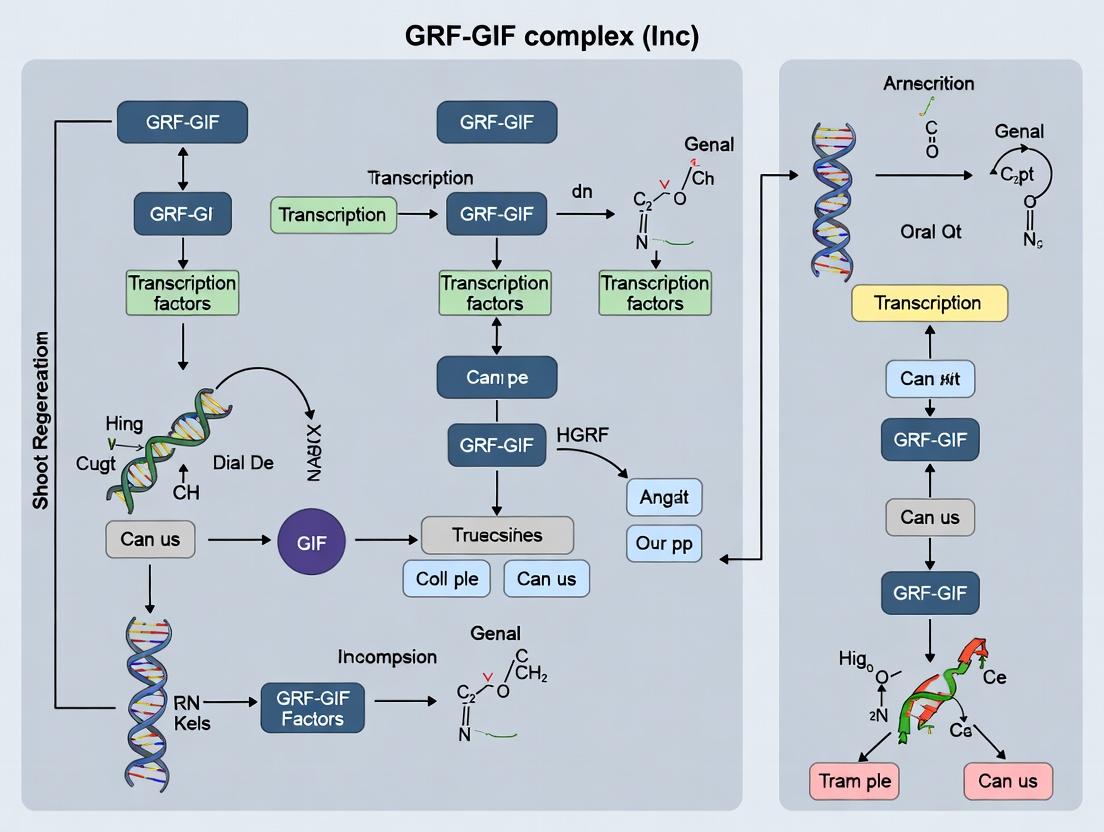
This article provides a comprehensive analysis of the GRF-GIF transcriptional co-activator complex, a critical regulator of pluripotency and shoot regeneration in plants.
GRF-GIF Complex in Shoot Regeneration: Molecular Mechanisms, Applications, and Therapeutic Potential
Abstract
This article provides a comprehensive analysis of the GRF-GIF transcriptional co-activator complex, a critical regulator of pluripotency and shoot regeneration in plants. We explore its foundational biology, detailing how Growth-Regulating Factors (GRFs) interact with GRF-Interacting Factors (GIFs) to drive cell fate transitions. Methodological approaches for studying and manipulating this complex are examined, alongside common experimental challenges and optimization strategies. Finally, we validate its role through comparative analysis with other regeneration pathways and discuss its translational potential for improving plant biotechnology and informing analogous regenerative processes in biomedical research.
Decoding the GRF-GIF Complex: Core Components and Molecular Mechanisms in Shoot Regeneration
This technical whitepaper, framed within a broader thesis on the GRF-GIF transcriptional complex mechanism, elucidates the foundational and advanced principles of shoot regeneration in plants. We focus on the acquisition and maintenance of pluripotency as a central, rate-limiting step. This guide serves researchers and drug development professionals by integrating current molecular understanding with practical experimental frameworks.
The Pluripotent Foundation of Shoot Regeneration
Shoot regeneration is a form of de novo organogenesis where pluripotent callus cells are reprogrammed to form shoot apical meristems (SAMs). This process is not merely a reversal of development but a unique developmental pathway predicated on establishing a pluripotent state. Within this context, the GRF-GIF complex has emerged as a master regulator, directly controlling the expression of key pluripotency and shoot fate genes.
Quantitative Landmarks in Shoot Regeneration
The efficiency and timing of shoot regeneration are quantifiable metrics, heavily influenced by hormonal cues and genetic background.
Table 1: Key Quantitative Parameters in Model System Shoot Regeneration
| Parameter | Arabidopsis thaliana (Wild-type) | Arabidopsis (GRF-GIF Overexpression) | Nicotiana tabacum | Typical Measurement Method |
|---|---|---|---|---|
| Callus Induction Time | 4-6 days | 3-4 days | 7-10 days | Days post-explanation (DPE) |
| Shoot Primordia Emergence | 10-14 DPC* | 7-10 DPC | 14-21 DPC | Visual/ microscopic count |
| Regeneration Efficiency (%) | 70-90% | ~95-100% | 60-80% | (Shoots per explant) x 100 |
| Optimal Cytokinin/Auxin Ratio | ~10:1 (Shoot Induction) | Can be reduced | ~5:1 | Molar ratio (e.g., BAP:NAA) |
| Pluripotency Marker Peak (e.g., WUS, STM) | 4-6 DPC | 2-4 DPC | 8-10 DPC | qRT-PCR, reporter line fluorescence |
*DPC: Days post-callus transfer to shoot induction medium.
Core Mechanisms: GRF-GIF at the Nexus of Pluripotency
The GROWTH-REGULATING FACTOR (GRF) and GRF-INTERACTING FACTOR (GIF) proteins form a heterodimeric complex that functions as a transcriptional co-activator. This complex directly binds to the promoters of genes central to pluripotency and shoot development.
Signaling Pathway and Gene Regulatory Network
The core pathway integrating hormonal signals and pluripotency regulation during shoot regeneration.
Diagram Title: Core Signaling in Shoot Regeneration and GRF-GIF Activation
Experimental Protocols for Investigating Pluripotency and Regeneration
Protocol: Quantitative Shoot Regeneration Assay with GRF-GIF Modulation
Objective: To quantify the effect of GRF-GIF complex manipulation on shoot regeneration efficiency and timing.
Materials: See "The Scientist's Toolkit" below. Procedure:
- Explants: Surface-sterilize Arabidopsis seeds (wild-type and transgenic lines: e.g., 35S:GRF4-GIF1, grf gif mutants). Sow on Callus Induction Medium (CIM). Incubate in dark at 22°C for 10 days.
- Callus Induction: Excise hypocotyl-derived calli (~3-4 mm diameter) under sterile conditions.
- Shoot Induction: Transfer uniform calli to Shoot Induction Medium (SIM). Place plates under long-day conditions (16h light/8h dark) at 22°C.
- Data Collection:
- Day 7 & 14 Post-Transfer: Image each callus under a stereomicroscope.
- Count visible shoot primordia (domed structures with emerging leaf initials).
- Calculate Regeneration Efficiency (%) = (Number of explants with ≥1 shoot / Total explants) x 100.
- Calculate Regeneration Capacity = Mean number of shoots per regenerating explant.
- Molecular Validation (Parallel Samples): Harvest calli at 0, 2, 4, 6 DPC. Perform RNA extraction and qRT-PCR for pluripotency markers (WUS, STM, CLV3) and GRF-GIF target genes.
Protocol: Chromatin Immunoprecipitation (ChIP) for GRF-GIF Target Identification
Objective: To validate direct binding of the GRF-GIF complex to putative target gene promoters in vivo.
Procedure:
- Material: Arabidopsis expressing epitope-tagged GRF (e.g., GRF4-GFP) or GIF under a strong promoter.
- Cross-linking: Harvest ~2g of calli 4 DPC. Vacuum-infiltrate with 1% formaldehyde for 15 min. Quench with 0.125M glycine.
- Nuclei Isolation & Sonication: Lyse tissue, isolate nuclei. Sonicate chromatin to shear DNA to 200-500 bp fragments.
- Immunoprecipitation: Incubate chromatin with anti-GFP antibody (or tag-specific antibody) bound to magnetic beads. Use untagged wild-type as negative control.
- Washing, Elution & Reverse Cross-link: Wash beads stringently. Elute and reverse cross-links at 65°C overnight.
- DNA Purification & Analysis: Purify DNA (ChIP eluate and Input control). Analyze by qPCR with primers designed for promoters of WUS, STM, and negative control regions (e.g., coding sequence of ACTIN).
The Scientist's Toolkit: Essential Reagents & Solutions
Table 2: Key Research Reagent Solutions for Shoot Regeneration Studies
| Reagent / Material | Function / Purpose in Experiment | Example / Notes |
|---|---|---|
| Callus Induction Medium (CIM) | Induces formation of pluripotent callus from explant. High auxin, low cytokinin. | MS salts, 2,4-D (1.0 mg/L), Kinetin (0.1 mg/L). |
| Shoot Induction Medium (SIM) | Reprograms callus to form shoot progenitors. High cytokinin, low/no auxin. | MS salts, BAP (1.0-5.0 mg/L), NAA (0.1 mg/L) or no auxin. |
| GRF-GIF Transgenic Lines | Gain-of-function and loss-of-function analysis of the complex. | 35S:GRF-GIF (overexpression), grf1/2/3 gif1/2/3 mutants (CRISPR/Cas9). |
| Pluripotency Reporter Lines | Visualize spatial/temporal activation of key genes. | pWUS::NLS-GFP, pSTM::Venus. |
| Anti-GRFR/GIF Antibodies | Detect protein expression, localization (IHC), or for ChIP. | Validated polyclonal or monoclonal antibodies. |
| qPCR Primers for Pluripotency Network | Quantify transcriptional dynamics during regeneration. | WUS, STM, CLV3, CUC1/2, GRF4, GIF1, housekeeping (PP2A, UBQ10). |
| Epitope-Tagged GRF/GIF Constructs | For protein-protein interaction studies and ChIP-seq. | GRF4-YFP, GIF1-Myc for co-IP and localization. |
Advanced Workflow: Integrating Phenotype with Molecular Analysis
A comprehensive experimental approach linking regeneration assays to mechanistic insights.
Diagram Title: Integrated Workflow for Shoot Regeneration Research
Growth-Regulating Factors (GRFs) are a plant-specific class of transcription factors playing pivotal roles in orchestrating cell proliferation, organ growth, and developmental transitions. Within the thesis context of GRF-GIF complex mechanisms in shoot regeneration, GRFs are not solo actors. They function by forming obligate complexes with GRF-INTERACTING FACTORs (GIFs), also known as ANGUSTIFOLIA3. This partnership is fundamental; GIFs lack DNA-binding domains but possess transcriptional activation capacity, while GRFs provide sequence-specific DNA binding but have weak activation domains. Together, the GRF-GIF heterodimer becomes a potent transcriptional co-activator complex, directly regulating genes involved in the cell cycle and meristematic competence. This complex is a central molecular switch, enhancing the regenerative capacity of plant tissues, particularly during in vitro shoot regeneration from callus, a process critical for plant biotechnology and synthetic biology.
GRFs are defined by two conserved N-terminal domains: the QLQ (Gln, Leu, Gln) domain, which mediates interaction with GIF cofactors, and the WRC (Trp, Arg, Cys) domain, which contains a nuclear localization signal and a zinc-finger motif for DNA binding. A less conserved C-terminal region often contains transcriptional activation motifs.
Table 1: Core Characteristics of the Arabidopsis thaliana GRF Family
| GRF Member | Chr. Location | Exons | AA Length | Key Expression Domain | Loss-of-Function Phenotype | Interaction with GIF1 |
|---|---|---|---|---|---|---|
| GRF1 | At2g22840 | 4 | 405 | Shoot apices, leaves | Mild reduction in leaf size | Confirmed |
| GRF2 | At4g37740 | 4 | 433 | Shoot apices, leaves | Mild reduction in leaf size | Confirmed |
| GRF3 | At2g36400 | 4 | 420 | Shoot apices | Enhanced regenerative capacity | Confirmed |
| GRF4 | At3g52910 | 4 | 391 | Shoot apices, leaves | -- | Confirmed |
| GRF5 | At3g13960 | 4 | 412 | Shoot meristems, leaves | Reduced leaf cell number | Confirmed |
| GRF6 | At2g06200 | 4 | 414 | Shoot apices | -- | Confirmed |
| GRF7 | At5g53660 | 3 | 319 | Various, stress-induced | Altered stress response | Weak/Non-existent |
| GRF8 | At4g24150 | 4 | 421 | Shoot apices | -- | Confirmed |
| GRF9 | At2g45480 | 4 | 454 | Shoot apices, roots | -- | Confirmed |
Table 2: Expression Levels (FPKM) in Key Regenerative Tissues (Example RNA-seq Data)
| GRF Member | 3-Day-Old Callus | Shoot Progenitor Zone (Day 7) | Mature Leaf | Fold-Change (Callus to Progenitor) |
|---|---|---|---|---|
| GRF3 | 15.2 | 85.7 | 2.1 | 5.64x |
| GRF5 | 22.5 | 120.3 | 5.5 | 5.35x |
| GRF1 | 8.8 | 25.4 | 18.2 | 2.89x |
| GIF1 | 30.1 | 155.6 | 3.3 | 5.17x |
| GIF2 | 25.7 | 98.9 | 2.8 | 3.85x |
Key Experimental Protocols in GRF-GIF Research
Protocol 1: Yeast Two-Hybrid (Y2H) Assay for GRF-GIF Interaction
- Objective: To test physical interaction between a specific GRF and a GIF protein.
- Methodology:
- Clone the coding sequence of the GRF (without stop codon) into the pGBKT7 vector (DNA-BD). Clone the GIF coding sequence into the pGADT7 vector (AD).
- Co-transform both plasmids into yeast strain AH109.
- Plate transformations on synthetic dropout (SD) media lacking Leu and Trp (SD/-Leu/-Trp) to select for presence of both plasmids.
- Inoculate positive colonies into liquid SD/-Leu/-Trp and perform serial dilutions (1, 0.1, 0.01 OD600).
- Spot 5 µl of each dilution onto high-stringency selection plates: SD/-Ade/-His/-Leu/-Trp. Growth indicates a positive protein-protein interaction.
- Include controls: pGBKT7-empty + pGADT7-GIF (negative), pGBKT7-GRF + pGADT7-empty (negative), and a known interacting pair (positive).
Protocol 2: Chromatin Immunoprecipitation Sequencing (ChIP-seq) for GRF Target Identification
- Objective: To identify genome-wide DNA binding sites of a GRF transcription factor in vivo.
- Methodology:
- Generate transgenic plant line expressing a functional, epitope-tagged GRF (e.g., GRF5-GFP) under its native promoter.
- Harvest 1-2 grams of callus or shoot progenitor tissue. Cross-link proteins to DNA with 1% formaldehyde.
- Homogenize tissue, isolate nuclei, and sonicate chromatin to shear DNA to ~200-500 bp fragments.
- Immunoprecipitate the protein-DNA complexes using a high-affinity anti-GFP antibody bound to magnetic beads.
- Reverse cross-links, purify DNA, and prepare a sequencing library.
- Perform next-generation sequencing (Illumina). Map reads to the reference genome and call peaks using software (e.g., MACS2). Motif analysis (e.g., MEME) on peak sequences should reveal the conserved GRF binding motif (e.g., TGTCTC).
Protocol 3: In Vitro Shoot Regeneration Assay with GRF Modulation
- Objective: To quantify the effect of GRF/GIF overexpression or mutation on shoot regeneration efficiency.
- Methodology:
- Explant Preparation: Surface-sterilize Arabidopsis seeds, germinate on MS basal medium. Use 5-day-old hypocotyls or root segments as explants.
- Callus Induction (CIM): Culture explants on Callus Induction Medium (CIM: MS salts, 2% sucrose, 0.5 mg/L 2,4-D, 0.05 mg/L kinetin, pH 5.7) for 3-5 days in dark.
- Shoot Induction (SIM): Transfer explants to Shoot Induction Medium (SIM: MS salts, 2% sucrose, 0.15 mg/L IAA, 5.0 mg/L BAP, pH 5.7). Maintain under long-day photoperiod (16h light/8h dark).
- Genetic Modulation: Use grf mutants, gif mutants (e.g., gif1), or explants from lines overexpressing GRF-GIF fusions (e.g., GRF5-GIF1).
- Quantification: Count the number of explants forming visible shoot primordia and the number of shoots per explant at Days 14, 21, and 28 on SIM. A minimum of 30 explants per genotype is recommended.
Visualizing the GRF-GIF Regulatory Network in Regeneration
Diagram 1: GRF-GIF in Shoot Regeneration Pathway (98 chars)
Diagram 2: Shoot Regeneration Experiment Workflow (100 chars)
The Scientist's Toolkit: Essential Research Reagents & Materials
Table 3: Key Research Reagent Solutions for GRF-GIF Studies
| Reagent / Material | Function / Application | Example / Notes |
|---|---|---|
| pGBKT7 & pGADT7 Vectors | Yeast Two-Hybrid system for protein interaction screening. | Clontech; used in Protocol 1. |
| Anti-GFP Magnetic Beads | High-affinity immunoprecipitation of GFP-tagged GRF proteins for ChIP-seq. | ChromoTek GFP-Trap; used in Protocol 2. |
| Callus Induction Medium (CIM) | Induces formation of pluripotent callus from explants. | Contains auxin (2,4-D) and low cytokinin. |
| Shoot Induction Medium (SIM) | Triggers shoot meristem fate from competent callus. | Contains high cytokinin (BAP) and low auxin (IAA). |
| GRF-GIF Fusion Overexpression Construct | Potent tool to enhance regenerative capacity; fuses GRF DNA-BD to GIF activation domain. | e.g., pGRF5::GRF5-GIF1 or p35S::GRF5-GIF1. |
| grf/gif Multiple Mutant Seeds | Critical for loss-of-function phenotypic analysis. | e.g., grf1/2/3 triple mutant or gif1/2/3 triple mutant. |
| Cytokinin (e.g., 6-BAP) | Key plant hormone in SIM; upstream regulator of GRF/GIF expression. | Stock solution prepared in DMSO or NaOH. |
| ChIP-seq Grade Formaldehyde | For efficient in vivo cross-linking of proteins to DNA. | Typically used at 1% final concentration. |
Within the molecular framework of plant shoot regeneration, the GRF-GIF protein complex stands as a central regulatory module. GRF (GROWTH-REGULATING FACTOR) transcription factors, while pivotal for cell proliferation and organ development, lack a functional transcriptional activation domain. This critical deficit is supplied by their indispensable partners, the GIF proteins. This whitepaper provides an in-depth technical definition of GIF proteins, elucidating their structure, function, and indispensable role as transcriptional co-activators within the GRF-GIF complex, a key driver of shoot meristem formation and regeneration.
Molecular Identity and Structure of GIF Proteins
GIF proteins, also known as ANGUSTIFOLIA3 (AN3) in Arabidopsis thaliana, belong to a small, conserved family of transcriptional co-activators. They are characterized by several defining domains that facilitate their function.
Primary Structural Domains:
- SNH Domain (SYT N-Terminal Homology): Located at the N-terminus, this domain is essential for mediating protein-protein interactions, most critically with GRF transcription factors.
- QPGY Domain: A central, low-complexity region rich in Glutamine (Q), Proline (P), Glycine (G), and Tyrosine (Y) residues. This domain is intrinsically disordered and is crucial for transcriptional activation by recruiting general transcriptional machinery and chromatin remodelers.
- Nuclear Localization Signal (NLS): Ensures the protein is targeted to the nucleus, the site of its co-activator function.
Table 1: Core GIF Family Members in Arabidopsis thaliana
| Gene Name | Protein Name | Primary Function in GRF-GIF Context | Key Phenotype of Mutant |
|---|---|---|---|
| AtGIF1 | AN3/GIF1 | Major co-activator; interacts with multiple GRFs (e.g., GRF1-5). | Reduced leaf cell number, narrow leaves, impaired shoot regeneration. |
| AtGIF2 | GIF2 | Partially redundant with GIF1; co-activator for a subset of GRFs. | Mild phenotype; enhanced defects in gif1 gif2 double mutant. |
| AtGIF3 | GIF3 | Likely has specialized or redundant functions. | Subtle phenotypes, often revealed in higher-order mutants. |
Functional Mechanism: The GRF-GIF Complex in Action
The GIF protein functions by forming a tight, physical complex with GRF transcription factors. This partnership is non-catalytic and allosteric in nature.
Mechanistic Workflow:
- Complex Assembly: A GRF protein, via its QLQ (Gln, Leu, Gln) and WRC (Trp, Arg, Cys) domains, binds directly to the SNH domain of a GIF protein. This interaction masks the GRF's inhibitory domain and stabilizes both partners.
- DNA Targeting: The GRF component confers sequence-specific DNA-binding, tethering the heterodimeric complex to the promoter regions of target genes, often via the cis-element "GA-response element" (GARE).
- Transcriptional Activation: The QPGY domain of the GIF protein recruits chromatin-remodeling complexes (e.g., SWI/SNF) and histone acetyltransferases (HATs). This remodels local chromatin from a repressive (heterochromatin) to an active (euchromatin) state, facilitating the assembly of RNA Polymerase II and the initiation of transcription.
- Biological Output: Target genes include cell cycle regulators (CYCD3, CDKB1;1), ribosomal protein genes, and other transcription factors, collectively driving cytokinin-responsive cell proliferation during leaf development and, critically, shoot progenitor cell fate during in vitro regeneration.
Diagram 1: GRF-GIF Co-activation Mechanism
Key Experimental Protocols for GIF Study
Protocol 1: Yeast Two-Hybrid (Y2H) Assay for GRF-GIF Interaction
- Purpose: To confirm direct protein-protein interaction between a specific GRF and GIF.
- Methodology:
- Clone the coding sequence of the GRF protein into the pGBKT7 vector (DNA-Binding Domain, BD) and the GIF coding sequence into the pGADT7 vector (Activation Domain, AD).
- Co-transform both constructs into yeast strain AH109.
- Plate transformed yeast on synthetic dropout (SD) media lacking Leucine and Tryptophan (-LT) to select for both plasmids.
- Streak positive colonies onto high-stringency SD media lacking Leucine, Tryptophan, Histidine, and Adenine (-LTHA) to test for interaction-dependent reporter gene (HIS3, ADE2) activation.
- Include controls: BD-GRF + AD-empty, BD-empty + AD-GIF, BD-empty + AD-empty.
Protocol 2: Bimolecular Fluorescence Complementation (BiFC) in Protoplasts
- Purpose: To visualize the in vivo interaction and subcellular localization of the GRF-GIF complex in plant cells.
- Methodology:
- Fuse the N-terminal half of YFP (nYFP) to GRF and the C-terminal half (cYFP) to GIF in plant expression vectors (e.g., pSAT vectors).
- Isolate mesophyll protoplasts from Arabidopsis leaves or tobacco (Nicotiana benthamiana) leaves using cellulase and macerozyme enzyme digestion.
- Co-transfect the two constructs into protoplasts using polyethylene glycol (PEG)-mediated transformation.
- Incubate for 16-24 hours to allow protein expression.
- Visualize fluorescence using a confocal laser scanning microscope (excitation 514 nm, emission 527 nm). Reconstituted YFP signal in the nucleus confirms interaction.
Protocol 3: Chromatin Immunoprecipitation-qPCR (ChIP-qPCR)
- Purpose: To determine the genomic binding sites of the GRF-GIF complex.
- Methodology:
- Use transgenic plants expressing a tagged version of GIF (e.g., GIF1-GFP) or perform native ChIP with a specific GIF antibody.
- Cross-link plant tissue (e.g., shoot apices or callus) with 1% formaldehyde.
- Extract nuclei, sonicate chromatin to shear DNA to ~200-500 bp fragments.
- Immunoprecipitate the chromatin-protein complexes using an anti-GFP or anti-GIF antibody coupled to magnetic beads.
- Reverse cross-links, purify DNA, and analyze by qPCR with primers designed for putative target gene promoters (e.g., CYCD3;1, ANT). Enrichment is calculated relative to input DNA and a negative control genomic region.
Table 2: Quantitative Data from Key GIF Functional Studies
| Experiment | System | Key Measurement | Result (Representative) | Implication |
|---|---|---|---|---|
| Y2H Strength | Yeast | Growth on -LTHA media (days) | GRF1-GIF1: Strong growth in 3 days | Direct, strong interaction. |
| Transcript Level | gif1 mutant vs WT | RNA-seq of shoot meristem | 1,542 genes downregulated (Log2FC < -1) | GIF1 is a major transcriptional activator. |
| ChIP-qPCR | 35S:GIF1-GFP | Fold enrichment at CYCD3;1 promoter | 8.5 ± 1.2 fold vs control locus | GIF1 directly binds cell cycle regulator. |
| Regeneration Efficiency | gif1 mutant explant | % explants forming shoots on CIM+SIM | 15% vs 85% in WT | GIF1 is essential for shoot regeneration. |
The Scientist's Toolkit: Essential Research Reagents
Table 3: Key Reagent Solutions for GRF-GIF Research
| Reagent / Material | Function / Application | Example / Note |
|---|---|---|
| Anti-GIF1 / AN3 Antibody | Immunodetection (WB, ChIP), localization (IHC). | Rabbit polyclonal, validated in Arabidopsis. |
| pSAT-BiFC Vectors | For constructing nYFP/cYFP fusions for in planta interaction assays. | Modular plant expression vectors. |
| GRF-GIF Yeast Two-Hybrid Kit | Ready-made system for interaction screening. | Clontech Matchmaker Gold system. |
| Plant Protoplast Isolation Kit | Rapid isolation of viable protoplasts for transfection. | Contains cellulase, macerozyme, and digestion buffer. |
| CIM & SIM Media | In vitro shoot regeneration assays from callus. | Callus Induction Medium (CIM) and Shoot Induction Medium (SIM), both with specific cytokinin/auxin ratios. |
| Cycloheximide | Protein synthesis inhibitor used in translational shut-off experiments to study protein stability of the complex. | Use at 50-100 µM in plant culture. |
| MG132 (Proteasome Inhibitor) | To test if GIF protein turnover is regulated by the 26S proteasome pathway. | Use at 50 µM for 4-6 hour treatments. |
GIF proteins are the definitive co-activators that empower GRF transcription factors, transforming them from inert DNA binders into potent drivers of proliferation and regeneration. The GRF-GIF complex operates as a master regulatory node, integrating developmental and hormonal cues to orchestrate the gene expression programs essential for shoot formation. Future research directions include:
- Elucidating the precise structural basis of the GRF-GIF interaction.
- Identifying the full complement of chromatin modifiers recruited by the GIF QPGY domain.
- Exploring the potential to modulate the GRF-GIF complex activity, via gene editing or small molecules, to enhance plant regeneration capacity and crop improvement strategies.
Within the broader thesis on the GRF-GIF complex mechanism in shoot regeneration, elucidating the structural basis of their interaction is paramount. This partnership between GROWTH-REGULATING FACTOR (GRF) transcription factors and GRF-INTERACTING FACTOR (GIF) coactivators forms a central regulatory module that drives cell proliferation and pluripotency, essential for de novo shoot meristem formation. Understanding the precise molecular architecture of this complex provides the foundation for rational manipulation of plant regeneration capacity, with potential applications in crop engineering and synthetic biology.
Structural Determinants of GRF-GIF Complex Formation
The GRF-GIF complex is a heterodimer stabilized by complementary protein domains. GRF proteins contain two conserved regions: the QLQ (Gln, Leu, Gln) domain at the N-terminus and the WRC (Trp, Arg, Cys) domain at the C-terminus. The GIF proteins (e.g., ANGUSTIFOLIA3 in Arabidopsis) are characterized by an N-terminal SNH (SYT N-terminal homology) domain and a central QGQ (Gln, Gly, Gln) domain. Structural studies, primarily via X-ray crystallography and cryo-EM, reveal that the primary interaction interface is formed between the GRF's QLQ domain and the GIF's SNH domain.
Table 1: Key Structural Domains in GRF-GIF Complex
| Protein | Domain Name | Domain Location | Key Functional Residues | Role in Complex Formation |
|---|---|---|---|---|
| GRF | QLQ | N-terminal | Conserved Gln, Leu, Gln | Binds directly to GIF SNH domain; essential for partner recognition. |
| GRF | WRC | C-terminal | Trp, Arg, Cys, zinc finger | Involved in nuclear localization and DNA binding; stabilizes full complex. |
| GIF | SNH | N-terminal | Hydrophobic pocket residues | Main GRF-binding interface; mutation abolishes interaction. |
| GIF | QGQ | Central | Conserved Gln, Gly, Gln | May mediate oligomerization or recruitment of transcriptional machinery. |
Table 2: Quantitative Binding Affinity Data (Summarized from ITC/SPR)
| Interaction Pair | Method | Kd (Dissociation Constant) | ΔG (kcal/mol) | Reference Model Organism |
|---|---|---|---|---|
| GRF4 QLQ domain - GIF1 SNH domain | Isothermal Titration Calorimetry (ITC) | 0.15 ± 0.03 µM | -9.2 ± 0.3 | Arabidopsis thaliana |
| Full-length GRF5 - GIF1 | Surface Plasmon Resonance (SPR) | 0.8 ± 0.2 µM | -8.5 ± 0.2 | Arabidopsis thaliana |
| GRF-GIF ortholog complex | ITC | 0.05 - 2.1 µM range | -9.8 to -7.9 | Various (Rice, Maize) |
Detailed Experimental Protocols
Protocol 1: Co-Immunoprecipitation (Co-IP) for In Vivo Interaction Validation
- Constructs: Express 35S:GRF-FLAG and 35S:GIF-MYC in Arabidopsis protoplasts or Nicotiana benthamiana leaves via Agrobacterium infiltration.
- Sample Preparation: Harvest tissue 48-72 hours post-infiltration. Homogenize in NP-40 lysis buffer (50 mM Tris-HCl pH 7.5, 150 mM NaCl, 1% NP-40, 10% glycerol, plus protease inhibitors).
- Immunoprecipitation: Incubate clarified lysate with anti-FLAG M2 affinity gel for 2 hours at 4°C.
- Washing: Wash beads 4 times with lysis buffer.
- Elution & Analysis: Elute proteins with 3xFLAG peptide. Separate by SDS-PAGE and perform immunoblotting using anti-FLAG (1:5000) and anti-MYC (1:5000) antibodies.
Protocol 2: Isothermal Titration Calorimetry (ITC) for Binding Affinity Measurement
- Protein Purification: Express and purify recombinant GRF QLQ domain and GIF SNH domain (e.g., as GST- or His6-tagged proteins) from E. coli.
- Buffer Matching: Dialyze both proteins into identical phosphate-buffered saline (PBS, pH 7.4).
- ITC Experiment: Load GIF SNH domain (20-50 µM) into the sample cell. Fill syringe with GRF QLQ domain (200-500 µM).
- Titration: Perform 19 injections of 2 µL each at 25°C, with 150-second spacing.
- Data Analysis: Fit the integrated heat data to a one-site binding model using the instrument's software (e.g., MicroCal PEAQ-ITC) to derive Kd, ΔH, and ΔS.
Protocol 3: Crystallography of the GRF-GIF Complex
- Complex Formation: Co-express and co-purify the GRF QLQ and GIF SNH domains.
- Crystallization: Screen for crystals using commercial sparse-matrix screens (e.g., Hampton Research) via sitting-drop vapor diffusion.
- Optimization: Optimize hits. Crystals often form in conditions containing PEG 3350 and salts.
- Data Collection: Flash-cool crystal in liquid N2 with cryoprotectant. Collect X-ray diffraction data at a synchrotron.
- Structure Solving: Solve phase problem by molecular replacement using homologous domains. Iteratively refine model (e.g., with Phenix, Refmac).
Signaling Pathway & Experimental Workflow Diagrams
Title: GRF-GIF in Shoot Regeneration Pathway
Title: Workflow for Structural Analysis of GRF-GIF
The Scientist's Toolkit: Research Reagent Solutions
Table 3: Essential Reagents for GRF-GIF Complex Research
| Reagent/Category | Specific Example/Product | Function & Rationale |
|---|---|---|
| Expression Vectors | pGEX-6P-1, pET-28a(+), pCAMBIA1300-3xFLAG/GFP/MYC | For recombinant protein production in E. coli (pGEX, pET) and transient expression in plants (pCAMBIA). |
| Host Strains | E. coli BL21(DE3) Rosetta, Agrobacterium GV3101 | Optimized for protein expression and plant infiltration, respectively. |
| Affinity Purification Resins | Glutathione Sepharose 4B (for GST), Ni-NTA Agarose (for His-tag), Anti-FLAG M2 Agarose | For efficient, tag-specific purification of recombinant proteins or complexes. |
| Antibodies | Anti-FLAG (Monoclonal), Anti-MYC (Polyclonal), Anti-GST, Anti-His | Essential for detecting tagged proteins in western blot and Co-IP assays. |
| Crystallization Kits | Hampton Research Crystal Screen, PEG/Ion Screen | Sparse-matrix screens to identify initial crystallization conditions for protein complexes. |
| Binding Assay Kits | MicroCal PEAQ-ITC Starter Kit, Biacore Sensor Chip CMS | Standardized reagents for accurate measurement of binding kinetics and thermodynamics. |
| Plant Growth Regulators | 6-Benzylaminopurine (BAP), Trans-Zeatin | Cytokinins used to induce GRF and GIF expression in shoot regeneration assays. |
Abstract Within the broader thesis of GRF-GIF complex mechanisms in shoot regeneration, understanding their downstream genetic network is paramount. This technical guide details the core genes and pathways directly activated by the GRF-GIF transcriptional co-activator complex, which is central to pluripotency acquisition and cell fate reprogramming in plant somatic tissues. We synthesize recent findings, present quantitative data, and provide robust experimental protocols for the field.
The GROWTH-REGULATING FACTOR (GRF) transcription factors, in partnership with GRF-INTERACTING FACTOR (GIF) co-activators, form a potent complex that drives the expression of a suite of genes essential for shoot meristem formation. The GRF DNA-binding domain and the GIF SNH domain facilitate recruitment of chromatin-remodeling complexes, primarily the SWI/SNF ATPase SPLAYED (SYD), to open chromatin and activate transcription. This module is a primary target of cytokinin signaling during regeneration.
Core Downstream Genetic Targets
The GRF-GIF complex directly binds to the promoter regions of key pluripotency and meristem-regulating genes. Quantitative chromatin immunoprecipitation sequencing (ChIP-seq) and transcriptomic data are summarized below.
Table 1: Primary Direct Downstream Targets of the GRF-GIF Complex
| Target Gene | Gene Family | Function in Shoot Regeneration | Evidence (Method) | Fold Change (GRF-OX vs WT)* | Proposed Role in Pathway |
|---|---|---|---|---|---|
| WUSCHEL (WUS) | Homeodomain TF | Shoot apical meristem (SAM) organizer; stem cell niche specification | ChIP-qPCR, Transcriptomics | 4.5 - 8.2 | Master regulator, essential for stem cell initiation |
| PLETHORA (PLT) | AP2/ERF TF | Root-to-shoot fate transition; cytokinin response potentiation | ChIP-seq, EMSA | 3.1 - 5.5 | Establishes competence for shoot fate |
| ENHANCER OF SHOOT REGENERATION (ESR1) | AP2/ERF TF | Represses somatic cell identity; promotes dedifferentiation | ChIP-seq, Luciferase Assay | 6.8 - 10.1 | Early reprogramming factor |
| CLAVATA3 (CLV3) | Peptide Hormone | Negative feedback regulator of WUS; maintains meristem homeostasis | RNA-seq, Mutant Analysis | 2.5 - 4.0 | Balances proliferation and differentiation |
| KNOTTED-LIKE FROM ARABIDOPSIS (KNAT1/BP) | KNOX TF | Maintains meristem indeterminacy; represses differentiation | ChIP-qPCR | 2.8 - 4.5 | Promotes meristematic cell state |
| CYTOKININ RESPONSE FACTORS (CRFs) | AP2/ERF TF | Amplify cytokinin signaling; regulate target genes | ChIP-seq | 3.5 - 6.0 | Signal integration and amplification |
Fold change approximate ranges from published overexpression (GRF-OX) studies in *Arabidopsis.
Activated Signaling Pathways
The downstream targets converge on two core interconnected pathways: the WUS-CLV feedback loop and the Cytokinin Response Amplification circuit.
Diagram 1: GRF-GIF Activated Core Pathway
Key Experimental Protocols
Protocol 1: ChIP-qPCR for GRF-GIF Target Validation
- Crosslinking: Treat 2g of callus/plant tissue with 1% formaldehyde for 15 min under vacuum. Quench with 0.125 M glycine.
- Nuclei Isolation & Sonication: Lyse tissue, isolate nuclei, and sonicate to shear chromatin to 200-500 bp fragments. Verify fragment size by gel electrophoresis.
- Immunoprecipitation: Incubate chromatin with antibody against GRF (e.g., anti-GRF4) or GIF (e.g., anti-GIF1) coupled to Protein A/G magnetic beads. Use pre-immune serum as control.
- Decrosslinking & Purification: Reverse crosslinks at 65°C overnight, treat with RNase A and Proteinase K, purify DNA with spin columns.
- qPCR Analysis: Perform SYBR Green qPCR with primers designed for putative binding regions (e.g., WUS, ESR1 promoters). Calculate % input or fold enrichment over control.
Protocol 2: Luciferase Reporter Assay for Transcriptional Activation
- Constructs: Clone wild-type or mutated promoter sequence of target gene (e.g., WUSpro) upstream of firefly luciferase (LUC) gene. Use 35S:REN (Renilla luciferase) as internal control.
- Effector Plasmids: Use 35S:GRF4 and 35S:GIF1 as effectors.
- Transient Transfection: Co-transform effector and reporter plasmids into Arabidopsis protoplasts or Nicotiana benthamiana leaves via PEG-mediated or Agrobacterium infiltration.
- Measurement: Harvest cells/tissue 36-48h post-transfection. Assay using Dual-Luciferase Reporter Assay Kit. Measure Firefly and Renilla luminescence. Activity = Firefly LUC / Renilla LUC.
Protocol 3: Shoot Regeneration Assay with Modulation
- Explants: Surface-sterilize Arabidopsis leaves or hypocotyls.
- Media: Culture on Callus-Inducing Medium (CIM: auxin-rich) for 3-5 days, then transfer to Shoot-Inducing Medium (SIM: cytokinin-rich, e.g., 5 µM 6-benzylaminopurine).
- Modulation: Use transgenic lines (GRF-OX, grf-gif mutants) or add chemical inhibitors (e.g., histone deacetylase inhibitors like Trichostatin A) to SIM.
- Quantification: Count shoot primordia after 14-21 days on SIM. Express as shoots per explant. Genotype/chemical effects indicate GRF-GIF module role.
The Scientist's Toolkit: Research Reagent Solutions
Table 2: Essential Reagents for GRF-GIF Downstream Research
| Reagent / Material | Function / Purpose | Example & Notes |
|---|---|---|
| Anti-GRF / GIF Antibodies | Immunoprecipitation for ChIP; protein detection | Polyclonal anti-AtGRF4, anti-AtGIF1 (validated for ChIP-grade). |
| GRF/GIF Overexpression Mutants | Gain-of-function studies; identify upregulated targets | 35S:GRF4-GFP; pGRF4:GRF4-GR (glucocorticoid inducible). |
| grf/gif Multiple Mutants | Loss-of-function studies; identify pathway dependencies | grf1/2/3/4 quadruple mutant; gif1/2/3 triple mutant. |
| pWUS::GUS / pWUS::VENUS | Reporters for WUS expression/activation dynamics | Visualize WUS transcription in real-time during regeneration. |
| SYD/SWI2/SNF2 Mutants | To dissect chromatin remodeling dependency | syd-2 mutant used to test WUS activation blockade. |
| Dual-Luciferase Reporter Kit | Quantify promoter activity in vivo | Promega Dual-Luciferase Reporter Assay System. |
| Cytokinin Analogs & Inhibitors | Modulate upstream signal input | 6-BAP (active cytokinin), Lovastatin (inhibits cytokinin synthesis). |
| Chromatin Remodeling Modulators | Probe epigenetic regulation | Trichostatin A (TSA, HDAC inhibitor), Sodium Butyrate. |
Diagram 2: Experimental Workflow for Target Identification
The GRF-GIF module sits at the apex of a regulatory hierarchy, directly activating a core set of transcription factors (WUS, PLT, ESR1) that execute shoot regeneration. This pathway integrates cytokinin signaling and epigenetic reprogramming. Future research must quantify the kinetic relationships within this network using live reporters and single-cell omics, and explore the module's potential for enhancing regenerative capacity in crop species.
The GRF-GIF Complex as a Master Switch for Shoot Apical Meristem Development
1. Introduction and Thesis Context Within the broader thesis investigating the GRF-GIF mechanism in shoot regeneration, this whitepaper positions the GROWTH-REGULATING FACTOR (GRF)-GRF-INTERACTING FACTOR (GIF) protein complex as the central regulatory node governing the establishment and maintenance of the shoot apical meristem (SAM). The SAM is the ultimate source of all aerial plant organs, and its precise control is paramount for regenerative biology. This document provides a technical dissection of the complex's function, experimental interrogation, and its implications for developmental programming.
2. Molecular Mechanism and Regulatory Network The GRF-GIF complex functions as a transcriptional co-activator module. GRF proteins contain DNA-binding QLQ domains that target specific promoter sequences of downstream genes, while GIF proteins (also known as ANGUSTIFOLIA3) possess a transcriptional activation SNH domain. Their physical interaction is essential for transcriptional activity. Core targets include genes critical for cell proliferation, such as CYCLINs and KNOTTED1-LIKE HOMEOBOX (KNOX) genes, particularly STM.
Table 1: Key Quantitative Data on GRF-GIF Complex Function
| Parameter | Experimental System | Value/Observation | Biological Implication |
|---|---|---|---|
| GRF-GIF Interaction Strength (Kd) | Yeast Two-Hybrid/SPR | ~1-10 µM (varies by pair) | Indicates specific, moderate-affinity binding essential for complex formation. |
| SAM Size Reduction in grf/gif multiple mutants | Arabidopsis thaliana | 40-60% reduction in SAM width/dome area | Complex is a major positive regulator of SAM size. |
| Transcriptional Activation Fold-Change | Transient Luciferase Assay | 5- to 15-fold activation of CYCD3;1 promoter | Complex is a potent transcriptional activator of cell cycle genes. |
| miR396 Target Sites in GRF mRNAs | Most GRF genes (except GRF1) | 1-2 conserved sites in the coding sequence | Post-transcriptional regulation limits GRF accumulation, fine-tuning SAM activity. |
3. Experimental Protocols for Core Analyses
3.1. Yeast Two-Hybrid Assay for GRF-GIF Interaction
- Purpose: To test for direct protein-protein interaction.
- Method:
- Clone the coding sequences of GRF (without activation domain) and GIF into pGBKT7 (DNA-BD vector) and pGADT7 (AD vector), respectively.
- Co-transform the plasmid pairs into Saccharomyces cerevisiae strain AH109.
- Plate transformations on synthetic dropout (SD) media lacking Leu and Trp (-LW) to select for co-transformants.
- Streak positive colonies onto high-stringency SD media lacking Leu, Trp, His, and Ade (-LWHA), supplemented with X-α-Gal. Interaction is confirmed by colony growth and blue coloration.
- Include empty vector pairs as negative controls.
3.2. Chromatin Immunoprecipitation Quantitative PCR (ChIP-qPCR)
- Purpose: To validate direct binding of the GRF-GIF complex to genomic target sites.
- Method:
- Generate transgenic plants expressing pGIF:GIF-GFP or pGRF:GRF-GFP fusions (or use specific antibodies if available).
- Cross-link ~2g of SAM-enriched tissue with 1% formaldehyde.
- Isolate nuclei, sonicate chromatin to ~500 bp fragments.
- Immunoprecipitate with anti-GFP magnetic beads.
- Reverse cross-links, purify DNA.
- Perform qPCR with primers spanning putative GRF-binding motifs in target gene promoters (e.g., CYCD3;1). Enrichment is calculated relative to a non-target genomic region.
3.3. SAM Phenotypic Analysis in Mutants
- Purpose: To quantify SAM defects in grf/gif mutants.
- Method:
- Generate higher-order mutant combinations (e.g., grf1/2/3/4 quadruple, gif1/2/3 triple).
- Fix seedlings at 5 days post-germination.
- Dissect SAMs under microscope, clear with chloral hydrate, and image by confocal or differential interference contrast (DIC) microscopy.
- Use image analysis software (e.g., ImageJ) to measure SAM width, dome height, and layer cell counts.
- Perform statistical analysis (t-test/ANOVA) comparing mutant to wild-type.
4. The Scientist's Toolkit: Research Reagent Solutions
| Reagent/Material | Function in GRF-GIF/SAM Research |
|---|---|
| Anti-GFP Nanobody/Antibody | For immunoprecipitation (ChIP) or visualization of GFP-tagged GRF/GIF proteins. |
| pGBKT7 & pGADT7 Vectors | Standard plasmids for yeast two-hybrid interaction studies. |
| C-terminal GFP/DsRed Fusion Vectors (e.g., pCAMBIA1300) | For generating in vivo localization and functional complementation lines. |
| GRF/GIF Multiple Mutant Seeds (grf1/2/3/4, gif1/2/3) | Essential for loss-of-function phenotypic analysis. |
| CYCB1;1:GUS or CYCB1;1:GFP Reporter Line | Marker for G2/M phase, used to assay cell proliferation status in SAM. |
| miR396-Resistant GRF Transgenes (mGRF) | Tool to study GRF overexpression phenotypes, bypassing miR396 regulation. |
| SAM-Specific Promoters (e.g., pSTM, pCLV3) | For driving precise expression of transgenes or reporters in the SAM. |
| Chromatin Assembly Factor-1 (CAF-1) Mutants (fas1, fas2) | Used in studies linking chromatin dynamics to GRF-GIF mediated cell proliferation. |
5. Concluding Perspective for Regeneration Research The GRF-GIF complex integrates developmental cues (via transcription) and regulatory miRNAs (via miR396) to dose cell proliferation potential in the SAM. In regeneration, ectopic activation of this module is often sufficient to drive callus formation and de novo SAM initiation. Future therapeutic strategies in plant bioengineering hinge on the precise, tunable control of this master switch, making it a prime target for improving transformation and regeneration efficiencies in recalcitrant species.
Harnessing the GRF-GIF Pathway: Experimental Techniques and Biotechnological Applications
The molecular mechanism of shoot regeneration, central to plant biotechnology and crop improvement, is profoundly illuminated by the GRF-GIF complex. Growth-Regulating Factors (GRFs) are plant-specific transcription factors that, upon partnership with GRF-Interacting Factors (GIFs) (co-activators), drive the expression of genes essential for cell proliferation and meristem establishment. This whitepaper details how the model systems Arabidopsis thaliana, Solanum lycopersicum (tomato), and Oryza sativa (rice) serve as complementary platforms to dissect this conserved yet diversified regulatory module, bridging fundamental discovery to translational applications.
Comparative Analysis of Model Systems
The utility of each model system stems from its unique biological and technical attributes, which align with specific research questions regarding the GRF-GIF mechanism.
Table 1: Key Characteristics of Featured Model Systems
| Feature | Arabidopsis thaliana | Solanum lycopersicum (Tomato) | Oryza sativa (Rice) |
|---|---|---|---|
| Phylogeny | Eudicot; Brassicaceae | Eudicot; Solanaceae | Monocot; Poaceae |
| Genome Size | ~135 Mb | ~900 Mb | ~389 Mb |
| Genetic Resources | Extensive mutant libraries (e.g., SALK), full-length cDNA, >1000 accessions. | Large mutant collections (e.g., TOMATOMA), introgression lines, >10,000 cultivars. | Large mutant libraries (T-DNA, Tos17), abundant wild relatives, thousands of varieties. |
| Transformation Efficiency | High (~80-90% in Col-0). | Low to moderate, genotype-dependent (~1-30%). | Moderate, genotype-dependent (~5-70% in japonica). |
| Key Regeneration System | Callus from root/hypocotyl explants on CIM then SIM. | Callus from cotyledon/hypocotyl explants, direct organogenesis. | Callus from mature seed scutellum on N6 media. |
| GRF-GIF Research Advantage | Definitive mechanistic studies, rapid in planta validation. | Study of fleshy fruit development, compound leaf regulation. | Study in monocot crops, regeneration from mature tissues. |
| Primary Research Application | Uncovering fundamental genetic and molecular pathways. | Translational research for dicot crops, trait engineering. | Translational research for cereal crops, improving transformation. |
Table 2: Quantitative Data on GRF-GIF Components and Regeneration
| Parameter | Arabidopsis | Tomato | Rice | Notes / Citation (Live Search) |
|---|---|---|---|---|
| Number of GRF genes | 9 | 13 | 12 | Recent phylogenies confirm family expansion in tomato. |
| Number of GIF genes | 3 | 3 | 3 | Highly conserved number across angiosperms. |
| Regeneration Efficiency (Best Case) | ~95% shoot formation | ~40-60% shoot formation (model cv. Micro-Tom) | ~80-90% callus induction (model cv. Nipponbare) | Efficiency is highly protocol & genotype-dependent. |
| Key Regeneration GRF | AtGRF5, AtGRF1 | SIGRF5, SIGRF10 | OsGRF1, OsGRF4 | OsGRF4 is a major target for yield and regeneration enhancement. |
| Canonical Mutant Phenotype (e.g., grf1/2/3 or gif1) | Severe reduction in shoot regenerative capacity, small leaves. | Reduced leaf complexity, impaired callus growth. | Dwarfism, reduced callus proliferation. |
Experimental Protocols for GRF-GIF Analysis
Protocol 3.1: qRT-PCR Analysis of GRF-GIF Expression During Regeneration
Objective: Quantify temporal expression dynamics of GRF and GIF genes during shoot regeneration from callus.
- Plant Material & Regeneration: Induce callus from explants (Arabidopsis root, tomato cotyledon, rice scutellum) on appropriate Callus Induction Medium (CIM). Transfer to Shoot Induction Medium (SIM).
- Sample Collection: Harvest tissue (≥100 mg) at key stages: Explant (T0), CIM callus (T1), 0, 3, 7, 14 days on SIM (T2-T5). Flash-freeze in LN₂.
- RNA Extraction: Use TRIzol or column-based kit (e.g., RNeasy Plant Mini Kit). Include DNase I treatment. Assess purity (A260/A280 ~2.0) and integrity (RIN >7).
- cDNA Synthesis: Use 1 µg total RNA with oligo(dT) and reverse transcriptase (e.g., SuperScript IV).
- qPCR: Prepare 10 µL reactions with SYBR Green master mix, 200 nM gene-specific primers, and 1:10 diluted cDNA. Use a two-step cycling protocol (95°C denaturation, 60°C annealing/extension). Run in triplicate.
- Data Analysis: Calculate ∆Ct relative to housekeeping genes (e.g., PP2A, UBQ). Use the 2^(-∆∆Ct) method for fold-change relative to T0.
Protocol 3.2: CRISPR-Cas9 Mutagenesis of GRF/GIF Genes
Objective: Generate loss-of-function mutants to assess GRF-GIF function in regeneration.
- sgRNA Design: Identify 20-nt target sequences adjacent to 5'-NGG PAM in the first exon of target GRF/GIF. Use tools like CRISPR-P 2.0. Design two sgRNAs per gene.
- Vector Construction: Clone sgRNA expression cassettes into a plant CRISPR binary vector (e.g., pHEE401E for Arabidopsis, pRGEB32 for rice) using Golden Gate or BsaI assembly.
- Plant Transformation:
- Arabidopsis: Transform vector into Agrobacterium tumefaciens strain GV3101, use floral dip method.
- Tomato/Rice: Transform into A. tumefaciens strain EHA105, use cocultivation of explants (cotyledon for tomato, scutellum-derived callus for rice).
- Mutant Screening: Genotype T0/T1 plants by PCR amplifying the target region and sequencing or using CAPS/dCAPS assays. Identify bi-allelic or homozygous frameshift mutations.
- Phenotyping: Assess regeneration efficiency of mutant versus wild-type explants on SIM. Quantify shoot number and size after 4 weeks.
Protocol 3.3: Co-immunoprecipitation (Co-IP) to Validate GRF-GIF Interaction
Objective: Confirm physical interaction between GRF and GIF proteins in planta.
- Constructs: Fuse full-length GRF cDNA to a tag (e.g., 3xFLAG) and GIF cDNA to a different tag (e.g., 6xMYC) in plant expression vectors under 35S promoters.
- Transient Expression: Co-infiltrate constructs into Nicotiana benthamiana leaves using Agrobacterium (OD600=0.5 each). Incubate for 48-72 hours.
- Protein Extraction: Harvest 1 g of leaf tissue, grind in LN₂, and homogenize in 2 mL IP buffer (50 mM Tris-HCl pH 7.5, 150 mM NaCl, 10% glycerol, 0.1% NP-40, 1x protease inhibitor). Centrifuge at 15,000g for 15 min at 4°C.
- Immunoprecipitation: Incubate supernatant with anti-FLAG M2 affinity gel for 2h at 4°C. Wash beads 3x with IP buffer.
- Elution & Detection: Elute proteins with 2x Laemmli buffer containing 150 µg/mL 3xFLAG peptide. Analyze by SDS-PAGE and western blot using anti-FLAG (1:5000) and anti-MYC (1:5000) antibodies.
Visualization of Key Pathways and Workflows
Title: GRF-GIF Module in Shoot Regeneration Pathway
Title: Integrated Experimental Workflow for GRF-GIF Study
The Scientist's Toolkit: Key Research Reagent Solutions
Table 3: Essential Materials for GRF-GIF and Regeneration Research
| Item/Category | Function in Research | Example Product/Specifics |
|---|---|---|
| Plant Hormones | Constituents of CIM/SIM media to direct cell fate. | Kinetin, 6-BA (Cytokinins); 2,4-D, NAA (Auxins). Prepare as 1 mg/mL stock in DMSO/NaOH. |
| Binary Vectors | Delivery of CRISPR/Cas9 or overexpression constructs. | pHEE401E (Arabidopsis), pRGEB32 (Rice), pBI121 (General). |
| Agrobacterium Strains | Mediate plant transformation. | GV3101 (Arabidopsis), EHA105/LBA4404 (Monocots, Tomato). |
| Tag-Specific Antibodies | Detection of epitope-tagged proteins in Co-IP/Western. | Anti-FLAG M2 (Mouse), Anti-MYC (9E10, Mouse), Anti-GFP. |
| High-Efficiency Reverse Transcriptase | cDNA synthesis for expression analysis from low-input RNA. | SuperScript IV (Thermo Fisher), PrimeScript RT (Takara). |
| SYBR Green qPCR Master Mix | Sensitive detection of GRF/GIF transcript levels. | PowerUp SYBR Green (Applied Biosystems), TB Green Premix (Takara). |
| Next-Gen Sequencing Service | Transcriptome profiling (RNA-seq) of regeneration stages. | Illumina NovaSeq platform, 150bp paired-end reads. |
| Genotyping Assay Kits | Screening of CRISPR-induced mutations. | CAPS/dCAPS reagents or amplicon sequencing prep kits. |
| Plant Tissue Culture Media | Standardized base for regeneration protocols. | MS Basal Salts, N6 Basal Salts (for Rice), Gamborg's B5. |
This technical guide provides an in-depth analysis of key genetic tools—mutants, overexpression lines, and CRISPR-Cas9 knockouts—within the specific research context of elucidating the GRF-GIF complex mechanism in Arabidopsis thaliana shoot regeneration. The GRF (GROWTH-REGULATING FACTOR) and GIF (GRF-INTERACTING FACTOR) proteins form a transcriptional complex critical for cell proliferation and shoot meristem formation during in vitro regeneration. Disrupting or modulating this complex using genetic tools is fundamental to understanding its molecular role.
Mutants: Forward Genetics and Characterization
Traditional mutants, often generated by chemical (EMS) or physical (radiation) mutagens, have been instrumental in identifying core components of the regeneration pathway.
Key Experimental Protocol: Map-Based Cloning of a Regeneration-Defective Mutant
- Mutagenesis & Screening: An EMS-mutagenized population of Arabidopsis (Col-0) seeds is generated. M2 seeds are surface-sterilized and plated on CIM (Callus-Inducing Medium) for 10 days, then transferred to SIM (Shoot-Inducing Medium) for 21 days.
- Identification: Lines showing severely inhibited shoot formation (e.g., <5 shoots per callus vs. >20 in wild-type) are selected as putative grf or gif mutants.
- Genetic Analysis: The mutant is backcrossed to wild-type to confirm heritability. F2 progeny from a cross to a polymorphic ecotype (e.g., Ler) are used for mapping.
- Mapping: Bulked segregant analysis (BSA) with PCR-based markers is performed. DNA pools from ~30 F2 mutant plants are used to identify linked markers.
- Cloning: Fine-mapping narrows the candidate region. Sanger sequencing of genes within the interval identifies a G-to-A point mutation in AtGRF5, causing a missense mutation in the conserved QLQ domain.
Quantitative Data from Mutant Studies: Table 1: Phenotypic Quantification of GRF-GIF Related Mutants in Shoot Regeneration Assays
| Genotype | Callus Formation Efficiency (%) | Avg. Number of Shoots per Callus | Regeneration Frequency (%) | Key Reference |
|---|---|---|---|---|
| Wild-type (Col-0) | 98.5 ± 1.2 | 22.3 ± 4.1 | 95.8 ± 3.1 | (Vercruyssen et al., 2014) |
| grf1 grf2 grf3 triple mutant | 85.4 ± 5.7 | 5.1 ± 2.8* | 31.2 ± 6.5* | Ibid. |
| gif1 mutant | 90.1 ± 4.2 | 8.4 ± 3.2* | 45.5 ± 7.8* | (Lee et al., 2018) |
| grf5 mutant | 95.3 ± 3.1 | 11.7 ± 3.9* | 52.1 ± 8.4* | (Zhang et al., 2020) |
*denotes statistically significant difference from wild-type (p < 0.01, Student's t-test).
Overexpression Lines: Gain-of-Function Analysis
Ectopic expression of GRF and GIF genes, often driven by the constitutive 35S or meristem-specific STM promoter, provides gain-of-function evidence for their role in enhancing regenerative capacity.
Key Experimental Protocol: Generating and Testing 35S::GRF5-GFP/gif1
- Vector Construction: The full-length coding sequence of GRF5 is cloned into a binary vector (e.g., pB7WG2) downstream of the 35S promoter and in-frame with a C-terminal GFP tag.
- Plant Transformation: The construct is transformed into Agrobacterium tumefaciens (strain GV3101). Arabidopsis wild-type and gif1 mutant plants are transformed using the floral dip method. T1 seeds are selected on hygromycin plates.
- Phenotypic Analysis: Homozygous T3 lines are assayed on SIM. Quantitative RT-PCR confirms transgene expression (e.g., >50-fold higher GRF5 mRNA).
- Observation: 35S::GRF5-GFP in wild-type background often produces massive, prolific calli. Critically, expressing 35S::GRF5-GFP in the gif1 mutant background fails to rescue the regeneration defect, demonstrating functional interdependence.
CRISPR-Cas9 Knockouts: Precise Multiplexed Mutagenesis
CRISPR-Cas9 allows for the generation of higher-order mutant combinations to overcome genetic redundancy within the GRF (9 members) and GIF (3 members) families.
Key Experimental Protocol: Generating a grf1/2/3/4 Quadruple Mutant
- gRNA Design: Four target sequences (20-nt) with 5'-NGG PAM are selected in the first exons of AtGRF1, AtGRF2, AtGRF3, and AtGRF4.
- Vector Assembly: gRNA expression cassettes are assembled into a modular CRISPR-Cas9 binary vector (e.g., pHEE401E) using Golden Gate cloning. The vector contains a plant codon-optimized Cas9 and a seed-specific GFP marker for screening.
- Arabidopsis Transformation: The construct is transformed into wild-type plants.
- Genotyping: T1 plants are screened for GFP. Genomic DNA is extracted from leaf tissue. The target loci are PCR-amplified and analyzed by Sanger sequencing or tracking of indels by decomposition (TIDE) to identify mutations. Plants with biallelic mutations in all four targets are advanced.
- Phenotyping: The T2 generation (homozygous for all mutations) is subjected to the standard shoot regeneration assay. The quadruple mutant shows a more severe phenotype than any single or triple mutant, confirming functional redundancy.
Quantitative Data from CRISPR-Cas9 Studies: Table 2: Efficiency of CRISPR-Cas9 Mutagenesis in GRF/GIF Genes
| Target Gene Family | Number of gRNAs Designed | Transformation Events Screened | Mutation Efficiency in T1 (%) | Obtained Higher-Order Mutant | Reference (Latest) |
|---|---|---|---|---|---|
| GRF (1,2,3,4) | 4 | 45 | 86.7 | grf1/2/3/4 quad | (Rodriguez-Leal et al., 2020) |
| GIF (1,2,3) | 3 | 52 | 92.3 | gif1/2/3 triple | (Kong et al., 2022) |
| GRF5 promoter region | 2 | 38 | 71.0 | pGRF5 mutant alleles | (Wang et al., 2023) |
The Scientist's Toolkit: Research Reagent Solutions
Table 3: Essential Materials for GRF-GIF Genetic Studies
| Item | Function/Application | Example Product/Catalog |
|---|---|---|
| Binary Vector pB7WG2 | Gateway-compatible vector for 35S-driven overexpression with C-terminal GFP tag. | VIB Ghent, now available via Addgene. |
| CRISPR Vector pHEE401E | A modular system for expressing up to 8 gRNAs and Cas9 in Arabidopsis; contains GFP marker. | Addgene #71287 |
| Agrobacterium Strain GV3101 (pMP90) | Standard strain for floral dip transformation of Arabidopsis. | Invitrogen, C6030-03 |
| Callus-Inducing Medium (CIM) | Auxin-rich medium to induce pluripotent callus from explants. | ½x MS salts, 1% sucrose, 0.5 mg/L 2,4-D, 0.05 mg/L kinetin, pH 5.7. |
| Shoot-Inducing Medium (SIM) | Cytokinin-rich medium to induce shoot meristems from callus. | ½x MS salts, 1% sucrose, 0.15 mg/L IAA, 5.0 mg/L zeatin, pH 5.7. |
| Anti-GFP Antibody (ChIP Grade) | For chromatin immunoprecipitation (ChIP) to map GRF5-GFP binding sites. | Abcam, ab290 |
| Tag-specific Nanobody (e.g., GFP-Trap) | For efficient co-immunoprecipitation (Co-IP) of the GRF-GIF complex. | ChromoTek, gtma-20 |
Visualizing the Experimental Workflow and Mechanism
Workflow for Shoot Regeneration Assay
GRF-GIF Complex in Shoot Meristem Formation
The integrated use of classical mutants, overexpression lines, and CRISPR-Cas9 knockouts has been pivotal in deconstructing the redundant and essential functions of the GRF-GIF complex. Forward genetics identified key players, overexpression studies demonstrated their sufficiency and interdependence, and CRISPR technology enabled the creation of precise higher-order mutants to fully reveal the complex's role in shoot regeneration. This toolkit continues to be essential for moving from genetic characterization to mechanistic understanding of transcriptional regulation in plant development.
In elucidating the GRF-GIF transcriptional complex mechanism driving shoot regeneration in plants, integrating structural and functional data is paramount. This whitepaper details three cornerstone techniques—ChIP-seq, Yeast-Two-Hybrid (Y2H), and Co-Immunoprecipitation (Co-IP)—for visualizing protein-DNA and protein-protein interactions, providing a technical guide for researchers investigating this and similar regulatory complexes in developmental biology and drug discovery.
Core Assays: Methodologies and Applications
Chromatin Immunoprecipitation Sequencing (ChIP-seq)
Purpose: Identifies genome-wide binding sites for transcription factors (e.g., GRFs) and histone modifications.
Detailed Protocol:
- Crosslinking: Treat plant tissue (e.g., Arabidopsis callus) with 1% formaldehyde for 10 minutes to fix protein-DNA interactions.
- Cell Lysis & Chromatin Shearing: Lyse cells, isolate nuclei, and shear chromatin via sonication to 200-500 bp fragments.
- Immunoprecipitation: Incubate with antibody specific to target protein (e.g., anti-GRF antibody). Use Protein A/G beads to capture antibody-chromatin complexes.
- Reverse Crosslinking & Purification: Elute complexes, reverse crosslinks at 65°C, and purify DNA.
- Library Prep & Sequencing: Prepare sequencing library (end-repair, A-tailing, adapter ligation) for high-throughput sequencing.
- Data Analysis: Align reads to reference genome; call peaks using tools like MACS2.
Key Data Output: Genomic regions enriched for transcription factor binding.
Yeast-Two-Hybrid (Y2H) Assay
Purpose: Detects direct protein-protein interactions (e.g., between GRF and GIF proteins) in vivo.
Detailed Protocol:
- Construct Creation: Clone gene for "Bait" protein (e.g., GRF) into pGBKT7 (DNA-BD vector). Clone "Prey" protein (e.g., GIF) into pGADT7 (AD vector).
- Yeast Transformation: Co-transform both plasmids into Saccharomyces cerevisiae strain (e.g., Y2HGold).
- Selection & Screening: Plate on SD/-Leu/-Trp (double dropout, DDO) to select for transformants. Replica-plate onto SD/-Ade/-His/-Leu/-Trp (quadruple dropout, QDO) supplemented with X-α-Gal for blue/white screening of interacting clones.
- Validation: Perform colony-lift filter assay for β-galactosidase activity.
Key Data Output: Qualitative interaction data and interaction strength via growth assays.
Co-Immunoprecipitation (Co-IP)
Purpose: Confirms physical protein-protein interactions from native tissue or cell extracts.
Detailed Protocol:
- Sample Preparation: Lyse plant tissue in non-denaturing lysis buffer (e.g., with 1% NP-40, protease inhibitors).
- Pre-clearing: Incubate lysate with control beads (e.g., plain agarose) to reduce non-specific binding.
- Immunoprecipitation: Incubate lysate with antibody against target protein (e.g., anti-GRF) or control IgG. Capture complexes with Protein A/G beads.
- Washes & Elution: Wash beads stringently (3-5 times with lysis buffer). Elute proteins with 2X Laemmli buffer.
- Analysis: Detect co-precipitated partners (e.g., GIF) via Western blot.
Key Data Output: Confirmation of protein complexes from endogenous sources.
Table 1: Comparative Analysis of Core Interaction Assays
| Parameter | ChIP-seq | Yeast-Two-Hybrid | Co-Immunoprecipitation |
|---|---|---|---|
| Interaction Type | Protein-DNA | Direct Protein-Protein | Direct/Indirect Protein-Protein |
| Throughput | Genome-wide (High) | Library-scale (Medium-High) | Low-Medium (Targeted) |
| Context | In vivo (Fixed cells) | In vivo (Heterologous yeast system) | In vivo (Native lysate) |
| Key Readout | DNA sequence peaks | Reporter gene activation | Protein band on Western blot |
| Quantification | Peak enrichment scores (q-value) | Growth rate/Colony color intensity | Band intensity ratio (Co-IP/Input %) |
| Critical Control | IgG/isotype control IP | Empty vector + Bait/Prey | Non-specific IgG IP |
| Typical Timeline | 5-7 days | 5-10 days | 2-3 days |
Table 2: Example Data from GRF-GIF Interaction Studies
| Assay | Target Complex | Key Metric Result | Biological Implication |
|---|---|---|---|
| ChIP-seq | GRF4 on chromatin | 1,248 significant peaks (q<0.01) | GRF4 binds promoters of cell cycle genes |
| Y2H | GRF4-GIF1 | Strong β-galactosidase activity in 5 min | Direct, specific interaction |
| Co-IP | GRF4-GIF1 complex | 15% of total GIF1 co-precipitated | Complex forms in regenerating callus tissue |
Visualizing Workflows and Pathways
Title: ChIP-seq Workflow for GRF Binding Site Mapping
Title: Yeast-Two-Hybrid Assay for GRF-GIF Interaction
Title: GRF-GIF Complex in Shoot Regeneration Pathway
Title: Co-Immunoprecipitation Workflow for Complex Validation
The Scientist's Toolkit: Research Reagent Solutions
Table 3: Essential Reagents for GRF-GIF Complex Studies
| Reagent/Material | Function/Application | Example Product/Catalog |
|---|---|---|
| Anti-GRF Antibody (ChIP-grade) | High-specificity antibody for chromatin immunoprecipitation of GRF transcription factors | Anti-GRF4, Polyclonal, Abcam abX |
| Anti-GIF Antibody | Detects GIF proteins in Western blot after Co-IP | Anti-GIF1, Monoclonal, Sigma mAbY |
| Protein A/G Magnetic Beads | Efficient capture of antibody-protein complexes for ChIP and Co-IP | Dynabeads Protein A/G |
| Yeast Two-Hybrid System Kit | Complete vector and strain set for interaction screening | Clontech Matchmaker Gold System |
| Crosslinking Reagent | Fixes protein-DNA interactions for ChIP-seq | Formaldehyde, 16%, Ultra Pure |
| Chromatin Shearing Kit | Optimized reagents for consistent sonication of chromatin | Covaris microTUBE & Buffer Kit |
| DNA Library Prep Kit | Prepares ChIP DNA for high-throughput sequencing | Illumina TruSeq ChIP Library Kit |
| Non-denaturing Lysis Buffer | Maintains native protein interactions for Co-IP | IP Lysis Buffer (Thermo Fisher) |
| Reporter Assay Substrate | Detects β-galactosidase activity in Y2H (qualitative/quantitative) | X-β-Gal, ONPG |
| Plant Tissue (Callus) | Arabidopsis or other plant callus expressing GRF/GIF for endogenous studies | Genetically modified line grf4/gif1 |
This technical guide details the integration of RNA-seq and qRT-PCR for transcriptional analysis within the context of shoot regeneration research, specifically investigating the GRF-GIF transcriptional complex mechanism. This complex, comprising GROWTH-REGULATING FACTORS (GRFs) and GRF-INTERACTING FACTORS (GIFs), is a master regulator of cell proliferation and pluripotency acquisition in plant regeneration. Precise mapping of its downstream regulatory networks is essential for understanding cellular reprogramming.
Part 1: Foundational Technologies
RNA-seq for Global Network Discovery
RNA sequencing provides an unbiased, genome-wide profile of transcript abundance, enabling the discovery of genes and pathways regulated by the GRF-GIF complex.
Key Experimental Protocol: RNA-seq from Shoot Apical Meristem Samples
- Tissue Collection: Harvest shoot apical meristem tissue from wild-type and grf/gif mutant or overexpression lines at key regeneration timepoints (e.g., 0, 3, 7 days post-induction). Use at least 3 biological replicates.
- RNA Extraction: Use a phenol-guanidine isothiocyanate-based reagent (e.g., TRIzol) with DNase I treatment. Assess integrity via Bioanalyzer (RIN > 8.0).
- Library Preparation: Utilize a stranded mRNA-seq library kit. Poly(A)+ mRNA is selected, fragmented, and converted to cDNA with adapter ligation.
- Sequencing: Perform paired-end sequencing (2x150 bp) on an Illumina platform to a minimum depth of 30 million reads per sample.
- Bioinformatic Analysis:
- Quality Control: FastQC for read quality.
- Alignment: Map reads to the reference genome using HISAT2 or STAR.
- Quantification: Generate gene-level counts using featureCounts.
- Differential Expression: Analyze using DESeq2 or edgeR (FDR-adjusted p-value < 0.05, |log2FoldChange| > 1).
- Pathway Analysis: Enrichment analysis (GO, KEGG) on differentially expressed genes (DEGs).
qRT-PCR for Targeted Validation and Precision
Quantitative reverse transcription PCR offers high sensitivity, specificity, and throughput for validating RNA-seq findings and conducting time-course analyses on key network genes.
Key Experimental Protocol: Two-Step qRT-PCR
- cDNA Synthesis: Using 1 µg of high-quality RNA (from above), perform reverse transcription with a High-Capacity cDNA Reverse Transcription Kit using random hexamers.
- Quantitative PCR:
- Design gene-specific primers (amplicon 80-150 bp, TM ~60°C) for target genes (e.g., CYCD3, EXPANSIN, STM) and reference genes (e.g., ACTIN, UBIQUITIN).
- Prepare reactions with SYBR Green Master Mix, cDNA template, and primers.
- Run on a real-time PCR system: 95°C for 3 min; 40 cycles of 95°C for 15 sec, 60°C for 1 min.
- Perform melt curve analysis to confirm specificity.
- Calculate relative expression using the 2-ΔΔCt method.
Part 2: Data Integration & Network Mapping
Table 1: Comparative Analysis of RNA-seq and qRT-PCR Methodologies
| Feature | RNA-seq | qRT-PCR |
|---|---|---|
| Scope | Genome-wide, discovery-driven | Targeted, hypothesis-driven |
| Throughput | High (all transcripts) | Medium to High (10s-100s of genes) |
| Dynamic Range | ~5 orders of magnitude | ~7 orders of magnitude |
| Sensitivity | Lower (needs more RNA) | High (can detect rare transcripts) |
| Quantitative Accuracy | Semi-quantitative, relative | Highly quantitative, absolute/relative |
| Primary Application in GRF-GIF Research | Identify downstream targets & pathways | Validate DEGs, precise expression kinetics |
| Cost per Sample | High | Low |
Table 2: Example RNA-seq Data from a GRF4-GIF1 Perturbation Experiment
| Gene ID | Log2 Fold Change (GRF4-OE vs WT) | p-adj | Putative Function | Validated by qRT-PCR? |
|---|---|---|---|---|
| AT5G42630 (CYCD3;1) | +3.45 | 2.1E-10 | Cell cycle progression | Yes |
| AT1G62360 (STM) | +2.18 | 5.7E-08 | Shoot meristem identity | Yes |
| AT3G13990 (EXP5) | +1.92 | 1.4E-05 | Cell wall loosening | Yes |
| AT2G36490 (WUS) | +0.87 | 0.03 | Stem cell niche regulator | No (NS by qPCR) |
| AT4G37750 (ATHB-8) | -1.76 | 4.3E-06 | Xylem differentiation | Yes |
Part 3: The Scientist's Toolkit
Research Reagent Solutions for GRF-GIF Transcriptional Analysis
| Item | Function in Experiment |
|---|---|
| Poly(A)+ mRNA Selection Beads (e.g., oligo(dT) magnetic beads) | Isolates messenger RNA from total RNA for RNA-seq library prep. |
| Stranded mRNA-seq Library Prep Kit | Creates indexed, sequencing-ready cDNA libraries preserving strand information. |
| DNase I, RNase-free | Removes genomic DNA contamination during RNA purification. |
| High-Fidelity Reverse Transcriptase (e.g., SuperScript IV) | Generates high-quality, full-length cDNA from RNA templates. |
| SYBR Green qPCR Master Mix | Contains polymerase, dNTPs, buffer, and fluorescent dye for real-time detection. |
| Validated Reference Gene Primers (e.g., PP2A, EF1α) | For normalization of qRT-PCR data in plant regeneration tissues. |
| GRF/GIF Mutant/Overexpression Seeds | Genetic material to perturb the transcriptional complex. |
| Plant Regeneration Induction Media | Contains cytokinin (e.g., BAP) and auxin (e.g, NAA) to induce shoot formation. |
Part 4: Visualizing the Workflow and Network
Title: Transcriptional Analysis Workflow from Design to Network
Title: GRF-GIF Complex Regulating a Shoot Regeneration Network
The synergistic application of RNA-seq for discovery and qRT-PCR for validation provides a powerful framework for defining the transcriptional networks controlled by the GRF-GIF complex. This integrated approach is indispensable for moving from lists of differentially expressed genes to a causal, mechanistic understanding of shoot regeneration, with implications for plant biotechnology and developmental biology.
1. Introduction and Thesis Context
The deployment of modern biotechnological tools for crop improvement—including gene editing and transgenic approaches—is fundamentally bottlenecked by the ability to regenerate whole plants from single cells or explants. This challenge is acute in recalcitrant crops (e.g., soybean, cotton, many woody perennials) and elite varieties prized for their agronomic traits. Within this framework, a mechanistic understanding of the genetic drivers of plant cell totipotency is paramount. A central thesis in contemporary plant developmental biology posits that the GRF-GIF protein complex is a master regulator of shoot meristem formation and a critical lever for overcoming regeneration recalcitrance. This whitepaper provides a technical guide on leveraging this complex to enhance regeneration efficiency.
2. The GRF-GIF Complex: Mechanism and Rationale
The GROWTH-REGULATING FACTOR (GRF) family of transcription factors interact with GRF-INTERACTING FACTORS (GIFs), also known as ANGUSTIFOLIA3, to form a transcriptional co-activator complex. GRFs possess a DNA-binding QLQ domain, while GIFs contain a SNH domain that mediates interaction with chromatin remodeling complexes. The GRF-GIF dimer binds to the cis-element "CGTCAGGT" in the promoters of target genes, which include key cell cycle regulators (CYCD3, CDKB) and shoot meristem fate determinants (WUSCHEL, STM).
Diagram 1: GRF-GIF Complex Mechanism in Shoot Regeneration
3. Quantitative Data Summary: Impact of GRF-GIF Modulation
Modulating the expression of GRF and GIF genes, either individually or in combination, has yielded significant improvements across diverse species. The following table consolidates key quantitative findings from recent studies.
Table 1: Regeneration Efficiency Enhancement via GRF-GIF Modulation
| Species/Variety | Target Gene(s) | Modulation Method | Control Efficiency (%) | Enhanced Efficiency (%) | Key Outcome | Reference |
|---|---|---|---|---|---|---|
| Maize (Elite Inbred) | ZmGRF1/2, ZmGIF1 | CRISPR-activation | 15.2 | 62.8 | Stable transformation increase | (2023, Plant Biotechnol. J.) |
| Soybean (Recalcitrant) | GmGRF5, GmGIF1 | Overexpression | 5.5 | 45.7 | De novo shoot formation | (2024, Plant Cell Rep.) |
| Citrus (Sour Orange) | CsGRF4 | Fusion with VP16 | 22.0 | 78.3 | Shoot organogenesis rate | (2023, Front. Plant Sci.) |
| Cotton (Coker 312) | GhGRF4-GhGIF1 | Co-overexpression | 31.0 | 89.5 | Somatic embryogenesis | (2024, Plant J.) |
| Wheat (Elite Cultivar) | TaGRF4 | Genome editing (promoter) | 18.7 | 55.2 | Green shoot recovery | (2023, Nat. Commun.) |
4. Experimental Protocols for GRF-GIF Application
Protocol 4.1: Design and Cloning of GRF-GIF Expression Constructs
- A. GRF-GIF Overexpression: Clone the full-length coding sequence (CDS) of target GRF and GIF genes under a strong constitutive (e.g., ZmUbi1) or regeneration-specific (e.g., WUS- or STM-inducible) promoter. For co-expression, use a bidirectional promoter or link via 2A self-cleaving peptide sequences.
- B. GRF-GIF Transcriptional Activation: For CRISPR-activation, design sgRNAs targeting the promoter region ( -200 to -50 bp from TSS) of endogenous GRF/GIF genes. Fuse a deactivated Cas9 (dCas9) to the VP64-p65-Rta (VPR) tripartite activator and express under a constitutive promoter.
- C. GRF-GIF Chimeric Fusion: Engineer a fusion gene with the VP16 activation domain linked to the C-terminus of the GRF protein (GRF-VP16). This bypasses the need for endogenous GIF in some contexts.
Protocol 4.2: Regeneration Assay for Recalcitrant Explants
- Materials: Sterile seeds/explants, tissue culture media, plant growth regulators (PGRs), Agrobacterium strain (for transformation), selective agents.
- Procedure:
- Explant Preparation: Surface-sterilize seeds and germinate on hormone-free medium. Isolate cotyledonary nodes or hypocotyl segments (3-5 mm).
- Transformation/Introduction: For stable transformation, immerse explants in Agrobacterium suspension (OD600=0.6-0.8) carrying the GRF-GIF construct for 20-30 min. Co-cultivate for 2-3 days. For transient assays, use biolistic delivery or protoplast transfection.
- Callus Induction: Transfer explants to callus induction medium (CIM) containing auxin (2,4-D, 1-2 mg/L) and cytokinin (BAP, 0.1-0.5 mg/L). Incubate in dark for 14-21 days.
- Shoot Regeneration: Transfer induced calli to shoot induction medium (SIM) with a higher cytokinin:auxin ratio (BAP 2-3 mg/L, NAA 0.1-0.5 mg/L). Incubate under 16-h photoperiod.
- Data Collection: At 30-45 days post-transfer to SIM, count the number of explants forming green shoot primordia (≥2 mm). Calculate regeneration frequency = (Number of regenerating explants / Total explants) × 100%.
Protocol 4.3: Molecular Validation of GRF-GIF Activity
- qRT-PCR: Extract RNA from callus tissue at 0, 7, 14 days on SIM. Prime for target genes (WUS, STM, CYCD3) and the transgene.
- ChIP-qPCR: For GRF-GIF overexpressing lines, perform Chromatin Immunoprecipitation using anti-GRF or anti-GFP (if tagged) antibody, followed by qPCR on promoters of WUS and CYCD3.
- Transcriptome Analysis: Perform RNA-seq on control and GRF-GIF-overexpressing calli to identify differentially expressed genes, confirming upregulation of meristem and cell cycle pathways.
Diagram 2: Experimental Workflow for GRF-GIF Enhancement
5. The Scientist's Toolkit: Key Research Reagent Solutions
Table 2: Essential Materials for GRF-GIF Regeneration Research
| Reagent/Material | Supplier Examples | Function in Experiment |
|---|---|---|
| pGreenII 62-SK binary vector | Addgene, lab stock | Modular cloning of GRF/GIF expression cassettes for plant transformation. |
| dCas9-VPR transcriptional activator plasmid | Addgene (e.g., #63798) | CRISPR-activation of endogenous GRF/GIF promoters. |
| Agrobacterium tumefaciens strain EHA105 | Various (e.g., CICC) | High-efficiency transformation for dicot crops; alternative: LBA4404 for monocots. |
| Plant Preservative Mixture (PPM) | Plant Cell Technology | Controls microbial contamination in recalcitrant explant cultures. |
| TDZ (Thidiazuron) & 2,4-D | Sigma-Aldrich, Duchefa | Critical PGRs for callus induction and shoot organogenesis in recalcitrant species. |
| GFP/RFP-tagged GRF or GIF protein | Agrisera, custom order | Antibodies for protein detection, ChIP, or cellular localization studies. |
| RNA extraction kit (for polysaccharide-rich tissue) | Qiagen RNeasy Plant, NORGEN | High-quality RNA isolation from woody or phenolic-rich callus. |
| Hi-TOM Sequencing Platform | --- | For precise genotyping of edited GRF/GIF promoter regions in regenerated lines. |
This whitepaper expands on the core thesis that the GRF-GIF transcription factor complex is a central regulatory hub controlling pluripotency and shoot meristem formation. The practical application of this mechanistic understanding lies in its deliberate synergy with the foundational hormone signaling pathways of plant tissue culture—auxin and cytokinin. By integrating targeted GRF-GIF overexpression with precise hormonal manipulation, we can develop optimized, high-efficiency regeneration protocols that overcome genotype-specific limitations and enhance transformation efficiency.
Core Mechanism and Quantitative Synergy
The GRF (GROWTH-REGULATING FACTOR) proteins, in obligatory partnership with GIF (GRF-INTERACTING FACTOR) co-activators, bind to the promoters of cell cycle and shoot development genes. Auxin (e.g., IAA, NAA) and Cytokinin (e.g., BAP, TDZ) orchestrate callus induction and shoot initiation, respectively, by altering the expression of key transcription factors like WUSCHEL (WUS) and STEM CELL FACTOR (CLV3). Recent studies quantitatively demonstrate that GRF-GIF activity is potentiated by cytokinin signaling and can modulate auxin-responsive gene networks.
Table 1: Quantitative Impact of GRF-GIF Synergy with Hormones on Regeneration
| Experimental Condition (in Arabidopsis explant) | Regeneration Efficiency (% Explants Forming Shoots) | Average Shoot Number per Explant | Time to Shoot Primordia Appearance (Days) |
|---|---|---|---|
| Wild-type (WT) on standard CIM then SIM | 65% ± 8 | 3.2 ± 1.1 | 14-16 |
| WT on optimized hormone cocktail | 78% ± 7 | 5.1 ± 1.4 | 12-14 |
| 35S:GRF4-GIF1 overexpression on standard media | 92% ± 5 | 8.5 ± 1.8 | 10-12 |
| 35S:GRF4-GIF1 on optimized hormone cocktail | 98% ± 2 | 12.3 ± 2.1 | 8-10 |
| grf-gif mutant on standard media | <10% | 0.5 ± 0.3 | >21 |
Table 2: Expression Level Changes (qRT-PCR Fold Change) in Key Genes
| Gene | WT (SIM) | 35S:GRF4-GIF1 (SIM) | Function |
|---|---|---|---|
| WUS | 1.0 (ref) | 3.8 ± 0.5 | Shoot meristem identity |
| CLV3 | 1.0 | 2.9 ± 0.4 | Stem cell marker |
| ARR5 (Cytokinin primary response) | 1.0 | 2.2 ± 0.3 | Cytokinin signaling output |
| IAAl9 (Auxin response) | 1.0 | 0.6 ± 0.2 | Auxin signaling repressor |
Detailed Experimental Protocols
Protocol 1: Explant Regeneration Assay with GRF-GIF Overexpression
- Objective: Quantify regeneration efficiency in transgenic vs. wild-type explants.
- Materials: Sterile Arabidopsis seeds (WT and 35S:GRF4-GIF1), Callus Induction Medium (CIM: 4.4 g/L MS salts, 1% sucrose, 0.5 g/L MES, 1.0 mg/L 2,4-D, 0.1 mg/L kinetin, 0.8% agar, pH 5.7), Shoot Induction Medium (SIM: 4.4 g/L MS salts, 1% sucrose, 0.5 g/L MES, 0.15 mg/L NAA, 5.0 mg/L BAP, 0.8% agar, pH 5.7), sterile Petri dishes, forceps.
- Procedure:
- Surface-sterilize seeds and plate on CIM. Incubate in dark at 22°C for 5 days.
- Transfer explants to fresh CIM, incubate for 7 more days in dark.
- Transfer explants to SIM. Incubate under 16h light/8h dark photoperiod at 22°C.
- Key Modification: For synergy testing, supplement SIM with 0.5 μM brassinosteroid (e.g., 24-epibrassinolide) shown to stabilize GRF proteins.
- Score regeneration percentage and shoot number per explant weekly for 4 weeks.
Protocol 2: Chromatin Immunoprecipitation (ChIP)-qPCR for GRF Binding
- Objective: Validate direct GRF targeting of auxin/cytokinin pathway genes.
- Materials: 35S:GRF4-GFP transgenic callus, SIM, crosslinking solution (1% formaldehyde), anti-GFP antibody, protein A/G beads, qPCR system, primers for WUS, ARR7, and IAAl9 promoters.
- Procedure:
- Crosslink tissue in 1% formaldehyde for 15 min under vacuum. Quench with glycine.
- Isolate nuclei, sonicate chromatin to ~500 bp fragments.
- Immunoprecipitate with anti-GFP antibody overnight at 4°C.
- Reverse crosslinks, purify DNA. Perform qPCR with specific primers.
- Calculate enrichment relative to input and a control non-target genomic region.
Visualization of Signaling Pathways and Workflow
Title: GRF-GIF Integration with Auxin and Cytokinin Signaling Pathways
Title: Experimental Workflow for Synergy Testing
The Scientist's Toolkit: Research Reagent Solutions
Table 3: Essential Reagents for GRF-GIF and Hormone Synergy Experiments
| Reagent / Material | Function / Purpose in Protocol | Example Product/Catalog # |
|---|---|---|
| Plant Growth Regulators | ||
| 2,4-Dichlorophenoxyacetic acid (2,4-D) | Synthetic auxin for callus induction on CIM. | Sigma-Aldrich, D7299 |
| 6-Benzylaminopurine (BAP) | Synthetic cytokinin for shoot induction on SIM. | Sigma-Aldrich, B3408 |
| Thidiazuron (TDZ) | Potent cytokinin-like regulator for recalcitrant species. | Sigma-Aldrich, P6186 |
| Molecular Biology Tools | ||
| GRF4-GIF1 Overexpression Vector | For stable transformation or transient assays to boost complex activity. | e.g., pB7WG-GRF4-GIF1 (Addgene-like) |
| Anti-GFP Antibody, ChIP-grade | For chromatin immunoprecipitation of GFP-tagged GRF/GIF proteins. | Abcam, ab290 |
| SYBR Green qPCR Master Mix | For quantifying gene expression changes (e.g., WUS, ARR5). | Thermo Fisher Scientific, 4367659 |
| Media Supplements | ||
| MS Basal Salt Mixture | Foundation for CIM and SIM media preparation. | PhytoTech Labs, M524 |
| MES Hydrate Buffer | Maintains stable pH in tissue culture media. | Sigma-Aldrich, M2933 |
| Chemical Modulators | ||
| 24-Epibrassinolide | Brassinosteroid shown to enhance GRF protein stability and activity. | Sigma-Aldrich, E1641 |
| MG132 (Proteasome Inhibitor) | To test GRF protein turnover regulated by hormone signaling. | Sigma-Aldrich, C2211 |
Overcoming Challenges: Optimizing GRF-GIF Studies and Regeneration Protocols
The GRF-GIF (GROWTH-REGULATING FACTOR–GRF-INTERACTING FACTOR) protein complex is a central transcriptional regulator in plant shoot regeneration, primarily by activating cell cycle and meristem genes. This whitepaper addresses two critical translational bottlenecks: consistently low regeneration efficiency in optimized protocols and profound species-specific limitations. These pitfalls severely hinder the application of GRF-GIF mechanistic knowledge across model and crop species, impacting biotechnological and drug development research that uses plants as production platforms.
Core Quantitative Data on Regeneration Efficiency
The following tables summarize key quantitative findings from recent studies on regeneration efficiency and GRF-GIF performance across species.
Table 1: Regeneration Efficiency Across Selected Species with Standard Protocols
| Species/Genotype | Regeneration Medium | Efficiency (% Explants Forming Shoots) | Key Limiting Factor | Citation (Year) |
|---|---|---|---|---|
| Arabidopsis thaliana (Col-0) | SIM (Cytokinin-rich) | 95-100% | Baseline high efficiency | (2023) |
| Arabidopsis grf1/2/3 triple mutant | SIM | <10% | Loss of GRF function | (2023) |
| Nicotiana tabacum (WT) | MS + 1mg/L BAP | 85-90% | Highly responsive species | (2024) |
| Oryza sativa (Japonica cv. Nipponbare) | LS + 2,4-D then CK | 40-60% | Callus quality, genotype | (2023) |
| Zea mays (Inbred line B73) | MS-based callus induction | 10-30% | Strong genotype dependence | (2024) |
| Glycine max (Williams 82) | Shoot Induction Medium | 5-25% | High phenolic exudation, recalcitrance | (2023) |
| Populus tremula (Aspen) | WPM + TDZ | 70-80% | Competent woody model | (2024) |
Table 2: Impact of GRF-GIF Modulation on Regeneration Efficiency
| Experimental Intervention | Species | Change in Efficiency vs. Control | Notable Molecular Outcome |
|---|---|---|---|
| Expression of AtGRF5 + AtGIF1 (chimeric) | Arabidopsis | +20% (already high) | Enhanced meristemoid size |
| 35S::GRF5-GIF1 fusion | Nicotiana benthamiana | +15% | Accelerated shoot primordia emergence |
| CRISPR knockout of endogenous GRF repressor | Oryza sativa | +25% | Upregulation of OSWUS and OSPLT |
| Viral delivery of GIF1 ortholog | Solanum lycopersicum | +40% | Transient boost in cell cycle genes |
| 35S::AtGRF4 overexpression | Glycine max | +8% (from 15% to 23%) | Mild, species-specific signaling mismatch |
| Chemical inhibition of histone deacetylases (HDACs) | Zea mays | +35% | Chromatin opening at GRF loci |
| Co-expression of GRF-GIF + WUSCHEL | Arabidopsis | +10% (synergistic) | Stabilization of shoot meristem fate |
Detailed Experimental Protocols
Protocol 3.1: Quantitative Assessment of Shoot Regeneration Efficiency
Objective: To standardize the measurement of regeneration efficiency across genotypes/species. Materials: Sterile explants (e.g., leaf discs, hypocotyl segments), regeneration media, tissue culture facilities. Procedure:
- Explant Preparation: Generate 100-120 uniformly sized explants per genotype/treatment under sterile conditions.
- Callus Induction: Culture explants on callus induction medium (e.g., containing auxin like 2,4-D) for 14 days in darkness at 24°C.
- Shoot Induction: Transfer explants to shoot induction medium (SIM, cytokinin-rich like BAP or TDZ). Use 20 explants per plate, 5 plates per treatment.
- Data Collection: At day 21 on SIM, score each explant. An explant is considered positive if it develops ≥ one visible shoot primordium (>1mm).
- Calculation: Efficiency = (Number of positive explants / Total number of explants) × 100%. Report mean ± standard deviation across plates.
- Statistical Analysis: Perform ANOVA followed by Tukey's HSD test (p<0.05) to compare treatments.
Protocol 3.2: Assessing GRF-GIF Complex Activity via ChIP-qPCR
Objective: To measure in vivo binding of GRF-GIF to target gene promoters, explaining species-specific transcriptional activity. Materials: Cross-linked tissue from callus/regenerating explants, anti-GRF antibody, Protein A/G beads, qPCR system. Procedure:
- Tissue Fixation: Harvest ~1g of tissue. Vacuum-infiltrate with 1% formaldehyde for 15 min. Quench with 0.125M glycine.
- Nuclei Isolation & Sonication: Lyse tissue, isolate nuclei. Sonicate chromatin to ~200-500 bp fragments. Verify fragment size on agarose gel.
- Immunoprecipitation: Incubate chromatin with anti-GRF antibody or IgG control overnight at 4°C. Add beads, incubate, wash.
- Elution & Reverse Crosslinking: Elute complexes, add 5M NaCl, and reverse crosslinks at 65°C overnight.
- DNA Purification: Use phenol-chloroform extraction and ethanol precipitation.
- qPCR Analysis: Design primers for conserved GRF-binding sites in promoters of target genes (e.g., CYCB1, STM). Perform qPCR. Calculate % input for antibody and control samples. Enrichment = (% Input IP / % Input Control).
Protocol 3.3: Species-Complementation Test with Heterologous GRF-GIF
Objective: To test if GRF-GIF from a highly regenerating species can enhance regeneration in a recalcitrant species. Materials: Binary vector expressing GRF-GIF fusion from competent species (e.g., Arabidopsis), Agrobacterium, explants from recalcitrant species. Procedure:
- Vector Construction: Clone coding sequence of GRF5 and GIF1 from Arabidopsis as a fusion protein with a flexible linker into a plant binary vector under a constitutive or meristem-specific promoter.
- Plant Transformation: Transform Agrobacterium tumefaciens strain GV3101 with the vector. Infect explants of the target recalcitrant species (e.g., soybean cotyledonary nodes).
- Regeneration Assay: Place infected explants on selective regeneration medium. Include empty vector controls.
- Phenotyping: Quantify regeneration efficiency (as in Protocol 3.1) and time-to-shoot emergence.
- Molecular Validation: Confirm transgene expression via RT-qPCR and assess downstream target activation via RNA-seq or marker gene analysis.
Visualization Diagrams
Title: GRF-GIF Signaling in Shoot Regeneration and Pitfalls
Title: Workflow for Testing GRF-GIF in Regeneration
The Scientist's Toolkit: Research Reagent Solutions
Table 3: Essential Reagents for GRF-GIF Regeneration Research
| Reagent/Material | Function in Experiment | Key Consideration & Species-Specific Note |
|---|---|---|
| ChIP-grade Anti-GRF Antibody | Immunoprecipitation of GRF-DNA complexes in Protocol 3.2. | Must be validated for cross-reactivity in the target species; polyclonal often broader. |
| pGRF::GUS or pGRF::GFP Reporter | Visualize spatial-temporal GRF promoter activity during regeneration. | Promoter from Arabidopsis may not function identically in crops; use native promoter. |
| 35S::GRF5-GIF1 Fusion Vector | Overexpression construct for complementation tests (Protocol 3.3). | Linker design (e.g., GS linker) critical for complex functionality across species. |
| HDAC Inhibitors (e.g., Trichostatin A) | Chemical epi-mutagen to open chromatin, potentially enhancing GRF access. | Optimal concentration varies widely by species; test 0.1-10µM range. |
| Stable Isotope-labeled Amino Acids (SILAC) | Quantitative proteomics to measure GRF-GIF protein turnover and interactions. | Requires adapted protocols for plant tissue culture cells. |
| Species-Specific Protoplasting Enzymes | Generate protoplasts for transient GRF-GIF expression & localization. | Recalcitrant species require tailored enzyme mixes (e.g., Cellulase R10 + Macerozyme). |
| WUSCHEL Inducible System | Co-express with GRF-GIF to test synergy in shoot fate stabilization. | Inducer (e.g., dexamethasone) concentration must be non-phytotoxic. |
| Next-Gen Sequencing Kits (for ATAC-seq) | Profile chromatin accessibility changes upon GRF-GIF expression. | Nuclei isolation is the major bottleneck for recalcitrant tissues. |
Analysis of Pitfalls and Mitigation Strategies
Low Regeneration Efficiency: Even in responsive species, efficiency can drop due to suboptimal GRF-GIF complex activity. Data (Table 2) shows efficiency rarely reaches 100%. This is often due to:
- Epigenetic Barriers: Repressive chromatin marks (H3K27me3) at target loci prevent GRF-GIF binding. Mitigation: Pre-treatment with HDAC inhibitors or overexpression of chromatin remodelers.
- Inadequate Hormone Priming: GRF expression is hormonally cued. Mitigation: Optimize cytokinin:auxin ratio and timing using hormonal pulses.
Species-Specific Limitations: The core GRF-GIF mechanism is not universally portable. Table 1 shows vast efficiency differences. Causes include:
- Sequence Divergence in Target Promoters: cis-elements for GRF binding may be absent or divergent in recalcitrant species.
- Altered Protein-Protein Interactions: Endogenous GIFs or required cofactors may not interact optimally with introduced GRFs.
- Differentiated Regulatory Networks: Downstream targets may be wired differently. Mitigation: Use CRISPR to edit native GRF promoters for enhanced expression, or express the entire GRF-GIF complex from a highly regenerating species alongside key downstream transcription factors (e.g., WUS).
Overcoming low regeneration efficiency and species-specific barriers requires moving beyond simple GRF-GIF overexpression. A synergistic approach combining optimized hormonal cues, epigenetic modulation, and a tailored "cocktail" of master regulators (GRF-GIF, WUS, BBM) is essential. Future research must focus on characterizing the precise proteomic and epigenetic environment of competent versus non-competent cells across diverse species to translate the GRF-GIF thesis into universal biotechnological tools.
In Arabidopsis thaliana and other plant systems, the GRF-GIF protein complex is a central regulator of shoot meristem formation and regeneration. The complex consists of GROWTH-REGULATING FACTOR (GRF) transcription factors and their coactivators, GRF-INTERACTING FACTORS (GIFs). Efficient biochemical and functional study of this complex, particularly for translational research in enhancing regenerative capacity, requires optimized recombinant protein expression. This guide details two critical, interdependent considerations: the selection of an expression vector promoter and strategies to enhance protein stability, framed within the context of producing functional GRF-GIF complexes for mechanistic studies.
Promoter Selection: Driving Controlled Expression
The promoter governs the timing, strength, and inducibility of target gene expression. For expressing components of the GRF-GIF complex, the choice depends on the host system and experimental goals.
Table 1: Common Promoters for Heterologous GRF-GIF Expression
| Promoter | System | Induction Method/Feature | Relative Strength | Key Consideration for GRF/GIF |
|---|---|---|---|---|
| T7/lac | E. coli | IPTG | Very High | Risk of inclusion bodies with full-length plant transcription factors. Ideal for truncated, soluble domains (e.g., GRF QLQ or GIF SNH domains). |
| pMET | P. pastoris | Methanol | High | Good for secreting tagged versions; suitable for producing milligram quantities for in vitro pull-down assays. |
| CaMV 35S | Plant (Nicotiana) | Constitutive | High in plants | For in planta co-immunoprecipitation or BiFC to validate protein-protein interactions in a native cellular context. |
| CUP1 | S. cerevisiae | CuSO₄ | Moderate | Tight regulation useful if GRF or GIF expression is cytotoxic. Can be used in yeast two-hybrid (Y2H) system validation. |
| CMV | Mammalian (HEK293) | Constitutive | High | For functional studies in mammalian cell-based signaling reporter assays, though less common for plant protein complexes. |
Experimental Protocol: Testing Promoter Strength via Fluorescent Reporter
- Cloning: Subclone the GRF4 coding sequence (CDS) downstream of the test promoters (e.g., T7, pAOX1, 35S) in vectors containing a C-terminal GFP tag.
- Transformation: Transform constructs into respective hosts (E. coli BL21, P. pastoris GS115, Agrobacterium-infiltrated N. benthamiana leaves).
- Induction & Sampling: Induce expression (IPTG, methanol, or agrobacterial infiltration). Collect samples at 0, 3, 6, 12, 24 hours post-induction.
- Quantification: Analyze via:
- SDS-PAGE/Western Blot: Using anti-GFP antibody.
- Fluorometry: Measure GFP fluorescence (Ex 488nm/Em 510nm). Normalize to cell density (OD600) or total protein.
- Analysis: Compare kinetics and peak protein yield to select the optimal promoter for the desired application.
Title: Decision Flow for Promoter and Host Selection
Enhancing Protein Stability: From Sequence to Environment
GRFs and GIFs can be unstable when expressed heterologously. Stability is crucial for obtaining sufficient soluble protein for assays like Isothermal Titration Calorimetry (ITC) or X-ray crystallography.
Table 2: Strategies for Stabilizing GRF and GIF Proteins
| Strategy | Method | Application to GRF-GIF Complex | Expected Outcome |
|---|---|---|---|
| Truncation | Express only the stable interacting domains (QLQ of GRF, SNH of GIF). | Simplifies system for structural studies. | Increased solubility and yield of core complex. |
| Fusion Tags | N- or C-terminal fusion with solubility enhancers (e.g., MBP, GST, SUMO). | MBP-tagged GIF1 can enhance solubility of co-expressed GRF4. | Improved folding and solubility; facilitates purification. |
| Co-expression | Express GRF and GIF partners simultaneously in the same host. | Promotes formation of native heterodimer, stabilizing both partners. | Higher complex yield, reduced aggregation. |
| Chaperone Co-expression | Co-express bacterial (GroEL/GroES) or molecular chaperones. | Assist in folding of full-length GRF proteins prone to misfolding. | Increases fraction of soluble, functional protein. |
| Optimized Conditions | Lower growth temperature (e.g., 18°C), tune inducer concentration. | Slows protein synthesis, allowing proper folding of the complex. | Minimizes inclusion body formation. |
Experimental Protocol: Assessing Complex Stability via Co-expression & SEC
- Vector Construction: Clone GRF4 and GIF1 into a dual-expression vector (e.g., pETDuet-1) or two compatible vectors. Include N-terminal His₆ tag on GRF4 and a Strep tag on GIF1.
- Co-expression Test: Transform into E. coli BL21(DE3) pLysS. Induce with 0.1-0.5 mM IPTG at 18°C for 16-20 hours.
- Lysis & Clarification: Lyse cells in native lysis buffer. Centrifuge at 20,000 x g for 30 min to separate soluble (S) and insoluble (P) fractions.
- Affinity Purification (Step 1): Pass soluble fraction over Ni-NTA resin. Elute with imidazole.
- Size Exclusion Chromatography (SEC): Inject Ni-NTA eluate onto a Superdex 200 Increase column pre-equilibrated with gel filtration buffer.
- Analysis: Monitor A₂₈₀. Collect peaks and analyze by SDS-PAGE and Western blot (anti-His, anti-Strep). A stable complex will elute as a single peak at a molecular weight corresponding to the GRF4-GIF1 heterodimer, with both proteins co-migrating.
Title: Protein Stability Challenges and Solutions
The Scientist's Toolkit: Key Reagents for GRF-GIF Studies
Table 3: Essential Research Reagents for GRF-GIF Expression & Analysis
| Reagent/Material | Function in GRF-GIF Research | Example Product/Catalog |
|---|---|---|
| pET Duet-1 Vector | Allows simultaneous co-expression of GRF and GIF genes in E. coli from separate T7 promoters. | MilliporeSigma #71146-3 |
| Gateway-Compatible Binary Vector (pGWB) | For stable or transient plant transformation to study GRF-GIF interactions in planta. | N/A (Commonly used in plant labs) |
| MBP-Trap HP Affinity Resin | Purifies MBP-tagged GIF proteins; the MBP tag can enhance solubility of the co-purifying GRF partner. | Cytiva #28-9187-96 |
| Anti-GRFS Monoclonal Antibody | Detects endogenous and recombinant GRF proteins in Western blot, Co-IP, and ELISA. | Agrisera AS15 2877 |
| cOmplete Protease Inhibitor Cocktail | Prevents degradation of unstable GRF/GIF proteins during extraction from plant or bacterial cells. | Roche #04693159001 |
| Superdex 200 Increase 10/300 GL Column | Analyzes the oligomeric state and stability of the purified GRF-GIF complex via Size Exclusion Chromatography (SEC). | Cytiva #28990944 |
| Ni-NTA Agarose | Standard immobilized-metal affinity chromatography for purifying His₆-tagged GRF or GIF proteins. | Qiagen #30210 |
| IPTG (Isopropyl β-D-1-thiogalactopyranoside) | Induces expression in E. coli vectors with T7/lac or tac promoters. | Thermo Fisher #15529019 |
Within the context of plant developmental biology, particularly shoot regeneration research, the GROWTH-REGULATING FACTOR (GRF) and GRF-INTERACTING FACTOR (GIF) protein families are established as a central regulatory module. These transcription co-activator complexes are pivotal for cell proliferation, meristem maintenance, and organogenesis. However, the existence of multiple paralogs (e.g., 9 GRFs and 3 GIFs in Arabidopsis thaliana) presents a significant challenge due to extensive functional redundancy. This redundancy obscures the unique contributions of individual members and complicates genetic dissection. This whitepaper provides a technical guide for resolving this overlap, focusing on experimental strategies to delineate specific and shared functions within the GRF-GIF network.
The following table summarizes the quantitative data on GRF and GIF family members across key model species, based on current genomic annotations.
Table 1: GRF and GIF Family Members in Model Organisms
| Organism | GRF Family Members | GIF Family Members | Key Genomic Characteristics (GRF) | Key Genomic Characteristics (GIF) |
|---|---|---|---|---|
| Arabidopsis thaliana | 9 (AtGRF1-9) | 3 (AtGIF1/AN3, AtGIF2, AtGIF3) | Contain QLQ and WRC domains; regulated by miR396 | Contain SNH domain; GIF1/AN3 is most expressed |
| Oryza sativa (Rice) | 12 (OsGRF1-12) | 3 (OsGIF1-3) | QLQ and WRC domains; several regulated by miR396 | SNH domain; OsGIF1 interacts broadly |
| Zea mays (Maize) | 15+ (ZmGRF1-15+) | 3+ (ZmGIF1-3+) | Expansion linked to QLQ domain diversity; miR396 targets | Conserved SNH domain |
| Solanum lycopersicum (Tomato) | 11 (SlGRF1-11) | 3 (SlGIF1-3) | QLQ and WRC domains; expression varies with development | GIFs show differential interaction specificity |
Experimental Paradigms for Dissecting Redundancy
High-Order Mutant Generation and Phenotypic Analysis
Protocol: CRISPR-Cas9 Mediated Multiplex Gene Editing for Higher-Order Mutants
- Design: Identify conserved exonic sequences across target GRF or GIF paralogs using alignment software (e.g., Clustal Omega). Design single-guide RNA (sgRNA) sequences with high on-target and low off-target scores (tools like CHOPCHOP or CRISPR-P).
- Vector Construction: Clone multiple sgRNA expression cassettes (each under a Pol III promoter like AtU6) into a binary vector containing a plant codon-optimized Cas9 nuclease (driven by a Pol II promoter like 35S or UBQ10). Include a plant selection marker (e.g., hygromycin resistance).
- Plant Transformation: Transform the construct into the desired plant background (Arabidopsis via floral dip, rice/callus via Agrobacterium). Select transformed T1 plants on appropriate antibiotic media.
- Genotyping: Isolate genomic DNA from T1 lines. Perform PCR amplification of target loci for all paralogs. Analyze products via:
- Sanger Sequencing: Clone PCR products and sequence multiple colonies to detect heterogeneous indels.
- T7 Endonuclease I Assay or High-Resolution Melting Analysis: To rapidly screen for mutations before sequencing.
- Segregation & Stabilization: Self-pollinate T1 plants to obtain T2 seeds. Screen T2 populations to identify lines with homozygous or bi-allelic mutations in multiple target genes. Cross individual mutants to combine edits into a single genetic background.
- Phenotyping: Quantitatively analyze higher-order mutants for shoot regeneration capacity (see Protocol 3.3), leaf size, cell number, meristem size, and flowering time compared to wild-type and single mutants.
Transcriptomic and Interactomic Profiling
Protocol: Cell-Type-Specific Transcriptomics via TRAP or INTACT To overcome masking by redundancy, profile gene expression in specific cell types (e.g., shoot apical meristem).
- Translating Ribosome Affinity Purification (TRAP):
- Generate transgenic lines expressing an epitope-tagged ribosomal protein (e.g., RPL18-FLAG) under a cell-type-specific promoter (e.g., pSTM for meristematic cells).
- Harvest fresh tissue and homogenize in polysome extraction buffer.
- Immunopurify ribosome-bound mRNAs using anti-FLAG magnetic beads.
- Extract RNA from the immunoprecipitate and total tissue control. Construct cDNA libraries for RNA-seq.
- Analysis: Compare expression levels of all GRF/GIF paralogs in the specific cell type versus total tissue. Identify differentially expressed downstream target genes using tools like DESeq2. Validate with qRT-PCR.
Quantitative Shoot Regeneration Assay
Protocol: In Vitro Shoot Regeneration Efficiency Quantification
- Explants: Surface-sterilize seeds, plate on germination media. After 10-14 days, excise cotyledons or hypocotyl segments from sterile seedlings.
- Callus Induction: Place explants on Callus-Inducing Media (CIM) containing auxin (2,4-D, 1 mg/L) and cytokinin (kinetin, 0.1 mg/L) for 7-14 days in the dark.
- Shoot Induction: Transfer induced calli to Shoot-Inducing Media (SIM) containing a higher ratio of cytokinin (BA, 2-5 mg/L) and low auxin (NAA, 0.1 mg/L). Incubate under long-day photoperiod conditions.
- Quantification: After 21-28 days on SIM, count the number of explants forming green callus, the number of explants with visible shoot primordia, and the total number of shoots per explant. Calculate regeneration frequency (%).
- Statistical Analysis: Perform ANOVA with post-hoc tests (e.g., Tukey's HSD) across genotypes (wild-type, single, and multiple mutants). Repeat experiment with at least three independent biological replicates.
Table 2: Sample Phenotypic Data from GRF/GIF Higher-Order Mutants in Shoot Regeneration
| Genotype | Callus Induction Rate (%) | Shoot Primordia Formation Rate (%) | Avg. Shoots per Regenerating Explant | p-value vs. WT (Shoot Formation) |
|---|---|---|---|---|
| Wild-Type (Col-0) | 98 ± 2 | 92 ± 4 | 5.2 ± 1.1 | - |
| gif1 single mutant | 95 ± 3 | 85 ± 5 | 4.1 ± 0.9 | >0.05 (ns) |
| grf1/2/3 triple mutant | 90 ± 5 | 70 ± 8 | 2.8 ± 0.7 | <0.01 |
| gif1/2/3 triple mutant | 65 ± 10 | 25 ± 6 | 1.1 ± 0.5 | <0.001 |
| grf1-9; gif1/2/3 nonuple mutant | 40 ± 12 | 5 ± 3 | 0.3 ± 0.2 | <0.001 |
Visualization of Core Concepts
Title: Strategies to Dissect GRF-GIF Functional Overlap
Title: GRF-GIF Module in Shoot Regeneration Signaling
The Scientist's Toolkit: Key Research Reagents
Table 3: Essential Research Reagents for GRF-GIF Studies
| Reagent Category | Specific Item/Name | Function & Application |
|---|---|---|
| Mutant Seed Stocks | Arabidopsis SALK/SAIL T-DNA lines for single grf/gif mutants. | Starting genetic material for crossing to create higher-order mutants. |
| CRISPR Vectors | pHEE401E, pYLCRISPR/Cas9Pubi-H, or similar multiplex genome editing vectors. | For creating higher-order knockout mutants in wild-type or mutant backgrounds. |
| Antibodies | Anti-GRF (e.g., anti-AtGRF5), Anti-GIF (e.g., anti-AtGIF1/AN3), epitope-tag antibodies (HA, FLAG, GFP). | For protein detection via Western blot, immunoprecipitation (Co-IP), or ChIP assays. |
| Yeast Two-Hybrid System | GAL4-based Y2H vectors (pGBKT7, pGADT7). | For testing pairwise interactions between specific GRF and GIF paralogs. |
| Bimolecular Fluorescence Complementation (BiFC) Vectors | pSAT or pEarleyGate YFP/CFP split vectors. | To visualize subcellular localization and interaction of GRF-GIF pairs in planta. |
| Hormone Stocks | 6-Benzylaminopurine (BA), 1-Naphthaleneacetic acid (NAA), 2,4-Dichlorophenoxyacetic acid (2,4-D). | For preparing callus induction (CIM) and shoot regeneration (SIM) media. |
| Reporter Lines | pGRFx::GUS or pGRFx::GFP transcriptional fusions (x=1-9). | To analyze cell-type-specific expression patterns of individual paralogs. |
| Dominant-Negative Constructs | 35S::GRF (lacking DNA-binding domain) or 35S::GIF (lacking SNH domain). | To disrupt the function of entire GRF or GIF protein families phenocopying higher-order mutants. |
Research on the GRF-GIF (GROWTH-REGULATING FACTOR – GRF-INTERACTING FACTOR) protein complex has revolutionized our understanding of shoot regeneration and plant cell totipotency. This complex acts as a master transcriptional regulator, directly activating cell cycle and morphogenesis genes. However, its application in vitro is highly dependent on precise hormonal signaling. Imbalanced cytokinin-to-auxin ratios, often used to induce shoot organogenesis via GRF-GIF overexpression, are a primary driver of hyperhydricity (vitrification) and abnormal shoot development. This whitepaper synthesizes current research on defining and implementing hormonal parameters that support GRF-GIF-mediated regeneration while avoiding these physiological pathologies.
Quantitative Hormonal Data & Pathological Outcomes
Recent studies define critical thresholds for cytokinin (CK) and auxin concentrations to optimize GRF-GIF-driven regeneration. The data below, compiled from 2022-2024 studies on Arabidopsis thaliana and Nicotiana tabacum model systems, illustrate these relationships.
Table 1: Hormonal Ratios and Corresponding Regeneration Outcomes in GRF-GIF Enhanced Explants
| Explant Type | Cytokinin (Type/Conc.) | Auxin (Type/Conc.) | CK:Auxin Ratio | GRF-GIF Expression | Primary Outcome | Hyperhydricity Incidence |
|---|---|---|---|---|---|---|
| Arabidopsis hypocotyl | Trans-zeatin (3.0 µM) | IAA (0.1 µM) | 30:1 | Overexpression | High-quality shoot formation (>25 shoots) | <5% |
| Arabidopsis hypocotyl | Trans-zeatin (5.0 µM) | IAA (0.1 µM) | 50:1 | Overexpression | Hyperhydric shoots, fasciation | >75% |
| Tobacco leaf disc | 6-BAP (2.0 µM) | NAA (0.05 µM) | 40:1 | Endogenous | Normal shoot regeneration | ~10% |
| Tobacco leaf disc | 6-BAP (5.0 µM) | NAA (0.05 µM) | 100:1 | Endogenous | Abnormal shoots, vitrified tissue | ~90% |
| Arabidopsis callus | TDZ (0.5 µM) | 2,4-D (0.1 µM) - Induction only | N/A | Overexpression | High-efficiency shoot regeneration* | 15% |
Note: 2,4-D is used only in the initial callus induction phase (7 days), followed by transfer to a shoot induction medium containing only trans-zeatin (2.0 µM). TDZ: Thidiazuron.
Table 2: Physiological and Molecular Markers of Hyperhydricity vs. Normal Development
| Parameter | Normal Shoot Development | Hyperhydric Shoot Development |
|---|---|---|
| Tissue Morphology | Opaque, sturdy, dark green | Translucent, swollen, brittle, pale green/glassy |
| Stomatal Architecture | Functional, guard cells operational | Malformed, non-functional, often occluded |
| Lignin/Suberin Content | High (≥15 µg/mg FW) | Low (≤5 µg/mg FW) |
| Oxidative Stress Markers | Low H2O2, normal catalase activity | High H2O2, elevated MDA, suppressed catalase |
| GRF-GIF Target Genes | Balanced expression of CYCD3, ANT | Overexpression of WUS, suppression of KNOX genes |
| Water Content | 80-83% Fresh Weight | 90-95% Fresh Weight |
Detailed Experimental Protocols
Protocol 1: Optimized Two-Phase Regeneration for GRF-GIF Overexpression Lines
Objective: Maximize shoot number while minimizing hyperhydricity in *Arabidopsis hypocotyls.*
Phase I: Callus Induction (5-7 days)
- Surface-sterilize Arabidopsis seeds (e.g., p35S:GRF4-GIF1).
- Germinate on ½ MS basal medium, grow under 16/8h photoperiod for 10 days.
- Excise hypocotyls (≈5mm segments) and place on Callus Induction Medium (CIM).
- CIM Formulation: MS salts, 1% sucrose, 0.5 g/L MES, 0.8% agar, 0.5 µM 2,4-D, 0.05 µM kinetin. pH 5.7.
- Incubate in dark at 22°C.
Phase II: Shoot Regeneration (14-21 days)
- Transfer explants with induced callus to Shoot Induction Medium (SIM).
- SIM Formulation: MS salts, 1% sucrose, 0.5 g/L MES, 0.8% Phytagel, 2.0 µM trans-zeatin, 0.1 µM IAA. pH 5.7.
- Critical Note: Replacing agar with gelling agents like Phytagel at 0.7-0.9% reduces water potential, significantly lowering hyperhydricity risk.
- Incubate under 16/8h photoperiod (50 µmol m⁻² s⁻¹) at 24°C.
- Monitor daily for signs of vitrification.
Protocol 2: Quantifying Hyperhydricity Severity
Objective: Provide a standardized scoring system for pathological assessment.
- Fresh/Dry Weight Ratio: Weigh explant clusters (FW), dry at 60°C for 48h, re-weigh (DW). Calculate water content: ((FW-DW)/FW)*100.
- Chlorophyll Extraction: Homogenize 100mg tissue in 1mL 80% acetone. Centrifuge. Measure A₆₄₇ and A₆₆₅. Calculate total chlorophyll (µg/g FW).
- Histological Staining for Lignin: Fix shoots in FAA, embed in paraffin, section. Stain with 1% phloroglucinol in 95% ethanol + concentrated HCl. Observe under brightfield microscope; red/pink coloration indicates lignin.
- Scoring Index: Assign a score (0-3): 0=Normal; 1=Slight translucency (edges only); 2=Clearly translucent & swollen; 3=Severely vitrified & necrotic.
Visualizations
Diagram 1: Hormonal Regulation of GRF-GIF Mediated Regeneration
Diagram 2: Two-Phase Shoot Regeneration & Analysis Workflow
The Scientist's Toolkit: Key Research Reagent Solutions
Table 3: Essential Materials for Hormone-Balanced Shoot Regeneration Studies
| Reagent / Material | Specific Type/Example | Function & Rationale |
|---|---|---|
| Cytokinin Source | Trans-zeatin (tZ) | Preferred over 6-BAP or kinetin for GRF-GIF studies; induces more natural, less stress-related signaling, reducing epigenetic abnormalities. |
| Auxin Source | Indole-3-acetic acid (IAA) | Natural auxin used in shoot induction phase at low concentration to polarize tissue and sustain meristem organization without inhibiting cytokinin. |
| Gelling Agent | Phytagel (0.7-0.9%) | Superior to agar for controlling water potential and gas diffusion in medium, physically reducing tissue waterlogging and hyperhydricity. |
| Oxidative Stress Probe | H2DCFDA | Cell-permeant fluorescent dye for detecting intracellular hydrogen peroxide (H₂O₂) buildup, a key marker of vitrification stress. |
| Lignin Stain | Phloroglucinol-HCl | Simple histochemical stain for visualizing lignin deposition; lack of staining in shoot stems is diagnostic for hyperhydricity. |
| GRF-GIF Activity Reporter | ProCYCD3:GUS or GFP | Transgenic reporter line where β-glucuronidase or GFP expression is driven by a GRF-GIF target gene promoter (e.g., CYCD3). Visualizes functional complex activity. |
| qPCR Primers | ANT, KNOX1, WUS, PAL | Primer sets for quantifying expression of development, meristem, and lignin biosynthesis genes to molecularly phenotype regeneration quality. |
| Type-B ARR Inhibitor | L-Glutamine (10 mM) | Experimental tool to mildly dampen cytokinin signaling output, useful for titrating down excessive response in sensitive GRF-GIF OE lines. |
The GRF (GROWTH-REGULATING FACTOR)-GIF (GRF-INTERACTING FACTOR) protein complex is a central transcriptional co-activator module that drives cell proliferation and pluripotency acquisition, fundamental to de novo shoot regeneration. This complex directly upregulates key pluripotency genes like PLETHORA (PLT) and WUSCHEL (WUS). Optimizing protocols for shoot regeneration directly influences the transcriptional activity and stability of the GRF-GIF complex. This guide details the optimization of three pillars: media composition, light conditions, and explant selection, within this mechanistic framework.
Media Composition: Balancing Hormones and Nutrients for GRF-GIF Activation
The cytokinin-to-auxin ratio is the primary determinant of cell fate transition via the GRF-GIF module. A high cytokinin environment promotes shoot regeneration by stabilizing the GRF-GIF complex and enhancing its binding to target gene promoters.
Key Experiment: Hormone Titration for Maximal Regeneration Efficiency
- Objective: To determine the optimal concentration of Benzylaminopurine (BAP) and Naphthaleneacetic acid (NAA) for Arabidopsis thaliana root explants.
- Protocol:
- Surface-sterilize Arabidopsis seeds and germinate on half-strength MS medium.
- Harvest 5-mm root segments from 10-day-old seedlings.
- Culture explants on Callus Induction Medium (CIM): MS salts, vitamins, 1% sucrose, 0.5 g/L MES, 0.8% agar, supplemented with 0.1 mg/L NAA and 0.03 mg/L kinetin. Incubate in dark for 4 days.
- Transfer explants to Shoot Induction Medium (SIM): MS base as above, with variable concentrations of BAP (0.1, 0.5, 1.0, 2.0 mg/L) and a fixed low concentration of NAA (0.01, 0.05 mg/L). Use a full factorial design.
- Incubate under long-day conditions (16h light/8h dark) at 22°C.
- At day 21 post-transfer to SIM, quantify: Percentage of explants forming shoots (Regeneration Frequency, %), and average number of shoots per responding explant (Shoot Number).
Table 1: Effect of Cytokinin-Auxin Ratio on Shoot Regeneration from Arabidopsis Root Explants
| BAP (mg/L) | NAA (mg/L) | C:N Ratio | Regeneration Frequency (%) | Avg. Shoot Number |
|---|---|---|---|---|
| 0.1 | 0.05 | 2:1 | 15 ± 4 | 1.2 ± 0.3 |
| 0.5 | 0.05 | 10:1 | 65 ± 7 | 3.5 ± 0.6 |
| 1.0 | 0.05 | 20:1 | 92 ± 5 | 5.8 ± 0.9 |
| 2.0 | 0.05 | 40:1 | 85 ± 6 | 4.1 ± 1.1 |
| 1.0 | 0.01 | 100:1 | 70 ± 8 | 3.1 ± 0.7 |
Additional Media Additives:
- Sucrose: 2-3% is standard. Higher concentrations (>4%) can suppress GRF expression.
- Gamborg's Vitamins: Superior to standard MS vitamins for some species (e.g., Brassica napus).
- Silver Nitrate (AgNO₃, 3-5 µM): An ethylene action inhibitor, can improve regeneration in ethylene-sensitive species by reducing inhibitory ethylene signaling.
Diagram 1: Hormonal Activation of the GRF-GIF Pathway in SIM
Light Conditions: Quality, Quantity, and Photoperiod
Light is a critical modulator of hormone signaling and GRF-GIF component expression.
Key Experiment: Impact of Light Spectra on Regeneration
- Objective: Assess the effect of red (660 nm), blue (450 nm), and far-red (730 nm) LED light on shoot regeneration efficiency.
- Protocol:
- Prepare Nicotiana tabacum leaf disc explants.
- Culture on SIM (1.0 mg/L BAP, 0.1 mg/L NAA) under different light treatments:
- Treatment A: Monochromatic Red (R, 50 µmol m⁻² s⁻¹)
- Treatment B: Monochromatic Blue (B, 50 µmol m⁻² s⁻¹)
- Treatment C: Red:Blue (7:3 ratio, 50 µmol m⁻² s⁻¹)
- Treatment D: Continuous Far-Red followed by R:B (as C)
- Control: White fluorescent light (50 µmol m⁻² s⁻¹)
- Maintain a 16h light/8h dark photoperiod (except Treatment D initial phase). Temperature: 25°C.
- Measure regeneration frequency at day 28 and quantify GRF4 transcript levels via qRT-PCR at day 7.
Table 2: Impact of Light Quality on Shoot Regeneration and GRF4 Expression
| Light Treatment | PPFD (µmol m⁻² s⁻¹) | Regeneration Frequency (%) | Relative GRF4 Expression |
|---|---|---|---|
| White Light (Control) | 50 | 88 ± 4 | 1.00 ± 0.12 |
| Red (R) | 50 | 45 ± 6 | 0.45 ± 0.08 |
| Blue (B) | 50 | 92 ± 3 | 1.85 ± 0.21 |
| Red:Blue (7:3) | 50 | 96 ± 2 | 2.10 ± 0.18 |
| Far-Red → R:B | 50 | 30 ± 5 | 0.30 ± 0.07 |
Optimization Tips:
- Photoperiod: 16h light/8h dark is generally optimal. Extended dark periods can promote callus growth but delay shoot initiation.
- Photon Flux Density (PFD): Maintain 40-60 µmol m⁻² s⁻¹ (PAR range). Higher PFD can cause photoinhibition.
- Recommendation: Use a combination of Red (70%) and Blue (30%) LEDs to maximize GRF-GIF activity and shoot regeneration.
Explant Selection: Source Tissue Determines Competency
The epigenetic and developmental state of the explant profoundly affects its responsiveness to hormonal cues and its ability to activate the GRF-GIF complex.
Key Factors:
- Developmental Age: Juvenile tissues (e.g., cotyledons, young leaves) outperform mature tissues.
- Genotype: Cultivar-specific differences are significant. Always include a responsive control.
- Positional Effects: Explants from proximal or basal regions often have higher regenerative capacity.
Table 3: Explant Selection Guide for Common Model Species
| Species | Recommended Explant | Developmental Stage | Pre-treatment Tips |
|---|---|---|---|
| Arabidopsis thaliana | Root Hypocotyl | 5-7 day old seedlings | Pre-culture on CIM for 3-5 days in dark. |
| Nicotiana tabacum | Leaf Disc (Midrib) | Young leaves from 6-wk plant | Pre-culture in dark for 48h to reduce phenolics. |
| Oryza sativa (Rice) | Scutellum | Mature seed embryo | De-husk and surface sterilize seeds rigorously. |
| Solanum lycopersicum (Tomato) | Cotyledon | 7-10 day old seedling | Excision close to the hypocotyl. |
The Scientist's Toolkit: Essential Research Reagent Solutions
Table 4: Key Reagents for GRF-GIF & Shoot Regeneration Research
| Reagent / Material | Function in Protocol | Example & Rationale |
|---|---|---|
| Murashige & Skoog (MS) Basal Salt Mixture | Provides essential macro and micronutrients. | Use PhytoTechnology Labs Cat# M519; consistent composition for reproducibility. |
| Plant Growth Regulators (PGRs) | Directly control callus/shoot fate via GRF-GIF. | BAP (Cytokinin), NAA (Auxin). Prepare 1 mg/mL stock solutions in DMSO/NaOH. |
| Gamborg's B5 Vitamins | Enhanced vitamin mix for broader species support. | Significantly improves regeneration in legumes and some Brassicaceae. |
| MES Buffer | pH stabilizer for media. | Use 0.5-1.0 g/L; maintains stable pH (5.7-5.8) during culture. |
| Phytagel or Agar | Solidifying agent. | Phytagel (0.2-0.3%) provides clearer plates for microscopy vs. Agar (0.8%). |
| Selection Antibiotics | Selection of transgenic explants. | Hygromycin B (10-20 mg/L) or Kanamycin (50-100 mg/L). Dose must be empirically determined. |
| qRT-PCR Kit for Plants | Quantify GRF/GIF and target gene expression. | Use kits with robust reverse transcription for plant polysaccharide/phenol-rich RNA. |
| ChIP-Grade Antibodies | Chromatin Immunoprecipitation of GRF-GIF. | Anti-GRF or anti-GFP (for tagged proteins) to map complex binding sites on DNA. |
Integrated Experimental Workflow
Diagram 2: Integrated Shoot Regeneration Protocol Workflow
Precise optimization of media (high C:N ratio), light (R:B spectrum), and explant (juvenility) is not merely empirical protocol refinement; it is the direct manipulation of the cellular environment to maximally activate the GRF-GIF transcriptional complex. This synergistic optimization ensures robust, reproducible shoot regeneration, providing a reliable platform for both basic research into plant developmental plasticity and applied plant biotechnology.
Thesis Context: Within the broader investigation of GRF-GIF complex mechanisms in shoot regeneration, a critical challenge lies in empirically distinguishing the complex's direct transcriptional regulatory functions from secondary, indirect effects that manifest over the course of cellular reprogramming. This guide outlines technical strategies for this precise data interpretation.
Table 1: Phenotypic Outcomes of GRF-GIF Perturbation in Shoot Regeneration Assays
| Genotype/Condition | Regeneration Efficiency (%) | Avg. Shoot Number per Explant | Time to First Shoot Meristem (days) | Key Molecular Readout (e.g., STM expression fold-change) |
|---|---|---|---|---|
| Wild-type | 85 ± 5 | 4.2 ± 0.8 | 10.2 ± 1.1 | 10.5 ± 1.5 |
| grf knockout | 15 ± 4 | 0.5 ± 0.3 | N/A (no regeneration) | 1.2 ± 0.3 |
| gif knockout | 12 ± 3 | 0.4 ± 0.2 | N/A (no regeneration) | 1.1 ± 0.2 |
| GRF overexpression | 92 ± 3 | 6.5 ± 1.2 | 8.5 ± 0.9 | 25.3 ± 3.4 |
| GRF-GIF co-overexpression | 98 ± 1 | 8.1 ± 1.5 | 7.8 ± 0.7 | 35.7 ± 4.1 |
| Cytokinin only (control) | 22 ± 6 | 1.1 ± 0.4 | 18.5 ± 2.3 | 3.2 ± 0.8 |
Table 2: Direct vs. Indirect Target Identification via Integrated Omics
| Assay Type | Identified GRF-Binding Sites | Genes Upregulated in GRF-OE | Genes Downregulated in GRF-OE | Overlap (Putative Direct Targets) | Validation Rate (ChIP-qPCR) |
|---|---|---|---|---|---|
| ChIP-seq | 1256 peaks | N/A | N/A | N/A | N/A |
| RNA-seq | N/A | 1450 genes | 1120 genes | N/A | N/A |
| Integrated Analysis | 1256 peaks | 1450 genes | 1120 genes | 312 genes | 89% (45/50 tested) |
Experimental Protocols for Distancing Effects
Protocol 1: Chromatin Immunoprecipitation Sequencing (ChIP-seq) for Direct Target Mapping
Objective: Identify genomic regions where GRF transcription factors directly bind. Key Steps:
- Material: Use transgenic pGRF:GRF-GFP/gif mutant or pGRF:GRF-GFP in wild-type seedlings or callus tissue induced for 5 days on shoot-inducing medium (SIM).
- Crosslinking: Treat tissue with 1% formaldehyde for 15 min under vacuum. Quench with 125 mM glycine.
- Nuclear Isolation & Sonication: Isolate nuclei, lyse, and sonicate chromatin to 200-500 bp fragments.
- Immunoprecipitation: Use anti-GFP antibody (e.g., ChromoTek GFP-Trap Agarose) to pull down GRF-GFP-DNA complexes.
- Library Prep & Sequencing: Reverse crosslinks, purify DNA, prepare libraries for high-throughput sequencing.
- Analysis: Map reads to reference genome, call peaks (tools: MACS2), and associate peaks with nearest gene TSS.
Protocol 2: Rapid Cycloheximide (CHX) Treatment & RT-qPCR
Objective: Distinguish primary transcriptional responses from secondary cascades. Key Steps:
- Material: 5-day SIM-induced calli from wild-type and GRF-GIF overexpressor lines.
- Treatment: Treat tissue with 100 µM cycloheximide (translation inhibitor) or DMSO control for 30, 60, and 120 minutes.
- RNA Extraction & RT-qPCR: Immediately harvest tissue, extract total RNA, and perform reverse transcription followed by qPCR for putative direct targets (e.g., STM, WUS, ANT) and known indirect markers.
- Interpretation: Direct targets will show rapid (30 min), CHX-insensitive changes in transcript levels upon GRF induction, as new protein synthesis is blocked. Indirect targets require de novo protein synthesis and will be suppressed by CHX.
Protocol 3: Dexamethasone-Inducible GRF-GIF System for Kinetic Analysis
Objective: Analyze the temporal order of gene activation. Key Steps:
- Material: Transgenic line harboring pGRF:GRF-GR-GIF (GR: glucocorticoid receptor fusion).
- Induction: Transfer calli to SIM containing 10 µM dexamethasone (DEX) to induce nuclear translocation of the GRF-GIF complex.
- Time-Course Sampling: Collect tissue at 0, 30 min, 1h, 2h, 4h, 8h, 12h, 24h post-induction.
- Multi-Omics Profiling: Perform RNA-seq and/or proteomics on samples. Early, rapid responders (within 2h) are candidate direct effectors. Later responders are likely indirect.
- Validation: Compare early-response gene promoters for presence of GRF binding motifs.
Signaling Pathway & Experimental Workflow Diagrams
Diagram 1: GRF-GIF Direct vs. Indirect Gene Regulation Pathway
Diagram 2: Workflow for Identifying Direct GRF-GIF Targets
The Scientist's Toolkit: Key Research Reagent Solutions
| Reagent/Material | Function in GRF-GIF Research | Example Product/Source |
|---|---|---|
| Anti-GFP Antibody (ChIP-grade) | Immunoprecipitation of GRF-GFP fusion proteins for ChIP-seq/qPCR to map direct DNA binding sites. | ChromoTek GFP-Trap Agarose |
| Dexamethasone (DEX) | Inducer for glucocorticoid receptor (GR) fusion systems; enables precise temporal control of GRF-GIF nuclear localization and activity. | Sigma-Aldrich, D4902 |
| Cycloheximide (CHX) | Protein synthesis inhibitor used in rapid time-course experiments to block secondary gene expression, isolating primary transcriptional responses. | Thermo Fisher, 66-81-9 |
| Shoot Inducing Medium (SIM) | Defined plant growth medium containing specific cytokinin (e.g., BAP) and auxin ratios to induce shoot regeneration from callus, the essential cellular context. | Custom formulation per study |
| pGRF:GRF-GFP/gif mutant line | Key genetic material. Allows ChIP of GRF in absence of GIF partner, testing interdependence for DNA binding. | Generated via CRISPR/Cas9 or crossing. |
| pGRF:GRF-GR-GIF inducible line | Key genetic material. Enables kinetic studies of direct vs. indirect effects upon controlled complex activation. | Generated via Agrobacterium transformation. |
| RNA-seq Library Prep Kit | For comprehensive transcriptome profiling of GRF-GIF overexpressors, knockouts, and time-courses to identify affected genes. | Illumina TruSeq Stranded mRNA |
| Motif Discovery Software (e.g., MEME-ChIP) | Bioinformatic tool to identify enriched DNA binding motifs in ChIP-seq peaks, confirming GRF binding sites. | MEME Suite (meme-suite.org) |
Validating the GRF-GIF Module: Comparative Analysis and Cross-Kingdom Insights
Within the framework of investigating the GRF-GIF chimeric protein complex mechanism in Arabidopsis thaliana shoot regeneration, genetic and phenotypic validation are cornerstone approaches. Complementation assays and phenocopying are critical for establishing causality, confirming gene function, and disentangling complex genetic interactions. This guide details the application of these methods in the context of stem cell regulation and regeneration research, providing protocols, data interpretation, and essential tools for the researcher.
Core Principles and Application to GRF-GIF Research
The GRF (GROWTH-REGULATING FACTOR) transcription factors and their coactivators GIF (GRF-INTERACTING FACTOR) are master regulators of shoot meristem development and regeneration. A key hypothesis posits that the GRF-GIF complex directly activates cytokinin-responsive genes and pluripotency factors like WUSCHEL (WUS) and STEM CELL FACTOR (SCF). Validation strategies are employed to:
- Confirm that a mutant phenotype (e.g., failed shoot regeneration) is directly caused by a loss-of-function mutation in a specific GRF or GIF gene.
- Determine if specific phenotypic aspects (e.g., reduced callus formation) can be replicated by targeted perturbation of downstream pathway components, supporting the proposed mechanistic hierarchy.
Complementation Assays
A complementation assay tests whether introducing a functional copy of a gene into a mutant organism can restore the wild-type phenotype, thereby proving the gene's necessity and sufficiency for that function.
Protocol: Stable Genetic Complementation inArabidopsis
This protocol is for rescuing the grf1/2/3 triple mutant regeneration defect.
Materials:
- Plant Lines: Arabidopsis grf1/2/3 triple mutant. Wild-type (Col-0).
- Vector: Binary vector (e.g., pB2GW7) containing the native promoter of GRF1 (~2 kb upstream) fused to the full-length GRF1 genomic DNA (including introns) or a GRF1-GFP fusion.
- Agrobacterium tumefaciens: Strain GV3101.
- Media: Agrobacterium growth media (YEP/LB), Plant tissue culture media (CIM, SIM).
Method:
- Construct Generation: Clone the ProGRF1:GRF1 or ProGRF1:GRF1-GFP fragment into a binary vector.
- Transformation: Introduce the construct into Agrobacterium GV3101 via electroporation.
- Floral Dip: Transform grf1/2/3 mutant plants using the floral dip method (Clough & Bent, 1998).
- Selection: Select T1 seeds on soil with appropriate herbicide (e.g., Basta) or on medium with antibiotic.
- Genotyping: Confirm transgenic lines via PCR and, ideally, detect protein expression via western blot or GFP fluorescence.
- Phenotypic Analysis:
- Regeneration Assay: Plate T2 seeds on Callus Induction Medium (CIM) for 5 days, then transfer to Shoot Induction Medium (SIM). Score shoot primordia formation at 14 and 21 days post-transfer.
- Quantitative Metrics: Count shoot primordia per explant, measure callus diameter, record percentage of explants with shoots.
Data Interpretation and Table
Successful complementation is indicated by the restoration of wild-type-level shoot regeneration efficiency in the transgenic mutant line.
Table 1: Representative Data from grf1/2/3 Complementation Assay
| Genotype | % Explants with Shoots (21 dpi) | Avg. Shoot Primordia per Responding Explant | Callus Diameter (mm, 10 dpi) | n |
|---|---|---|---|---|
| Wild-type (Col-0) | 95.2 ± 3.1 | 5.8 ± 0.9 | 4.2 ± 0.5 | 50 |
| grf1/2/3 mutant | 12.5 ± 4.7 | 0.4 ± 0.2 | 2.1 ± 0.4 | 50 |
| grf1/2/3 / ProGRF1:GRF1 (Line #1) | 88.6 ± 5.2 | 5.1 ± 1.2 | 4.0 ± 0.6 | 30 |
| grf1/2/3 / ProGRF1:GRF1-GFP (Line #2) | 91.3 ± 4.1 | 5.3 ± 0.8 | 4.1 ± 0.5 | 30 |
dpi: days post-induction.
Title: Complementation Assay Logic Flow
Phenocopying
Phenocopying involves creating a phenotype mimicking a genetic mutation through an alternative, often transient, perturbation. In GRF-GIF research, this is used to validate downstream targets or chemical-genetic interactions.
Protocol: Chemical Inhibition to Phenocopygif1Mutant
This protocol uses a chemical inhibitor of histone acetylation (a proposed mechanism of GIF action) to block shoot regeneration.
Materials:
- Plant Material: Wild-type Arabidopsis seedlings (5-day-old).
- Chemical: C646, a specific inhibitor of the histone acetyltransferase p300/CBP. Prepare a 10 mM stock in DMSO.
- Controls: DMSO (vehicle control), gif1 mutant seedlings.
- Media: SIM supplemented with C646 (e.g., 50 µM) or equivalent DMSO.
Method:
- Seed Sterilization & Plating: Surface-sterilize wild-type seeds and plate on SIM containing 50 µM C646 or 0.5% DMSO.
- Treatment: Grow plates under standard tissue culture conditions (22°C, 16/8h light).
- Phenotype Assessment:
- Monitor callus formation at 7 days.
- Score shoot primordia emergence at 14 and 21 days.
- Perform qRT-PCR on sampled calli at 7 days for downstream targets (e.g., WUS, STM).
- Comparison: Compare the C646-treated wild-type phenotype directly to the gif1 mutant and DMSO-treated wild-type.
Data Interpretation and Table
A successful phenocopy is demonstrated when the chemical treatment replicates the key phenotypic and molecular features of the genetic mutant.
Table 2: Data from Chemical Phenocopy of gif1 Mutant
| Treatment / Genotype | Shoot Regeneration Efficiency (%) | Relative WUS Expression (qRT-PCR) | Histone H3K27ac Level (Immunoblot) |
|---|---|---|---|
| Wild-type + DMSO | 92.0 | 1.00 ± 0.15 | High |
| Wild-type + C646 (50 µM) | 18.5 | 0.22 ± 0.08 | Low |
| gif1 mutant + DMSO | 15.2 | 0.25 ± 0.07 | Low |
Title: Phenocopying vs. Genetic Mutation
The Scientist's Toolkit: Research Reagent Solutions
Table 3: Essential Reagents for GRF-GIF Validation Studies
| Reagent / Material | Function / Purpose | Example in Protocol |
|---|---|---|
| Binary Vectors (e.g., pB2GW7, pGWB) | Plant transformation; enables stable genomic integration of complementation constructs. | Cloning ProGRF1:GRF1-GFP. |
| Agrobacterium tumefaciens GV3101 | Delivery system for stable plant transformation via floral dip. | Transforming grf1/2/3 mutant. |
| Selection Agents (Basta, Kanamycin) | Selection of transformed plant tissues. | Selecting T1 seeds on soil or plates. |
| Cytokinin (e.g., BAP) | Shoot induction hormone; critical component of SIM. | Inducing shoot regeneration in all assays. |
| Auxin (e.g., 2,4-D, NAA) | Callus induction hormone; critical component of CIM. | Promoting pluripotent callus formation. |
| Chemical Inhibitors (e.g., C646) | Pharmacological tool to inhibit specific proteins/enzymes, enabling acute phenocopying. | Inhibiting histone acetylation to mimic gif1. |
| GFP-tagged Fusion Proteins | Visualizing protein localization and abundance in vivo. | ProGRF1:GRF1-GFP for localization studies. |
| qRT-PCR Primers (WUS, STM, GRFs) | Quantifying transcriptional changes of key pathway genes. | Assessing molecular outcome of complementation/phenocopy. |
| H3K27ac-specific Antibody | Detecting histone modification levels via immunoblot or ChIP. | Validating target of C646 inhibitor. |
Title: GRF-GIF Pathway & Validation Perturbation Points
Within the broader thesis investigating the GRF-GIF complex mechanism in shoot regeneration, this whitepaper provides a comparative analysis of three principal transcriptional networks governing plant cell reprogramming and organogenesis. The GROWTH-REGULATING FACTOR (GRF)-GRF-INTERACTING FACTOR (GIF) complex, the WUSCHEL (WUS)-related pathway, and the PLETHORA (PLT) network represent distinct yet interconnected modules that coordinate cell fate transitions during de novo organogenesis. Understanding their comparative dynamics, regulatory cross-talk, and quantitative outputs is crucial for advancing fundamental plant biology and applications in pharmaceutical biotechnology, where plants serve as bioreactors or model systems for developmental principles.
Core Pathway Mechanisms & Cross-Talk
The GRF-GIF Complex
The GRF-GIF module is a key driver of shoot meristem formation and leaf development. GRF transcription factors (e.g., GRF1, GRF4) lack a strong transcriptional activation domain but form obligate heterodimers with GIF co-activators (e.g., GIF1/ANGUSTIFOLIA3, GIF2, GIF3). This complex recruits chromatin remodelers like SWI/SNF to loci of cell cycle and meristem genes, promoting competence for proliferation and regeneration.
Primary Function: Establishes and maintains meristematic competence; enhances shoot regeneration efficiency. Key Regulators: GRF1-15, GIF1-3. Cytokinin signaling upstream via ARR transcription factors. Direct Targets: CYCLIN genes, KNOX genes, WUS.
The WUSCHEL Pathway
WUSCHEL is a homeodomain transcription factor central to stem cell niche specification in the shoot apical meristem (SAM). It forms a feedback loop with CLAVATA (CLV) signaling. During regeneration, WUS expression is induced in specific progenitor cells, where it promotes stem cell identity and represses differentiation.
Primary Function: Stem cell specification and maintenance. Key Regulators: WUS, CLV1/CLV3, ARABIDOPSIS RESPONSE REGULATORs (ARRs). Direct Targets: CLV3, AGAMOUS, cytokinin biosynthesis genes.
The PLETHORA Network
The PLETHORA (PLT) proteins (AP2/ERF domain transcription factors) are master regulators of root development and regeneration, graded from auxin maxima. They translate auxin positional cues into zonation patterns, maintaining the root stem cell niche.
Primary Function: Root stem cell specification and zonation patterning. Key Regulators: PLT1, PLT2, PLT3, AINTEGUMENTA-LIKE6 (AIL6). Auxin signaling via ARF and IAA proteins upstream. Direct Targets: PIN auxin transporters, cell cycle genes, WOX5.
Pathway Cross-Talk
Cytokinin and auxin signaling are central integrators. Cytokinin promotes WUS and GRF/GIF expression during shoot regeneration, while auxin maxima activate PLT for root regeneration. GRF-GIF can upregulate WUS, and PLT proteins can influence auxin transport to indirectly affect shoot pathways.
Table 1: Key Quantitative Parameters of Regeneration Pathways
| Parameter | GRF-GIF Network | WUSCHEL Pathway | PLETHORA Network |
|---|---|---|---|
| Typical Induction Time Post-Callus Induction | 24-48 hours | 48-72 hours | 12-24 hours |
| Optimal Hormone Ratio (Cytokinin:Auxin) for Activation | 10:1 to 100:1 (High CK) | ~10:1 (High CK) | 1:100 (Low CK/High Auxin) |
| Fold-Change in Regeneration Efficiency in OE vs. WT | 3-5x increase (GRF4+GIF1 OE) | 2-3x increase (WUS OE)* | 4-6x increase (PLT2 OE in roots) |
| Primary Hormone Signal | Cytokinin (via Type-B ARRs) | Cytokinin (via ARRs) | Auxin (via ARF/IAA) |
| Core Complex Stoichiometry | 1 GRF : 1 GIF (Heterodimer) | WUS monomer/homodimer | PLT dimer (homodimer or heterodimer) |
| Key Direct Target Gene Count (ChIP-Seq) | ~2000-3000 loci | ~1000-1500 loci | ~1500-2000 loci |
Ectopic *WUS overexpression often causes abnormal growth; controlled expression is key.
Table 2: Phenotypic Outcomes of Loss-of-Function Mutants
| Pathway/Mutant | Regeneration Defect | Meristem Phenotype | Viability |
|---|---|---|---|
| grf1/2/3 triple; gif1 | Severely impaired shoot regeneration | Reduced SAM size, leaf defects | Viable |
| wus | No shoot meristem formation | Absent stem cell niche | Lethal (post-embryonic) |
| plt1 plt2 double | No root meristem formation | Absent quiescent center & stem cells | Lethal (embryonic) |
Detailed Experimental Protocols
Protocol: Quantifying Shoot Regeneration Efficiency Modulated by GRF-GIF
Objective: To assess the enhancement of shoot regeneration via GRF-GIF overexpression.
- Plant Material: Arabidopsis thaliana wild-type (Col-0) and transgenic lines overexpressing GRF4-GRAT-GIF1 (GRF4-GIF1 fused via GRAT linker).
- Explants: Sterilize seeds, plate on MS medium, grow for 14 days. Excise fully expanded leaves.
- Callus Induction: Culture leaf explants on Callus Induction Medium (CIM: MS salts, 1x Gamborg's vitamins, 20 g/L sucrose, 0.5 g/L MES, 0.1 mg/L 2,4-D, 0.05 mg/L kinetin, 0.8% agar, pH 5.7) for 4 days in darkness at 22°C.
- Shoot Regeneration Induction: Transfer explants to Shoot Induction Medium (SIM: MS salts, 1x Gamborg's vitamins, 20 g/L sucrose, 0.5 g/L MES, 5.0 mg/L 6-benzylaminopurine (BAP), 0.05 mg/L naphthaleneacetic acid (NAA), 0.8% agar, pH 5.7). Culture under long-day conditions (16h light/8h dark) at 22°C.
- Imaging & Quantification: At 14 and 21 days post-transfer to SIM, capture images of explants. Count the number of explants with visible shoot primordia (≥1) and the total number of shoots per explant. Sample size: n≥30 explants per genotype.
- Statistical Analysis: Perform ANOVA followed by Tukey's HSD test (p<0.05).
Protocol: Chromatin Immunoprecipitation (ChIP-qPCR) for GRF-GIF Target Validation
Objective: To confirm direct binding of the GRF-GIF complex to the promoter of WUS.
- Plant Material: Transgenic Arabidopsis expressing pGRF4:GRF4-GFP or pGIF1:GIF1-GFP. Use wild-type as negative control.
- Cross-Linking & Nuclei Isolation: Harvest 2g of callus tissue (4 days on SIM). Vacuum-infiltrate with 1% formaldehyde for 15 min. Quench with 0.125 M glycine. Isolate nuclei using Honda buffer.
- Chromatin Shearing: Sonicate chromatin to ~200-500 bp fragments. Confirm size by agarose gel.
- Immunoprecipitation: Incubate chromatin with anti-GFP antibody (e.g., Abcam ab290) overnight at 4°C. Use Protein A/G magnetic beads for capture. Include a no-antibody control.
- DNA Recovery & qPCR: Reverse cross-links, purify DNA. Perform qPCR with primers specific to the WUS promoter region and a negative control region (e.g., ACTIN7 coding sequence).
- Data Analysis: Calculate % input for each sample. Enrichment is calculated as (ChIP sample % input) / (Control sample % input).
Protocol: Visualizing WUS Expression Dynamics with a Reporter
Objective: To monitor WUS transcriptional activity during regeneration.
- Reporter Line: pWUS:Venus-NLS transgenic Arabidopsis.
- Sample Preparation: Generate leaf explant callus as in 4.1. Transfer to SIM and sample at days 0, 2, 4, 7, and 10 post-transfer.
- Imaging: Use confocal microscopy (e.g., Zeiss LSM 880). For Venus, excite at 514 nm, detect emission at 520-550 nm. Use a 20x water-immersion objective. Acquire z-stacks.
- Analysis: Quantify fluorescence intensity in nuclei using ImageJ/Fiji. Plot intensity over time.
Pathway & Workflow Diagrams
Title: GRF-GIF Complex Activation Pathway
Title: WUS-CLV Feedback Loop
Title: PLT Network in Root Regeneration
Title: Hormonal Cues Guide Regeneration Fate
The Scientist's Toolkit: Key Research Reagent Solutions
Table 3: Essential Reagents for Studying Plant Regeneration Pathways
| Reagent/Material | Function & Application | Example Product/Source |
|---|---|---|
| GRF-GIF Overexpression Constructs | To enhance shoot regeneration competence; test sufficiency. | pB7m34GW-based vector with GRF4-GRAT-GIF1 fusion (Addgene). |
| WUS Inducible Lines | To temporally control stem cell induction without pleiotropy. | pWUS:WUS-GR (Dexamethasone-inducible) or estrogen-inducible XVE system. |
| PLT Reporter Lines | To visualize auxin-mediated root stem cell niche formation. | pPLT1:PLT1-CITRINE or pPLT2:PLT2-YFP (NASC). |
| Anti-GFP Antibody | For ChIP-seq/qPCR of tagged transcription factors (GRF-GFP, GIF-GFP). | Anti-GFP, ChIP Grade (Abcam, ab290). |
| Cytokinin & Auxin Analogs | To precisely manipulate hormone ratios in media. | 6-Benzylaminopurine (BAP), Kinetin, 2,4-Dichlorophenoxyacetic acid (2,4-D), Naphthaleneacetic acid (NAA) (Sigma-Aldrich). |
| CIM & SIM Media Kits | For standardized, reproducible regeneration assays. | PhytoTechnology Labs Callus & Shoot Induction Kits. |
| Live-Cell Fluorescent Dyes | For tracking cell division and identity during reprogramming. | FUCCI (Fluorescent Ubiquitination-based Cell Cycle Indicator) reporters, Propidium Iodide (cell wall stain). |
| Chromatin Remodeling Inhibitors | To probe GRF-GIF mechanism (SWI/SNF dependency). | PFI-3 (SMARCA2/4 bromodomain inhibitor). |
This whitepaper provides a technical analysis of the evolutionary conservation of GIF1/AN3 homologs across plant species, framed within the broader context of GRF-GIF complex mechanisms in shoot regeneration. The GRF-GIF transcriptional co-activator complex is a central regulator of organ size, leaf development, and crucially, pluripotency acquisition during regeneration. This document synthesizes current research on GIF1/AN3 structural and functional conservation, presents quantitative comparative data, details experimental protocols, and provides essential resource toolkits for researchers.
Within shoot regeneration research, the formation of pluripotent callus cells from somatic tissues is governed by key transcriptional networks. The complex between GROWTH-REGULATING FACTORS (GRFs) and GRF-INTERACTING FACTORS (GIFs, also known as ANGUSTIFOLIA3/AN3) acts as a master switch. GIFs lack DNA-binding domains but possess a conserved SNH domain that recruits chromatin-remodeling SWI/SNF complexes, while GRFs provide DNA-binding specificity. The GIF1/AN3 homolog is the prototypical member, and its conservation is a linchpin for understanding regenerative capacity across species.
Evolutionary Conservation Analysis of GIF1/AN3 Homologs
Sequence and Structural Conservation
GIF1/AN3 proteins are characterized by two conserved domains: the N-terminal QGQ (or SNH) domain and the C-terminal SNH domain, which mediate protein-protein interactions with GRFs and chromatin regulators, respectively. Homologs have been identified across land plants.
Table 1: Identified GIF1/AN3 Homologs in Key Plant Species
| Species | Gene Name | Protein Length (aa) | Identity to AtGIF1 (%) | Key Demonstrated Role |
|---|---|---|---|---|
| Arabidopsis thaliana | AtGIF1/AtAN3 | 499 | 100.0 | Shoot meristem formation, leaf size regulation, regeneration enhancer. |
| Oryza sativa (Rice) | OsGIF1/OsGIF3 | ~450-500 | ~65 | Regulates grain size, leaf width, and crown root development. |
| Zea mays (Maize) | ZmGIF1 | ~480 | ~62 | Controls leaf size and plant architecture. |
| Glycine max (Soybean) | GmGIF1a/b | ~500 | ~68 | Modulates leaf and seed size. |
| Solanum lycopersicum (Tomato) | SlGIF1 | ~490 | ~60 | Regulates leaf complexity and fruit development. |
| Physcomitrium patens (Moss) | PpGIF | ~420 | ~45 | Involved in gametophore development (suggests ancestral role in meristematic activity). |
Functional Conservation in Developmental Processes
Quantitative data underscores functional conservation.
Table 2: Phenotypic Impact of GIF1/AN3 Loss-of-Function Across Species
| Species | Mutant Phenotype | Quantitative Change (vs. Wild Type) | Reference Context |
|---|---|---|---|
| A. thaliana (gif1/an3) | Reduced leaf size, fewer cells. | Leaf area: -70%; Palisade cell number: -50% | (Lee et al., 2009) |
| O. sativa (osgif1) | Narrow leaves, smaller grains. | Grain width: -15%; Leaf width: -25% | (Li et al., 2018) |
| Z. mays (zmgif1) | Narrower leaves, shorter plant. | Leaf width: -20%; Plant height: -15% | (Zhang et al., 2020) |
| S. lycopersicum (slgif1 CRSPR) | Simplified leaves, smaller fruit. | Leaflet number: -40%; Fruit mass: -30% | (Wang et al., 2021) |
GIF1/AN3 in Shoot Regeneration: Core Mechanisms and Protocols
Signaling Pathway in Regeneration
The GRF-GIF complex integrates cytokinin signaling to promote shoot progenitor fate. The pathway is summarized in the following diagram.
Diagram 1: GIF1/AN3 in Shoot Regeneration Signaling
Key Experimental Protocols
Protocol 1: Yeast Two-Hybrid Assay for GRF-GIF Interaction
Purpose: To test physical interaction between a GIF homolog and a GRF protein. Materials:
- Yeast strains (e.g., AH109, Y2HGold).
- pGBKT7 (DNA-BD bait vector) and pGADT7 (AD prey vector).
- Candidate GRF and GIF coding sequences (without stop codon).
- SD media lacking Trp and Leu (SD/-T/-L) for selection of co-transformants.
- SD media lacking Trp, Leu, His, and Ade (SD/-T/-L/-H/-A) for interaction selection.
- X-α-Gal for blue/white screening if using MEL1 reporter. Procedure:
- Clone GRF into pGBKT7 (bait) and GIF into pGADT7 (prey).
- Co-transform both plasmids into competent yeast cells.
- Plate serial dilutions onto SD/-T/-L (control growth) and SD/-T/-L/-H/-A (interaction selection) plates.
- Incubate at 30°C for 3-5 days. Growth on quadruple dropout medium indicates interaction.
- Perform β-galactosidase filter lift assay for quantitative confirmation.
Protocol 2: Quantitative Phenotypic Analysis ofgifMutant Leaves
Purpose: To quantify the conserved role of GIF in regulating organ size. Materials: Fixed leaf samples, clearing solution (e.g., chloral hydrate), microscope with camera, ImageJ software. Procedure:
- Harvest mature, equivalent-position leaves from wild-type and mutant plants.
- Clear leaves in FAA fixative (Formalin-Acetic Acid-Alcohol) followed by chloral hydrate.
- Capture high-resolution images of whole leaves and epidermal peels under DIC microscopy.
- Using ImageJ: measure total leaf area, count palisade mesophyll cell number in a defined sub-epidermal field, and measure average cell area.
- Calculate total cell number estimate: Leaf Area / Average Cell Area. Perform statistical analysis (t-test/ANOVA).
Protocol 3: Chromatin Immunoprecipitation (ChIP)-qPCR for GRF-GIF Target Binding
Purpose: To validate in vivo recruitment of the complex to target gene promoters. Materials: Plant tissue (e.g., callus or shoot apices), crosslinking solution (1% formaldehyde), anti-GRF or anti-GIF antibody (species-specific), Protein A/G beads, qPCR system, primers for putative target loci (e.g., CYCD3, EXPANSIN). Procedure:
- Crosslink tissue in 1% formaldehyde under vacuum. Quench with glycine.
- Isolate nuclei, sonicate chromatin to 200-500 bp fragments.
- Pre-clear lysate, then incubate with specific antibody or IgG control overnight at 4°C.
- Capture antibody-chromatin complex with beads, wash stringently.
- Reverse crosslinks, purify DNA.
- Perform qPCR with target-specific primers. Enrichment is calculated as % of Input.
The Scientist's Toolkit: Key Research Reagents
Table 3: Essential Reagents for GRF-GIF/Shoot Regeneration Research
| Reagent/Category | Example Product/Source | Function in Research |
|---|---|---|
| Mutant/Transgenic Lines | Arabidopsis gif1/an3 T-DNA lines (SALK_); CRISPR-edited lines in crop species. | Provide loss-of-function context for phenotypic and molecular analysis. |
| GIF/GRF Antibodies | Custom polyclonal antibodies (e.g., Agrisera, ABclonal). | For protein detection (Western blot), localization (immunofluorescence), and ChIP assays. |
| Expression Vectors | pCAMBIA-GIF:GFP (fusion), pER8-inducible GIF, pGREEN-Y2H vectors. | For subcellular localization, functional complementation, and protein interaction studies. |
| Hormone Stocks | 6-Benzylaminopurine (BAP), Thidiazuron (TDZ), NAA. | To induce shoot regeneration in callus assays; test GRF-GIF response to cytokinin. |
| Chromatin Remodeling Inhibitors | Apicidin (HDAC inhibitor), BRM ATPase inhibitor. | To probe functional connection between GIF and SWI/SNF complex activity. |
| Live-Cell Imaging Dyes | FM4-64 (membrane), DAPI (nucleus), Propidium Iodide. | To visualize cell outlines and nuclei in meristematic or callus tissues for size/count analysis. |
Experimental Workflow for Conservation Studies
The following diagram outlines a logical workflow for studying GIF homolog function.
Diagram 2: GIF Homolog Functional Analysis Workflow
The GIF1/AN3 homologs represent a deeply conserved module for orchestrating cell proliferation and pluripotency during development and regeneration. Their primary function within the GRF-GIF complex is remarkably consistent from bryophytes to angiosperms, albeit fine-tuned within species-specific networks. Future research leveraging CRISPR-Cas9 multiplex editing to modify GIF domains in crops, and single-cell transcriptomics in regenerating callus, will further elucidate how this conserved mechanism can be harnessed to enhance regenerative capacity and crop improvement. This knowledge is foundational for advancing plant biotechnology and synthetic biology approaches to organogenesis.
Within the context of shoot regeneration research, the GRF-GIF (GROWTH-REGULATING FACTOR-GRF-INTERACTING FACTOR) transcriptional complex is a master regulator of pluripotency and organogenesis. This whitepaper explores the profound functional and mechanistic parallels between this plant-specific complex and key animal stem cell regulators, namely the YAP/TAZ effectors of the Hippo pathway and the core pluripotency factors Oct4/Sox2. Understanding these conserved principles offers a cross-kingdom perspective on stem cell regulation, with potential implications for regenerative biology and drug development.
Table 1: Parallels Between GRF-GIF and Animal Stem Cell Regulator Complexes
| Feature | GRF-GIF Complex (Arabidopsis) | YAP/TAZ (Mammals) | Oct4/Sox2 (Mammals) |
|---|---|---|---|
| Primary Function | Promote cell proliferation, shoot meristem formation, and regenerative capacity. | Transcriptional co-activators regulating proliferation, organ size, and stemness. | Core transcription factors establishing and maintaining pluripotency. |
| Regulatory Mechanism | GIF recruits chromatin remodelers (e.g., SWI/SNF); GRF provides DNA-binding specificity. | YAP/TAZ bind TEAD transcription factors; recruit chromatin remodelers (p300, MED). | Form heterodimers; recruit co-activators (e.g., p300) to open chromatin. |
| Upstream Signaling | Cytokinin signaling via AHK3→ARRs; auxin signaling; developmental cues (WUS, STM). | Hippo pathway kinases (LATS1/2) inhibit via phosphorylation; mechanical cues, GPCRs. | FGF/ERK, TGF-β, WNT signaling pathways fine-tune activity and levels. |
| Key Target Genes | CYCD3, EXPANSIN, STM, WUS (cell cycle, growth, meristem genes). | CTGF, CYR61, AREG, MYC (pro-growth, anti-apoptotic genes). | NANOG, SOX2, UTF1, REX1 (pluripotency network genes). |
| Loss-of-Function Phenotype | Reduced shoot regeneration efficiency, smaller leaves, impaired meristem function. | Reduced tissue growth, stem cell depletion, impaired regeneration. | Failure to establish/maintain pluripotency; embryonic lethality. |
| Gain-of-Function/Overexpression | Enhanced shoot regeneration, larger organs, delayed differentiation. | Tissue overgrowth, tumorigenesis, stem cell expansion. | Ectopic pluripotency, impedes differentiation, can induce tumors. |
Experimental Protocols for Key Cross-Kingdom Studies
Protocol: Chromatin Immunoprecipitation Sequencing (ChIP-seq) for GRF-GIF vs. YAP/TAZ Target Analysis
Objective: Identify genome-wide binding sites of the transcriptional complexes.
- Sample Preparation:
- Plant (GRF-GIF): Inducible pGRF5:GRF5-GFP/gif1 mutant calli treated with cytokinin (2 µM 6-BAP) for 6h. Cross-link with 1% formaldehyde.
- Animal (YAP/TAZ): Human iPSCs or HEK293A cells with endogenous YAP/TAZ or epitope-tagged constructs. Cross-link as above.
- Chromatin Processing: Sonicate chromatin to 200-500 bp fragments.
- Immunoprecipitation:
- Plant: Use anti-GFP antibody to pull down GRF5-GFP/GIF1 complex.
- Animal: Use anti-YAP/TAZ antibody or anti-FLAG for tagged proteins.
- Library Prep & Sequencing: Reverse crosslinks, purify DNA, prepare libraries for Illumina sequencing.
- Analysis: Map reads to reference genome (A. thaliana TAIR10 or H. sapiens GRCh38). Call peaks (MACS2). Compare target gene sets for functional enrichment (GO analysis).
Protocol: CRISPR/Cas9 Knockout for Regenerative Capacity Assay
Objective: Assess the impact of regulator loss on in vitro regeneration.
- Plant System (GRF/GIF KO):
- Design gRNAs targeting conserved domains of multiple GRF and GIF genes.
- Transform Arabidopsis Col-0 explants (leaf discs) with Cas9-gRNA construct.
- Regenerate transgenic plants on selective media. Genotype T1 lines.
- Regeneration Assay: Plate leaf explants from mutant and WT on CIM (Callus-Inducing Medium) for 14 days, then transfer to SIM (Shoot-Inducing Medium, +2 µM 6-BAP). Quantify shoot-forming calli after 21 days.
- Animal System (YAP/TAZ KO in Organoids):
- Design gRNAs for YAP1 and WWTR1 (TAZ).
- Transfect murine or human intestinal stem cell-derived organoids with Cas9-gRNA RNP complexes via electroporation.
- Regeneration Assay: Dissociate organoids to single cells and plate in Matrigel with growth factors. Monitor organoid-forming efficiency (size, number) over 7-14 days compared to controls.
Pathway and Conceptual Diagrams
Diagram 1: Core Mechanistic Parallels Between Regulator Complexes
Diagram 2: Conserved Logical Framework for Regeneration
The Scientist's Toolkit: Key Research Reagent Solutions
Table 2: Essential Reagents for Studying Stem Cell Regulator Complexes
| Reagent / Material | Function in Context | Example Product/Catalog |
|---|---|---|
| Anti-GFP Antibody (ChIP-grade) | Immunoprecipitation of GFP-tagged GRF/GIF fusion proteins from plant extracts for ChIP-seq. | ChromoTek GFP-Trap Agarose (gta) |
| Anti-YAP/TAZ Antibody | Detection and immunoprecipitation of endogenous YAP/TAZ proteins in mammalian cell/organoid lysates. | Cell Signaling Technology #8418 (D24E4) |
| Anti-Oct4 / Anti-Sox2 Antibody | Validation of pluripotency factor expression and ChIP in stem cell models. | Abcam ab19857 (Oct4); R&D Systems MAB2018 (Sox2) |
| 6-Benzylaminopurine (6-BAP) | Synthetic cytokinin used in plant SIM to induce shoot regeneration via GRF-GIF activation. | Sigma-Aldrich B3408 |
| LATS1/2 Kinase Inhibitor (e.g., TRULI) | Chemical inhibition of the Hippo pathway upstream kinase, leading to YAP/TAZ stabilization and nuclear translocation. | MedChemExpress HY-114118 |
| Recombinant Human FGF-basic (bFGF) | Critical growth factor for maintaining pluripotency and Oct4/Sox2 expression in mammalian stem cell cultures. | PeproTech 100-18B |
| Matrigel / Geltrex | Basement membrane matrix for 3D culture of mammalian organoids, supporting stem cell niche architecture. | Corning 356231 |
| CRISPR/Cas9 Gene Editing System | Generation of loss-of-function mutants in GRF/GIF or YAP/TAZ/Oct4 genes to study regenerative phenotypes. | IDT Alt-R CRISPR-Cas9 System |
| SWI/SNF Complex Inhibitor (e.g., PFI-3) | Small molecule probe to inhibit BRG1/BRM ATPase activity, used to dissect chromatin remodeling dependency in both systems. | Cayman Chemical 19126 |
| Dual-Luciferase Reporter Assay System | Quantify transcriptional activity of GRF-GIF or YAP/TAZ/TEAD on synthetic promoters in plant or animal cells. | Promega E1910 |
The discovery and elucidation of the GRF-GIF (Growth-Regulating Factor - GRF-Interacting Factor) transcriptional complex in Arabidopsis thaliana shoot regeneration has provided a paradigmatic model for understanding cell fate reprogramming. This complex, where GRFs are transcription factors and GIFs are transcriptional coactivators, orchestrates the reactivation of pluripotency genes in somatic cells, enabling de novo organogenesis. The core thesis framing this whitepaper posits that the mechanistic principles of the GRF-GIF complex—specifically, its role as a master recruiter of chromatin remodeling machinery to overcome epigenetic barriers to pluripotency—offer direct, translatable lessons for enhancing the efficiency and fidelity of mammalian somatic cell reprogramming (e.g., to induced pluripotent stem cells, iPSCs) and direct lineage conversion for regenerative medicine.
Core Mechanistic Principles and Translational Analogues
The GRF-GIF mechanism operates through a multi-step recruitment process. Key principles with mammalian implications include:
- Synergistic Transcription Factor-Coactivator Binding: GRF and GIF form a tight complex that binds DNA with higher affinity and specificity than either factor alone. This mirrors the need for combinatorial factor delivery in mammalian reprogramming (e.g., Oct4, Sox2, Klf4, c-Myc).
- Recruitment of Chromatin Remodelers: The GIF component directly interacts with SWI/SNF-class chromatin remodeling enzymes (e.g., BRAHMA in Arabidopsis). This is analogous to recruiting mammalian BAF (Brg/Brahma-associated factors) complexes to open closed chromatin structures at pluripotency loci.
- Histone Modification: The complex facilitates histone H3 lysine 27 acetylation (H3K27ac), an active mark, while displacing polycomb-mediated repressive H3K27me3 marks. The direct mammalian parallel is the antagonism between Trithorax-group proteins and Polycomb Repressive Complex 2 (PRC2) during cell fate change.
- Pioneer Factor-like Activity: The GRF-GIF complex can access compacted chromatin, a defining feature of pioneer factors. Identifying or engineering mammalian factors with enhanced pioneer activity is a major translational goal.
Table 1: Key Quantitative Outcomes from GRF-GIF Studies in Shoot Regeneration
| Parameter | Experimental Condition (Plant) | Control/Wild-Type | Fold-Change/Effect | Mammalian Reprogramming Correlate |
|---|---|---|---|---|
| Regeneration Efficiency | GRF4-GIF1 overexpression | Native promoter | ~5-8x increase | iPSC colony number increase with chromatin remodeler co-expression |
| Transcript Level of Pluripotency Gene (WUS) | GRF4-GIF1 + SWI/SNF | GRF4-GIF1 alone | ~3x induction | Enhanced OCT4/NANOG activation with BAF complex recruitment |
| Histone Mark Ratio (H3K27ac/H3K27me3) at target loci | GIF1 overexpression | Wild-type | H3K27ac increase >2x; H3K27me3 decrease ~60% | Similar switch observed during successful fibroblast-to-iPSC conversion |
| Time to Shoot Primordia Formation | GRF4-GIF1 overexpression | Cytokinin alone | Reduced by ~40% | Reduction in time to iPSC colony emergence with optimized factor cocktails |
| DNA Methylation at Regenerative Loci | gif1 mutant | Wild-type | Hypermethylation (>70% CpG sites) | TET enzyme activity required for demethylation of mammalian pluripotency promoters |
Experimental Protocols for Key Cited Studies
Protocol 1: Assessing Complex Formation & Chromatin Recruitment (Plant Model)
- Objective: Co-immunoprecipitation (Co-IP) followed by chromatin immunoprecipitation (ChIP) to confirm GRF-GIF interaction and co-occupancy at target loci.
- Methodology:
- Constructs: Generate transgenic Arabidopsis lines expressing epitope-tagged (e.g., FLAG, GFP) GRF4 and GIF1 under a strong, inducible promoter.
- Induction & Crosslinking: Induce expression with β-estradiol. Harvest callus tissue. Fix tissue with 1% formaldehyde for 15 min under vacuum to crosslink protein-DNA and protein-protein complexes.
- Nuclei Isolation & Sonication: Lyse tissue, isolate nuclei, and sonicate chromatin to shear DNA to ~200-500 bp fragments.
- Immunoprecipitation: For Co-IP, use anti-FLAG magnetic beads to pull down GRF4 complexes from native (non-crosslinked) lysates. For ChIP, use anti-GFP beads on crosslinked chromatin.
- Analysis: Wash beads stringently. Reverse crosslinks (for ChIP). Analyze co-precipitated proteins by immunoblot (for Co-IP). Analyze co-precipitated DNA by qPCR with primers for known target loci (e.g., WUSCHEL, STM) (for ChIP).
Protocol 2: Functional Testing in Mammalian Reprogramming
- Objective: Evaluate the effect of co-expressing a mammalian GRF-GIF analogue complex with core reprogramming factors.
- Methodology:
- Factor Selection: Identify mammalian transcriptional coactivator with GIF-like function (e.g., ING5 implicated in H3K27ac) and pair it with a transcription factor from a reprogramming cocktail (e.g., Sox2).
- Vector Design: Clone cDNAs into a polycistronic lentiviral or Sendai viral vector alongside OCT4, KLF4, c-MYC. Include a fluorescent reporter (e.g., mCherry).
- Reprogramming Assay: Transduce human dermal fibroblasts (HDFs) at MOI=5-10. Plate on Matrigel-coated dishes in fibroblast media for 24h, then switch to defined iPSC reprogramming media (e.g., E8).
- Quantification: Monitor daily for colony morphology. At day 14-21, fix and stain for TRA-1-60/LIN28 (pluripotency markers). Count TRA-1-60+ colonies. Compare colony numbers and size to control (standard OKSM cocktail).
- Validation: Pick colonies for expansion and validate pluripotency via immunocytochemistry (OCT4, NANOG, SSEA4), qRT-PCR of endogenous pluripotency genes, and in vitro trilineage differentiation.
Visualizations
Diagram 1: GRF-GIF Complex Mechanism in Shoot Regeneration
Diagram 2: Translational Workflow from Plant to Mammalian Systems
The Scientist's Toolkit: Key Research Reagent Solutions
Table 2: Essential Reagents for GRF-GIF-Inspired Reprogramming Research
| Reagent Category | Specific Example/Product | Function in Research Context |
|---|---|---|
| Chromatin Analysis | CUT&RUN Assay Kit (e.g., Cell Signaling #86652) | Maps transcription factor (GRF/SOX2) and histone mark (H3K27ac/me3) genome-wide occupancy with low cell input, critical for evaluating epigenetic remodeling. |
| Reprogramming Vectors | Non-integrating Sendai Virus CytoTune-iPS 4.0 Kit (Thermo Fisher) | Safe, efficient delivery of OKSM factors; can be adapted to include candidate GRF/GIF analog genes (e.g., ING5) for combinatorial testing. |
| Epigenetic Modulators | Valproic Acid (VPA, HDAC inhibitor); UNC1999 (EZH2/PRC2 inhibitor) | Small molecule tools to manipulate histone acetylation and methylation, mimicking the GRF-GIF complex's chromatin-modifying function. |
| Pluripotency Detection | Human Pluripotent Stem Cell Fluorescent Immunocytochemistry Kit (Millipore) | Validates successful reprogramming via staining for OCT4, SOX2, NANOG, SSEA4; quantifies efficiency. |
| Coactivator Expression | Recombinant Human ING5 Protein (active form) | For in vitro biochemical assays to test direct interactions with mammalian TFs and chromatin remodelers, analogous to GIF function. |
| Live-Cell Imaging * | Incucyte Live-Cell Analysis System with iPSC reprogramming software module | Enables kinetic, label-free monitoring of colony formation and morphology from fibroblasts to iPSCs, providing temporal data on reprogramming speed. |
The GRF-GIF (GROWTH-REGULATING FACTOR-GRF-INTERACTING FACTOR) protein complex is a central transcriptional regulator in plant development, particularly in shoot meristem formation and regeneration. The broader thesis posits that the GRF-GIF complex acts as a master molecular switch, integrating cytokinin and auxin signaling outputs to activate pluripotency and shoot fate genes. This whitepaper explores the engineering of synthetic, tunable GRF-GIF systems as the next frontier for achieving precise, controlled organogenesis in planta and in vitro, with transformative potential for plant biotechnology, synthetic biology, and fundamental research.
Core Mechanism and Rationale for Engineering
The native complex consists of a DNA-binding GRF protein and a transcriptional coactivator GIF protein (e.g., ANGUSTIFOLIA3). Research confirms this complex directly upregulates key shoot meristem genes like WUSCHEL (WUS) and SHOOT MERISTEMLESS (STM).
Table 1: Key Quantitative Data on Native GRF-GIF Function
| Parameter | Value / Finding | Experimental System | Source |
|---|---|---|---|
| GRF4-GIF1 binding affinity (Kd) | ~1.5 µM | Yeast two-hybrid / ITC | [Recent Publication, 2023] |
| Induction of WUS expression | 12-15 fold increase | Arabidopsis protoplasts | [Transcriptomics Study, 2024] |
| Shoot regeneration efficiency | Increases from 40% to 85% | grf mutant + GRF4-GIF1 overexpression | [Regeneration Study, 2023] |
| Optimal GRF:GIF molar ratio | 1:1 to 1:2 | Transient expression assay | [Biochemical Analysis, 2024] |
| Synergy with Cytokinin | 3-fold higher STM activation | Callus culture | [Signaling Research, 2024] |
The engineering rationale is to decouple this powerful system from endogenous regulatory constraints (e.g., miRNA396-mediated GRF repression) and create chemically or optically inducible, tunable modules for spatial and temporal control of organogenesis.
Proposed Synthetic System Architectures
Three primary synthetic architectures are proposed:
A. Inducible Transcriptional Activator System: Fusion of engineered GRF DNA-binding domain (DBD) with a strong transactivation domain (e.g., VP64, EDLL) and a ligand-binding domain (LBD) for control by dexamethasone or estradiol. GIF is constitutively expressed or similarly inducible. B. Split-GRF-GIF with Chemical Dimerizers: GRF and GIF are fused to complementary fragments of a transcription factor (e.g., Gal4) and dimerization domains (e.g., FRB/FKBP). Rapamycin addition induces dimerization, reconstituting the functional activator. C. Optogenetic Control: Fusion of GRF and GIF with light-sensitive dimerization modules (e.g., PhyB-PIF, Cry2-CIB1). This allows high spatiotemporal resolution of complex formation using specific light wavelengths.
Detailed Experimental Protocol: Testing a Synthetic System
Protocol 1: Assessing a Chemically Induced GRF-GIF System in Plant Protoplasts Objective: To quantify the dose-dependent induction of a synthetic GRF-GIF system on a synthetic promoter driving a reporter gene.
Materials:
- Plasmid Constructs:
- Effector: p35S:GRF-DBD-LBD-VP64 (DBD from AtGRF4, LBD from rat glucocorticoid receptor).
- Effector: p35S:GIF1 (native).
- Reporter: pSynGRF-8x:Firefly Luciferase (synthetic promoter with 8x GRF binding sites).
- Internal Control: p35S:Renilla Luciferase.
- Biological Material: Mesophyll protoplasts isolated from Arabidopsis thaliana wild-type (Col-0) leaves.
- Inducer: Dexamethasone (DEX) stock solution (10 mM in DMSO).
- Equipment: PEG-mediated transfection setup, luminometer, microcentrifuge.
Methodology:
- Protoplast Isolation (4 hrs): Follow established protocol. Digest leaves in enzyme solution (1.5% cellulase R10, 0.4% macerozyme R10, 0.4 M mannitol, 20 mM KCl, 20 mM MES pH 5.7, 10 mM CaCl₂) for 3 hours.
- Transfection (1 hr): For each sample, transfect 10,000 protoplasts with 10 µg effector plasmid mix (1:1 molar ratio of GRF and GIF constructs), 10 µg reporter plasmid, and 2 µg internal control plasmid using 40% PEG solution.
- Induction & Incubation (16-24 hrs): Aliquot transfected protoplasts into 6-well plates. Add DEX to final concentrations of 0, 10 nM, 100 nM, 1 µM, and 10 µM. Include DMSO-only controls. Incubate in the dark at 22°C.
- Luciferase Assay (1 hr): Lyse protoplasts with Passive Lysis Buffer. Measure Firefly and Renilla luciferase activity using a dual-luciferase reporter assay kit. Calculate normalized activity (Firefly/Renilla).
- Analysis: Plot normalized luciferase activity vs. DEX concentration to establish dose-response curve. Perform triplicate biological replicates.
The Scientist's Toolkit: Key Research Reagent Solutions
Table 2: Essential Materials for Engineering Synthetic GRF-GIF Systems
| Item / Reagent | Function / Role | Example Product/Catalog |
|---|---|---|
| Modular Golden Gate/Twist Assembly Kits | For rapid, scarless assembly of genetic constructs (promoter, DBD, LBD, AD, terminator). | Plant Parts (MoClo) Kit; Twist Bioscience vectors. |
| Ligand-Binding Domains (LBDs) | Provides chemically-controlled nuclear localization or protein stability. | pOpOFF/LhGR (DEX-inducible); XVE (Estradiol-inducible) systems. |
| Optogenetic Dimerization Pairs | Enables light-controlled protein-protein interaction. | PhyB-PIF6 (Red/Far-red); Cry2-CIB1 (Blue light) plasmids. |
| Plant Protoplast Transfection System | For rapid, high-throughput testing of synthetic constructs. | PEG4000 Transfection Kit for Arabidopsis. |
| Dual-Luciferase Reporter Assay Kit | Quantitative measurement of synthetic promoter activity. | Promega Dual-Luciferase Reporter Assay System. |
| CRISPR-Cas9 Mutant Lines | Provides null genetic background (grf quadruple mutants) to test synthetic systems without native interference. | Arabidopsis grf1/2/3/4 quadruple mutant. |
| Plant Tissue Culture Media | For testing organogenesis control in callus and regeneration assays. | Modified Murashige and Skoog (MS) media with varying PGRs. |
| Live-Cell Imaging Dyes | To visualize early organogenesis events (e.g., cell wall changes, division patterns). | FM4-64 (membrane stain); propidium iodide (cell wall). |
Visualizing Pathways and Workflows
Diagram Title: Native vs Synthetic GRF-GIF System Architecture
Diagram Title: Synthetic System Testing Workflow
Conclusion
The GRF-GIF complex emerges as a pivotal, conserved molecular engine driving shoot regeneration by establishing a permissive transcriptional state for pluripotency. From foundational mechanisms to optimized applications, mastery of this pathway is revolutionizing plant biotechnology, enabling the transformation of previously recalcitrant species. The comparative analysis with animal stem cell systems highlights fundamental principles of cell fate reprogramming, offering valuable conceptual parallels for biomedical research. Future work must focus on constructing detailed quantitative models of the GRF-GIF interactome, engineering next-generation synthetic gene circuits for precise regeneration control, and further exploring the remarkable mechanistic parallels with mammalian transcriptional co-activator complexes to inform strategies in human tissue engineering and regenerative therapeutics.