Precision Gene Editing: A Detailed Guide to How Cytosine Base Editors (CBEs) Work and Their Applications in Biomedicine
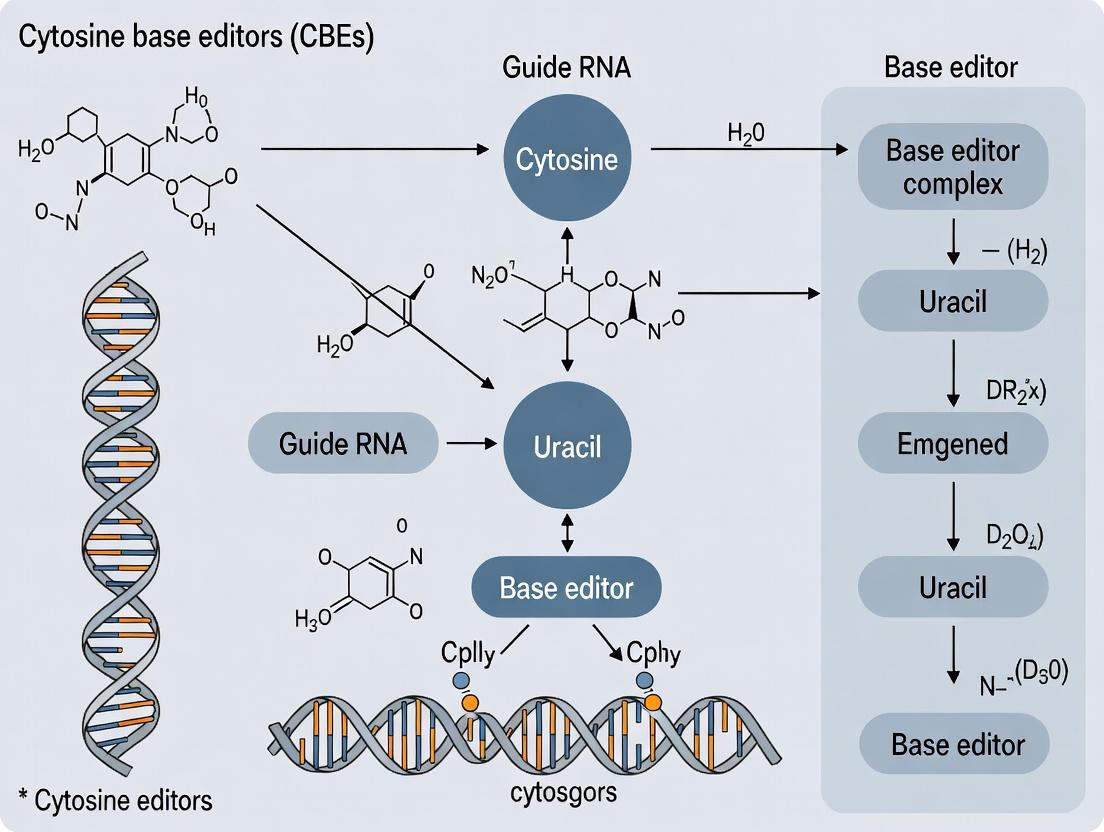
This article provides a comprehensive overview of cytosine base editors (CBEs), a transformative class of precision gene editing tools.
Precision Gene Editing: A Detailed Guide to How Cytosine Base Editors (CBEs) Work and Their Applications in Biomedicine
Abstract
This article provides a comprehensive overview of cytosine base editors (CBEs), a transformative class of precision gene editing tools. It explores the foundational molecular architecture of CBEs, detailing how they combine a deaminase enzyme with a CRISPR-Cas system to achieve programmable C•G to T•A base pair conversion without creating double-strand DNA breaks. The guide covers methodological workflows for experimental design, delivery, and application across diverse research and therapeutic contexts. It addresses common challenges in efficiency, specificity, and off-target effects, offering troubleshooting and optimization strategies. Finally, the article validates and compares current CBE variants, assessing their performance against other gene editing modalities. Aimed at researchers, scientists, and drug development professionals, this resource synthesizes the latest advances to inform the effective and responsible use of CBEs in genetic research and therapeutic development.
Understanding CBE Fundamentals: From Molecular Architecture to Precise C-to-T Conversion
Base editors represent a transformative advancement in precision genome editing, enabling targeted, irreversible conversion of a single DNA base without inducing double-strand breaks (DSBs). This technical guide deconstructs the core components of Cytosine Base Editors (CBEs) within the critical research context: How do cytosine base editors (CBEs) work? The fundamental mechanism involves the programmable targeting of a cytidine deaminase enzyme to a specific genomic locus via a catalytically impaired Cas protein guided by a single guide RNA (gRNA), resulting in the conversion of C•G to T•A.
The Core Triad: Function and Evolution
Cytidine Deaminase: The active enzyme component. It catalyzes the hydrolytic deamination of cytidine (or methylcytidine) to uridine (or thymidine) in single-stranded DNA (ssDNA). In the cell, this uridine is read as thymidine, leading to a C•G to T•A change after DNA repair or replication.
- Common Source: The APOBEC (Apolipoprotein B mRNA Editing Catalytic Polypeptide-like) family, notably rat APOBEC1 (rAPOBEC1), is widely used in first-generation CBEs. Newer variants leverage engineered human APOBEC3A (hA3A) or evoAPOBEC1 for altered sequence context preferences (e.g., relaxed 5'-TC context) and reduced off-target editing.
Cas Protein (nickase): The programmable DNA-binding component. CBEs predominantly use a Cas9 nickase (nCas9) with a D10A mutation that inactivates one of its two nuclease domains, allowing it to nick the non-edited strand but not create a DSB. Its primary function is to locally unwind the DNA duplex, creating an R-loop and exposing a transient ssDNA "bubble" for the deaminase to act upon. The use of nCas9 minimizes indel formation while improving editing efficiency by directing cellular repair to the edited strand.
Single Guide RNA (gRNA): The targeting component. A ~20-nucleotide sequence within the gRNA determines the specificity of the nCas9-deaminase fusion protein via Watson-Crick base pairing with the target DNA strand (the "non-target strand" for editing). The Protospacer Adjacent Motif (PAM) sequence, recognized by Cas9, defines the editable window, typically positioned within nucleotides 4-10 (protospacer positions 1-18) for canonical SpCas9-based CBEs.
Quantitative Performance Metrics of CBE Components
The performance of a CBE is defined by the interplay of its components. Key metrics are summarized below.
Table 1: Performance Characteristics of Common CBE Architectures
| CBE System (Example) | Core Deaminase | Cas Protein | Editing Window* | Typical Efficiency (in mammalian cells)* | Primary Sequence Context Preference | Key Advantage(s) |
|---|---|---|---|---|---|---|
| BE3 / BE4 | rAPOBEC1 | SpCas9 (D10A) | ~C4-C8 (≈ positions 4-8) | 20-50% | 5'-TC preferred | Standard, well-validated architecture. |
| Target-AID | PmCDA1 | SpCas9 (D10A) | ~C3-C9 | 15-40% | 5'-YC (Y = C/T) | Compact deaminase, efficient in various systems. |
| BE4 with hA3A | hAPOBEC3A | SpCas9 (D10A) | ~C3-C10 | 30-60% | Relaxed (5'-RC, R = A/G) | Broader sequence targeting, higher on-target efficiency. |
| evoFERNY | evoAPOBEC1 | SpCas9 (D10A) | ~C2-C9 | 40-70% | Nearly context-independent | High efficiency with minimal sequence constraint. |
| SECURE (BE3 variant) | rAPOBEC1 (R33A) | SpCas9 (D10A) | ~C4-C8 | 15-35% | 5'-TC | Greatly reduced RNA off-target editing. |
| CBE with xCas9 | rAPOBEC1 | xCas9 (D10A) | Varies with PAM | 10-30% | 5'-TC | Broader PAM recognition (NG, GAA, GAT). |
*Editing window and efficiency are highly dependent on specific target sequence, cell type, and delivery method. Values represent common ranges observed in literature.
Table 2: Quantitative Analysis of On-Target vs. Off-Target Effects (Representative Data)
| CBE Variant | Avg. On-Target Editing (%) | Indel Formation (%)* | gRNA-Dependent DNA Off-Targets (relative to BE3) | gRNA-Independent / RNA Off-Targets (relative to BE3) |
|---|---|---|---|---|
| BE3 | 44.2 | 1.2 | 1.0 (baseline) | 1.0 (baseline) |
| BE4max | 51.7 | 0.8 | ~0.8-1.2 | ~1.0-1.5 |
| SECURE-BE3 | 28.5 | 0.9 | ~1.0 | < 0.01 |
| YE1-BE3-FNLS* | 18.3 | <0.5 | ~0.1-0.3 | < 0.05 |
*Higher-fidelity variants often trade off some efficiency for specificity. *RNA off-targets refer to promiscuous deamination of cellular RNA transcripts.*
Detailed Experimental Protocol: Evaluating CBE Efficiency and Specificity
Protocol: Mammalian Cell Transfection and Deep Sequencing Analysis of CBE Activity
Objective: To quantify on-target editing efficiency, product purity (indel %), and byproduct distribution (e.g., C-to-G, C-to-A) at a defined genomic locus.
Materials & Reagents:
- Cell Line: HEK293T or other relevant adherent cell line.
- CBE Plasmid: Expression plasmid encoding the CBE (e.g., nCas9-deaminase-UGI) under a CMV or EF1α promoter.
- gRNA Plasmid: U6-promoter driven expression plasmid for the target-specific gRNA.
- Transfection Reagent: Polyethylenimine (PEI, 1 mg/mL) or commercial lipid-based reagent (e.g., Lipofectamine 3000).
- Lysis Buffer: QuickExtract DNA Extraction Solution or similar.
- PCR Reagents: High-fidelity polymerase (e.g., Q5, KAPA HiFi), dNTPs, target-specific primers.
- Sequencing: Illumina MiSeq or NovaSeq platform with custom primers for amplicon sequencing.
Procedure:
- Cell Seeding: Seed 2.5 x 10⁵ HEK293T cells per well in a 24-well plate 18-24 hours before transfection.
- Transfection Complex Formation:
- For PEI: Dilute 0.5 µg CBE plasmid + 0.25 µg gRNA plasmid in 50 µL Opti-MEM. Add 1.5 µL PEI (1 mg/mL), vortex, incubate 15 min at RT.
- For Lipofectamine 3000: Follow manufacturer's protocol for plasmid DNA.
- Transfection: Add complex dropwise to cells. Include controls: CBE plasmid only, gRNA plasmid only, and untransfected cells.
- Harvest: Incubate cells for 72 hours. Aspirate media, wash with PBS, and lyse cells in 50 µL QuickExtract buffer at 65°C for 15 min, then 98°C for 10 min.
- Target Amplification: Perform PCR on 2 µL lysate using locus-specific primers with overhangs for Illumina sequencing indices. Use ≤ 25 cycles.
- Amplicon Purification & Library Prep: Purify PCR products via magnetic beads. Perform a second, limited-cycle PCR to attach dual indices and full Illumina adapters.
- Sequencing & Analysis: Pool libraries, quantify, sequence on a MiSeq (2x250 bp). Align reads to reference using BWA or similar. Use CRISPResso2, BE-Analyzer, or custom scripts to quantify base conversion percentages, indels, and other substitutions at the target site.
Visualizing the CBE Mechanism and Experimental Workflow
The Scientist's Toolkit: Essential Research Reagents
Table 3: Key Research Reagent Solutions for CBE Studies
| Reagent / Material | Function in CBE Research | Example / Notes |
|---|---|---|
| CBE Expression Plasmids | Deliver the core editor components (nCas9-deaminase-UGI) into cells. | BE4max (Addgene #112093), A3A-BE3 (Addgene #140002). Essential for initial testing. |
| gRNA Cloning Vectors | Enable rapid insertion of target-specific 20nt spacer sequences for expression. | pU6-sgRNA (Addgene #52694) or all-in-one vectors containing both CBE and gRNA. |
| High-Fidelity Polymerase | Accurate amplification of the target genomic locus from cell lysates for sequencing. | Q5 (NEB), KAPA HiFi HotStart. Critical to avoid PCR errors that confound editing analysis. |
| Next-Gen Sequencing Kit | Prepare amplicon libraries from PCR products for deep sequencing. | Illumina Nextera XT, NEBNext Ultra II FS DNA. Enables multiplexing of many targets. |
| CRISPResso2 Software | Bioinformatic tool specifically designed to quantify editing outcomes from NGS data. | Quantifies base conversions, indels, and provides visualization. Standard in the field. |
| PEI Max / Lipofectamine | Chemical transfection reagents for delivering plasmids into mammalian cell lines. | PEI Max (Polysciences) is cost-effective; Lipofectamine 3000 (Thermo) offers high efficiency. |
| Synthetic gRNA + Cas9 Protein | For RNP (Ribonucleoprotein) delivery of CBEs, reducing off-target DNA exposure time. | Chemically synthesized gRNA + purified nCas9-deaminase fusion protein. Increases specificity. |
| Uracil DNA Glycosylase Inhibitor (UGI) | A component fused to CBEs; blocks base excision repair of U:G mismatch, improving efficiency. | Included in most CBE architectures (e.g., BE3, BE4). Also available as a separate recombinant protein. |
Cytosine Base Editors (CBEs) are precision genome editing tools that enable the direct, irreversible conversion of a cytosine (C) to a thymine (T) within a window of single-stranded DNA without generating double-strand breaks (DSBs). This whitepaper elucidates the core molecular mechanism of CBEs—programmable deamination—framed within the broader research thesis of How do cytosine base editors (CBEs) work?. We detail the architecture, kinetics, and experimental methodologies underpinning this technology, providing a technical guide for researchers and drug development professionals.
Core Mechanism: From Programmable Binding to Targeted Deamination
The central dogma of CBEs is a three-step process: 1) CRISPR-Cas-derived programmable DNA binding, 2) local DNA unwinding and R-loop formation, and 3) enzymatic deamination of cytosine within a transient single-stranded DNA bubble. This avoids the error-prone DNA repair pathways triggered by DSBs.
Molecular Architecture
A canonical CBE is a fusion protein consisting of:
- A catalytically impaired Cas9 variant (dCas9 or nickase Cas9, nCas9) that retains DNA binding ability but cannot cleave both DNA strands. nCas9 (e.g., D10A mutation) introduces a nick in the non-edited strand.
- A cytidine deaminase enzyme (e.g., rat APOBEC1, human APOBEC3A, or CDA1) that catalyzes the hydrolytic deamination of cytosine to uracil (U) within single-stranded DNA.
- A linker that optimizes spatial positioning of the deaminase.
- A uracil glycosylase inhibitor (UGI) domain that prevents excision of the product Uracil by cellular base excision repair (BER), thereby increasing editing efficiency and product purity.
Diagram Title: Core CBE Mechanism: From Binding to Base Conversion
Quantitative Performance Landscape of Common CBEs
Table 1: Characteristics of Prominent Cytosine Base Editors
| CBE Name (Deaminase) | Cas9 Variant | Editing Window (Position from PAM) | Typical Editing Efficiency (%) | Primary Product (C→T) | Key Reference (Example) |
|---|---|---|---|---|---|
| BE3 (rAPOBEC1) | nCas9 (D10A) | ~4-8 (C4-C8) | 20-60 | C•G to T•A | Komor et al., Nature, 2016 |
| BE4max (rAPOBEC1) | nCas9 (D10A) | ~4-8 (C4-C8) | 40-80 | C•G to T•A | Koblan et al., Nat. Biotechnol., 2018 |
| A3A-BE3 (hAPOBEC3A) | nCas9 (D10A) | ~1-5 (C1-C5) | 30-70 | C•G to T•A | Wang et al., Nat. Biotechnol., 2018 |
| eA3A-BE4max (evoAPOBEC3A) | nCas9 (D10A) | ~2-4 (C2-C4) | 50-90 | C•G to T•A | Gehrke et al., Science, 2018 |
| Target-AID (pmCDA1) | nCas9 (D10A) | ~1-7 (C1-C7) | 10-40 | C•G to T•A | Nishida et al., Science, 2016 |
| CBE4 (Anc689) | nCas9 (D10A) | ~4-10 (C4-C10) | 20-50 | C•G to T•A | Sürün et al., NAR, 2020 |
Data is representative and varies by cell type, target sequence, and delivery method.
Detailed Experimental Protocol: Assessing CBE Activity In Vitro
This protocol outlines a key experiment for quantifying CBE activity and specificity using next-generation sequencing (NGS) in mammalian cells.
Materials and Reagents
Table 2: Research Reagent Solutions for CBE Validation
| Reagent/Material | Function/Description | Example Vendor/Catalog |
|---|---|---|
| CBE Expression Plasmid | Encodes CBE fusion protein (nCas9-Deaminase-UGI) under a mammalian promoter (e.g., CAG, EF1α). | Addgene (various deposits) |
| sgRNA Expression Vector | Encodes target-specific sgRNA under a U6 or other Pol III promoter. | Synthesized or cloned |
| HEK293T Cells | Commonly used, easily transfected cell line for initial validation. | ATCC |
| Transfection Reagent | For plasmid delivery (e.g., lipofection, electroporation reagent). | PEI Max, Lipofectamine 3000 |
| Genomic DNA Extraction Kit | Isolate genomic DNA 3-7 days post-transfection. | QIAamp DNA Blood Mini Kit |
| PCR Primers | Amplify target genomic locus (with Illumina adapters for NGS). | IDT |
| High-Fidelity DNA Polymerase | For specific, low-error PCR amplification of target. | Q5 Hot-Start (NEB) |
| NGS Library Prep Kit | Prepare amplicon libraries for deep sequencing. | Nextera XT (Illumina) |
| Bioinformatics Pipeline | Analyze sequencing data for editing efficiency and byproducts. | CRISPResso2, BE-Analyzer |
Step-by-Step Methodology
- Target Selection & sgRNA Design: Choose a target site with a canonical NGG PAM (for SpCas9-derived CBE). Design sgRNA to position target cytosines within the editor's activity window (typically positions 4-8). Include off-target control sites.
- Plasmid Construction: Clone the target sgRNA sequence into the sgRNA expression vector. The CBE plasmid is often pre-constructed.
- Cell Transfection: Seed HEK293T cells in a 24-well plate. Co-transfect 500ng CBE plasmid and 250ng sgRNA plasmid per well using the transfection reagent per manufacturer's protocol. Include controls (sgRNA only, CBE only).
- Harvest & Genomic DNA Extraction: Incubate cells for 72-96 hours. Harvest cells and extract genomic DNA using a commercial kit. Quantify DNA.
- Target Locus Amplification: Perform PCR using high-fidelity polymerase with primers containing partial Illumina adapter sequences. Validate PCR product size by gel electrophoresis.
- NGS Library Preparation & Sequencing: Clean PCR products and index them in a second PCR to add full Illumina adapters and sample-specific barcodes. Pool libraries, quantify, and sequence on an Illumina MiSeq or HiSeq platform (aim for >10,000x read depth per sample).
- Data Analysis: Use CRISPResso2 or a similar tool. Input fastq files and provide the amplicon reference sequence and sgRNA sequence. The output quantifies:
- Editing Efficiency: Percentage of reads with C→T conversions within the activity window.
- Product Purity: Percentage of edited reads containing only the desired C→T change(s).
- Indel Frequency: Percentage of reads with insertions/deletions (should be <1% for an ideal CBE).
- Off-Target Deamination: Assess by sequencing predicted off-target sites.
Pathway Visualization: Cellular Fate of CBE-Induced Uracil
The U•G mismatch created by the deaminase is resolved through cellular DNA repair and replication pathways, determining the final edit outcome.
Diagram Title: Cellular Resolution Pathways for a CBE-Created U•G Mismatch
Advanced Considerations and Future Directions
Recent research within the thesis framework focuses on overcoming limitations:
- Reducing Off-Targets: Protein engineering to minimize deaminase activity on single-stranded DNA in trans (non-target ssDNA, RNA).
- Improving Product Purity: Development of "dual-UGI" fusions or engineered glycosylase inhibitors to further suppress unwanted BER.
- Altering Editing Windows: Using Cas9 variants with different PAM requirements or fusing deaminases with different processivity and window profiles.
- Mitigating Cas-Independent Off-Targets: Identifying and engineering deaminase variants (e.g., SECURE-CBEs) with reduced random genomic and transcriptomic deamination.
The evolution of CBEs continues towards higher fidelity, specificity, and a broader targeting scope, solidifying their role as indispensable tools for precise gene correction, disease modeling, and therapeutic development—all achieved without the genomic instability risks associated with double-strand breaks.
Cytosine base editors (CBEs) are a transformative technology in precision genome editing, enabling the direct, programmable conversion of a C•G base pair to T•A without inducing double-strand DNA breaks. Their core functionality is derived from natural cytidine deaminase enzymes, which catalyze the hydrolytic deamination of cytidine to uridine. This technical guide explores the evolutionary origins, structural mechanisms, and functional adaptations of the key deaminase families—notably APOBEC1 and AID—that form the foundation of CBE engineering, framed within the broader thesis of understanding CBE function and optimization.
Evolutionary Origins and Functional Divergence
The foundation of CBEs lies in the AID/APOBEC family of zinc-dependent deaminases. These enzymes evolved from a common ancestral cytidine deaminase and diverged to fulfill specialized roles in innate immunity and RNA/DNA editing.
- APOBEC1 (Apolipoprotein B mRNA Editing Catalytic Polypeptide 1): The prototypical RNA editor. Discovered as the enzyme responsible for the site-specific C-to-U editing of APOB mRNA in the mammalian intestine, it requires auxiliary factors (e.g., A1CF) for specificity and activity. Its high catalytic efficiency on single-stranded RNA made it the initial deaminase of choice for first-generation CBEs when fused to Cas9.
- AID (Activation-Induced Deaminase): A DNA-specific deaminase critical for somatic hypermutation and class switch recombination in antibody diversification. AID operates on single-stranded DNA exposed during transcription, introducing targeted mutations in immunoglobulin genes. Its DNA-targeting nature and processivity provided a blueprint for improving CBE efficiency and specificity.
- Other APOBEC Family Members (APOBEC3s): A cluster of enzymes that evolved primarily as antiviral restriction factors, deaminating cytosines in viral cDNA (e.g., HIV). They exhibit varying sequence context preferences (e.g., -1T for many APOBEC3s) and are a rich source of diversity for engineering CBEs with altered sequence compatibility and reduced off-target editing.
Table 1: Key AID/APOBEC Deaminase Family Members and Their Characteristics
| Deaminase | Primary Natural Substrate | Key Biological Role | Sequence Context Preference (5'→3') | Relevance to CBE Development |
|---|---|---|---|---|
| APOBEC1 | Single-stranded RNA | mRNA editing (ApoB) | Upstream AU-rich elements (for RNA); loose DNA preference (e.g., -1T/-1C) | First deaminase used in CBEs (BE1-BE4). Moderate activity, off-target RNA editing. |
| AID | Single-stranded DNA | Antibody diversification (SHM, CSR) | WRC (W=A/T, R=A/G) motif | Inspired DNA-targeting fusions. Engineered hyperactive variants (e.g., evoAID, AID*) improve CBE efficiency. |
| APOBEC3A (A3A) | Single-stranded DNA | Antiviral defense | 5'TC motif | High activity, broadened targeting range (non-TC contexts in engineered forms). |
| APOBEC3G (A3G) | Single-stranded DNA | Antiviral defense (HIV) | 5'CC motif | Used to create CC-context preferring CBEs, expanding targeting space. |
| CBE Ancestor (predicted) | Cytidine/Deoxycytidine | Nucleotide metabolism | Not defined | Root of AID/APOBEC evolutionary tree. |
Structural Mechanisms and Catalysis
All AID/APOBEC deaminases share a conserved core structure featuring a central five-stranded β-sheet surrounded by six α-helices. The catalytic site coordinates a zinc ion (Zn²⁺) via a conserved motif (HxE-PCxxC), where the glutamic acid and two cysteines are essential for activating water for nucleophilic attack on cytosine's C4 position. Key structural variations in loops, particularly loops 1, 3, and 7, dictate substrate specificity (ssDNA vs. RNA), processivity, and sequence context preference.
Diagram: Deaminase Catalytic Mechanism and CBE Architecture
Experimental Protocols for Deaminase Characterization and CBE Evaluation
Protocol 1: In Vitro Deaminase Activity Assay (Fluorometric)
- Objective: Quantify deaminase catalytic rate and substrate preference.
- Materials: Purified deaminase enzyme, fluorescently labeled ssDNA/RNA oligo substrate (e.g., FAM-labeled), reaction buffer (50 mM HEPES pH 7.5, 50 mM KCl, 1 mM DTT, 0.1 mg/mL BSA), UDG (Uracil DNA Glycosylase), APE1 (Apurinic/apyrimidinic endonuclease).
- Method:
- Incubate deaminase (0-100 nM) with substrate (50 nM) in reaction buffer at 37°C for 10-30 min.
- Heat-inactivate at 75°C for 15 min.
- Add UDG (1 unit) and APE1 (1 unit) to cleave the uracil-containing product. Incubate 1 hr at 37°C.
- Resolve cleavage products via denaturing PAGE or capillary electrophoresis. Quantify product formation (cleaved FAM-fragment) vs. intact substrate.
- Calculate kinetic parameters (kcat, KM) using Michaelis-Menten analysis.
Protocol 2: Cellular CBE Editing Efficiency and Specificity Analysis (Targeted Sequencing)
- Objective: Measure on-target editing efficiency and genome-wide off-target profiles of a CBE variant.
- Materials: HEK293T or relevant cell line, CBE expression plasmid (e.g., BE4max), transfection reagent, genomic DNA extraction kit, PCR primers for on-target locus, GUIDE-seq or Digenome-seq reagents for off-target discovery, high-throughput sequencer.
- Method:
- Transfection: Co-transfect cells with CBE plasmid and target-specific sgRNA plasmid.
- Harvest: Extract genomic DNA 72-96 hrs post-transfection.
- On-Target Analysis: Amplify target locus by PCR, prepare sequencing libraries, and perform deep sequencing (≥10,000x coverage). Analyze C-to-T editing frequency within the editing window (typically positions 4-10, protospacer).
- Off-Target Analysis (GUIDE-seq): Transfect with an end-protected dsODN tag. Extract DNA, tag-integrate and enrich via PCR, sequence, and bioinformatically map potential off-target sites for validation by amplicon sequencing.
The Scientist's Toolkit: Research Reagent Solutions
| Reagent/Material | Supplier Examples | Function in CBE/Deaminase Research |
|---|---|---|
| APOBEC1, AID, A3A Purified Proteins | RayBiotech, Sino Biological, in-house purification | For in vitro biochemical assays to determine kinetics, substrate specificity, and structural studies. |
| BE4max, ABE8e Plasmid Kits | Addgene (#112093, #138489) | Benchmark CBE and ABE plasmids for comparative editing studies and as backbone for new deaminase fusions. |
| Uracil Glycosylase Inhibitor (UGI) | NEB, Thermo Fisher | Essential component of CBEs to prevent uracil excision and improve editing efficiency by blocking base excision repair. |
| Target-seq or Guide-seq Kits | Integrated DNA Technologies, NEB | Streamlined kits for comprehensive on-target and genome-wide off-target editing analysis via next-generation sequencing. |
| Cas9 Nickase (D10A) Stable Cell Lines | Thermo Fisher, GenScript | Provide a consistent cellular background for evaluating novel deaminase-CBE fusions without Cas9 transfection variability. |
| Chemically Modified sgRNAs | Synthego, Dharmacon | Enhance CBE delivery efficiency and editing yields, especially in primary cells, via improved stability and RNP compatibility. |
| C-to-T Base Editor Sensor Cell Lines | TaKaRa, in-house engineering | Reporter cell lines (e.g., GFP recovery via C-to-T edit) for rapid, flow-cytometry-based screening of CBE variant activity. |
| Structural Analysis Software (HADDOCK, PyMOL) | BioSOFT, Schrödinger | For modeling deaminase-DNA interactions and rational engineering of deaminase variants with altered properties. |
The evolution of deaminases from RNA/DNA editors and antiviral factors into the engineered core of CBEs exemplifies how understanding natural protein evolution enables transformative biotechnology. Current research focuses on evolving deaminases with narrowed editing windows (e.g., SECURE-CBEs), altered PAM compatibility via Cas fusion, and minimized off-target editing (both DNA and RNA). Insights from the structural and mechanistic divergence of AID, APOBEC1, and the APOBEC3 family continue to guide the rational design of next-generation base editors with enhanced precision for research and therapeutic applications.
This article is presented within the context of a broader thesis on the mechanisms of cytosine base editors (CBEs), focusing on a critical parameter governing their precision and efficacy.
Cytosine base editors (CBEs) are engineered molecular machines that enable the direct, programmable conversion of a C•G base pair to a T•A base pair without inducing double-stranded DNA breaks. Their architecture typically comprises a catalytically impaired Cas9 (Cas9n) fused to a cytidine deaminase enzyme (e.g., APOBEC1) and a uracil glycosylase inhibitor (UGI). The "editing window" refers to a narrow region of single-stranded DNA within the R-loop formed by Cas9-sgRNA binding, where deamination can occur. The precise position of the target cytosine within the protospacer, relative to the Protospacer Adjacent Motif (PAM), is a primary determinant of editing outcome, defining the functional editing window and its constraints.
Quantitative Analysis of Editing Window Constraints
The efficiency of deamination varies significantly with the position of the target cytosine. The following table summarizes typical position-dependent editing efficiency data for first- and second-generation CBEs, compiled from recent studies.
Table 1: Position-Dependent Editing Efficiency of Representative CBEs
| CBE Variant | Deaminase | Primary Editing Window (PAM-distal position #) | Peak Efficiency Position(s) | Typical Efficiency at Peak (%) | Key Constraint Factor |
|---|---|---|---|---|---|
| BE1/BE2 | APOBEC1 | 4-8 (C4 to C8) | C5, C6, C7 | 15-40 | ssDNA exposure, UGIs, processivity |
| BE3/BE4 | APOBEC1 | 4-10 (C4 to C10) | C5-C8 | 30-60 | UGI inclusion, Cas9n variant |
| evoAPOBEC1-BE4max | evoAPOBEC1 | 2-12 (C2 to C12) | C4-C9 | 50-80 | Evolved deaminase, extended ssDNA access |
| AID-CBE (Target-AID) | AID | 2-7 (C2 to C7) | C3-C6 | 20-50 | Different deaminase ssDNA preference |
| CBE4max-SpRY | APOBEC1 | 4-15+ | Broad, variable | 10-70 | PAM-less SpRY Cas9, window defined by R-loop |
The table illustrates the expansion of the editing window from early BE3 (positions 4-10) to evolved systems like BE4max (positions 2-12), highlighting how protein engineering directly impacts positional constraints.
Experimental Protocol: Mapping the Editing Window
A standard experiment to define the protospacer position constraints for a novel CBE involves deep sequencing of a multi-cytosine target site.
Protocol: Editing Window Profiling via Deep Sequencing
- Design of Target Plasmid: Clone a 200-300 bp genomic locus of interest, or a synthetic sequence, into a standard plasmid backbone. The target sequence must contain a suitable PAM and a protospacer with cytosines distributed across all potential positions (e.g., C1 to C20).
- Cell Transfection: Transfect HEK293T cells (or another relevant cell line) in triplicate with:
- Experimental: Plasmid expressing the CBE of interest + plasmid expressing the target-specific sgRNA.
- Controls: sgRNA-only and CBE-only plasmids.
- Harvesting Genomic DNA: 72 hours post-transfection, harvest cells and extract genomic DNA using a silica-column-based kit.
- PCR Amplification: Amplify the target locus using high-fidelity PCR with primers containing Illumina adapter overhangs. Use a minimal number of cycles (≤25) to prevent PCR-generated mutations.
- Library Preparation & Sequencing: Index the amplicons with dual indices via a second, limited-cycle PCR. Purify the library and quantify via qPCR. Sequence on an Illumina MiSeq or NextSeq platform to achieve >10,000x coverage per sample.
- Data Analysis: Align sequencing reads to the reference sequence. For each cytosine position within the protospacer, calculate the percentage of reads showing a C-to-T (or G-to-A on the opposite strand) conversion. Plot editing efficiency (%) against cytosine position number (PAM-distal 1 to ~20) to visualize the editing window.
Visualizing CBE Mechanism and Editing Window Determination
The following diagrams illustrate the core mechanism of CBEs and the experimental workflow for defining the editing window.
Diagram Title: Mechanism of Cytosine Base Editors (CBEs)
Diagram Title: Editing Window Determination Workflow
The Scientist's Toolkit: Research Reagent Solutions
Table 2: Essential Reagents for CBE Editing Window Analysis
| Item | Function in Experiment | Example/Notes |
|---|---|---|
| CBE Expression Plasmid | Expresses the base editor fusion protein (nCas9-deaminase-UGI). | pCMV_BE4max (Addgene #112093). Critical to use a validated, high-activity construct. |
| sgRNA Expression Plasmid/Vector | Expresses the single guide RNA targeting the locus of interest. | pU6-sgRNA (Addgene #41824). sgRNA sequence must be designed with a suitable PAM. |
| Target Plasmid (Multi-C) | Contains the target sequence with cytosines across all positions for window profiling. | Custom cloning required. Ensures assessment of all potential deamination sites. |
| Cell Line | Cellular context for editing. | HEK293T (high transfection efficiency) or relevant primary/therapeutic cell types. |
| Transfection Reagent | Delivers plasmids into cells. | Polyethylenimine (PEI) for HEK293T; Lipofectamine CRISPRMAX for harder-to-transfect cells. |
| High-Fidelity PCR Kit | Amplifies target locus with minimal error. | KAPA HiFi HotStart ReadyMix. Essential to prevent background noise in sequencing. |
| Illumina-Compatible Indexing Primers | Adds unique barcodes to amplicons for multiplexed sequencing. | Nextera XT Index Kit v2. Allows pooling of multiple samples in one sequencing run. |
| Next-Generation Sequencer | Provides deep, quantitative sequencing of the target amplicon. | Illumina MiSeq. 300-cycle kit provides ample read length and depth for analysis. |
| Sequence Analysis Pipeline | Aligns reads and quantifies base conversions. | CRISPResso2, BE-Analyzer, or custom Python scripts. Required for accurate efficiency calculation. |
Implications for Research and Therapy
Understanding protospacer position constraints is non-negotiable for effective CBE application. In basic research, it dictates sgRNA design to place the target cytosine within the optimal window (e.g., positions 4-8 for BE4). In therapeutic contexts, these constraints can limit the number of disease-relevant SNPs that are editable, driving the development of engineered CBEs with widened or altered windows (e.g., using evolved deaminases or Cas9 variants with different R-loop dynamics). Furthermore, position affects bystander editing—the conversion of non-target Cs within the window—which is a major consideration for minimizing off-target effects within the target site. Therefore, navigating the editing window by strategically designing sgRNAs and selecting the appropriate CBE variant is fundamental to precise genome engineering.
This whitepaper details the evolution of Cytosine Base Editors (CBEs), a transformative class of gene-editing tools derived from CRISPR-Cas systems. Within the broader thesis on "How do cytosine base editors (CBEs) work?", this document provides a technical guide to their core architecture, historical progression, and experimental characterization.
CBEs create targeted C•G to T•A base pair conversions without requiring double-stranded DNA breaks (DSBs). The core fusion protein consists of a catalytically impaired Cas9 variant (e.g., dCas9 or nCas9) linked to a cytidine deaminase enzyme (e.g., rAPOBEC1). The nCas9 creates a single-strand nick in the non-edited strand, biasing DNA repair to incorporate the edited base.
Historical Milestones and Quantitative Evolution
The development of CBEs has been marked by sequential engineering to improve efficiency, product purity, and reduce off-target effects.
Table 1: Evolution of Key CBE Variants
| Variant (Year) | Core Components | Key Innovation | Average Editing Efficiency (%)* | Window (positions from PAM) | Key Reference |
|---|---|---|---|---|---|
| BE1 (2016) | dCas9 + rAPOBEC1 | Proof-of-concept; no strand nicking. | 5-15 | ~positions 13-17 | Komor et al., Nature, 2016 |
| BE2 (2016) | nCas9 (D10A) + rAPOBEC1 + UGI | Added UGI to inhibit uracil excision; improved efficiency. | 20-40 | ~positions 13-17 | Komor et al., Nature, 2016 |
| BE3 (2016) | nCas9 (D10A) + rAPOBEC1 + UGI | Canonical architecture; standard for comparison. | 30-60 | ~positions 13-17 | Komor et al., Nature, 2016 |
| BE4 (2017) | nCas9 + rAPOBEC1 + 2xUGI | Second UGI copy; improved product purity & reduced indels. | 40-70 | ~positions 13-17 | Komor et al., Nat. Biotechnol., 2017 |
| Target-AID (2016) | nCas9 + PmCDA1 | Alternative deaminase (sea lamprey); narrower window. | 10-40 | ~positions 14-17 | Nishida et al., Science, 2016 |
| eBE (2019) | nCas9 + evolved rAPOBEC1 variant | Engineered deaminase; reduced off-target RNA editing. | 50-75 | ~positions 13-17 | Grunewald et al., Nature, 2019 |
| BE4max (2020) | nCas9 + rAPOBEC1* + 2xUGI | Codon-optimized & nuclear-localized; higher efficiency in cells. | 60-80 | ~positions 13-17 | Koblan et al., Nat. Biotechnol., 2020 |
| SECURE-SpCas9 BE3 (2020) | Engineered nCas9 + rAPOBEC1 | Mutations in SpCas9 to reduce RNA off-targets. | 30-50 (with reduced RNA off-targets) | ~positions 13-17 | Grünewald et al., Nature, 2020 |
| YE1-BE3-FNLS (2021) | nCas9 + rAPOBEC1 (YE1) variant | High-fidelity deaminase mutant; minimizes Cas-independent DNA/RNA off-targets. | 20-50 (with high on-target specificity) | ~positions 13-17 | Doman et al., Nat. Biotechnol., 2021 |
| AncBE4max (2022) | nCas9 + Anc689 + 2xUGI | Ancestral reconstruction of deaminase; improved activity & specificity. | 60-85 | ~positions 13-17 | Chen et al., Nat. Biotechnol., 2022 |
*Efficiencies are approximate, averaged across multiple genomic loci in mammalian cells.
Core Experimental Protocol: Evaluating a Novel CBE Variant
The following methodology outlines a standard workflow for characterizing a new CBE construct.
Protocol: In-Cell Editing Efficiency and Product Purity Analysis
Objective: To quantify on-target C•G to T•A editing efficiency and byproduct formation (indels, undesired base edits) of a CBE variant in HEK293T cells.
Materials (See Section 5: The Scientist's Toolkit)
- Cell Culture: HEK293T cells, DMEM complete medium, transfection reagent (e.g., PEI or lipofectamine).
- Plasmids:
- Test: pCMV-[CBE variant]-NLS expression plasmid.
- Control: pCMV-BE4max (positive control), empty vector (negative control).
- Targeting: pU6-sgRNA expression plasmid (targeting a well-characterized locus, e.g., HEK3 site 4).
- Genomic Analysis: QuickExtract DNA Solution, PCR Master Mix, Sanger sequencing primers, NGS library prep kit, bioinformatics pipeline (e.g., CRISPResso2).
Detailed Procedure:
- Cell Seeding & Transfection: Seed 2e5 HEK293T cells per well in a 24-well plate. At ~70% confluency, co-transfect cells with 500 ng of CBE plasmid and 250 ng of sgRNA plasmid using transfection reagent per manufacturer's protocol.
- Harvest Genomic DNA: 72 hours post-transfection, aspirate medium, add 100 μL of QuickExtract DNA Solution to each well, and incubate at 65°C for 15 min, 68°C for 15 min, then 98°C for 10 min. Dilute lysate 1:10 in nuclease-free water.
- Target Site Amplification: Perform PCR on the genomic DNA lysate using locus-specific primers that add partial Illumina adapter sequences. Purify PCR products using SPRI beads.
- Next-Generation Sequencing (NGS) Library Preparation: Add unique dual indices (i7 and i5) to the purified PCR amplicons via a second, limited-cycle PCR. Pool, purify, and quantify the final library. Sequence on an Illumina MiSeq (2x250 bp).
- Data Analysis: Use CRISPResso2 (or similar) to align sequencing reads to the reference amplicon sequence. Key output metrics include:
- % Editing Efficiency: (Number of reads with C•G to T•A conversions in the editing window / Total reads) x 100.
- % Product Purity: (Number of reads with only the desired C•G to T•A change(s) / Total edited reads) x 100.
- % Indel Frequency: (Number of reads with insertions/deletions / Total reads) x 100.
- Byproduct Analysis: Quantification of other nucleotide substitutions (e.g., C to G, C to A).
Visualizing CBE Function and Evolution
Diagram 1: The Evolution of Cytosine Base Editors
Diagram 2: CBE Molecular Mechanism: Deamination and Repair
The Scientist's Toolkit: Essential Reagents for CBE Research
Table 2: Key Research Reagent Solutions
| Item | Function in CBE Experiments | Example/Notes |
|---|---|---|
| nCas9 (D10A) Expression Plasmid | Backbone for constructing CBE fusions. Provides DNA targeting and single-strand nicking. | pCMV-BE4max is a common backbone for engineering new variants. |
| Cytidine Deaminase Expression Plasmid | Source of deaminase domain (e.g., rAPOBEC1, evoAPOBEC1, PmCDA1, Anc689). | Often cloned as a fusion with nCas9 via a linker (e.g., XTEN or (GGGGS)n). |
| Uracil Glycosylase Inhibitor (UGI) | Inhibits host uracil DNA glycosylase (UDG), preventing reversal of C-to-U edit and increasing product purity. | Typically expressed as one or two C-terminal fused domains. |
| sgRNA Expression Vector | Delivers the targeting guide RNA. Usually under a U6 promoter. | Cloning involves annealing oligos into a BsmBI or BsaI site. |
| Validated sgRNA Target Sequences | Positive control targets for benchmarking editor performance. | Common loci: HEK3 site 4, EMX1, FANCF, RNF2. |
| High-Efficiency Transfection Reagent | For delivering plasmid DNA into cultured mammalian cells. | Lipofectamine 3000, PEI Max, or electroporation systems (e.g., Neon). |
| Quick DNA Extraction Buffer | Rapid, PCR-compatible genomic DNA isolation from cultured cells. | QuickExtract DNA Solution or homemade lysis buffer. |
| NGS Library Prep Kit for Amplicons | Prepares target amplicons for high-throughput sequencing to quantify editing. | Illumina TruSeq LT, NEBNext Ultra II, or KAPA HyperPlus kits. |
| Bioinformatics Analysis Tool | Quantifies editing efficiency, purity, and byproducts from NGS data. | CRISPResso2, BE-Analyzer, or custom Python/R scripts. |
| Off-Target Assessment Service/Kits | Profiles genome-wide or transcriptome-wide off-target effects. | GUIDE-seq, CIRCLE-seq, or RNA-seq for transcriptome-wide deamination. |
CBE Protocols and Applications: From Bench to Therapeutic Pipeline
Cytosine Base Editors (CBEs) represent a major advancement in precision genome editing, enabling the direct, irreversible conversion of a C•G base pair to a T•A without generating double-strand breaks (DSBs) or requiring donor DNA templates. Within the broader research thesis of How do cytosine base editors (CBEs) work?, this guide addresses the critical translational step: applying mechanistic knowledge to practical experimental design. Selecting the optimal editor and guide RNA (gRNA) is paramount for achieving high-efficiency editing with minimal unwanted byproducts, directly impacting the success of functional genomics studies and therapeutic development.
CBE Architecture and Variant Landscape
CBEs are fusion proteins consisting of a catalytically impaired Cas9 (dCas9) or Cas9 nickase (nCas9), a cytidine deaminase enzyme, and often an inhibitor of base excision repair (e.g., uracil glycosylase inhibitor, UGI). The deaminase catalyzes the conversion of cytidine to uridine within a narrow editing window, which is then replicated as thymine.
Key CBE Variants and Their Properties:
| Variant Name | Deaminase Origin | Cas9 Scaffold | Primary Edit Window (PAM: NGG) | Key Characteristics | Common Applications |
|---|---|---|---|---|---|
| BE1 | rAPOBEC1 | dCas9 | ~ Positions 4-8 | First-generation; low efficiency due to uracil repair. | Proof-of-concept studies. |
| BE2 | rAPOBEC1 | dCas9 | ~ Positions 4-8 | + Single UGI; improved efficiency. | Historical reference. |
| BE3 | rAPOBEC1 | nCas9 (D10A) | Positions 4-8 | + Nickase activity; standard for efficiency. | General C-to-T editing. |
| BE4max | rAPOBEC1 | nCas9 (D10A) | Positions 4-8 | + Second UGI, codon/architecture optimization; higher efficiency & purity. | Standard for high-efficiency, high-purity editing. |
| evoAPOBEC1-BE4max | evoAPOBEC1 | nCas9 (D10A) | Positions 3-7 | Reduced sequence-context dependency; broadened targetability. | Sites refractory to BE4max. |
| AID-BE4max | Activation-Induced Deaminase (AID) | nCas9 (D10A) | Broader (~Pos 3-10) | Wider window but higher off-target RNA editing. | Specialized applications requiring broader window. |
| Target-AID | Petromyzon marinus cytidine deaminase (pmCDA1) | nCas9 (D10A) | Positions 2-5 (narrower) | Narrower editing window near PAM. | Precise editing at positions 2-5. |
| YE1-BE4max | rAPOBEC1 (Y130F, R132E) | nCas9 (D10A) | Positions 4-8 | Drastically reduced off-target DNA & RNA editing. | Therapeutic applications where fidelity is critical. |
| FNLS-BE4max | rAPOBEC1 (W90Y, R126E) | nCas9 (D10A) | Positions 4-8 | Very high on-target DNA editing with minimal RNA off-targets. | Balancing high on-target efficiency with fidelity. |
Recent High-Fidelity Variants (2023-2024): Emerging variants continue to address the trade-off between efficiency and specificity. Data from recent literature indicates that variants like SECURE-BE3 (mutations in rAPOBEC1) and BE4max-HF (high-fidelity Cas9 variants) offer further reductions in off-target effects while maintaining robust on-target activity.
gRNA Design: Principles and Optimization
The gRNA is not merely a targeting moiety; its sequence profoundly influences editing efficiency, precision, and byproduct profile.
Critical gRNA Design Parameters:
| Parameter | Consideration | Impact on Experiment |
|---|---|---|
| Targeted C Position | Must lie within the edit window of the chosen CBE (e.g., C4-C8 for BE4max). | Primary determinant of success. Use in silico tools to scan target sequence. |
| Sequence Context (Motif) | rAPOBEC1 prefers 5'-TC-3' (C in a TpC context). evoAPOBEC1 has relaxed context. | Influences efficiency. Avoid disfavored contexts (e.g., 5'-GC-3') for rAPOBEC1. |
| gRNA Length | Standard 20-nt spacer. Truncated (17-18 nt) "enhanced specificity" gRNAs can reduce off-targets. | May lower on-target efficiency. Useful for reducing predicted genomic off-target sites. |
| Seed Region Stability | Strong binding in the seed region (PAM-proximal 10-12 bases) is critical. | Mismatches here drastically reduce efficiency. |
| Off-Target Potential | Use algorithms (Cas-OFFinder, CHOPCHOP) to predict genomic off-target sites with up to 3-4 mismatches. | High-scoring off-targets necessitate gRNA redesign or use of high-fidelity Cas9 variants. |
| Secondary Structure | gRNA self-complementarity or target DNA secondary structure can impede binding. | Can reduce efficiency. Check via RNA folding tools. |
Integrated Experimental Protocol for Selection
This protocol outlines a systematic approach to select the optimal CBE/gRNA pair for a new target.
Phase 1: In Silico Design and Prioritization
- Target Analysis: Identify all possible gRNAs targeting your genomic region of interest (PAM: NGG for SpCas9). Ensure the target base(s) are Cs on the non-complementary strand.
- gRNA Scoring: Rank gRNAs using tools like Benchling or CRISPOR based on:
- On-target score (predicts efficiency).
- Off-target score (predicts specificity).
- Position of target C(s) relative to PAM.
- Sequence context preference.
- CBE Variant Selection: Based on your needs (efficiency vs. purity, editing window), select 2-3 candidate CBEs (e.g., BE4max for general use, YE1-BE4max for fidelity, evoAPOBEC1-BE4max for difficult contexts).
- Construct Design: Clone top 3-5 gRNAs into your expression plasmid (e.g., U6-driven sgRNA scaffold). Have plasmids for your selected CBE variants ready (e.g., CMV or CAG promoter-driven).
Phase 2: In Vitro Validation (HEK293T Cell Transfection)
- Goal: Rapid, quantitative comparison of gRNA/CBE combinations.
- Protocol:
- Seed HEK293T cells in 96-well plates.
- Co-transfect cells with a constant amount of each CBE plasmid and individual gRNA plasmids. Include a non-targeting gRNA control and a GFP-only transfection control.
- Harvest genomic DNA 72-96 hours post-transfection.
- PCR & Sequencing: Amplify the target region by PCR and submit for Sanger or next-generation sequencing (NGS).
- Analysis: Use NGS data analysis tools (e.g., BE-Analyzer, Crispresso2) or quantify from Sanger traces (e.g., using EditR or TIDE) to determine:
- Editing Efficiency: % C-to-T conversion at each target base.
- Product Purity: % of desired edit vs. indels or other base substitutions (e.g., C-to-G, C-to-A).
- Editing Window Profile: Efficiency across all Cs within the window.
Phase 3: Specificity and Functional Validation
- Off-Target Assessment: For the leading 1-2 combinations from Phase 2:
- Perform NGS-based off-target screening (e.g., GUIDE-seq, CIRCLE-seq) or target the top in silico predicted off-target sites by amplicon sequencing.
- If off-target editing is concerning, switch to a high-fidelity CBE variant (e.g., YE1-BE4max) or a high-fidelity Cas9 scaffold and repeat Phase 2.
- Cell Line/ Primary Cell Validation: Test the optimized combination in your final experimental model system (e.g., iPSC, primary T cells). Delivery methods (e.g., nucleofection, electroporation) and dosages will need re-optimization.
Visualization of Workflow and Mechanisms
CBE and gRNA Selection Workflow
CBE Molecular Editing Mechanism
The Scientist's Toolkit: Essential Research Reagents
| Research Reagent Solution | Function / Explanation |
|---|---|
| CBE Expression Plasmids | Mammalian expression vectors (e.g., pCMV-BE4max, pCAG-YE1-BE4max) encoding the base editor fusion protein. Essential for delivery of the editor. |
| gRNA Cloning Backbone | Plasmid with U6 promoter and sgRNA scaffold (e.g., pU6-sgRNA). Used to clone the 20-nt spacer sequence targeting the genomic site of interest. |
| High-Efficiency Transfection Reagent | For delivery of plasmids into HEK293T or other validation cell lines (e.g., Lipofectamine 3000, PEI Max). Critical for initial screening. |
| Nucleofection/Electroporation Kit | For delivering RNP complexes or plasmids into hard-to-transfect primary cells (e.g., iPSCs, T cells). Kits are cell-type specific. |
| NGS Library Prep Kit for Amplicons | (e.g., Illumina DNA Prep) To prepare sequencing libraries from PCR-amplified target sites for high-throughput, quantitative analysis of editing outcomes. |
| BE-Analyzer or Crispresso2 Software | Bioinformatics tools specifically designed to quantify base editing efficiency and byproducts from NGS data. Non-negotiable for accurate analysis. |
| Genomic DNA Extraction Kit | Rapid, high-quality DNA extraction from cultured cells (e.g., column-based kits) for subsequent PCR amplification of target loci. |
| High-Fidelity PCR Polymerase | To accurately amplify the target genomic region from extracted DNA without introducing errors (e.g., Q5, KAPA HiFi). |
Within the broader thesis on How do cytosine base editors (CBEs) work, the efficient and safe delivery of the CBE machinery—typically a fusion of a cytidine deaminase, a Cas9 nickase (nCas9), and a uracil glycosylase inhibitor (UGI)—into target cells is a critical translational challenge. This technical guide provides an in-depth comparison of three principal delivery modalities: viral vectors, lipid nanoparticles (LNPs), and electroporation. Each system presents distinct advantages and limitations concerning payload capacity, immunogenicity, editing efficiency, and applicability to in vivo versus ex vivo contexts.
Core Delivery Systems: A Technical Comparison
Viral Vectors
Viral vectors are engineered viruses stripped of replicative capacity, used to transduce cells with CBE-encoding genetic material.
Key Types:
- Adeno-Associated Virus (AAV): The most common for in vivo delivery. Serotypes dictate tropism. Has a small packaging capacity (~4.7 kb), often requiring split-intein systems or dual-vector approaches for larger CBEs.
- Lentivirus (LV): Integrates into the host genome, enabling stable expression. Used primarily for ex vivo applications (e.g., T-cell, HSC editing) due to insertional mutagenesis risk.
- Adenovirus (AdV): High packaging capacity (~36 kb), episomal, and highly immunogenic, potentially useful for transient expression in immune-privileged tissues.
Lipid Nanoparticles (LNPs)
LNPs are synthetic, multi-component vesicles that encapsulate and deliver CBE mRNA and sgRNA. They are cationic or ionizable lipids that facilitate endosomal escape, now clinically validated for mRNA vaccines.
Mechanism: LNPs protect nucleic acids from degradation, enter cells via endocytosis, and release payload into the cytoplasm following endosomal membrane disruption.
Electroporation
Electroporation uses short, high-voltage electrical pulses to create transient pores in the cell membrane, allowing direct cytoplasmic delivery of CBE as ribonucleoprotein (RNP) complexes or plasmid DNA.
Primary Use: The gold standard for ex vivo delivery to hard-to-transfect primary cells (e.g., hematopoietic stem cells, T cells). Offers rapid, transient RNP exposure, minimizing off-target effects.
Quantitative Data Comparison
Table 1: Key Characteristics of CBE Delivery Systems
| Parameter | Viral Vectors (AAV) | Lipid Nanoparticles (LNP) | Electroporation (RNP) |
|---|---|---|---|
| Typical Payload | DNA (plasmid) | mRNA + sgRNA | Protein (RNP) + sgRNA |
| Max Payload Size | Small (~4.7 kb for AAV) | Large (Theoretically unlimited) | Limited by RNP complex size |
| Editing Duration | Prolonged (weeks-months) | Transient (days) | Very Short (hours) |
| Immunogenicity | Moderate-High (Pre-existing/adaptive immunity) | Moderate (LNP & mRNA can be immunogenic) | Low (Minimal foreign nucleic acid) |
| Tropism/Targeting | Can be tailored via serotype/ pseudotyping | Tunable via lipid composition & surface ligands | Physical method; requires ex vivo setup |
| Typical Application | In vivo systemic or local delivery | In vivo systemic delivery | Ex vivo cell therapy |
| Production Scalability | Complex, high cost | Rapid, scalable (clinically proven) | Simple for ex vivo use |
| Key Risk/ Limitation | Capsid immunity, genotoxicity (LV), size limit | Potential liver tropism, reactogenicity | High cell mortality, scale limitations |
Table 2: Representative Editing Efficiencies from Recent Studies (2023-2024)
| Delivery System | Target Cell/Tissue | CBE Target | Reported Efficiency (%) | Key Citation (Style: First Author, Journal, Year) |
|---|---|---|---|---|
| AAV9 | Mouse Liver (PCSK9) | PCSK9 | 35-62% | Lee, Nat. Commun., 2023 |
| LNP (mRNA) | Mouse Liver (PCSK9) | PCSK9 | 45-78% | Chen, Cell, 2023 |
| Electroporation (RNP) | Human HSPCs (HEMGN) | HEMGN | 85±6% | Zhang, Blood, 2024 |
| LNP (mRNA) | Primary T cells ex vivo (TRAC) | TRAC | 92±4% | Nguyen, Sci. Adv., 2023 |
| AAV | Mouse Brain (MECP2) | MECP2 | 22-41% | Suresh, Neuron, 2024 |
Detailed Experimental Protocols
Protocol 1:In VivoCBE Delivery via LNP-mRNA
Aim: To achieve targeted base editing in mouse hepatocytes. Materials: CBE mRNA (purified, modified), target-specific sgRNA (chemically modified), proprietary ionizable lipid, DSPC, Cholesterol, PEG-lipid, microfluidic mixer, PBS, syringes. Method:
- LNP Formulation: Use a microfluidic device to mix an aqueous phase (CBE mRNA + sgRNA in citrate buffer, pH 4.0) with an ethanol phase (ionizable lipid, DSPC, cholesterol, PEG-lipid) at a 3:1 flow rate ratio.
- Buffer Exchange: Dialyze or use tangential flow filtration against PBS (pH 7.4) to remove ethanol and adjust pH.
- Characterization: Measure particle size (Zetasizer, target: 70-100 nm), PDI, and encapsulation efficiency (RiboGreen assay).
- Administration: Inject 3-5 mg/kg mRNA dose intravenously via tail vein.
- Analysis: Harvest liver tissue at day 7. Extract genomic DNA and assess editing efficiency by next-generation sequencing (NGS) of the target locus following PCR amplification.
Protocol 2:Ex VivoCBE Delivery via Electroporation of RNP
Aim: To edit primary human T cells for cell therapy. Materials: Purified CBE protein (e.g., BE4max), synthetic sgRNA, P3 Primary Cell 4D-Nucleofector X Kit, Nucleofector device, pre-warmed RPMI-1640 + IL-2 medium. Method:
- RNP Complex Formation: Incubate CBE protein (100 pmol) with sgRNA (120 pmol) in a small volume of buffer at room temperature for 10 minutes.
- Cell Preparation: Isolate PBMCs, activate T cells with CD3/CD28 beads for 48h. Count and centrifuge 1e6 cells.
- Nucleofection: Resuspend cell pellet in 20 µL P3 Nucleofector Solution. Mix with pre-formed RNP complexes. Transfer to a Nucleocuvette and electroporate using program EO-115.
- Recovery: Immediately add pre-warmed medium, transfer to a plate. Remove beads after 24 hours, and culture cells in IL-2 medium.
- Analysis: On day 3-5, extract genomic DNA for NGS analysis of on-target editing. Perform T7E1 or ICE assays for rapid quantification.
Visualizations
LNP mRNA Delivery Pathway
Ex Vivo Electroporation Workflow
Delivery System Selection Logic
The Scientist's Toolkit: Key Research Reagent Solutions
Table 3: Essential Materials for CBE Delivery Experiments
| Reagent/Material | Function | Example Vendor/Cat. (Representative) |
|---|---|---|
| CBE Plasmid DNA | Template for mRNA production or viral vector packaging. Codon-optimized, with appropriate nuclear localization signals (NLS). | Addgene (Various BE4, BE4max deposits) |
| CBE mRNA (Modified) | Direct payload for LNP delivery. Contains 5' cap, UTRs, and modified nucleosides (e.g., N1-methylpseudouridine) to enhance stability and reduce immunogenicity. | TriLink BioTechnologies (Custom synthesis) |
| CBE Purified Protein | For RNP assembly and electroporation. High-purity, nuclease-free, His-tagged or other for purification. | Thermo Fisher Scientific (GeneArt) or in-house purification. |
| Ionizable Lipid (Proprietary) | Critical LNP component for encapsulation and endosomal escape (e.g., DLin-MC3-DMA, SM-102). | BroadPharm, Avanti Polar Lipids |
| Nucleofector Kits | Optimized reagents and protocols for electroporation of specific primary cell types (e.g., T cells, HSPCs). | Lonza (P3, 4D-Nucleofector X Kit) |
| AAV Helper/ Rep-Cap Plasmids | For research-scale AAV vector production via triple transfection in HEK293 cells. | Vigene Biosciences, Cell Biolabs |
| sgRNA (chemically modified) | Enhances stability and editing efficiency. Often contains 2'-O-methyl and phosphorothioate modifications at 3 terminal nucleotides. | Synthego, Integrated DNA Technologies |
| RiboGreen Assay Kit | Quantifies encapsulated vs. free nucleic acid in LNPs to determine encapsulation efficiency. | Thermo Fisher Scientific (R11490) |
| T7 Endonuclease I (T7E1) | Enzyme for mismatch cleavage assay, a rapid method to estimate editing efficiency before NGS validation. | New England Biolabs (M0302S) |
| Next-Generation Sequencing Kit | For precise, quantitative analysis of base editing outcomes and byproducts (e.g., indels, off-target effects). | Illumina (MiSeq), IDT (xGen amplicon panels) |
The selection of a delivery system for CBE therapeutics is contingent on the specific application, balancing payload requirements, desired editing kinetics, immunogenicity, and target cell accessibility. Viral vectors offer persistent expression but face immune and size constraints. LNPs provide a versatile, transient, and scalable platform for in vivo mRNA delivery. Electroporation of RNP complexes remains the optimal choice for high-efficiency, low-toxicity ex vivo engineering of sensitive primary cells. Advancements in vector engineering, novel lipid discovery, and electroporation protocols will continue to expand the therapeutic window of CBEs, a core enabling technology for the broader thesis on their mechanism and application.
Cytosine Base Editors (CBEs) are precision genome editing tools that enable the direct, irreversible conversion of a C•G base pair to a T•A base pair without inducing double-stranded DNA breaks (DSBs). Within the broader thesis on "How do cytosine base editors (CBEs) work?", this protocol details the standard workflow for applying this technology in both in vitro and in vivo settings. CBEs function by fusing a catalytically impaired CRISPR-Cas nuclease (e.g., dCas9 or nickase Cas9) to a cytidine deaminase enzyme (e.g., APOBEC1) and a uracil glycosylase inhibitor (UGI). The complex localizes to a target DNA sequence via a guide RNA (gRNA), where the deaminase catalyzes the conversion of cytidine (C) to uridine (U) within a defined activity window (typically positions 4-8 in the protospacer, counting from the PAM-distal end). Subsequent DNA replication or repair processes then result in a C•G to T•A transition.
Core Components & Design
Research Reagent Solutions: The Scientist's Toolkit
| Reagent/Material | Function & Explanation |
|---|---|
| CBE Plasmid | Expression vector encoding the base editor fusion protein (e.g., BE4max, AncBE4max). Provides the core editing machinery. |
| gRNA Expression Plasmid | Vector for expressing the single guide RNA (sgRNA) targeting the genomic locus of interest. Critical for specificity. |
| Delivery Vehicle (in vitro) | Lipofectamine 3000, polyethyleneimine (PEI), or electroporation system. Enables transfection of plasmids/RNPs into cultured cells. |
| Delivery Vehicle (in vivo) | Adeno-associated virus (AAV), lipid nanoparticles (LNPs), or hydrodynamic injection. For systemic or localized delivery in animal models. |
| Target-Specific gRNA | Chemically synthesized or cloned sgRNA. Must be designed within the CBE activity window for optimal efficiency. |
| Uracil Glycosylase Inhibitor (UGI) | Domain fused to CBEs to prevent uracil excision, thereby promoting the desired C-to-T conversion over undesired repair outcomes. |
| Next-Generation Sequencing (NGS) Kit | For deep sequencing of the target locus to quantify editing efficiency and profile byproducts (e.g., indels, undesired edits). |
| T7 Endonuclease I or Surveyor Nuclease | Alternative for initial rapid assessment of editing activity via detection of DNA mismatches in heteroduplex DNA. |
| Cell Culture Media | Appropriate medium for the target cell line (e.g., DMEM for HEK293T, RPMI for primary T cells). Essential for cell viability. |
| Animal Model | Typically mice (C57BL/6, BALB/c) or rats for in vivo studies. Requires IACUC-approved protocols. |
Table 1: Representative Editing Efficiencies of Common CBEs Across Systems
| CBE Variant | Deaminase Source | Typical In Vitro Efficiency (HEK293T) | Primary Cell Efficiency Range | Key In Vivo Application | Common Byproducts (Indel %) |
|---|---|---|---|---|---|
| BE4max | rat APOBEC1 | 50-80% | 10-40% (T cells) | Liver editing (AAV) | 0.1 - 1.5% |
| AncBE4max | Ancestral APOBEC1 | 40-75% | 15-50% (HSCs) | Brain editing (AAV) | 0.1 - 1.0% |
| Target-AID | Petromyzon marinus AID | 20-50% | 5-30% (iPSCs) | Plant editing | 0.5 - 3.0% |
| evoFERNY | evolved Ferroplasma | 30-60% | 10-35% (neurons) | Retinal editing | < 0.5% |
| Table 2: Key Design Parameters for CBE Experiments | |||||
| Parameter | Optimal Range/Consideration | Impact on Outcome | |||
| gRNA Spacer Length | 20 nt (standard) | Affects specificity and on-target efficiency. | |||
| Activity Window (from PAM, NGG) | Positions 4-8 (1-based indexing) | Edits outside this window are rare. | |||
| PAM Sequence (for SpCas9-based) | NGG (canonical) | Defines targetable genomic loci. | |||
| Dosage (in vitro plasmid) | 500-1000 ng BE + 250-500 ng gRNA per well (24-well) | High doses may increase off-targets. | |||
| Timepoint for Analysis (in vitro) | 48-72 hours post-transfection | Allows for DNA replication/repair. | |||
| AAV Serotype (in vivo, mouse) | AAV9 (broad tropism), AAV8 (liver) | Determines tissue transduction efficiency. |
Step-by-Step Experimental Protocols
Protocol A: In Vitro Editing in Mammalian Cell Lines
Objective: To install a specific C•G to T•A point mutation in a cultured adherent cell line.
Materials:
- HEK293T cells (or other target line)
- Plasmid DNA: CBE expression vector (e.g., pCMV_BE4max) and sgRNA expression vector (e.g., pU6-sgRNA)
- Transfection reagent (e.g., Lipofectamine 3000)
- Opti-MEM Reduced Serum Medium
- Appropriate cell culture medium and supplements
- Genomic DNA extraction kit
- PCR reagents, NGS library prep kit.
Methodology:
- Day 1: Cell Seeding. Seed HEK293T cells in a 24-well plate at ~70-80% confluency in complete growth medium without antibiotics.
- Day 2: Transfection. a. For each well, prepare DNA mix: Dilute 750 ng BE4max plasmid and 250 ng sgRNA plasmid in 25 µL Opti-MEM. b. Prepare lipid mix: Dilute 1.5 µL Lipofectamine 3000 reagent in 25 µL Opti-MEM. Incubate 5 min at RT. c. Combine DNA and lipid mixes, incubate 15-20 min at RT to form complexes. d. Add the 50 µL complex dropwise to the well containing 500 µL fresh medium. Gently swirl.
- Day 3/4: Media Change. Replace medium 6-24 hours post-transfection with fresh complete medium.
- Day 5: Harvest & Analysis. a. Harvest cells 72 hours post-transfection. Extract genomic DNA using a commercial kit. b. PCR-amplify the target genomic locus (~300-500 bp amplicon). c. Quantitative Analysis: Purify PCR product and subject to next-generation amplicon sequencing. Analyze reads for C-to-T conversion efficiency at target sites and assess indels. d. Qualitative Analysis (Alternative): Perform T7E1 assay on re-annealed PCR products to confirm editing.
Protocol B: In Vivo Editing in Mouse Liver via Hydrodynamic Tail Vein Injection (HDTVI)
Objective: To achieve CBE-mediated editing in mouse hepatocytes for disease modeling or therapeutic assessment.
Materials:
- C57BL/6 mice (6-8 weeks old, IACUC approval required).
- Endotoxin-free plasmid DNA: CBE and sgRNA expression plasmids.
- Physiological saline (0.9% NaCl).
- Sterile syringes (1-3 mL), 27G needles.
- Animal heating pad.
- Equipment for DNA delivery, tissue harvest, and genomic analysis.
Methodology:
- Plasmid Preparation: Prepare endotoxin-free plasmid maxiprep of pCMV_AncBE4max and pU6-sgRNA targeting the mouse Pcsk9 gene (as an example). Resuspend in sterile TE buffer or saline. For HDTVI, mix plasmids at a mass ratio of 3:1 (BE:gRNA).
- Solution Preparation: For a 20g mouse, dilute the plasmid mix (typically 10-40 µg total DNA) in a volume of physiological saline equivalent to 8-10% of the mouse body weight (e.g., 1.6-2.0 mL). Filter through a 0.22 µm membrane.
- Hydrodynamic Injection: a. Restrain and warm the mouse to dilate the tail vein. b. Insert the needle into a lateral tail vein. c. Inject the entire volume rapidly (within 5-8 seconds). Successful injection is indicated by no resistance and blanching of the vein. d. Monitor the animal until fully recovered.
- Tissue Harvest & Analysis: a. At desired timepoint (e.g., 3-7 days post-injection), euthanize mice and harvest liver tissue. b. Snap-freeze a section in liquid N₂ for DNA extraction. Homogenize tissue and extract genomic DNA. c. PCR-amplify the target locus from liver genomic DNA and perform deep sequencing as in Protocol A. d. Assess editing efficiency, purity, and potential off-target effects in predicted sites.
Visualization of Workflows and Mechanisms
Diagram 1: Integrated Workflow for CBE Editing
Diagram 2: Molecular Mechanism of CBE Action
Within the broader thesis investigating How do cytosine base editors (CBEs) work?, understanding their research applications is critical. CBEs, which enable programmable C•G to T•A conversions without inducing double-strand DNA breaks, have revolutionized our ability to model genetic diseases and conduct functional genomics screens. This whitepaper details the technical methodologies and current applications of CBEs in these two pivotal areas, providing a framework for researchers to harness these tools for mechanistic discovery and therapeutic development.
Core Principles of Cytosine Base Editors
CBEs are fusion proteins comprising a catalytically impaired Cas9 (dCas9 or nCas9), a cytidine deaminase enzyme (e.g., APOBEC1), and an uracil glycosylase inhibitor (UGI). The nCas9 creates a single-strand DNA nick, the deaminase converts cytosine (C) to uracil (U) within a programmable window (typically positions 4-8 in the protospacer), and the UGI prevents base excision repair, leading to replication-dependent conversion to thymine (T).
Modeling Genetic Diseases with CBEs
CBEs enable precise installation of pathogenic point mutations in cell lines and model organisms, creating accurate isogenic models for study.
Key Disease Models Created via CBE
Table 1: Representative Genetic Diseases Modeled Using CBEs
| Disease | Gene | Pathogenic SNP (C->T) | Model System | Primary Phenotype Observed |
|---|---|---|---|---|
| Alzheimer's Disease | APOE | rs429358 (CGC->TGC, R158C) | Human iPSC-derived neurons | Increased Aβ42 aggregation, tau hyperphosphorylation |
| Parkinson's Disease | LRRK2 | G2019S (ggt->agt, G605S) | Mouse model & human cell lines | Increased kinase activity, neuronal toxicity |
| Progeria (HGPS) | LMNA | c.1824 C>T (GGC->GGT, G608G) | Human mesenchymal stem cells | Nuclear blebbing, premature senescence |
| Hereditary Hemochromatosis | HFE | C282Y (TGC->TAC, C282Y) | HEK293T & hepatocyte cell lines | Disrupted hepcidin regulation, iron overload |
| Dilated Cardiomyopathy | TTN | c.43648 C>T (R14562*) | Human engineered heart tissues | Reduced contractile force, sarcomere disarray |
Experimental Protocol: Creating an Isogenic Disease Model in iPSCs
Objective: Introduce a pathogenic point mutation into a specific gene locus in human induced pluripotent stem cells (iPSCs) using a CBE.
Materials & Reagents:
- iPSC Line: Wild-type, well-characterized.
- CBE Plasmid: e.g., BE4max (Addgene #112093) encoding nCas9, APOBEC1, and 2x UGI.
- sgRNA Plasmid: U6-promoter driven sgRNA targeting the locus of interest.
- Delivery Method: Nucleofection (e.g., Lonza 4D-Nucleofector).
- Culture Media: Essential 8 Flex, mTeSR Plus.
- Validation: PCR primers flanking target site, Sanger sequencing kit, T7 Endonuclease I or ICE analysis software for editing efficiency.
Methodology:
- Design & Cloning: Design a 20nt sgRNA spacer to place the target cytosine within the editing window (positions 4-8, counting the PAM as 21-23). Clone into the sgRNA expression plasmid.
- Cell Preparation: Culture iPSCs to ~80% confluency in a 6-well plate. Harvest cells using Accutase.
- Nucleofection: For 1x10^6 cells, combine 2 µg of CBE plasmid and 1 µg of sgRNA plasmid in nucleofection buffer. Use the appropriate iPSC nucleofection program.
- Recovery & Expansion: Plate cells on Matrigel-coated plates in Essential 8 with 10µM ROCK inhibitor (Y-27632). Change media after 24h. Allow recovery for 72h.
- Enrichment & Cloning: Optionally, use puromycin selection (if plasmid contains a resistance marker) for 48h. For clonal isolation, seed cells at low density, pick individual colonies after 7-10 days, and expand in 96-well plates.
- Genotyping: Extract genomic DNA from expanded clones. Perform PCR amplification of the target region. Submit for Sanger sequencing. Analyze chromatograms for C-to-T conversion.
- Phenotypic Validation: Differentiate the isogenic mutant and wild-type control clones into relevant cell types (e.g., neurons, cardiomyocytes). Perform disease-relevant functional assays.
Pathway: CBE-Mediated Disease Modeling Workflow
Title: Workflow for Creating Genetic Disease Models with CBEs
Functional Genomics Screens with CBEs
CBE-based saturation mutagenesis or "base editing screens" enable functional assessment of all possible C-to-T (and some G-to-A) mutations within a target region, linking genotype to phenotype at scale.
Screen Types and Quantitative Outcomes
Table 2: CBE-Based Functional Genomics Screen Types and Outputs
| Screen Type | Library Design | Typical Scale | Readout | Key Metric | Example Finding (2023-2024) |
|---|---|---|---|---|---|
| Saturation Mutagenesis | sgRNAs tiling across a gene's exons, covering all Cs. | 1,000 - 10,000 sgRNAs | NGS + Phenotype (Flow, Survival) | Enrichment/Depletion Score (β) | In BRCA1, identified 12 pathogenic missense variants with functional impact comparable to truncations. |
| Variant Effect Mapping | sgRNAs targeting known VUS (Variants of Unknown Significance). | 100 - 5,000 sgRNAs | NGS + Cellular Assay (Reporter, Growth) | Functional Score (normalized to WT & KO) | Classified >200 TP53 VUS in hematopoiesis screens, correlating with clinical databases. |
| Cis-Regulatory Element (cRE) Screening | sgRNAs targeting Cs in putative enhancer/promoter regions. | 10,000 - 50,000 sgRNAs | scRNA-seq or Protein Expression (CITE-seq) | Effect on Target Gene Expression (log2FC) | In MYC enhancer, specific C>T mutations at TF motifs reduced expression by 70%, altering proliferation. |
| Splice Site Interrogation | sgRNAs targeting canonical splice donor/acceptor Cs. | 100 - 500 sgRNAs | RT-PCR, long-read RNA-seq | Percent Spliced In (ΔPSI) | In CFTR, corrected a pathogenic splice-site mutation with 45% efficiency, restoring channel function. |
Experimental Protocol: A CBE Saturation Mutagenesis Screen
Objective: Identify loss-of-function (LOF) and gain-of-function (GOF) mutations in an oncogene under drug selection pressure.
Materials & Reagents:
- Cell Line: A cancer cell line with stable, inducible expression of CBE (e.g., BE4max).
- sgRNA Library: Lentiviral library of sgRNAs targeting all Cs in coding exons of the target gene. Include non-targeting controls (500+).
- Library Production: HEK293T cells, lentiviral packaging plasmids (psPAX2, pMD2.G), polybrene.
- Selection & Screening: Puromycin, the drug of interest (e.g., targeted therapy).
- Sequencing: Genomic DNA extraction kit, PCR primers for amplifying integrated sgRNAs, Illumina sequencing platform.
Methodology:
- Library Design & Cloning: Design 3-5 sgRNAs per target cytosine, ensuring coverage. Clone pooled oligos into a lentiviral sgRNA backbone (e.g., lentiGuide-Puro).
- Lentivirus Production: Produce lentivirus of the sgRNA library in HEK293T cells via transfection with packaging plasmids. Titer the virus.
- Cell Infection & Selection: Infect the CBE-expressing cell line at a low MOI (<0.3) to ensure single integration. Use puromycin selection for 7 days to generate the "T0" population. Harvest 5x10^6 cells as a reference.
- Phenotypic Selection: Split the remaining cells into experimental arms (e.g., Drug Treatment vs. DMSO Control). Culture for 14-21 days, maintaining library representation (>500 cells per sgRNA).
- Genomic DNA Harvesting: Harvest cells from each arm at endpoint. Extract gDNA.
- sgRNA Amplification & Sequencing: Perform PCR to amplify the integrated sgRNA cassette from gDNA using indexing primers for multiplexing. Purify and quantify the amplicons. Sequence on an Illumina NextSeq (75bp single-end).
- Bioinformatic Analysis:
- Read Alignment: Map reads to the reference sgRNA library using MAGeCK or BAGEL2.
- Abundance Calculation: Count reads per sgRNA in each sample.
- Statistical Analysis: Calculate normalized fold-changes and perform statistical testing (e.g., negative binomial) to identify sgRNAs significantly enriched or depleted in the treatment arm compared to control.
- Variant Scoring: Aggregate scores from sgRNAs targeting the same base to assign a functional impact score to each C-to-T mutation.
Pathway: CBE Saturation Screen Workflow
Title: CBE Saturation Mutagenesis Screen Pipeline
The Scientist's Toolkit: Research Reagent Solutions
Table 3: Essential Reagents for CBE-Based Disease Modeling and Screens
| Reagent/Material | Supplier Examples | Function in CBE Applications |
|---|---|---|
| BE4max Plasmid | Addgene (#112093) | High-efficiency, evolved CBE construct (nCas9-APOBEC1-2xUGI) with nuclear localization signals. |
| Lenti- BE4max | Addgene (#112100) | Lentiviral all-in-one construct for stable, inducible CBE expression in hard-to-transfect cells. |
| sgRNA Cloning Vector (U6) | Addgene (#132995) | Backbone for expressing sgRNAs from a U6 promoter, compatible with BE4max delivery. |
| Pre-designed sgRNA Libraries | Synthego, Twist Bioscience | Pooled, chemically synthesized sgRNA libraries for saturation mutagenesis or focused screens. |
| Lentiviral Packaging Mix (3rd Gen) | Invitrogen, Takara | Plasmid mix (gag/pol, rev, VSV-G) for producing high-titer, replication-incompetent lentivirus. |
| 4D-Nucleofector X Kit | Lonza | Electroporation solution and cuvettes for high-efficiency delivery of RNP or plasmid to iPSCs/primary cells. |
| EDIT-R Inducible CBE Cell Lines | Horizon Discovery | Ready-to-use cell lines with inducible, stable CBE expression, reducing experimental variability. |
| T7 Endonuclease I | NEB | Enzyme for detecting small indels; used as a preliminary check for nCas9 activity in CBE experiments. |
| HiFi Amplification Mix (for NGS) | KAPA Biosystems | High-fidelity polymerase for accurate amplification of sgRNA barcodes from genomic DNA pre-sequencing. |
| MAGeCK Flute | Open Source (Bioconductor) | Bioinformatics pipeline specifically designed for the analysis of CRISPR (including base editor) screen data. |
Current Challenges and Future Directions
While powerful, CBE applications face challenges: predictable off-target editing (both DNA and RNA), sequence context dependence (e.g., TC motifs favored by APOBEC1), and bystander editing within the activity window. Next-generation editors like SECURE-CBEs (with reduced off-targets) and dual base editors (targeting both C and A) are expanding the toolbox. Integrating CBE screens with single-cell multi-omics readouts represents the cutting edge, allowing simultaneous mapping of genetic variants and their transcriptional consequences.
The advent of CRISPR-Cas genome editing has revolutionized biomedical research. Within this field, cytosine base editors (CBEs) represent a precise, efficient, and predictable technology for correcting point mutations without inducing double-strand DNA breaks (DSBs). This whitepaper delves into the therapeutic potential of CBEs, framed explicitly within the ongoing research thesis: "How do cytosine base editors (CBEs) work?". We explore the mechanistic foundations, current experimental protocols, quantitative performance data, and the critical toolkit required by researchers to advance these tools toward clinical application for genetic disorders.
Mechanistic Workflow of Cytosine Base Editors
CBEs are fusion proteins that combine a catalytically impaired Cas9 (nickase or dead Cas9) with a cytidine deaminase enzyme and often a uracil glycosylase inhibitor (UGI). They facilitate the direct, irreversible conversion of a C•G base pair to a T•A base pair within a programmable window of single-stranded DNA (ssDNA), typically 4-8 nucleotides wide.
Diagram 1: Core CBE Mechanism
Key Research Reagent Solutions
The following table details essential materials and reagents for conducting CBE research.
| Reagent / Solution | Function & Rationale |
|---|---|
| CBE Plasmid Constructs | Expresses the fusion protein (e.g., BE4, hA3A-BE3). May include nuclear localization signals (NLS) and be delivered via viral or non-viral vectors. |
| sgRNA Expression Cassette | Encodes the single-guide RNA (sgRNA) that directs the CBE to the specific genomic locus via complementary base pairing. |
| Delivery Vehicle (e.g., AAV, LNPs) | In vivo delivery requires optimized carriers. Adeno-associated virus (AAV) is common for ex vivo work, while lipid nanoparticles (LNPs) are promising for systemic delivery. |
| Target Cell Line with Defined Mutation | Genetically characterized cells (e.g., patient-derived iPSCs, immortalized cell lines) harboring the pathogenic point mutation to be corrected. |
| Next-Generation Sequencing (NGS) Library Prep Kit | Essential for quantifying editing efficiency, purity, and assessing off-target events via deep sequencing (e.g., amplicon-seq). |
| Uracil Glycosylase Inhibitor (UGI) Protein/Expression | Integrated into the CBE construct or co-delivered to enhance editing efficiency by preventing base excision repair of the U:G intermediate. |
| Cell Transfection/Transduction Reagents | Polyethylenimine (PEI), Lipofectamine, or electroporation kits for introducing CBE components into cells in vitro. |
| Antibodies for CBE Component Detection | Validate CBE protein expression via Western blot (e.g., anti-FLAG, anti-Cas9, anti-deaminase antibodies). |
Quantitative Performance Data
Current literature reveals a spectrum of efficiencies and specificities for different CBE variants. The data below is summarized from recent studies (2023-2024).
Table 1: Comparison of Representative CBE Systems
| CBE Variant | Deaminase Source | Avg. Editing Efficiency* | Editing Window (Protospacer Pos.) | Key Off-Target Concerns | Primary Therapeutic Model Cited |
|---|---|---|---|---|---|
| BE4max | rAPOBEC1 | 40-60% | C4-C8 (≈PAM dist. 18-12) | Cas9-dependent DNA off-targets; rAPOBEC1-mediated RNA editing | Sickle Cell Disease (HBB point correction in HSPCs) |
| hA3A-BE3 | human APOBEC3A | 20-40% | C3-C7 | Broader DNA sequence context tolerance; potential genomic instability | Tyrosinemia (Fah point mutation in mouse liver) |
| Target-AID | pmCDA1 | 10-30% | C4-C9 | Lower efficiency but well-characterized | Oncogenic point mutation studies in cell lines |
| evoFERNY-CBE | evolved F. novicida | 50-70% | C4-C7 | Greatly reduced RNA off-targets; improved specificity | Progeria (LMNA C•G to T•A correction in mice) |
| YE1-BE3-FNLS | engineered rAPOBEC1 | 30-50% | Primarily C5-C7 | Dramatically reduced RNA off-target activity (<0.1% of BE3) | Hearing Loss (Tmc1 point mutation in mouse cochlea) |
*Efficiency range for optimal target sites in mammalian cells. Highly variable based on cell type, delivery, and sequence context.
Table 2: In Vivo Delivery & Therapeutic Outcome Metrics
| Study (Model) | Delivery Method | Target Gene / Mutation | Max In Vivo Editing Efficiency | Key Therapeutic Readout |
|---|---|---|---|---|
| Liu et al., 2023 (Mouse Liver) | Dual AAV8 | Pah (PKU model) | ~25% in hepatocytes | Sustained >90% reduction in blood phenylalanine for 6 months. |
| Newby et al., 2024 (Mouse Brain) | AAV-PHP.eB | Mecp2 (RTT model) | ~15% in cortical neurons | Partial rescue of synaptic physiology and motor coordination deficits. |
| Rothgangl et al., 2024 (NHP Liver) | LNP | Angptl3 (for CVD) | ~60% in hepatocytes | Durable >70% reduction in ANGPTL3 protein and blood lipids. |
Detailed Experimental Protocols
Protocol: Assessing CBE Editing Efficiency in Vitro via NGS
Objective: Quantify the percentage of C-to-T conversion at the target locus and within the editing window.
Materials:
- CBE expression plasmid and sgRNA plasmid/clone.
- Target cells (e.g., HEK293T, patient iPSCs).
- Transfection reagent.
- Genomic DNA extraction kit.
- PCR primers flanking target site (≈300 bp product).
- High-fidelity PCR master mix.
- NGS amplicon library preparation kit and sequencer.
Method:
- Transfection: Co-transfect cells with CBE plasmid (1 µg) and sgRNA plasmid (0.5 µg) per well in a 24-well plate using preferred transfection reagent. Include a negative control (sgRNA only).
- Harvest: Incubate for 72 hours. Harvest cells and extract genomic DNA.
- Amplification: Perform first-round PCR on 50 ng gDNA to amplify the target region. Use primers with overhangs compatible with your NGS platform index primers.
- Library Prep: Clean the PCR product. Perform a second, limited-cycle PCR to attach dual indices and full sequencing adapters.
- Sequencing: Pool libraries, quantify, and sequence on an Illumina MiSeq or equivalent (≥10,000x read depth per sample).
- Analysis: Align reads to the reference genome. Use computational tools (e.g., CRISPResso2, BE-Analyzer) to calculate the frequency of C-to-T (and other) substitutions at every position within the amplicon.
Protocol: Evaluating DNA Off-Targets via CIRCLE-seq
Objective: Identify genome-wide, Cas9-dependent off-target sites for a given sgRNA.
Materials:
- Purified CBE protein (or nCas9 protein as control).
- sgRNA (chemically synthesized or in vitro transcribed).
- CIRCLE-seq kit or components: End-repair mix, circulase, phi29 polymerase, fragmentation reagents, adapter ligation mix.
- NGS platform.
Method:
- Genomic DNA Isolation & Processing: Extract high-molecular-weight gDNA from cells of interest. Shear and end-repair.
- Circularization: Ligate sheared DNA into circular molecules. Remove linear DNA with exonuclease digestion.
- In Vitro Cleavage/Deamination: Incubate circularized DNA with the assembled CBE ribonucleoprotein (RNP) complex. This step will "nick" or deaminate at off-target sites, creating abasic sites or nicks.
- Linearization & Amplification: Treat with a combination of repair enzymes (e.g., APE1, USER enzyme for uracil processing) and nick-translating polymerases (phi29) to linearize and amplify only fragments cleaved/deaminated by the RNP.
- Sequencing & Analysis: Fragment, adapter-ligate, and sequence the amplified products. Map reads to the reference genome to identify off-target loci. Compare to nCas9-only control to distinguish deamination-specific signals.
Critical Pathways and Workflows
Diagram 2: CBE Therapeutic Development Pipeline
Diagram 3: Cellular DNA Repair Fate After CBE Action
Cytosine Base Editors (CBEs) represent a precise genome editing technology derived from CRISPR-Cas systems, enabling the direct, irreversible conversion of a C•G base pair to a T•A base pair without requiring double-stranded DNA breaks or donor DNA templates. Within the thesis context of How do cytosine base editors (CBEs) work?, this whitepaper explores their transformative application in agricultural and industrial biotechnology. By facilitating single-nucleotide polymorphisms (SNPs), CBEs allow for the introduction of gain-of-function mutations, the knockout of deleterious genes via premature stop codons, and the fine-tuning of metabolic pathways in crops and microbial strains with unprecedented accuracy and efficiency.
The canonical CBE architecture consists of three core components:
- A catalytically impaired Cas9 nickase (nCas9) or dead Cas9 (dCas9) fused via a flexible linker.
- A cytidine deaminase enzyme (e.g., rAPOBEC1, CDA1, or AID).
- A uracil glycosylase inhibitor (UGI) to prevent base excision repair.
The operational mechanism follows a defined molecular pathway, visualized below.
Diagram Title: CBE Molecular Mechanism Pathway
Applications in Crop Engineering
CBEs facilitate precise edits to improve yield, nutrition, stress tolerance, and herbicide resistance.
Table 1: Key Applications of CBEs in Crop Improvement
| Trait Category | Target Gene | Edited Base(s) | Resulting Phenotype | Crop | Editing Efficiency (Range) |
|---|---|---|---|---|---|
| Herbicide Resistance | ALS (Acetolactate synthase) | C to T (W574L) | Resistance to sulfonylurea herbicides | Rice, Wheat | 12% - 65% |
| Disease Resistance | eIF4E (Eukaryotic translation initiation factor) | C to T (Multiple SNPs) | Resistance to Potyvirus infection | Tomato, Cucumber | 10% - 45% |
| Yield & Quality | GW2 (Grain width and weight) | C to T (Premature stop) | Increased grain weight and yield | Rice | ~20% |
| Abiotic Stress | OsNRT1.1B (Nitrate transporter) | C to T (SNP enhancement) | Improved nitrogen use efficiency | Rice | Up to 60% |
Protocol 1: CBE-mediated Herbicide Resistance in Monocots
- Plant Material: Embryogenic calli of rice (Oryza sativa).
- Vector Construction: Use a CBE plasmid (e.g., pnBE) expressing nCas9 (D10A), rAPOBEC1, UGI, and sgRNA targeting the ALS W574 codon (TGG→TTG).
- Delivery: Deliver plasmid via Agrobacterium tumefaciens strain EHA105-mediated transformation of calli.
- Selection & Regeneration: Culture calli on selective media containing the corresponding sulfonylurea herbicide for 4 weeks. Regenerate resistant calli on shoot/root induction media.
- Genotyping: Extract genomic DNA from regenerated plantlets. Amplify the ALS target region via PCR and perform Sanger sequencing. Analyze chromatograms using EditR or BEAT for C-to-T conversion efficiency.
- Phenotyping: T0 plants are treated with field-relevant doses of herbicide; survival and chlorophyll retention are quantified versus wild-type.
Applications in Microbial Strain Engineering
CBEs optimize metabolic pathways in industrial microbes for the production of biofuels, enzymes, and pharmaceuticals.
Table 2: Applications of CBEs in Microbial Strain Optimization
| Application | Host Strain | Target Locus/Goal | Key Outcome | Efficiency (Reported) |
|---|---|---|---|---|
| Biofuel Production | Clostridium cellulolyticum | Inactivate hydA gene | Redirected metabolic flux to increase butanol production | >99% in modified clones |
| Enzyme Production | Bacillus subtilis | Introduce stabilizing SNPs in protease gene | Enhanced thermostability of industrial protease | ~40% (pooled screening) |
| Precursor Synthesis | Saccharomyces cerevisiae | Fine-tune promoter of ERG10 | Optimized flux through mevalonate pathway | 15-70% (allele-dependent) |
| Antibiotic Production | Streptomyces spp. | Activate cryptic biosynthetic gene cluster | Production of novel secondary metabolites | N/A (Screening-based) |
Protocol 2: CBE-driven Metabolic Pathway Tuning in Yeast
- Strain & Growth: S. cerevisiae BY4741 cultured in YPD at 30°C.
- CBE Expression: Design sgRNA targeting the promoter region of ERG10. Clone into a galactose-inducible CBE expression plasmid (e.g., pYES-nCas9-APOBEC1-UGI).
- Transformation: Introduce plasmid into yeast via lithium acetate (LiAc) transformation. Plate on synthetic dropout media lacking uracil.
- Induction & Editing: Inoculate transformants into media with 2% galactose for 24-48h to induce CBE expression.
- Screening: Plate cells on selective media to screen for desired phenotype (e.g., resistance to a pathway intermediate). Screen colonies via targeted amplicon sequencing (NGS) to quantify base editing spectrum and efficiency across the population.
- Fermentation Validation: Edit-positive strains are cultured in bioreactors, and metabolite titers (e.g., mevalonate) are quantified via HPLC-MS.
The Scientist's Toolkit: Essential Reagents for CBE Experiments
Table 3: Key Research Reagent Solutions for CBE Applications
| Reagent/Material | Supplier Examples | Function in CBE Workflow |
|---|---|---|
| CBE Plasmid Kits (e.g., BE4max, AncBE4max) | Addgene | All-in-one vectors for mammalian, plant, or microbial expression of optimized CBE components. |
| High-Efficiency Agrobacterium Strains (EHA105, LBA4404) | Thermo Fisher, Lab Stock | Essential for plant transformation and CBE plasmid delivery into plant cells and calli. |
| NGS-based Editing Analysis Kits (Edit-seq, Amplicon-EZ) | Illumina, Azenta | For deep sequencing and precise quantification of editing efficiency and byproduct profiles. |
| UGI Domain Plasmids | Addgene, cDNA libraries | Used as a component for custom CBE assembly or as a control to modulate repair outcomes. |
| Chemical Inhibitors (e.g., SCR7, NU7026) | Tocris, Selleckchem | Inhibitors of DNA repair pathways; used to study and potentially shift editing outcomes. |
| Cell-Penetrating Peptides (CPPs) | Genscript, AnaSpec | For delivery of CBE ribonucleoprotein (RNP) complexes into plant protoplasts or certain microbes. |
| Single-Stranded DNA Repair Template | IDT, Genscript | While not required for canonical CBE action, used in combination strategies for precise combinational edits. |
Experimental Workflow & Data Analysis
A standard CBE experiment involves design, delivery, validation, and phenotypic analysis stages.
Diagram Title: Standard CBE Experiment Workflow
Challenges and Future Perspectives
While CBEs are powerful, limitations include off-target editing (DNA and RNA), sequence context preference (e.g., TC motif bias for rAPOBEC1), and bystander editing within the ~5nt activity window. Current research within the thesis framework focuses on engineering next-generation CBEs with improved precision (e.g., SECURE-CBEs with reduced RNA off-targets), expanded targeting scope (e.g., NG-PAM compatible variants), and reduced bystander edits. The integration of CBEs with other editing tools (prime editing, CRISPRa/i) will further accelerate the engineering of complex agronomic traits and sophisticated microbial cell factories.
Optimizing CBE Performance: Addressing Efficiency, Specificity, and Off-Target Effects
Within the broader research on how cytosine base editors (CBEs) work, achieving high editing efficiency is paramount for research and therapeutic applications. However, efficiency can be compromised at multiple points. This guide provides a technical framework for diagnosing the principal factors: gRNA design, delivery, and cellular context.
gRNA Design Factors
The gRNA sequence is the primary determinant of CBE targeting and efficiency. Key parameters include:
- Protospacer Adjacent Motif (PAM) Compatibility: CBEs derived from Streptococcus pyogenes Cas9 (SpCas9) require an NGG PAM sequence 3' of the target site.
- Protospacer Sequence: The 20-nt guide sequence must be complementary to the target DNA strand. Single-nucleotide mismatches can drastically reduce efficiency.
- Editing Window: CBEs typically deaminate cytosines within a ~5-nt window (positions 4-8, counting the PAM as 21-23) on the non-target strand. The target C must lie within this window.
- gRNA Secondary Structure: Stable secondary structures in the gRNA scaffold or spacer can impair ribonucleoprotein (RNP) assembly or target DNA binding.
Table 1: Impact of gRNA Design Parameters on CBE Efficiency
| Parameter | Optimal Condition | Typical Efficiency Impact if Suboptimal | Diagnostic Experiment |
|---|---|---|---|
| PAM Sequence | NGG (for SpCas9) | Near-total loss (>95% reduction) | Validate target locus PAM. Use PAM-flexible Cas9 variants (e.g., SpG, SpRY). |
| Target C Position | Within window (e.g., C4-C8) | Severe reduction; position-dependent (C5-C7 often highest) | Design multiple gRNAs tiling across target region and measure editing via amplicon sequencing. |
| gRNA Scaffold | Unstructured, canonical | Moderate reduction (30-70%) | Predict secondary structure in silico (e.g., UNAFold). Use truncated or modified scaffolds (e.g., tRNA-gRNA). |
| Poly-T stretches | Absent in spacer | Moderate reduction (Termination of Pol III transcription) | Avoid >4 consecutive T's in spacer sequence. |
Protocol 1: High-Throughput gRNA Tiling for Editing Window Mapping
- Design: For your target locus, design a series of 20-nt gRNA spacers that tile across the region, ensuring each has a requisite PAM.
- Cloning: Clone each spacer into your CBE expression plasmid (e.g., via BsaI Golden Gate assembly into a U6 promoter-driven gRNA backbone).
- Delivery: Co-transfect HEK293T cells (or relevant cell line) with a constant amount of CBE plasmid (e.g., BE4max) and each individual gRNA plasmid using a standard transfection reagent (e.g., PEI Max).
- Analysis: Harvest genomic DNA 72 hours post-transfection. Amplify the target region via PCR and subject to next-generation amplicon sequencing. Analyze the frequency of C-to-T conversion at each cytosine position for each gRNA.
Delivery Factors
Efficient delivery of CBE components into the nucleus is critical.
Table 2: Delivery Methods and Their Impact on CBE Efficiency
| Method | Typical Efficiency in Dividing Cells | Key Limiting Factors | Best Use Case |
|---|---|---|---|
| Plasmid Transfection | Moderate (10-60%) | Nuclear envelope breakdown during mitosis; cytotoxicity. | Rapid screening in vitro; easy to scale. |
| mRNA + gRNA Transfection | High (20-80%) | mRNA stability, innate immune response, RNP complex formation. | Primary cells; reduced off-target DNA integration risk. |
| RNP Electroporation | Very High (50-90%) | Cellular toxicity from electroporation; RNP complex stability. | Hard-to-transfect cells (e.g., T cells, HSPCs). |
| Viral Delivery (AAV, Lentivirus) | Variable (5-70%) | Packaging size limit (<4.7kb for AAV), prolonged expression increases off-target edits. | In vivo delivery; stable cell line generation. |
Protocol 2: Ribonucleoprotein (RNP) Delivery via Electroporation for Primary T Cells
- RNP Complex Formation: Assemble recombinant SpCas9 protein (or CBE base editor protein) with chemically synthesized crRNA and tracrRNA (or synthetic sgRNA) at a molar ratio of 1:1.2:1.2 (protein:crRNA:tracrRNA) in duplex buffer. Incubate at 25°C for 10 minutes.
- Cell Preparation: Isolate and activate primary human T cells. Wash and resuspend cells in electroporation buffer (e.g., P3 buffer) at a concentration of 1-2 x 10^7 cells/mL.
- Electroporation: Mix 10 µL cell suspension with 2-5 µL of pre-assembled RNP complex (final dose ~50 pmol). Transfer to a 16-well electroporation cuvette. Electroporate using a 4D-Nucleofector (pulse code EH-115 for T cells).
- Recovery & Analysis: Immediately add pre-warmed medium and transfer cells to a culture plate. Harvest cells at 72-96 hours for genomic DNA extraction and amplicon sequencing analysis.
Cellular Context Factors
Intrinsic cellular processes significantly influence CBE outcomes.
Table 3: Cellular Factors Affecting CBE Efficiency
| Factor | Mechanism Impacting CBE | Potential Intervention |
|---|---|---|
| Cell Cycle Stage | CBEs primarily edit in G1/S phase. NHEJ is dominant in G2/M. | Synchronize cells; use CBEs fused to cell-cycle regulatory peptides (e.g., Geminin). |
| DNA Repair Bias | High HDR activity may revert C•G to original state. | Suppress mismatch repair (MMR) via small molecules (e.g., MLH1 knockdown) or use CBE variants resistant to MMR. |
| Chromatin Accessibility | Closed chromatin (heterochromatin) limits Cas9 binding. | Use chromatin-modulating peptides (e.g., HS1) fused to CBEs or pre-treat with HDAC inhibitors. |
| Cellular Deaminase Activity | Endogenous APOBEC3 proteins may cause bystander edits. | Select CBE variants with narrower editing windows (e.g., SECURE-CBEs). |
| Transcriptional Status | Transcriptionally active regions may have higher editing. | Consider timing of delivery relative to gene expression cues. |
Protocol 3: Assessing the Impact of Mismatch Repair (MMR) on CBE Outcomes
- Cell Line Preparation: Use isogenic cell lines proficient (MMR+) and deficient (MMR-, e.g., MLH1 knockout) in MMR.
- Editing: Deliver an identical dose of CBE (e.g., BE4max plasmid) and a target gRNA into both cell lines via a consistent method (e.g., transfection).
- Longitudinal Sampling: Harvest genomic DNA at multiple time points (e.g., day 3, 7, 14).
- Analysis: Perform amplicon sequencing. Compare the edit purity (percentage of alleles with only the desired C•G to T•A change without bystander edits) and persistence of edits over time between MMR+ and MMR- lines. MMR deficiency often leads to higher purity and persistence.
The Scientist's Toolkit: Research Reagent Solutions
| Reagent / Material | Function in CBE Research | Example Product / Note |
|---|---|---|
| CBE Expression Plasmid | Encodes the fusion protein (deaminase-Cas9n-UGI). | pCMV-BE4max (Addgene #112093) |
| gRNA Cloning Backbone | Vector with Pol III promoter for gRNA expression. | pU6-sgRNA (Addgene #41824) |
| Synthetic sgRNA | Chemically modified, high-purity RNA for RNP experiments. | Synthesized with 2'-O-methyl 3' phosphorothioate modifications for stability. |
| Recombinant Base Editor Protein | Purified CBE protein for RNP formation. | BE4max HiFi S.p. Cas9 Nuclease (ToolGen) |
| Electroporation System | For high-efficiency RNP delivery into hard-to-transfect cells. | Lonza 4D-Nucleofector X Unit |
| NGS Amplicon Sequencing Kit | For precise quantification of editing efficiency and outcomes. | Illumina MiSeq, with custom primers for target amplification. |
| MMR Inhibitor | Small molecule to transiently inhibit mismatch repair, improving edit purity. | MLH1 inhibitor (e.g., NSC-67307) used at low µM concentration. |
| Cell Cycle Synchronization Agent | To arrest cells in a specific phase (e.g., G1) for studying cycle effects. | Nocodazole (G2/M arrest) or Double Thymidine Block (G1/S arrest). |
Visualizing Key Relationships and Workflows
Diagnosing Low CBE Editing Efficiency Factors
Standard CBE Editing & Analysis Workflow
Cellular Context Factors Impacting CBE Mechanism
The development of cytosine base editors (CBEs) represents a monumental advance in precision genome editing, enabling the direct, programmable conversion of a C•G base pair to T•A without requiring double-stranded DNA breaks (DSBs). The core thesis of CBE research asks: How do cytosine base editors work to achieve efficient, precise base conversion while minimizing collateral genomic damage? This whitepaper addresses a critical facet of this inquiry: the mitigation of two major undesired byproducts—stochastic insertions/deletions (indels) and A•T to G•C off-target transitions. These byproducts threaten the safety and specificity of therapeutic and research applications, making their reduction a paramount objective in the field.
Mechanisms of Byproduct Generation
Understanding the origin of these byproducts is essential for developing mitigation strategies.
- Indel Formation: Despite the nickase activity of Cas9 (D10A), the single-strand nick in the non-edited strand can be converted into a DSB via cellular repair pathways or through excision of uracil by uracil DNA glycosylase (UDG), leading to error-prone repair.
- A•T to G•C Off-Target Transitions: These occur primarily via two mechanisms: 1) Deamination of adenosine to inosine by the APOBEC deaminase domain on the non-target strand, and 2) "Cas9-independent" off-target editing due to free, plasmid- or mRNA-expressed deaminase acting on single-stranded DNA in trans.
Quantitative Analysis of Byproduct Frequencies
The following table summarizes key quantitative findings from recent studies on byproduct frequencies associated with different CBE architectures and mitigation strategies.
Table 1: Comparison of Byproduct Frequencies Across CBE Generations & Strategies
| CBE Variant / Strategy | Average On-Target C•G to T•A Efficiency (%) | Average Indel Frequency (%) | A•T to G•C Off-Target Reduction (Fold) | Key Mechanism/Modification | Primary Reference |
|---|---|---|---|---|---|
| First-Generation BE3 | 15-50 | 0.5 - 3.5 | Baseline (1x) | rAPOBEC1-nCas9-UGI | Komor et al., 2016 |
| SECURE-CBE (APOBEC1 R33A) | 10-40 | 0.3 - 2.0 | >10x | Attenuated DNA binding of deaminase | Grunewald et al., 2019 |
| eA3A-CBE | 20-60 | <1.0 | >100x | Engineered Ancestral APOBEC3A variant | Gehrke et al., 2022 |
| CBE with UGI Duplication | 20-55 | <0.5 | ~2x | Enhanced uracil blockage | Vakulskas et al., 2023 |
| hA3A-CBEmax (Y130F) | 25-65 | 0.1 - 1.2 | >50x | Human APOBEC3A + fidelity mutation | Chen et al., 2021 |
| Target-AID (pmCDA1) | 10-30 | 1.0 - 5.0 | N/A | Activation-induced deaminase (AID) | Nishida et al., 2016 |
Experimental Protocols for Assessing Byproducts
Protocol 4.1: Comprehensive Off-Target Analysis via Targeted Deep Sequencing
Objective: Quantify both indel frequencies and A•T to G•C transitions at predicted off-target sites. Materials: Genomic DNA, PCR primers for on-target and off-target loci, high-fidelity PCR master mix, barcoding primers for multiplexing, deep sequencing platform. Procedure:
- Site Prediction: Use algorithms like Cas-OFFinder to identify potential off-target sites with up to 5 mismatches.
- PCR Amplification: Amplify genomic regions surrounding on-target and off-target loci (amplicon size: 250-400 bp).
- Library Preparation: Perform a second PCR to add Illumina-compatible adapters and sample-specific barcodes.
- Sequencing & Analysis: Pool libraries for deep sequencing (minimum 50,000x read depth per site). Analyze using CRISPResso2 or similar tools with base editing-aware parameters to quantify C-to-T and A-to-G conversion frequencies, as well as indel percentages.
Protocol 4.2: Genome-Wide off-Target Detection by DISCOVER-Seq
Objective: Identify Cas9-independent, deaminase-driven off-target sites across the genome. Materials: Cells treated with CBE, anti-MRE11 antibody, protein A/G magnetic beads, library prep kit for sequencing. Procedure:
- Cell Treatment & Fixation: Deliver CBE (RNP or mRNA format preferred) to cells. At 24-48h post-editing, harvest and fix cells.
- Immunoprecipitation: Sonicate chromatin and immunoprecipitate with an antibody against MRE11, a protein recruited to DSB repair intermediates.
- Library Construction & Sequencing: Process precipitated DNA for next-generation sequencing.
- Data Analysis: Map sequencing reads to the reference genome. Peaks of enrichment correspond to sites of DNA break repair, revealing loci where off-target editing may have led to DSBs.
Strategic Toolkit for Mitigation
Table 2: Research Reagent Solutions for Byproduct Mitigation
| Reagent / Tool | Category | Function / Mechanism | Example Product/Vendor |
|---|---|---|---|
| eA3A-BE4max Plasmid | Engineered CBE | Provides high on-target activity with drastically reduced RNA and DNA off-target editing. | Addgene #194093 |
| SECURE-APOBEC1 R33A | Deaminase Mutant | Attenuated deaminase reduces access to non-target strand DNA and ssDNA. | Addgene #132282 |
| UGI-Dimer Encoding mRNA | Inhibitor Enhancement | Two copies of Uracil Glycosylase Inhibitor (UGI) more effectively block UDG, reducing indel formation. | TriLink BioTechnologies |
| High-Fidelity Cas9 Domain (HiFi) | Cas9 Variant | Reduces DNA-binding affinity, decreasing off-target nicking and subsequent indel formation. | Integrated DNA Technologies |
| Rationally Designed gRNAs | Guide RNA | Guides with high on-target specificity scores minimize initial Cas9 binding at off-target loci. | Synthego EZ Kit |
| BE-Analyzer | Analysis Software | Web tool for designing base editing experiments and analyzing Sanger sequencing results for efficiency and purity. | (Public Web Tool) |
| CRISPResso2 | Analysis Software | Computational pipeline for quantifying base editing and indel outcomes from next-generation sequencing data. | (Open-Source Software) |
Visualizing Key Pathways and Strategies
Diagram 1: Pathways of Byproduct Formation and Mitigation
Diagram 2: Experimental Workflow for Byproduct Assessment
Mitigating indel formation and A•T to G•C off-target transitions is a central challenge in answering the broader thesis of how CBEs work. The field has moved beyond first-generation editors through protein engineering—creating deaminases with exquisite strand specificity (e.g., eA3A) and enhanced inhibitory domains. The combined use of high-fidelity Cas9 variants, optimized UGI constructs, and rigorously designed gRNAs within a framework of stringent experimental validation (using protocols like those outlined above) is now considered best practice. Future research will likely focus on the development of all-in-one screening platforms to simultaneously assess multiple byproducts and the engineering of fully orthogonal editor systems that eliminate residual off-target activity, ultimately paving the way for safer therapeutic applications.
This whitepaper serves as a technical guide within the broader thesis research on How do cytosine base editors (CBEs) work? A fundamental challenge in CBE application is the induction of unwanted, off-target genomic edits. These can arise from Cas protein binding at non-canonical sites (Cas-dependent off-targets) and, more problematically, from promiscuous deaminase activity on single-stranded DNA or RNA (Cas-independent off-targets). This document details strategies to mitigate these risks through the use of high-fidelity Cas protein variants and engineered deaminases with refined activity windows.
Strategy: High-Fidelity Cas Proteins
High-fidelity (HiFi) Cas9 variants, such as SpCas9-HF1 and eSpCas9(1.1), were engineered to reduce non-specific interactions with the phosphate backbone of target DNA. This decreases binding affinity at mismatched off-target sites while maintaining robust on-target activity. For base editing, nicking versions of these HiFi Cas9s (e.g., HiFi nCas9) are integrated into the editor construct.
Experimental Protocol: Evaluating Cas-Dependent Off-Targets with CIRCLE-seq This method comprehensively identifies potential Cas-dependent off-target sites in vitro.
- Genomic DNA Isolation & Fragmentation: Extract genomic DNA from target cells. Shear it into ~300 bp fragments.
- Adapter Ligation & Circularization: Ligate adapters to fragment ends. Circulate the fragments using a single-stranded DNA ligase.
- In Vitro Cleavage with RNP: Incubate circularized DNA with the ribonucleoprotein (RNP) complex of the Cas protein (e.g., HiFi nCas9) and its guide RNA.
- Linearization of Cleaved Fragments: Use a nicking enzyme that cuts at the adapter sequence to linearize only the circles that were cleaved by the RNP.
- Library Preparation & Sequencing: Amplify linearized fragments, prepare an NGS library, and sequence.
- Data Analysis: Map sequencing reads to the reference genome to identify all cleavage sites, generating a list of potential off-target loci for validation in cells.
Quantitative Data: Off-Target Reduction by HiFi Cas Proteins
Table 1: Comparison of Cas9 Variants in Base Editor Context
| Cas9 Variant | Key Mutation(s) | Relative On-Target Efficiency* | Relative DNA Off-Target Rate* | Primary Improvement |
|---|---|---|---|---|
| Wild-type SpCas9 | - | 100% | 100% | Baseline |
| SpCas9-HF1 | N497A, R661A, Q695A, Q926A | 70-80% | 1-10% | Reduced non-specific DNA backbone contacts |
| eSpCas9(1.1) | K848A, K1003A, R1060A | 70-85% | 1-5% | Reduced non-specific DNA backbone contacts |
| HypaCas9 | N692A, M694A, Q695A, H698A | 60-75% | <2% | Stabilized recognition helix in RuvC domain |
| evoCas9 | Derived from directed evolution | 50-70% | <0.1% | Stringent recognition of target sequence |
Data are approximate, relative to wild-type SpCas9, and can vary by cell type and target locus. Compiled from recent literature.
Strategy: Engineered Deaminases
First-generation CBEs used wild-type APOBEC1 or activation-induced cytidine deaminase (AID), which have broad activity on single-stranded DNA (ssDNA). New variants with altered sequence context preference and reduced ssDNA affinity minimize Cas-independent off-target editing.
Experimental Protocol: Detecting Cas-Independent Off-Targets with RNA Sequencing To assess deaminase-mediated off-target RNA editing, a common side effect of early CBEs.
- Cell Transfection: Deliver the CBE construct (with engineered deaminase) and a control (e.g., catalytically dead deaminase) into cultured cells.
- RNA Extraction: 48-72 hours post-transfection, harvest cells and isolate total RNA.
- Library Preparation & Whole-Transcriptome Sequencing: Deplete ribosomal RNA, prepare cDNA libraries, and perform deep sequencing (RNA-seq).
- Variant Calling Analysis: Use bioinformatics pipelines (e.g., GATK) to call C-to-U (reads as T) variants from the RNA-seq data.
- Background Subtraction: Filter variants against the control sample and standard SNP databases to identify deaminase-specific RNA editing events.
Quantitative Data: Performance of Engineered Deaminase Variants
Table 2: Engineered Deaminases for Safer Cytosine Base Editors
| Deaminase Variant | Parent | Key Mutation(s)/Feature | Relative CBE On-Target* | Relative RNA Off-Target* | Primary Improvement |
|---|---|---|---|---|---|
| rAPOBEC1 | Rat APOBEC1 | Wild-type | 100% | 100% | Baseline CBE deaminase |
| BE3 | rAPOBEC1 | +UGI | 90-110% | >500% | Increased DNA editing efficiency & RNA off-targets |
| SECURE-BE3 | rAPOBEC1 | W90Y, R126E, R132E | 60-80% | <5% | Reduced ssDNA/RNA binding |
| eA3A | Human APOBEC3A | D107Q, H29Y, etc. | 70-90% | <1% | Narrowed sequence context (TC motif), low RNA binding |
| Anc689 | Evolved Ancestral | Phylogenetic consensus | 80-100% | <1% | High specificity for ssDNA in R-loop context |
| TadA-8e | E. coli TadA | Evolved for ABE, used in dual CBE designs | N/A (Adenosine) | <1% | Exclusively DNA-active; used in ACBE or twin editors |
Data are approximate, relative to rAPOBEC1 in a standard CBE context. Compiled from recent literature.
The Scientist's Toolkit: Research Reagent Solutions
Table 3: Essential Materials for High-Fidelity Base Editing Research
| Reagent / Material | Function & Brief Explanation |
|---|---|
| High-Fidelity Cas9 Expression Plasmid (e.g., pCMV-HiFi-nCas9) | Vector for delivering the high-fidelity nickase Cas9 protein into target cells. |
| Engineered Deaminase Expression Cassette (e.g., SECURE-APOBEC1) | Genetic construct encoding the optimized, low-off-target deaminase variant. |
| sgRNA Cloning Vector (e.g., pU6-sgRNA) | Backbone for synthesizing and expressing the target-specific guide RNA. |
| CIRCLE-seq Kit | Commercial kit (e.g., from IDT or custom protocol) for comprehensive in vitro Cas off-target profiling. |
| Next-Generation Sequencing (NGS) Library Prep Kit (e.g., Illumina) | For preparing sequencing libraries from CIRCLE-seq or genomic DNA/RNA for off-target analysis. |
| RNA Deaminase Inhibitor (e.g., 5-azacytidine) | Chemical control to inhibit potential RNA editing during validation experiments. |
| Targeted Deep Sequencing Amplicon Kit | To validate predicted on- and off-target loci from NGS screens with high read depth. |
| HEK293T or U2OS Cells | Standard cell lines with high transfection efficiency, commonly used for initial off-target profiling. |
Visualizations
Diagram 1: Dual Strategies to Minimize CBE Off-Target Editing
Diagram 2: CIRCLE-seq Workflow for Cas-Dependent Off-Target ID
Cytosine Base Editors (CBEs) represent a revolutionary advancement in precision genome editing, enabling the direct, irreversible conversion of a C•G base pair to T•A without inducing double-strand breaks. The core architecture of a CBE comprises a catalytically impaired Cas9 protein (dCas9 or nCas9) fused to a cytidine deaminase enzyme (e.g., APOBEC1) and a uracil glycosylase inhibitor (UGI). However, the targeting scope of canonical CBEs is intrinsically constrained by the protospacer adjacent motif (PAM) requirement of the associated Cas protein. SpCas9, for instance, necessitates an NGG PAM sequence immediately downstream of the target site, severely limiting the fraction of editable genomic loci. This whitepaper explores the central challenge of PAM restriction within CBE research and details how engineered Cas variants are expanding the editable genome, thereby unlocking new therapeutic and research applications.
The PAM Limitation: A Quantitative Barrier
The following table summarizes the PAM requirements and theoretical genomic coverage of various Cas nucleases, illustrating the limitation and the opportunity for expansion.
Table 1: PAM Requirements and Genomic Targetability of Cas Proteins
| Cas Protein | Canonical PAM | Approximate % of Human Genome Targetable* | Key Limitation |
|---|---|---|---|
| SpCas9 | NGG | ~9.9% | Stringent PAM reduces targetable disease alleles. |
| SpCas9-VQR | NGAN or NGNG | ~19% | Broadened but still limited variant scope. |
| SpCas9-NG | NG | ~30% | Increased off-target risk requires careful validation. |
| xCas9(3.7) | NG, GAA, GAT | ~66% | Broad PAM but can exhibit reduced activity at some sites. |
| SpRY (near PAM-less) | NRN (prefers) > NYN | ~100% in theory | Maximum flexibility but with variable efficiency per site. |
| SaCas9 | NNGRRT | ~13% | Compact size useful for AAV delivery but limited PAM. |
| SaCas9-KKH | NNNRRT | ~25% | Engineered variant with expanded SaCas9 range. |
*Percentages are theoretical estimates based on PAM frequency and are dependent on sequence context.
Engineered Cas Variants for Expanded CBE Targeting
To overcome PAM constraints, protein engineering strategies have been employed to alter the PAM-interacting domains of Cas proteins.
Key Engineering Approaches:
- Directed Evolution: Libraries of mutant Cas proteins are screened in bacterial or mammalian systems for functionality on non-canonical PAM sequences.
- Structure-Guided Design: Crystal structures of Cas protein-DNA complexes inform rational mutations to residues that contact the PAM.
- Phage-Assisted Continuous Evolution (PACE): An accelerated, non-supervised evolution system that rapidly selects for Cas variants with desired PAM specificities.
Table 2: Performance Metrics of Engineered Cas-CBE Fusions
| Cas Variant (in CBE context) | Editing Window (Typical) | Average C-to-T Efficiency* | Reported Off-Target Rate (vs. SpCas9-CBE) | Primary Use Case |
|---|---|---|---|---|
| SpCas9(NGG)-CBE (e.g., BE4max) | Positions 4-8 (1-based) | 30-60% | Baseline | Standard, high-efficiency editing at NGG sites. |
| SpCas9-NG-CBE | Positions 4-9 | 10-50% (highly sequence-dependent) | Comparable or slightly elevated | Targeting NG PAMs, common in AT-rich regions. |
| xCas9(3.7)-CBE | Positions 4-8 | 5-40% (wide variance) | Generally lower | Broad PAM recognition for maximum target scope. |
| SpRY-CBE | Positions 4-10 | 1-30% (extremely context-dependent) | Requires rigorous assessment | "PAM-less" targeting for virtually any genomic locus. |
| SaCas9-KKH-CBE | Positions 3-9 | 10-40% | Comparable to SaCas9 | Compact editor for AAV delivery to non-NGG sites. |
*Efficiency is highly dependent on cell type, delivery method, and specific target sequence. Data compiled from recent literature.
Detailed Experimental Protocol: Evaluating a Novel Cas-CBE Variant
This protocol outlines key steps for characterizing the PAM scope and efficiency of a newly engineered Cas-CBE.
Protocol: PAM-SCREEN for CBE Variants
- Library Construction: Synthesize a plasmid library containing a randomized PAM region (e.g., NNNN) within a reporter gene (e.g., GFP) that is rendered non-functional by a premature stop codon (TAG) that can be corrected via C-to-T editing (TAG -> TAA is still a stop, but TAG -> TGG via C->T at position 2 can be used with a different design, or use a restoration-of-function assay like TEM1 β-lactamase).
- Cell Transfection: Co-transfect the PAM library plasmid with the plasmid encoding the novel Cas-CBE variant and a library of guide RNAs targeting the randomized PAM region into HEK293T cells.
- Selection & Sequencing: After 72 hours, harvest cells. Use FACS or antibiotic selection to isolate cells where successful base editing has restored gene function. Recover the integrated PAM regions via PCR from both the selected and unselected populations and subject them to next-generation sequencing (NGS).
- Data Analysis: Align sequences and calculate the enrichment of specific PAM sequences in the selected population compared to the unselected control. This identifies all permissive PAMs for the Cas-CBE variant. Perform downstream validation on individual genomic loci containing identified PAMs via targeted amplicon sequencing.
Visualizing the CBE Mechanism and Cas Variant Engineering Workflow
Diagram 1: CBE Action & Cas Engineering Decision Flow
Diagram 2: Engineered Cas-CBE Architecture & Targeting
The Scientist's Toolkit: Research Reagent Solutions
Table 3: Essential Reagents for Engineered Cas-CBE Research
| Reagent/Material | Function in Experiment | Key Consideration |
|---|---|---|
| Engineered Cas-CBE Plasmids (e.g., SpRY-BE4max, xCas9-BE) | Provide the base editor fusion protein for delivery. | Choose variant based on desired PAM scope; optimize codon usage for target cell type. |
| PAM Library Plasmid Kits (e.g., PAM-SCAN, custom synth) | High-throughput identification of permissible PAM sequences for a novel variant. | Ensure reporter (GFP, antibiotic) is compatible with your cell line and editing window. |
| NGS-based Off-Target Analysis Kit (e.g., GUIDE-seq, CIRCLE-seq) | Genome-wide profiling of potential off-target sites for novel Cas-CBEs. | Critical for therapeutic development; more sensitive than computational prediction alone. |
| Targeted Amplicon Sequencing Service/Primers | Quantify base editing efficiency and purity at specific genomic loci. | Design primers at least 100bp away from edit site for unbiased PCR; use dual-indexing. |
| High-Efficiency Transfection Reagent (e.g., lipofection, electroporation kits) | Deliver plasmid or RNP complexes into hard-to-transfect primary cells. | RNP delivery can reduce off-target effects and editing timeframes. |
| Validated Positive Control gRNA & Target Site | Serves as an internal positive control for CBE activity in experiments. | Use a well-characterized site (e.g., HEK3 site for NGG PAMs) to benchmark new variants. |
| Uracil Glycosylase Inhibitor (UGI) | Essential component fused to CBE to prevent uracil base excision repair, which would revert the edit. | Dimeric UGI fusions are standard for maximizing editing efficiency. |
Within the broader thesis on "How do cytosine base editors (CBEs) work?", a central challenge emerges: ensuring precise editing outcomes. Canonical CBEs, which typically consist of a cytidine deaminase (e.g., rAPOBEC1) fused to a Cas9 nickase, catalyze the conversion of cytosine (C) to uracil (U) within a programmable window. This U is then processed by cellular machinery to yield a thymine (T) during DNA replication. However, competitive and undesired outcomes, notably C-to-G and C-to-A transversions, frequently arise, limiting product purity and therapeutic applicability. These byproducts primarily result from the engagement of alternative DNA repair pathways, namely alternate end-joining (alt-EJ) and mismatch repair (MMR). This guide details current mechanistic understanding and experimental strategies to favor the desired C-to-T transition.
Mechanisms of Byproduct Formation
Understanding the cellular pathways is key to devising optimization strategies. The following diagram outlines the primary DNA repair pathways engaged following cytosine deamination by a CBE.
Diagram 1: CBE outcomes via DNA repair pathways.
Quantitative Analysis of Byproduct Frequencies
The prevalence of undesired edits varies based on CBE architecture, cell type, and target sequence. Recent data (2023-2024) highlights the baseline challenge and the efficacy of intervention strategies.
Table 1: Typical Baseline Editing Outcomes for Canonical BE4max at a Model Locus
| Outcome | Average Frequency Range (%) | Primary Causative Pathway |
|---|---|---|
| C-to-T (Desired) | 40-60% | Replication / Long-patch BER |
| C-to-G | 10-25% | alt-EJ / MMR |
| C-to-A | 5-15% | UNG-initiated BER |
| Indels | 1-5% | Nick-induced DSB repair |
Table 2: Impact of Optimization Strategies on Product Purity
| Strategy | C-to-T Purity Increase (Relative) | C-to-G Reduction | C-to-A Reduction | Key Mechanism Targeted |
|---|---|---|---|---|
| MMR Inhibition (e.g., MLH1dn) | 20-50% | 40-70% | Minimal | Suppresses alt-EJ initiation |
| UNG Inhibition (UGI domain) | 5-15% | Minimal | 60-90% | Blocks uracil excision |
| eCBE Architecture | 10-30% | 30-50% | 10-20% | Reduced ssDNA exposure time |
| Cell Cycle Synchronization (G1) | 15-35% | 20-40% | Variable | Favors BER over MMR |
Core Strategies for Maximizing C-to-T Purity
Engineering CBE Architecture
- Principle: Minimize the time the deaminated U is exposed to error-prone repair. "Fast" or "evolved" CBEs (eCBE) use engineered deaminases with faster on-target kinetics or reduced ssDNA residency time.
- Protocol: Screening eCBE Variants:
- Cloning: Construct lentiviral vectors encoding candidate eCBE (e.g., evoFERNY, evoAPOBEC) fused to nCas9 and a nuclear localization signal (NLS).
- Delivery: Transduce HEK293T or relevant primary cells at low MOI to ensure single-copy integration.
- Editing: Co-transfect with sgRNA plasmids targeting a panel of genomic loci (e.g., HEK2, HEK4, EMX1).
- Analysis: Harvest genomic DNA 72h post-transfection. Perform PCR amplification of target sites and analyze by high-throughput sequencing (HTS). Calculate the ratio of C-to-T to (C-to-G + C-to-A) for each variant.
Modulating DNA Repair Pathways
- Principle: Directly inhibit the pathways responsible for byproducts.
- Protocol: Co-delivery with MMR Inhibitors:
- Design: Create an expression vector for a dominant-negative fragment of MLH1 (MLH1dn) or MSH2 (MSH2dn).
- Co-transfection: Transfect cells with a constant amount of CBE/sgRNA plasmid and a titrated amount of MMRdn plasmid (e.g., 1:1, 1:2, 1:3 molar ratio).
- Control: Include a transfection with CBE/sgRNA + empty vector.
- Validation: Assess MMR inhibition efficacy via a separate fluorescent reporter assay. Perform HTS on genomic targets as above. Monitor indel rates to ensure no increase from potential nCas9 toxicity.
Harnessing Cell Cycle Control
- Principle: MMR and alt-EJ are more active in S/G2 phases, while BER is dominant in G1.
- Protocol: Editing in G1-Synchronized Cells:
- Synchronization: Treat an adherent cell culture (e.g., hIPS cells) with 2 mM thymidine for 18h (block at G1/S). Release into fresh medium for 3h. Treat with 10 μM RO-3306 (CDK1 inhibitor) for 12h to arrest at G1.
- Flow Verification: Fix a sample of cells, stain with propidium iodide, and analyze DNA content by flow cytometry to confirm >70% G1 population.
- Electroporation: Deliver CBE ribonucleoprotein (RNP) complexes into the synchronized cells via nucleofection immediately after release from RO-3306.
- Analysis: Allow cells to progress for 48h before HTS analysis.
The integration of these strategies is summarized in the following experimental workflow.
Diagram 2: Integrated workflow for C-to-T optimization.
The Scientist's Toolkit: Key Reagent Solutions
Table 3: Essential Materials for Optimizing C-to-T Conversion
| Reagent / Material | Function in Optimization | Example Product / Identifier |
|---|---|---|
| Engineered CBE Plasmid | Core editor with faster kinetics or improved specificity. | pCMV-evoFERNY-BE4max (Addgene #196832) |
| MMR Inhibitor Plasmid | Co-expression to suppress C-to-G byproducts. | pCMV-MLH1dn (Addgene #196845) |
| UNG Inhibitor (UGI) | Standard domain in CBEs to prevent C-to-A edits. | Incorporated in BE4max architecture |
| Cell Cycle Inhibitors | For synchronization to favor BER (G1 phase). | Thymidine, RO-3306 (CDK1 inhibitor) |
| Nucleofection Kit | For efficient delivery of RNP complexes into synchronized cells. | Lonza P3 Primary Cell Kit, Neon System |
| High-Fidelity Polymerase | Accurate amplification of edited genomic loci for NGS. | Q5 Hot Start (NEB), KAPA HiFi |
| NGS Library Prep Kit | Preparation of amplicons for deep sequencing analysis. | Illumina DNA Prep, Swift Accel-NGS |
| Editing Analysis Software | Quantification of base conversion frequencies and indels. | CRISPResso2, BE-Analyzer |
Maximizing C-to-T conversion purity requires a multi-faceted approach that intersects protein engineering, cellular pathway modulation, and precise experimental timing. By selecting advanced CBE architectures, strategically inhibiting key DNA repair pathways like MMR, and exploiting cell cycle dynamics, researchers can significantly suppress C-to-G and C-to-A byproducts. The integration of these strategies, validated through rigorous HTS analysis, is critical for advancing CBEs towards research and therapeutic applications where high-fidelity editing is non-negotiable. This progression is a vital component of the overarching thesis on CBE mechanism, moving from understanding how they work to directing how they work best.
Benchmarking CBEs: Validation Techniques and Comparative Analysis with Other Editors
Within the broader thesis on "How do cytosine base editors (CBEs) work?", rigorous validation of intended genomic modifications is paramount. CBEs, which typically consist of a Cas9 nickase fused to a cytidine deaminase and uracil glycosylase inhibitor, enable programmable C•G to T•A conversion without generating double-strand breaks. Assessing their on-target efficacy and specificity requires a multi-modal approach integrating sequencing-based quantification, computational decomposition, and functional readouts. This guide details the core methodologies for validating on-target CBE editing.
Key Validation Methodologies
Targeted Deep Sequencing (Amplicon-Seq)
This is the gold standard for quantifying editing efficiency and assessing the distribution of edit types at the target locus.
Detailed Protocol:
- Genomic DNA Extraction: Harvest cells 72-96 hours post-transfection/delivery. Use a column-based or magnetic bead kit for high-quality gDNA.
- PCR Amplification: Design primers (with overhangs for Illumina indexing) flanking the target site. Perform PCR with a high-fidelity polymerase.
- Cycle Number: Limit to ≤25 cycles to avoid skewing variant frequencies.
- Library Preparation & Indexing: Clean the PCR amplicon. Perform a second, limited-cycle PCR to attach full Illumina adapters and unique dual indices.
- Sequencing: Pool libraries and sequence on an Illumina MiSeq or HiSeq platform (2x250bp or 2x300bp is ideal).
- Data Analysis: Align reads to the reference sequence using tools like
bwa-memorBowtie2. Use specialized software (e.g.,CRISPResso2,BE-Analyzer) to quantify the percentage of reads containing C-to-T (or other) conversions within the editing window.
Quantitative Data Summary (Example CBE Experiment):
Table 1: Representative Deep Sequencing Data for CBE On-Target Analysis
| Target Locus | Total Reads | % Edited Reads | Predominant Conversion | Editing Window (C# to C#) | Product Purity (% C->T within window) |
|---|---|---|---|---|---|
| EMX1 Site 1 | 150,000 | 65% | C4>C4T (50%) | C3 - C8 | 92% |
| VEGFA Site 2 | 120,500 | 42% | C6>C6T (38%) | C4 - C9 | 85% |
| HEK4 Site 3 | 135,000 | 18% | C5>C5T (12%) | C5 - C10 | 78% |
TIDE (Tracking of Indels by DEcomposition) Analysis
TIDE provides a rapid, cost-effective approximation of editing efficiency by Sanger sequencing, suitable for initial screening.
Detailed Protocol:
- PCR & Sanger Sequencing: Amplify the target region from gDNA (as above) and perform Sanger sequencing with one of the PCR primers.
- Chromatogram Upload: Sequence the edited sample and an unedited control. Ensure high-quality traces.
- Web Tool Analysis: Upload both chromatogram (.ab1) files to the TIDE web tool (https://tide.nki.nl).
- Parameter Setting: Define the target sequence and the genomic location of the protospacer adjacent motif (PAM). Set the expected edit window (e.g., nucleotides 4-10 for SpCas9-based CBE).
- Interpretation: TIDE decomposes the mixed trace and reports the overall editing efficiency and a breakdown of the predominant base substitutions.
Quantitative Data Summary (Example TIDE Output):
Table 2: TIDE Analysis Output for CBE Editing
| Sample | Editing Efficiency | R² of Fit | Main Edited Sequence | Frequency | Indel Noise |
|---|---|---|---|---|---|
| CBE at EMX1 | 58% | 0.99 | C4->T | 47% | <0.5% |
| Control (Mock) | 0.5% | N/A | N/A | N/A | 0.3% |
Functional Assays
These assays confirm that DNA edits result in meaningful phenotypic or functional changes.
Detailed Protocol (Example: Restriction Fragment Length Polymorphism - RFLP):
- Principle: A CBE-induced C-to-T change can create or destroy a restriction enzyme site.
- Post-Editing PCR: Amplify the target region from gDNA.
- Digestion: Incubate the PCR product with the relevant restriction enzyme (e.g., BsaI for a newly created site).
- Analysis: Run digested products on an agarose gel. The fraction of cleaved product correlates with editing efficiency.
- Correlation: This efficiency should correlate with deep sequencing data.
Detailed Protocol (Example: Phenotypic Reporter Assay):
- Reporter Design: Clone the target genomic sequence (containing the CBE target site) into a plasmid upstream of a reporter gene (e.g., GFP) such that the desired C-to-T edit restores the correct coding sequence.
- Co-transfection: Co-deliver the CBE components and the reporter plasmid into cells.
- Flow Cytometry: Measure GFP-positive cells 48-72 hours later. The percentage of GFP+ cells indicates functional editing efficiency.
The Scientist's Toolkit
Table 3: Essential Research Reagent Solutions for CBE Validation
| Reagent / Material | Function / Explanation |
|---|---|
| High-Fidelity PCR Master Mix (e.g., Q5, Kapa HiFi) | Ensures accurate amplification of target loci from genomic DNA without introducing errors. |
| Illumina-Compatible Indexing Primers | Allows multiplexing of samples for cost-effective deep sequencing. |
| CRISPResso2 / BE-Analyzer Software | Specialized bioinformatics tools to align NGS reads and quantify base editing outcomes accurately. |
| TIDE Web Tool | Provides a rapid, computational decomposition of Sanger sequencing traces to estimate editing efficiency. |
| Site-Specific Restriction Enzyme | For RFLP assays to quickly assess editing by gel electrophoresis. |
| Flow Cytometer | Essential for quantifying fluorescent reporter signals in functional phenotypic assays. |
| gDNA Extraction Kit (Magnetic Bead-based) | Enables high-throughput, high-quality genomic DNA isolation from edited cell populations. |
Visualizing Validation Workflows
Diagram 1: CBE On-Target Validation Workflow
Diagram 2: CBE Mechanism & Editing Outcome
The development of Cytosine Base Editors (CBEs) has enabled precise, programmable conversion of C•G to T•A base pairs without requiring double-stranded DNA breaks. This technology is pivotal for correcting point mutations implicated in genetic diseases. However, the potential for off-target editing, driven by the guide RNA (gRNA) or the deaminase enzyme's promiscuity, poses significant safety concerns for therapeutic applications. Accurate assessment of these off-target effects is therefore a critical component of the CBE development pipeline. This guide focuses on two key genome-wide, unbiased methods for off-target profiling: GUIDE-seq and CIRCLE-seq, detailing their application within CBE research.
Core Methodologies
GUIDE-seq (Genome-wide, Unbiased Identification of DSBs Enabled by Sequencing)
GUIDE-seq was originally developed to identify off-target sites of CRISPR-Cas nucleases by capturing double-strand breaks (DSBs). For CBEs, which are nuclease-deficient, the protocol requires adaptation through co-delivery of a catalytically active nuclease (e.g., Cas9) to create DSBs at sites of off-target deamination. The method relies on the incorporation of a double-stranded oligodeoxynucleotide (dsODN) tag into DSBs, which serves as a primer for sequencing.
Detailed Experimental Protocol:
- Cell Transfection: Co-transfect target cells with three components:
- The CBE plasmid (e.g., BE4max).
- A plasmid expressing a catalytically active Cas9 nuclease programmed with the same gRNA.
- The GUIDE-seq dsODN tag.
- Genomic DNA Extraction: Harvest cells 48-72 hours post-transfection and extract genomic DNA.
- Tag Enrichment & Library Prep: Shear the DNA and perform a nested PCR to specifically amplify fragments containing the integrated dsODN tag. Attach sequencing adapters.
- Sequencing & Analysis: Perform high-throughput sequencing. Use a dedicated bioinformatics pipeline (e.g., GUIDESeq software) to align reads, detect tag integration sites, and identify off-target loci. Sites are ranked by read count.
CIRCLE-seq (Circularization forIn VitroReporting of Cleavage Effects by Sequencing)
CIRCLE-seq is a highly sensitive, cell-free method that detects nuclease off-target activity in vitro. For CBEs, it is used to profile the gRNA-dependent DNA binding specificity of the deaminase-nCas9 complex. It offers ultra-sensitive detection due to the reduction of background genomic DNA.
Detailed Experimental Protocol:
- Genomic DNA Circularization: Extract genomic DNA and shear it. End-repair and circularize the fragments using a highly efficient ssDNA ligase.
- Cas9 Cleavage In Vitro: Incubate the circularized DNA with a CBE (or the nCas9 component alone as a control) and the gRNA of interest. Off-target binding and nicking/cleaving (if a nickase is used) linearizes the circular DNA at susceptible sites.
- Library Preparation: Repair the linearized ends and attach sequencing adapters via PCR. Only linearized fragments (representing potential off-target sites) are amplified.
- Sequencing & Analysis: Sequence the library and align reads to the reference genome. Breakpoints indicate sites of nicking/cleavage, revealing off-target binding profiles. Statistical analysis (e.g., CIRCLE-seq analysis tool) identifies significant sites above background.
Quantitative Data Comparison
Table 1: Comparative Summary of GUIDE-seq and CIRCLE-seq for CBE Off-Target Assessment
| Feature | GUIDE-seq | CIRCLE-seq |
|---|---|---|
| System | Cell-based, in vivo | Cell-free, in vitro |
| Readout for CBEs | Indirect, via co-delivered nuclease | Direct, via nCas9 binding/nicking |
| Sensitivity | High (detects sites in cellular context) | Ultra-high (low background) |
| Biological Context | Yes (includes chromatin, repair factors) | No (pure DNA sequence specificity) |
| Throughput | Lower (requires transfection & cell culture) | Higher (scalable biochemical assay) |
| Primary Application | Identifying functional off-target edits in relevant cells | Defining the binding landscape of the CBE-gRNA complex |
| Key Limitation | False negatives if DSB repair is tag-free; requires nuclease activity. | May overpredict sites not accessible in chromatin. |
Visualizing Workflows
GUIDE-seq Experimental Workflow for CBEs
CIRCLE-seq Experimental Workflow
The Scientist's Toolkit: Research Reagent Solutions
Table 2: Essential Reagents for Off-Target Profiling
| Item | Function & Relevance | Example/Notes |
|---|---|---|
| CBE Expression Plasmid | Delivers the base editor (e.g., A3A-BE4max, evoFERNY-CBE) into cells for GUIDE-seq. | Ensure proper promoter for target cell type. |
| Active Cas9 Nuclease (for GUIDE-seq) | Creates DSBs at off-target deamination sites to enable dsODN tag integration. | Required for adapted GUIDE-seq on CBEs. |
| GUIDE-seq dsODN | Double-stranded tag that integrates into DSBs, providing a universal priming site for sequencing. | Commercially available as a ready-to-use oligo. |
| CIRCLE-seq Adapter Oligos | For ligation during circularization and subsequent NGS library preparation. | Specific sequences are critical for method success. |
| Highly Efficient ssDNA Ligase | Enzymatically circularizes sheared genomic DNA for CIRCLE-seq library prep. | Critical for reducing background. |
| High-Fidelity PCR Enzyme | Used in nested PCR (GUIDE-seq) and final library amplification (both methods). | Minimizes PCR-introduced errors. |
| NGS Platform | For high-throughput sequencing of final libraries. | Illumina platforms are standard. |
| Bioinformatics Software | Dedicated tools for identifying and ranking off-target sites from sequencing data. | GUIDESeq, CIRCLE-seq analyzers, CRISPResso2. |
For a comprehensive thesis on CBE functionality and safety, integrating both GUIDE-seq and CIRCLE-seq provides a powerful, orthogonal strategy for off-target assessment. GUIDE-seq reveals off-target editing within the relevant cellular context, while CIRCLE-seq offers an ultra-sensitive, biochemical map of potential binding sites. Together, these methods are indispensable for characterizing and ultimately improving the specificity of next-generation base editors for therapeutic applications.
Within the broader thesis on How do cytosine base editors (CBEs) work?, a comparative analysis with adenine base editors (ABEs) is essential. Both are precision genome editing tools derived from the CRISPR-Cas system, enabling targeted, programmable point mutations without generating double-strand DNA breaks (DSBs). This technical guide provides an in-depth comparison of their molecular scope, editing fidelity, and therapeutic applications.
Core Mechanism and Editing Scope
CBEs and ABEs share a common architecture: a catalytically impaired Cas9 nickase (nCas9) fused to a nucleobase deaminase enzyme. Their fundamental difference lies in the deaminase and its substrate, dictating their editing outcomes.
Cytosine Base Editors (CBEs): Fuse nCas9 to a cytidine deaminase (e.g., rAPOBEC1). The deaminase converts cytidine (C) to uridine (U) within a narrow editing window (typically positions 4-8, counting from the PAM-distal end). The cellular machinery then reads U as thymine (T), resulting in a C•G to T•A base pair change. Some CBEs can also facilitate C•G to G•C transversions via alternative repair pathways.
Adenine Base Editors (ABEs): Fuse nCas9 to an engineered adenosine deaminase (e.g., TadA-8e). The deaminase converts adenosine (A) to inosine (I), which is read as guanosine (G) by polymerases, effecting an A•T to G•C base pair change.
The following table summarizes their core editing capabilities:
Table 1: Fundamental Characteristics of CBEs and ABEs
| Feature | Cytosine Base Editors (CBEs) | Adenine Base Editors (ABEs) |
|---|---|---|
| Core Deaminase | Cytidine deaminase (e.g., rAPOBEC1, CDA1) | Engineered tRNA adenosine deaminase (e.g., TadA-8e) |
| Primary Conversion | C → U (DNA) / C → T (Outcome) | A → I (DNA) / A → G (Outcome) |
| Base Pair Change | C•G → T•A | A•T → G•C |
| Typical Editing Window | Positions ~4-10 (protospacer) | Positions ~4-9 (protospacer) |
| Key Architectures | BE4, BE4max, evoFERNY-CBE, ABE8e | ABE7.10, ABE8e, ABE8s |
Fidelity and Off-Target Effects
Fidelity encompasses both on-target editing precision and the minimization of unwanted, off-target edits.
On-Target Product Purity: CBEs can suffer from undesired byproduct formation. The U•G mismatch can be processed by uracil DNA glycosylase (UDG), leading to error-prone repair and indels or transversions. Modern CBEs incorporate UGI (uracil glycosylase inhibitor) proteins to block this pathway, enhancing pure C•G to T•A conversion. ABEs generally produce cleaner edits with minimal indel byproducts, as inosine is not a substrate for major repair pathways that cause indels.
DNA Off-Target Editing: Both can cause Cas9-dependent off-target edits at genomic loci with sequence similarity to the target. High-fidelity Cas9 variants (e.g., SpCas9-HF1) reduce this. More critically, Cas9-independent off-target editing can occur when the deaminase acts transiently on single-stranded DNA across the genome. Recent engineered deaminase variants (e.g., SECURE-* for CBEs, ABE8e with reduced ssDNA activity) have dramatically improved specificity.
RNA Off-Target Activity: Some early deaminases (e.g., rAPOBEC1 in CBEs, certain TadA* variants) could deaminate RNA, causing transcriptome-wide changes. Protein engineering has yielded RNA-off-target free variants like SECURE-BE3 and ABE8e (R132) mutants.
Table 2: Fidelity and Specificity Profiles
| Metric | CBEs (Modern, e.g., BE4max+UGI) | ABEs (Modern, e.g., ABE8e) |
|---|---|---|
| Typical On-Target Editing Efficiency | 10-50% (varies by locus) | 20-70% (often higher than CBEs) |
| Indel Byproduct Ratio | <1% (with UGI) | <0.1% (typically) |
| Cas9-Independent DNA Off-Target Risk | Moderate to High (old); Low (SECURE variants) | Moderate (ABE7.10); Low (engineered ABE8e) |
| RNA Off-Target Risk | High (old); Negligible (SECURE variants) | Moderate (ABE7.10); Negligible (R132 mutants) |
| Sequence Context Preference | Yes (e.g., rAPOBEC1 prefers TC motifs) | Minimal context preference |
Applications in Research and Therapy
The complementary scopes of CBEs and ABEs enable correction or installation of all four transition mutations (CT, AG), covering a majority of known pathogenic single-nucleotide polymorphisms (SNPs).
Therapeutic Applications:
- CBEs: Ideal for correcting C•G to T•A mutations (e.g., TP53 R248Q) or installing premature stop codons (TAG, TAA, TGA) for gene knockdown.
- ABEs: Ideal for correcting A•T to G•C mutations (e.g., HBB for sickle cell disease, FXN in Friedreich's ataxia) or reverting T•A to C•G via complementary strand editing.
Research Applications:
- Saturation Mutagenesis: Used in tandem to create comprehensive A•T to G•C and C•G to T•A variant libraries for functional genomics.
- Model Generation: Efficient creation of precise animal and cell line models for disease.
Table 3: Primary Application Domains
| Application Domain | Preferred Editor | Rationale |
|---|---|---|
| Correcting C•G to T•A Pathogenic SNPs | CBE | Direct reversal of mutation. |
| Correcting A•T to G•C Pathogenic SNPs | ABE | Direct reversal of mutation. |
| Installing TAG Stop Codons (Knockout) | CBE | Converts CAA (Q), CAG (Q), CGA (R), TGG (W) to TAG. |
| Installing C•G to G•C Transversions | CBE (with specific repair) | Possible with some CBE designs without UGI. |
| Creating A•T to G•C SNV Libraries | ABE | High efficiency and purity. |
Experimental Protocols for Comparison
Protocol 1: Side-by-Side On-Target Efficiency and Product Analysis
- Design: Select a target genomic locus. Design 2 sgRNAs (one optimal for each editor's editing window).
- Delivery: Co-transfect HEK293T cells (or relevant cell line) with plasmids encoding CBE (e.g., BE4max) and its sgRNA, and ABE (e.g., ABE8e) and its sgRNA, in separate wells. Include a non-edited control.
- Harvest: Extract genomic DNA 72 hours post-transfection.
- Amplification: PCR amplify the target region.
- Analysis: Submit amplicons for Sanger sequencing or next-generation sequencing (NGS). Use decomposition tools (e.g., BE-Analyzer, CRISPResso2) to calculate editing efficiency (%), purity (ratio of desired product to indels/other base edits), and editing window profile.
Protocol 2: Assessing DNA Off-Target Editing (GOTI-like Method)
- Generate Experimental Model: Create a single-cell mouse embryo or a stable cell line with two distinguishable alleles (e.g., via SNP).
- Edit: Introduce the CBE or ABE complex with a high-risk sgRNA (predicted off-target sites).
- Single-Cell Sorting & Expansion: Isolate single edited cells and grow into clonal populations.
- Whole-Genome Sequencing (WGS): Perform deep WGS on edited clones and an unedited control clone.
- Bioinformatic Analysis: Use a dedicated pipeline (e.g., GATK) to call single-nucleotide variants (SNVs). Filter against the control and database polymorphisms. Off-target SNVs with the expected C-to-T or A-to-G signature that are unique to edited clones are potential deaminase-driven off-target events.
Visualizing Core Mechanisms and Workflows
Title: Core Editing Pathways for CBEs and ABEs
Title: Experimental Workflow for CBE/ABE Evaluation
The Scientist's Toolkit: Key Research Reagent Solutions
Table 4: Essential Reagents for Base Editing Research
| Reagent / Material | Function & Description | Example Product/Catalog |
|---|---|---|
| High-Fidelity Base Editor Plasmids | Expression vectors for modern, high-fidelity CBEs (e.g., BE4max, evoFERNY-CBE) and ABEs (e.g., ABE8e, ABE8s). Essential for clean experiments. | Addgene: #124163 (BE4max), #138491 (ABE8e) |
| Chemically Competent E. coli | For high-efficiency plasmid amplification and storage. NEB Stable or similar are recommended for large, complex plasmids. | NEB C3040H (NEB Stable) |
| Lipid-Based Transfection Reagent | For delivering editor plasmids and sgRNAs into mammalian cell lines (e.g., HEK293T). | Lipofectamine 3000, Fugene HD |
| Nucleofection Kit | For efficient delivery into hard-to-transfect primary cells or stem cells. | Lonza 4D-Nucleofector Kits |
| sgRNA Synthesis Kit | For in vitro transcription (IVT) of high-quality, sequence-specific sgRNAs. | NEB E3320S (HiScribe T7 Quick) |
| Genomic DNA Extraction Kit | For clean, PCR-ready genomic DNA harvest from edited cells. | Qiagen DNeasy Blood & Tissue Kit |
| High-Fidelity PCR Master Mix | For specific, error-free amplification of target loci for sequencing analysis. | NEB Q5 Hot Start, KAPA HiFi |
| NGS Library Prep Kit for Amplicons | For preparing multiplexed sequencing libraries from PCR amplicons to quantify editing. | Illumina DNA Prep |
| CRISPR Editing Analysis Software | Open-source tools for quantifying base editing outcomes from sequencing data. | CRISPResso2, BE-Analyzer |
CBEs and ABEs are transformative, complementary tools in precision genome engineering. CBEs, the focus of our broader thesis, solve the critical problem of effecting C-to-T changes without DSBs, but their development has necessitated overcoming challenges in product purity and off-target editing. ABEs, evolved from a different deaminase scaffold, excel at A-to-G conversions with inherently high product purity. The parallel engineering of both systems has led to dramatic improvements in fidelity, expanding their safe use in both basic research and clinical therapeutic development. The choice between CBE and ABE is fundamentally dictated by the specific nucleotide conversion required at the target site.
This technical guide, framed within the broader thesis on understanding how cytosine base editors (CBEs) work, compares two precise genome editing strategies: nickase-mediated base editing (using CBEs) and CRISPR-Cas9 Homology-Directed Repair (HDR). The choice between these technologies is critical for experimental and therapeutic outcomes, as each offers distinct advantages, limitations, and optimal use cases.
Core Mechanism & Quantitative Comparison
How CBEs Function: A Recap
CBEs are fusion proteins comprising a catalytically impaired Cas9 nickase (nCas9) or a deactivated Cas9 (dCas9), a cytidine deaminase enzyme, and a uracil glycosylase inhibitor (UGI). The deaminase catalyzes the conversion of cytosine (C) to uracil (U) within a programmable window of the single-stranded DNA bubble created by the Cas protein. UGI prevents the excision of U by cellular repair enzymes. Subsequent DNA replication or repair processes interpret the U as thymine (T), resulting in a C•G to T•A base pair conversion without generating double-strand breaks (DSBs).
Key Quantitative Comparison
Table 1: Core Characteristics of CBE vs. HDR Editing
| Parameter | Cytosine Base Editor (CBE) | CRISPR-Cas9 HDR |
|---|---|---|
| Primary Editing Outcome | C•G to T•A point mutation. | Precise insertion or substitution, templated by donor DNA. |
| Reliance on DSB | No DSB; uses targeted DNA nick. | Requires a DSB generated by Cas9 nuclease. |
| Donor Template Required | No. | Yes (single-stranded or double-stranded DNA). |
| Editing Efficiency (Typical Range) | 10-50% (can be >80% in optimized systems). | Usually 0.5-20%, highly cell-type dependent. |
| Indel Formation | Very low (<1%) with careful design. | High (often >10%), a major byproduct of DSB repair via NHEJ. |
| Cell Cycle Dependence | Active in both dividing and non-dividing cells. | Favors S/G2 phases; inefficient in non-dividing cells. |
| Primary Application | Disease-modeling point mutations, gene knockdown via premature stops, certain correctives. | Knock-ins, large insertions, multi-nucleotide substitutions, endogenous tagging. |
Table 2: Practical Decision Matrix for Technology Selection
| Experimental Goal | Recommended Technology | Key Rationale |
|---|---|---|
| Introduce a specific pathogenic point mutation (C->T, G->A). | CBE | High efficiency, minimal indels, no donor required. |
| Create a precise protein tag (e.g., GFP) knock-in. | HDR | Necessary for templated insertion of large sequences. |
| Correct a disease-causing point mutation (to T->C, A->G). | Adenine Base Editor (ABE) *Note: Not CBE. | CBE cannot make these reverse corrections. |
| Generate a loss-of-function allele via premature stop codon. | CBE | Efficient introduction of STOP codons (e.g., CAA (Q) -> TAA (STOP)). |
| Edit primary, non-dividing cells (e.g., neurons). | CBE | Operates independently of HDR pathways active in dividing cells. |
| Perform multi-base pair substitutions not covered by base editors. | HDR | Requires a donor template to specify the new sequence. |
Detailed Experimental Protocols
Objective: Introduce a specific C•G to T•A mutation in a gene of interest in HEK293T cells. Key Reagents: CBE plasmid (e.g., BE4max), sgRNA plasmid/clone, target genomic DNA PCR primers, T7 Endonuclease I or next-generation sequencing (NGS) validation reagents.
- sgRNA Design: Design a 20-nt spacer sequence where the target cytosine is located at positions 4-10 (protospacer positions 13-19, counting the PAM) within the protospacer for optimal editing window efficiency.
- Plasmid Preparation: Clone the sgRNA sequence into the CBE expression backbone. Prepare high-purity plasmid DNA.
- Cell Transfection: Seed HEK293T cells in a 24-well plate. At 60-80% confluency, co-transfect with 500 ng of CBE plasmid and 250 ng of sgRNA plasmid using a suitable transfection reagent (e.g., PEI or lipofectamine).
- Harvest and Analysis: Harvest cells 72 hours post-transfection. Extract genomic DNA.
- Validation: Amplify the target locus by PCR. Assess editing efficiency by Sanger sequencing followed by decomposition analysis (e.g., using EditR or TIDE) or, for higher accuracy, by targeted amplicon deep sequencing.
Protocol 2: CRISPR-Cas9 HDR for Precise Knock-in
Objective: Insert a short FLAG epitope tag at the N-terminus of a protein via HDR. Key Reagents: Cas9 nuclease expression plasmid, sgRNA plasmid/clone, single-stranded oligodeoxynucleotide (ssODN) HDR donor template, antibiotic selection reagents if needed.
- Donor Template Design: Synthesize an ssODN donor (~100-200 nt) containing the FLAG sequence flanked by homologous arms (35-50 nt each) identical to the genomic sequence surrounding the Cas9 cut site. Incorporate silent mutations in the PAM or seed sequence of the sgRNA binding site in the donor to prevent re-cutting.
- Targeting Complex Assembly: Co-transfect cells with three components: Cas9 expression plasmid (500 ng), sgRNA plasmid (250 ng), and ssODN donor template (100-200 pmol).
- Enrichment (Optional): If using a selection cassette, apply appropriate antibiotic 48 hours post-transfection for 5-7 days.
- Screening: Isolate clones via limiting dilution or picking. Screen clones by junction PCR (one primer in the inserted FLAG, one in the endogenous genomic region outside the donor homology arm) and confirm by Sanger sequencing across the edited locus.
Visualizing Key Concepts
Title: CBE Mechanism: From Binding to Permanent Base Change
Title: Decision Workflow: Selecting an Editing Technology
The Scientist's Toolkit: Research Reagent Solutions
Table 3: Essential Reagents for CBE and HDR Experiments
| Reagent Category | Specific Example(s) | Function in Experiment |
|---|---|---|
| Editor Expression Plasmids | BE4max (CBE), ABE8e (ABE), SpCas9 (HDR). | Delivers the core editing protein (nCas9-deaminase-UGI or Cas9 nuclease) into the cell. |
| sgRNA Delivery Format | Cloned into U6-expression vector, synthetic crRNA:tracrRNA duplex. | Provides the targeting specificity by complementary base pairing with the genomic DNA. |
| Donor Template (for HDR) | Ultramer ssODNs, dsDNA donor with homology arms. | Serves as the repair template for precise incorporation of the desired sequence via HDR. |
| Transfection Reagent | Lipofectamine CRISPRMAX, Lonza Nucleofector. | Facilitates intracellular delivery of editing machinery (RNP or plasmid). |
| Efficiency Validation | T7 Endonuclease I (surveyor assay), targeted amplicon NGS kits. | Detects and quantifies the level of genetic modification at the target locus. |
| Clone Isolation | Puromycin/Blasticidin selection antibiotics, cloning discs. | Enriches for or physically isolates single-cell derived colonies for screening. |
| Cell Line Engineering | HEK293T, iPSCs, relevant primary cell types. | The cellular context for editing; choice drastically impacts efficiency and outcome. |
Base editing enables the direct, irreversible conversion of one DNA base pair to another without requiring double-stranded DNA breaks (DSBs) or donor DNA templates. Cytosine Base Editors (CBEs) achieve this by coupling a cytidine deaminase enzyme to a catalytically impaired Cas9 nickase (nCas9). The deaminase acts on single-stranded DNA exposed by the Cas9-sgRNA complex, converting cytosine (C) to uracil (U). Subsequent cellular DNA repair processes resolve the U•G mismatch to a T•A base pair, completing the C•G to T•A conversion. This guide evaluates the performance and safety profiles of advanced CBE variants, including AncBE4max, BE4max, and SECURE-CBE, within the broader research thesis of understanding CBE mechanisms and optimizing them for therapeutic application.
Core Architecture and Evolutionary Refinement
First-generation CBEs, like BE1 and BE2, evolved into BE3 and BE4 by incorporating an uracil DNA glycosylase inhibitor (UGI) to prevent unwanted U reversal and optimizing nuclear localization signals. The "max" series (e.g., BE4max) introduced further enhancements through codon optimization, additional NLS sequences, and linker improvements, boosting editing efficiency across diverse cell types and genomic loci.
A significant evolutionary step was the incorporation of a naturally occurring ancestral cytidine deaminase, reconstructed via phylogenetic analysis. AncBE4max utilizes this deaminase, which demonstrates higher thermostability and activity than its modern counterparts, resulting in consistently high editing efficiency with a reduced off-target profile.
A parallel development track focuses on addressing the primary safety concern of CBEs: unwanted, sgRNA-independent off-target deamination across the genome, primarily resulting from free deaminase activity. The SECURE-CBE (SElective Curbing of Unwanted RNA Editing) variants represent this paradigm. They are engineered through directed evolution or rational design to reduce this promiscuous activity, drastically lowering genome-wide and transcriptome-wide off-target mutations while retaining robust on-target editing.
Quantitative Performance Comparison
The following tables summarize key performance metrics for selected next-generation CBEs, compiled from recent literature.
Table 1: On-Target Editing Efficiency and Product Purity
| Editor | Average C•G to T•A Efficiency (%)* | Typical Editing Window (PAM-distal positions) | Indel Frequency (%)* | Key Feature |
|---|---|---|---|---|
| BE4max | 40-60 | 4-8 (C4-C8) | 0.5-1.5 | High efficiency benchmark |
| AncBE4max | 50-75 | 4-8 (C4-C8) | 0.3-1.0 | High efficiency & thermostability |
| SECURE-BE4max | 30-50 | 4-8 (C4-C8) | <0.5 | Greatly reduced genome-wide DNA off-targets |
| BE4max-YEE | 45-65 | 4-8 (C4-C8) | 0.5-1.0 | Altered sequence preference (Y = C/T) |
*Efficiency varies by cell type and target locus. Positions are numbered 1-20 within the protospacer, where position 1 is the PAM-distal end. *Indels are undesirable byproducts of DNA repair.
Table 2: Off-Target Profile Assessment
| Editor | sgRNA-Dependent DNA Off-Targets* | sgRNA-Independent DNA Off-Targets* | RNA Off-Targets* | Primary Safety Innovation |
|---|---|---|---|---|
| BE4max | Moderate | High | High | Baseline |
| AncBE4max | Moderate | Moderate | Moderate | Ancestral deaminase |
| SECURE-CBE (e.g., SECURE-BE4max) | Low | Very Low | Very Low | Engineered deaminase variants (e.g., R33A) |
| HF-CBE | Low | High | High | High-fidelity Cas9 variant |
*Relative assessment based on whole-genome sequencing (WGS) and RNA sequencing studies.
Experimental Protocols for Evaluation
A comprehensive evaluation of CBE performance requires standardized protocols.
Protocol 1: Measuring On-Target Editing Efficiency
- Design & Cloning: Design sgRNAs targeting genomic loci of interest. Clone sgRNA sequences into a CBE expression plasmid (e.g., pCMV-BE4max).
- Delivery: Transfect the construct into cultured mammalian cells (e.g., HEK293T) using a suitable method (lipofection, nucleofection).
- Harvest & Lysis: Harvest cells 72-96 hours post-transfection. Isolate genomic DNA.
- PCR Amplification: Amplify the target genomic region using high-fidelity PCR.
- Analysis: Utilize next-generation sequencing (NGS) of the amplicons or Sanger sequencing with decomposition tools (e.g., EditR, BEAT) to quantify C-to-T conversion percentages and indel frequencies.
Protocol 2: Assessing Genome-Wide, sgRNA-Independent Off-Target Deamination
- Cell Line Preparation: Generate cell lines (e.g., HEK293) stably expressing the CBE of interest without any sgRNA.
- Clonal Expansion: Isolate and expand single-cell clones.
- Whole-Genome Sequencing (WGS): Perform deep WGS (>50X coverage) on multiple clones and matched control cells.
- Bioinformatic Analysis: Use mutation-calling pipelines (e.g., GATK) to identify single-nucleotide variants (SNVs). Filter for C•G to T•A transitions present in CBE-expressing clones but absent in controls. This identifies background deamination events.
Protocol 3: Evaluating RNA Off-Target Editing
- Treatment: Transiently transfect cells with CBE + sgRNA (or CBE alone) and a no-editor control.
- RNA Extraction: Harvest cells at 48-72 hours for total RNA extraction. Perform poly-A selection.
- RNA-Sequencing: Prepare and sequence cDNA libraries.
- Analysis: Map reads to the transcriptome. Use specialized tools (e.g., RNAEditor) to call C-to-U edits. Compare rates between CBE-treated and control samples.
Visualization of CBE Mechanism and Evaluation Workflow
CBE Mechanism and Experimental Evaluation Workflow
Molecular Mechanism of C-to-T Base Editing
The Scientist's Toolkit: Key Research Reagent Solutions
Table 3: Essential Reagents for CBE Research
| Reagent / Material | Function & Description | Example Source/Identifier |
|---|---|---|
| CBE Expression Plasmids | Mammalian expression vectors for the CBE protein (e.g., BE4max, AncBE4max). | Addgene: #112093 (pCMVBE4max), #138501 (pCMVAncBE4max) |
| sgRNA Cloning Backbone | Vector for expressing sgRNA under a U6 or other Pol III promoter. | Addgene: #41824 (pU6-sgRNA) |
| High-Fidelity PCR Master Mix | For accurate amplification of genomic target loci prior to sequencing. | NEB Q5, KAPA HiFi |
| NGS Library Prep Kit | For preparing sequencing libraries from PCR amplicons or whole genomes. | Illumina DNA Prep, Swift Accel-NGS |
| Cell Line with Genomic Target | A well-characterized cell line containing the genomic sequence of interest. | HEK293T, U2OS, HCT116, iPSCs |
| Transfection Reagent | For delivering plasmid DNA into mammalian cells. | Lipofectamine 3000, Nucleofector kits |
| Genomic DNA Isolation Kit | For high-quality, PCR-ready DNA extraction from cultured cells. | Qiagen DNeasy, Zymo Quick-DNA |
| Sanger Sequencing Service | For initial, rapid validation of editing outcomes. | In-house facility or commercial provider |
| Off-Target Prediction Tool | In silico tool to predict potential sgRNA-dependent off-target sites. | Cas-OFFinder, CRISPRoff |
| Mutation Analysis Software | To quantify base editing from Sanger (EditR) or NGS data (CRISPResso2). | CRISPResso2, BEAT, EditR |
Understanding the safety and immunogenicity profile of genome editing tools is paramount for their clinical translation. This analysis is framed within the broader research thesis of "How do cytosine base editors (CBEs) work?", extending from mechanism to practical application. CBEs, which combine a catalytically impaired Cas9 nickase (nCas9) with a cytidine deaminase and uracil glycosylase inhibitor (UGI), enable precise C•G to T•A conversions without generating double-strand breaks (DSBs). This stands in contrast to traditional CRISPR-Cas9 systems, which rely on DSB formation and subsequent repair via non-homologous end joining (NHEJ) or homology-directed repair (HDR). This guide provides a technical comparison of the safety and immunogenicity profiles of these two editing approaches, focusing on the components that drive their differences.
Core Component Comparison & Quantitative Safety Profiles
The fundamental differences in protein architecture and editing outcomes between CBEs and traditional CRISPR-Cas9 directly influence their safety.
Table 1: Quantitative Comparison of Editing Outcomes and Off-Target Effects
| Parameter | Traditional CRISPR-Cas9 (SpCas9) | Cytosine Base Editor (e.g., BE4max) | Notes & Key References |
|---|---|---|---|
| Primary Editing Product | Indels from NHEJ; precise edits from HDR. | Direct C•G to T•A point mutation without DSBs. | HDR is inefficient in most cell types. |
| Double-Strand Break Formation | High (catalyzed by wild-type Cas9). | Very Low/None (uses nCas9 D10A). | DSBs are a major source of genomic instability. |
| On-Target Editing Efficiency | Variable (1-80%), highly dependent on HDR. | High for suitable targets (often 20-80%). | CBE efficiency depends on deaminase window accessibility. |
| Indel Formation at Target Site | High (primary outcome of NHEJ). | Low (<1-2% with optimized architectures). | Indels primarily from residual nicking or UGI omission. |
| Cas9-Dependent Off-Targets | Present (cleavage at mismatched sites). | Reduced (nCas9 has lower DNA affinity). | gRNA-dependent off-target editing still occurs. |
| Deaminase-Dependent Off-Targets | Not applicable. | Present (single-stranded DNA deamination). | Can occur genome-wide or on ssDNA in R-loops. |
| Bystander Editing | Not applicable. | Common (multiple Cs within deamination window). | A key source of on-target product heterogeneity. |
Detailed Protocol: Assessing Cas9-Independent, Deaminase-Driven Off-Targets
A critical safety assay for CBEs involves quantifying random deamination in cellular DNA or RNA.
- Cell Culture & Transfection: HEK293T cells are cultured and transfected with (a) CBE plasmid (nCas9-deaminase-UGI + gRNA), (b) Deaminase-only plasmid, (c) nCas9-only control, and (d) empty vector.
- Genomic DNA Extraction: 72 hours post-transfection, perform gDNA extraction using a DNeasy Blood & Tissue Kit. Treat with RNase A.
- Whole Genome Sequencing (WGS): Prepare WGS libraries (150bp paired-end) from 1µg of gDNA per sample. Sequence to a minimum depth of 30x coverage.
- Bioinformatic Analysis: Align sequences to the human reference genome (hg38). Use a robust variant-calling pipeline (e.g., GATK Best Practices) with strict filtering against the control samples.
- Variant Analysis: Identify and count all C•G to T•A substitutions, excluding those within the intended on-target region. Normalize counts to total sequenced bases. A significant increase in random C-to-T mutations in the CBE sample versus controls indicates genome-wide deaminase off-target activity.
Immunogenicity Profile of System Components
Foreign protein delivery can trigger innate and adaptive immune responses, posing risks for in vivo therapies.
Table 2: Immunogenic Potential of System Components
| Component | Traditional CRISPR-Cas9 | Cytosine Base Editor (CBE) | Immunological Concern |
|---|---|---|---|
| Cas9 Protein | Wild-type SpCas9 (163kDa). Common pre-existing antibodies in humans. | nCas9 (D10A) mutant. Similar pre-existing humoral and T-cell immunity expected. | Major immunogen. Size and bacterial origin drive adaptive responses. |
| Effector Domain | None. | Cytidine Deaminase (e.g., rAPOBEC1, 27kDa). Derived from human/rat/mammalian sources. | Human enzymes may be less immunogenic but could break tolerance. Rat proteins may elicit new responses. |
| Auxiliary Protein | None. | Uracil Glycosylase Inhibitor (UGI, 9.6kDa). Derived from B. subtilis bacteriophage. | Novel bacterial antigen with high potential to elicit new antibody and T-cell responses. |
| Delivery Format | Plasmid DNA, mRNA, RNP. | Plasmid DNA, mRNA, RNP. | Plasmid DNA can trigger TLR9/cGAS-STING pathways; mRNA via TLR7/8; RNP is generally less immunogenic. |
| Cellular Outcome | DSBs, p53 activation, cellular stress/senescence. | Minimal DSBs, but potential DNA/RNA base damage response. | Cellular damage-associated molecular patterns (DAMPs) can enhance inflammatory context. |
Detailed Protocol:In VitroT-Cell Activation Assay
To assess adaptive immunogenicity of CBE components.
- PBMC Isolation: Isolate peripheral blood mononuclear cells (PBMCs) from healthy human donors using Ficoll-Paque density gradient centrifugation.
- Antigen Presentation Cell (APC) Preparation: Differentiate CD14+ monocytes into immature dendritic cells (iDCs) with IL-4 and GM-CSF over 6 days. Load iDCs with:
- Recombinant SpCas9 protein
- Recombinant nCas9 protein
- Recombinant rAPOBEC1 protein
- Recombinant UGI protein
- Overlapping peptide libraries covering each protein. Use unloaded iDCs and iDCs loaded with a CMV pp65 peptide pool as negative and positive controls, respectively.
- Co-culture & Measurement: Co-culture loaded iDCs with autologous CFSE-labeled CD4+ or CD8+ T-cells for 7 days. Measure T-cell proliferation via CFSE dilution by flow cytometry. Analyze supernatant for IFN-γ by ELISA as a marker of Th1 activation.
The Scientist's Toolkit: Essential Reagents for Safety Profiling
Table 3: Key Research Reagent Solutions
| Reagent/Material | Supplier Examples | Function in Safety/Immunogenicity Assays |
|---|---|---|
| BE4max Plasmid | Addgene (#112093) | A high-efficiency, codon-optimized CBE for benchmarking on-target and off-target activity. |
| SpCas9 (WT) Plasmid | Addgene (#48138) | Benchmark traditional CRISPR system for comparative DSB and immunogenicity studies. |
| IDT xGen Hybridization Capture Probes | Integrated DNA Technologies | For targeted deep sequencing of predicted off-target sites and on-target loci. |
| KAPA HyperPrep Kit | Roche | Library preparation for high-throughput sequencing (WGS or amplicon-seq). |
| Recombinant Human rAPOBEC1 Protein | Novoprotein, Abcam | For use as an antigen in T-cell activation and antibody detection assays. |
| Recombinant B. subtilis UGI Protein | Custom synthesis (e.g., GenScript) | Critical for assessing immunogenicity of this unique CBE component. |
| Anti-Cas9 Monoclonal Antibody | Takara Bio (7A9-3A3) | Detection of Cas9/nCas9 protein expression and persistence in cells. |
| Human IFN-γ ELISA Kit | BioLegend, R&D Systems | Quantifies T-cell immune response activation in co-culture assays. |
| In Vitro Transcription Kit (for mRNA) | Thermo Fisher (MEGAscript) | Generate mRNA for RNP or direct delivery, comparing immunogenicity of delivery formats. |
| Cas9 HIGHlighter (DSB Sensor) Cell Line | Synthego | Reporter cell line to visually quantify and compare DSB formation between Cas9 and CBE. |
Visualizing Key Concepts and Workflows
Diagram 1: CBE vs CRISPR-Cas9 Editing Mechanism and Safety Distinction
Diagram 2: Immune Recognition Pathways for CBE Components
CBEs offer a distinct safety profile compared to traditional CRISPR-Cas9 systems, primarily characterized by the absence of DSBs, which reduces risks associated with chromosomal rearrangements and large deletions. However, they introduce unique risks, including deaminase-driven off-target editing (on ssDNA) and bystander edits. Immunogenically, while CBEs may share the Cas9-directed immune responses of traditional systems, they add new potential antigens in the deaminase and, most notably, the bacterial phage-derived UGI protein. A comprehensive safety assessment for therapeutic applications must therefore extend beyond Cas9-dependent off-targets to include rigorous profiling of deaminase activity and component-specific immune responses, using the detailed protocols and reagents outlined herein.
Conclusion
Cytosine base editors represent a powerful and precise leap forward in genetic engineering, enabling single-nucleotide conversions with unprecedented control and reduced genotoxic risk compared to DSB-dependent methods. This article has detailed their foundational mechanism, practical applications, critical optimization strategies, and rigorous validation benchmarks. The future of CBEs lies in the continued engineering of improved variants with expanded targeting ranges, minimized off-target effects, and enhanced delivery efficiency. For researchers and drug developers, mastering CBE technology is crucial for advancing functional genomics, creating accurate disease models, and developing next-generation therapeutics for a wide array of genetic disorders. As the field progresses, integrating CBEs with other modular platforms will likely unlock new frontiers in synthetic biology and personalized medicine.